Key takeaways
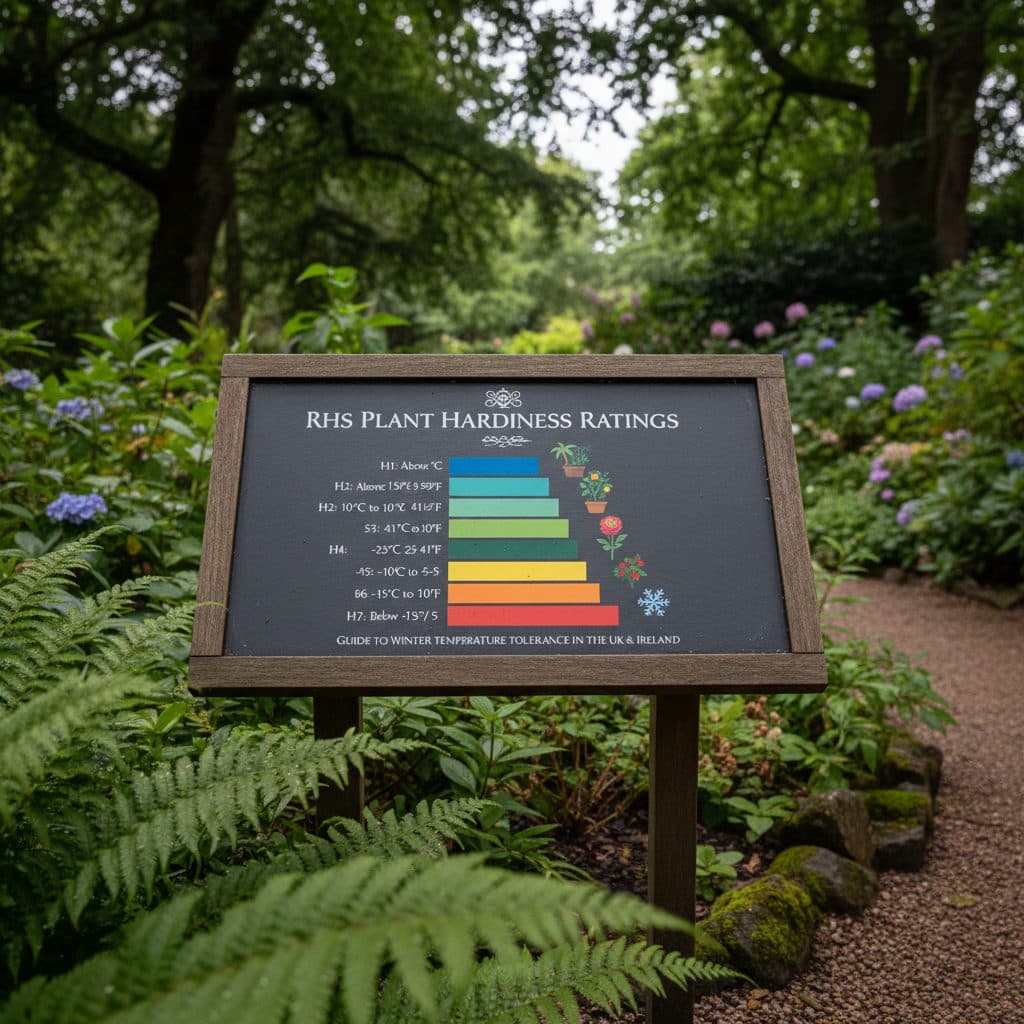
- The RHS hardiness rating system classifies plants from H1a to H7 based on the minimum temperature range they can survive in the UK and northern Europe.
- H4 is the standard benchmark for UK garden hardiness, meaning a plant survives an average British winter down to -10°C in well-drained soil.
- H3 plants are half-hardy perennials that survive outdoors in sheltered coastal areas or urban microclimates but require winter protection in colder inland districts.
- In the UK maritime climate, winter wet and poor drainage cause more plant losses than cold air temperatures alone.
- Soil type, aspect, wind exposure, and elevation significantly modify a garden's effective hardiness rating.
- Roots are more sensitive to freezing than above-ground wood, so container plants require greater frost protection than the same species in the ground.
Quick answer: RHS hardiness ratings are a standardised 1 to 7 scale developed by the Royal Horticultural Society to indicate the minimum temperature range a plant can survive in the UK and northern Europe. Ratings range from H1 (tender, requiring heated glass) through H4 (hardy across most of the UK down to -10°C) to H7 (fully hardy down to below -20°C).
Choosing plants that survive British winters without unexpected losses is a fundamental skill for UK gardeners. For decades, British growers struggled with international hardiness systems that failed to reflect the United Kingdom's unique maritime climate, where mild overall winter temperatures are accompanied by persistent cloud cover, high humidity, waterlogged soils, and sudden late spring frosts.
To provide clear, practical guidance, the Royal Horticultural Society established the rhs hardiness ratings scale. This tiered system defines exactly how much cold a plant can tolerate and what level of seasonal protection it requires to thrive year after year in British gardens and allotments.
+-------------------------------------------------------------+
|               RHS HARDINESS RATINGS (H1 TO H7)              |
|                                                             |
|   RATING   MIN TEMP       PROTECTION / ENVIRONMENT          |
|   ------   --------       ------------------------          |
|   H1a      > 15°C         Heated glass, year-round tropical |
|   H1b      10°C to 15°C   Heated glass, intermediate tropic.|
|   H1c      5°C to 10°C    Heated glass, warm temperate      |
|   H2       1°C to 5°C     Tender / frost-free protection    |
|   H3       -5°C to 1°C    Half-hardy; mild coastal / microcl|
|   H4       -10°C to -5°C  Hardy: average UK winter          |
|   H5       -15°C to -10°C Hardy: cold UK winter / inland    |
|   H6       -20°C to -15°C Very hardy: severe winter / Scotl.|
|   H7       < -20°C        Extremely hardy; severe exposure  |
+-------------------------------------------------------------+
The complete RHS hardiness scale explained (H1 to H7)
The RHS scale divides plant cold tolerance into distinct bands based on the lowest temperature range a plant can endure without suffering permanent structural damage or death.
+-------------------------------------------------------------+
|                  RHS CLASSIFICATION TIERS                   |
|                                                             |
|   TENDER (H1a, H1b, H1c, H2):                               |
|   - Must be kept indoors or in heated/frost-free glass      |
|   - Examples: Citrus, Bananas, Bougainvillea, Pelargoniums  |
|                                                             |
|   HALF-HARDY (H3):                                          |
|   - Outdoors in mild coastal microclimates or summer beds   |
|   - Overwinter in cold frame, unheated tunnel, or fleece    |
|   - Examples: Tender Agapanthus, Cordyline, Dahlias         |
|                                                             |
|   FULLY HARDY (H4, H5, H6, H7):                             |
|   - Survives outdoors year-round across the UK              |
|   - Examples: Apple trees (H6), English Oak, Hawthorn (H7)  |
+-------------------------------------------------------------+
Tender categories: H1a, H1b, H1c, and H2
- H1a (Above 15°C): Tropical foliage plants and indoor ornamentals (such as Monstera and orchids) that require continuous year-round warmth and cannot tolerate cool drafts.
- H1b (10°C to 15°C): Subtropical species (such as Citrus and banana plants) that can sit outside in a sunny, sheltered courtyard during peak summer but must be moved to a heated glasshouse or conservatory by late September.
- H1c (5°C to 10°C): Plants that tolerate cool conditions but must remain strictly frost-free. Many tender perennials and Mediterranean succulents fall into this band.
- H2 (1°C to 5°C): Frost-sensitive plants that survive winter in an unheated greenhouse, porch, or cold frame, provided temperatures remain above freezing. Bedding pelargoniums and fuchsias are typical H2 candidates.
Half-hardy: H3
- H3 (-5°C to 1°C): Half-hardy species that tolerate light, brief frosts down to -5°C. In coastal Cornwall, western Scotland, and sheltered London microclimates, H3 plants frequently survive outdoors year-round in free-draining soil. Agapanthus cultivars vary widely: evergreen types are generally H3 or H4 and need winter protection outside mild areas, while deciduous cultivars (such as 'Midnight Star') are often H5 and reliably hardy across the UK.
Garden hardy: H4, H5, H6, and H7
- H4 (-10°C to -5°C): An H4 rating indicates that a plant will survive an average British winter outdoors in virtually all parts of England and Wales, provided the soil does not become stagnant and waterlogged.
- H5 (-15°C to -10°C): Hardy in severe winter conditions, including exposed rural sites, frost hollows, and upland valleys across northern England and southern Scotland.
- H6 (-20°C to -15°C): Very hardy species (such as native field maples, hardy currants, and most cultivated dessert apple varieties) that survive anywhere in the British Isles even during prolonged Siberian easterly blasts.
- H7 (Below -20°C): Plants capable of surviving severe sub-zero exposure, heavy snow cover, and frozen ground without protection. Native birch, Scots pine, and mountain ash are typical of H7 hardiness.
To evaluate botanical adaptability across diverse cultivation zones, examine our analytical dataset in hardiness breadth.
Why the UK needed its own hardiness system
Gardeners often ask why the UK does not rely solely on the United States Department of Agriculture (USDA) plant hardiness zone map.
Climate Factor | USDA Hardiness Focus | RHS Hardiness Focus |
|---|---|---|
Primary Metric | Absolute minimum winter temperature | Minimum temperature plus damp tolerance |
Summer Heat | Continental summers (hot and dry) | Maritime summers (cool and humid) |
Soil Conditions | Frozen, dry snow-insulated ground | Wet, unfrozen to intermittently frozen soil |
Season Transitions | Distinct, sharp seasonal shifts | Long, damp, drawn-out spring and autumn |
The USDA system divides North America and Europe into uniform 10°F (5.5°C) bands based on historical average annual minimum temperature. The RHS system, by contrast, uses unequal, biologically defined bands focused on British and European gardening practice — particularly the critical transitions around 0°C (frost), -5°C (severe frost for tender plants), and -10°C to -15°C (standard cold-winter thresholds for woody plants).
The UK has an oceanic, maritime climate tempered by the North Atlantic Drift (Gulf Stream). While our absolute minimum temperatures rarely drop below -10°C in the south, our winter days are characterized by high rainfall, persistent overcast skies, and soil that remains saturated for weeks at a time.
A plant rated to survive -15°C in continental North America may rot and die at -3°C in a British garden if its root zone is sitting in cold, waterlogged clay. Excess soil moisture suffocates fine root hairs and promotes fungal root rots, compounding the stress of low temperatures. For technical insights into this mechanism, see our analysis of cold wet soil nutrient deficiency.
How garden microclimates alter hardiness
A plant's published RHS rating is a guide, not an absolute guarantee. Your garden's topography, aspect, and structure create distinct microclimates that effectively raise or lower hardiness ratings by one to two full tiers.
+-------------------------------------------------------------+
|                GARDEN MICROCLIMATE DYNAMICS                 |
|                                                             |
|   WARMING FACTORS (+1 Rating Tier):                         |
|   - South-facing brick wall (Radiant thermal mass)          |
|   - Elevated slope (Cold air drains downhill)               |
|   - Gritty, sandy, free-draining loam                       |
|   - Urban heat island effect (Paved courtyards)             |
|                                                             |
|   COOLING FACTORS (-1 Rating Tier):                         |
|   - Valley bottom / Frost pocket (Traps dense freezing air) |
|   - Exposed, wind-swept hilltop or open allotment           |
|   - Heavy, wet, compacted clay soil                        |
|   - Northern shadow of tall buildings or dense evergreen hedges
+-------------------------------------------------------------+
Frost pockets and air drainage
Cold air is denser than warm air and flows downhill like water on calm, clear winter nights. If your garden sits at the bottom of a slope backed by a solid fence, freezing air pools against the barrier, creating a frost pocket where temperatures can drop 3°C to 5°C lower than the top of the garden.
Soil drainage modifications
Drainage is the single most important cultural factor influencing winter survival in Britain. An H3 half-hardy Mediterranean perennial (like rosemary or lavender) will often survive severe frost in a gravel garden on free-draining sandy loam, but will perish at mild frost in heavy, sodden clay.
Container plants and hardiness vulnerability
Growing trees, shrubs, or perennials in containers significantly reduces their cold tolerance compared to in-ground planting.
+-------------------------------------------------------------+
|             CONTAINER VS IN-GROUND ROOT EXPOSURE            |
|                                                             |
|   IN-GROUND PLANT:                                          |
|   - Vast surrounding earth insulates roots                  |
|   - Soil temperature remains warmer than freezing air       |
|                                                             |
|   CONTAINER PLANT:                                          |
|   - Cold air surrounds thin pot walls from all sides        |
|   - Potting compost freezes solid within hours              |
|   - Result: Needs extra frost and wind protection           |
+-------------------------------------------------------------+
Roots are more sensitive to freezing than above-ground wood, and container soil freezes from all sides; a potted plant therefore tolerates significantly less frost than the same plant in the ground, and in severe weather its container should be insulated, moved against a sheltered house wall, or brought into an unheated glasshouse.
To learn how to protect potted fruit trees throughout the winter, review our advice in apple tree in pot.
Seasonal protection methods for tender and half-hardy plants
You can successfully grow half-hardy (H3) and tender (H2) plants in British gardens by implementing seasonal protection strategies before the first severe autumn frosts arrive:
- Fleece wrapping: Wrap the crowns of tree ferns and tender cordylines in breathable horticultural fleece packed loosely with dry straw. Avoid non-breathable plastic bubble wrap directly against foliage, which traps condensation and leads to crown rot.
- Root zone mulching: Apply a 10 to 15 cm blanket of coarse bark chips or dry straw over the crowns of dahlias, agapanthus, and salvias left in the ground.
- Temporary structures: Move half-hardy specimens into an unheated cold frame or polytunnel to shield them from driving winter rains. Compare shelter performance in our overview of polytunnel vs greenhouse.
- Selecting winter-hardy crops: When planning your edible plot, choose crops that comfortably match UK winter conditions, as detailed in our guide to winter vegetables to grow in the UK.