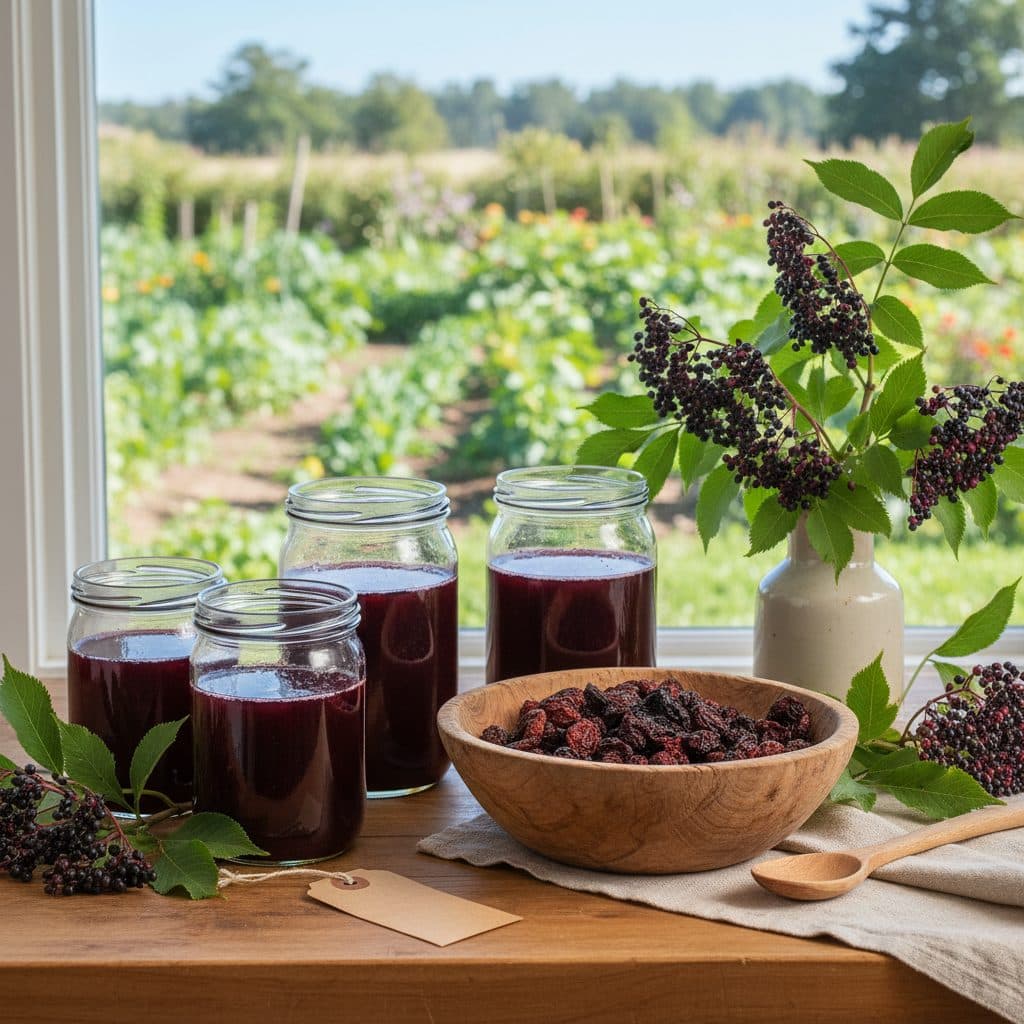
Key takeaways
- Elderberries thrive in USDA zones 3 through 9, preferring well-drained soil with a pH between 5.5 and 6.5.
- Harvest elderberries when they are deep purple or black, typically from late July to early September in many US regions.
- An oxymel combines honey and vinegar to extract plant compounds; ratios run from honey-forward, like the 3:1 honey-to-vinegar used here, to vinegar-forward blends that keep longer.
- For elderberry oxymel, steep dried elderberries in raw honey and apple cider vinegar for two to four weeks.
- Consider growing companion herbs like garden sage (Salvia officinalis) for additional immune-season blends.
- Proper storage in cool, dark places keeps dried elderberries usable for about two years, and finished oxymel for about a year.
Quick answer: Elderberry oxymel is a traditional blend of dried elderberries, honey, and apple cider vinegar, typically using a 3:1 honey-to-vinegar ratio, steeped for weeks to extract immune-supporting compounds. It’s made by filling a jar with dried berries, covering with honey, then topping with apple cider vinegar.
In the Midwest, from Ohio to Iowa, many of us are turning to our gardens for immune-season support, especially as the cooler months approach. Elderberries, specifically Sambucus canadensis, are a staple in this effort, offering their dark fruit for various preparations. A well-established elderberry patch can yield 10 to 15 pounds of berries per plant annually.
One traditional preparation gaining renewed interest is the oxymel, a blend of honey and vinegar that effectively extracts and preserves plant compounds. This ancient method, dating back over 2,000 years, offers a palatable way to consume beneficial herbs. This section covers how to cultivate these resilient plants and turn their harvest into immune-season blends, including the popular elderberry oxymel, using ratios like a 3:1 honey-to-vinegar base.
growing elderberries for immune support
Growing elderberries (Sambucus canadensis) is a straightforward process for many US gardeners, particularly those in USDA zones 3 through 9. These hardy shrubs prefer full sun, at least six hours daily, and well-drained soil with a pH between 5.5 and 6.5. A mature plant can reach 6 to 10 feet tall and wide, providing a significant harvest each year. For optimal growth, consider amending heavy clay soils with 2 to 3 inches of aged compost before planting, ensuring good drainage.
selecting and planting your elderberry patch
When selecting plants, choose varieties suited to your local climate; ‘Adams’ and ‘York’ are common choices in many northern states, known for their large berries and good yields. Plant at least two different cultivars — American elderberry sets a much heavier crop when it is cross-pollinated, which is why those two are usually sold as a pair. Plant elderberry bushes 6 to 8 feet apart to allow for mature spread and good air circulation, which helps prevent fungal issues. Water new plantings regularly, providing one to two inches of water per week during their first growing season. You can monitor soil moisture effectively using a soil moisture meter. Keep the top 2 to 3 inches of soil consistently damp but not waterlogged. Established plants are quite drought-tolerant, needing less intervention after their first year.
- choose a site with six hours of direct sunlight
- ensure soil pH is between 5.5 and 6.5
- space plants 6 to 8 feet apart for growth
- water one to two inches weekly for new plants
- prune dead or weak canes in late winter, removing up to 25% of old growth
harvesting and processing elderberries
Elderberry harvest season typically runs from late July through early September in many parts of the US, depending on your specific USDA zone and cultivar [1]. It is important to harvest berries when they are fully ripe, meaning they are deep purple or black and soft to the touch. Unripe green or red fruit is higher in the compounds that cause digestive upset, so avoid it entirely. Note also that red elderberry (Sambucus racemosa) is a separate species whose fruit is still red when ripe and which is not used the way American elderberry is — if your shrub bears red berries at maturity, do not harvest it. A single mature elderberry bush can produce 10 to 15 pounds of berries, enough for several gallons of juice or many batches of oxymel.
drying and storing your harvest
To process, gently remove the berries from their stems using a fork or your fingers, discarding any green berries or stems. The stems, leaves and unripe fruit contain cyanogenic glycosides, and the ripe berries carry traces of their own, so separate the fruit carefully and discard every scrap of stem. Raw elderberry is conventionally cooked before it is eaten or drunk, because uncooked berries can cause nausea, vomiting and diarrhea. Cold steeping in honey and vinegar applies no heat, so use dried berries rather than fresh, keep to the stated dose, and stop if a batch causes any stomach upset. Fresh berries can be used immediately, frozen for up to 12 months, or dried for long-term storage. For drying, spread berries in a single layer on screens or baking sheets and dry in a dehydrator at 100°F to 110°F for 12 to 24 hours until brittle. Properly dried elderberries should have a moisture content below 10%, storing well in airtight containers for 18 to 24 months in a cool, dark pantry. This preservation method ensures you have a supply ready for immune-season preparations throughout the year [2].
- harvest fully ripe, deep purple or black berries
- remove all green berries and stems carefully
- freeze fresh berries for up to one year
- dehydrate berries at 100°F for 12 to 24 hours
- store dried berries in airtight containers for up to two years
crafting your elderberry oxymel
An oxymel is a traditional herbal preparation combining honey and vinegar, a term derived from Greek, literally meaning ‘acid and honey’. This blend is excellent for extracting both water-soluble and alcohol-soluble compounds from herbs, making it a versatile base for immune support. For a potent elderberry oxymel, you will need dried elderberries, raw honey, and apple cider vinegar. A common ratio is one part dried herb to three parts honey and one part vinegar, though you can adjust to taste and desired potency. Local raw honey is worth using for its flavor and for supporting nearby beekeepers; the popular claim that it eases seasonal allergies has not held up in controlled testing. The ‘mother’ in raw apple cider vinegar is a cellulose matrix of acetic acid bacteria — a sign the vinegar is unpasteurized, not an established probiotic.
making and using your oxymel
To make the oxymel, fill a clean glass jar one-quarter to one-third full with dried elderberries. Measure rather than layer: combine three parts raw honey to one part apple cider vinegar, enough to cover the berries by an inch, and leave about one inch of headspace. Stir thoroughly to combine. Make sure all plant material is submerged. Cap the jar tightly and store it in a cool, dark place for two to four weeks, shaking it daily for the first week to keep the fruit submerged and the extraction even. A jar this sweet will ferment if berries sit exposed above the liquid or the jar warms up, so keep everything covered, and discard the batch if you see mold, smell yeast, or find the lid bulging. After steeping, strain the mixture through cheesecloth, squeezing out all liquid. The finished oxymel can be stored in a dark bottle for up to 12 months. A typical adult dose is one to two teaspoons, one to three times daily, diluted in water or taken straight. Because the base is raw honey, no oxymel should be given to a child under twelve months of age. Remember to label your jar with the date and ingredients for future reference.
- use a 3:1 honey-to-vinegar ratio as a starting point
- fill a jar one-quarter to one-third with dried elderberries
- steep for two to four weeks in a cool, dark place
- shake daily for the first seven days
- strain and store in a dark bottle for up to 12 months
other immune-season herbal blends
This builds directly on crafting elderberry oxymel.
Beyond elderberry oxymel, your home apothecary can produce a range of immune-supporting blends using herbs from your garden. Many common culinary herbs, like garden sage (Salvia officinalis), possess beneficial properties. Sage, for instance, is known for its soothing qualities and can be easily grown in USDA zones 4 through 8. A small herb garden can provide a consistent supply of fresh leaves for teas, tinctures, and infused honeys. Consider planting three to five different immune-supportive herbs to diversify your preparations.
herbal teas and tinctures
For a simple immune-boosting tea, combine one teaspoon of dried elderberries with one teaspoon of dried garden sage and a half-teaspoon of dried ginger root. Steep in 8 ounces of hot water for 10 to 15 minutes. You can also create herbal tinctures using high-proof alcohol (like 80-proof vodka) at a 1:5 herb-to-alcohol ratio. Mullein (Verbascum thapsus), a naturalized plant common on disturbed ground across USDA zones 3 to 9, is a traditional respiratory herb. It is listed as a noxious weed in some states, so check yours before deliberately planting it, and filter any mullein preparation through fine cloth or a coffee filter — the leaf hairs irritate the throat. Steep dried mullein leaves in alcohol for six weeks, shaking periodically, then strain and store in dark dropper bottles. These tinctures typically last for five years or more. Always ensure proper plant identification, especially if foraging, to avoid adverse effects from misidentified species.
- grow garden sage for soothing teas and infusions
- consider mullein for respiratory support in tinctures
- combine elderberries, sage, and ginger for a warming tea
- use a 1:5 herb-to-alcohol ratio for tinctures
- store tinctures in dark bottles for five years or longer
Comparison of Immune-Season Herbal Preparations
Preparation | Primary Ingredients | Typical Shelf Life | Common Dosage |
|---|---|---|---|
Elderberry Oxymel | Elderberries, Honey, Apple Cider Vinegar | 12 months | 1-2 teaspoons, 1-3 times daily |
Herbal Tea | Dried herbs (e.g., Elderberry, Sage, Ginger), Hot Water | Freshly brewed | 8 ounces, 2-3 times daily |
Herbal Tincture | Dried herbs, High-proof Alcohol (e.g., Vodka) | 5+ years | 20-40 drops, 1-3 times daily |
Infused Honey | Dried herbs, Raw Honey | 12-18 months | 1 tablespoon, 1-2 times daily |
optimal pH: Elderberry does best in soil with a pH between 5.5 and 6.5; outside that band the plants still grow but crop less reliably.
oxymel ratio: A traditional oxymel often uses a 3:1 honey-to-vinegar ratio, which effectively extracts beneficial compounds from a 1:4 herb-to-liquid proportion.
drying temperature: Drying elderberries at 100°F to 110°F for 12 to 24 hours reduces moisture content to below 10%, extending shelf life to 18-24 months.
Frequently asked questions
What is the best time to harvest elderberries?
Elderberries are best harvested when they are fully ripe, which means they are deep purple or black and soft. This typically occurs from late July through early September in many US regions, depending on the specific cultivar and local climate conditions [1].
Can I use fresh elderberries for oxymel?
Dry them first. Drying removes the moisture that would otherwise thin the honey and invite mold, and it reduces the cyanogenic glycoside content of the fruit. Uncooked elderberry can cause nausea, vomiting and diarrhea even when the fruit is fully ripe, so if you want a preparation from fresh berries, simmer them into a syrup rather than cold-macerating them.
What is the shelf life of homemade elderberry oxymel?
When stored in a cool, dark place in a tightly sealed, dark bottle, homemade elderberry oxymel can last for up to 12 months. The honey and vinegar act as natural preservatives, maintaining the blend’s potency and freshness for a significant period.
Are there any elderberry diseases I should watch for?
Yes. Elderberry hosts several viruses, including elderberry carlavirus and elderberry latent carmovirus, and in humid summers it is also prone to leaf spot and powdery mildew. Regular pruning to improve air circulation and planting disease-resistant varieties can help manage these issues. Always inspect your plants for unusual spots or wilting.
What other herbs pair well with elderberry for immune support?
Many herbs complement elderberry for immune support. Garden sage (Salvia officinalis), ginger root, and echinacea (Echinacea purpurea) are excellent choices. Sage can be grown in USDA zones 4 through 8 and offers soothing properties, while ginger adds a warming element to blends.
References
- Elderberry Season (2026). Elderberry Season.
- Elderberry Season (2026). Elderberry Season.
- oxymel, n. (2023). oxymel, n..
- USDA Natural Resources Conservation Service (2024). USDA Natural Resources Conservation Service.