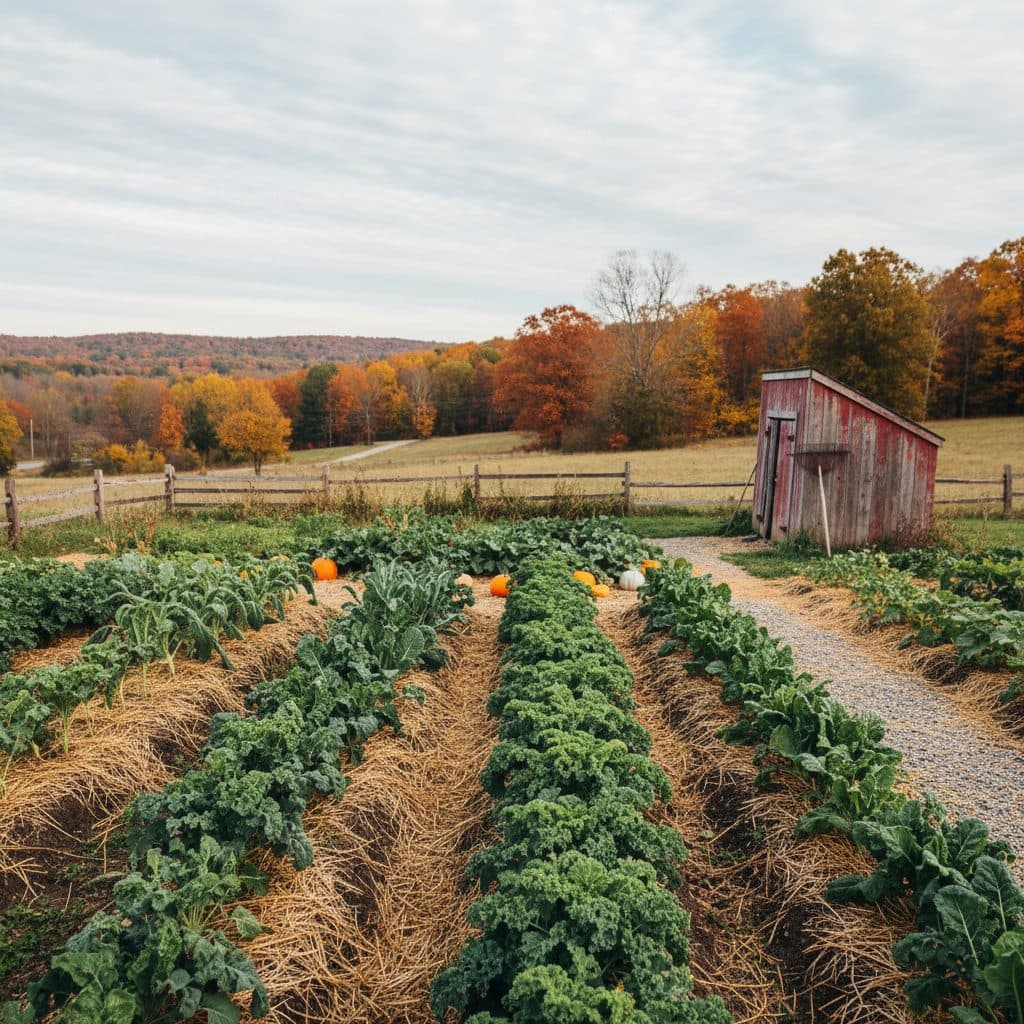
Key takeaways
- Identify your local average first frost date using resources like the National Oceanic and Atmospheric Administration or USDA data for your specific USDA zone.
- Calculate fall planting dates by subtracting a crop’s ‘days to maturity’ plus a 14-day buffer from your average first frost date.
- Select cold-hardy crops such as spinach, kale, and carrots, which can tolerate light frosts and often improve in flavor after a chill.
- Integrate fall planting into a crop rotation plan, like following a summer squash bed with a nitrogen-fixing cover crop, to improve soil health.
- Practice succession planting in the fall by staggering plantings of fast-growing crops every two to three weeks to extend your harvest window.
- Prepare your soil with organic matter, aiming for a 6-inch depth of rich, well-draining soil, and ensure consistent moisture for successful fall growth.
Quick answer: To calculate fall planting dates, subtract a crop’s ‘days to maturity’ plus a 10-14 day buffer from your average first frost date. This accounts for slower growth in cooler, shorter fall days.
In the high desert of northern Arizona in USDA zone 6, the growing season can feel short. Summer heat gives way to crisp autumn air rather quickly, making precise timing for fall planting essential. Knowing exactly when to put seeds in the ground for a second, or even third, harvest requires a bit of planning – specifically, working backward from that critical first frost date.
This method extends your garden’s output, improves soil health through continuous cover, and keeps fresh produce coming well into the colder months. Here are the practical steps to calculate your optimal fall planting schedule, whether you are in a mild USDA zone 9 or a cooler zone 4.
Finding your local first frost date
Pinpointing your average first frost date is the foundational step for any fall planting strategy. This date isn’t a hard deadline but rather a statistical average, often based on 30 years of weather data for a specific region. For example, in parts of USDA zone 6, like central Pennsylvania, the average first frost typically occurs between October 1st and October 15th. However, local microclimates can shift this by as much as two weeks, so observing your specific property is valuable.
using USDA resources for accuracy
The USDA Natural Resources Conservation Service provides extensive data that can help you determine your local climate patterns [6]. You can often find detailed frost maps and historical averages for your county or even specific zip code. For instance, a gardener in USDA zone 8 in coastal California might have a first frost date in late November or even December, allowing for a much longer fall growing season than someone in USDA zone 4 in northern Minnesota, where frost can arrive in early September. Always look for the average date of the first killing frost, which is generally defined as 28°F or below, as this temperature is usually sufficient to damage most tender annual crops.
- Consult the National Oceanic and Atmospheric Administration (NOAA) for historical frost data.
- Check local university extension offices for region-specific planting calendars.
- Observe your garden’s microclimates, noting areas that frost earlier or later.
- Consider elevation changes; a 1,000-foot increase in elevation can shorten the growing season by 10-14 days.
- Ask experienced local growers for their historical frost observations.
The backward calculation method
Once you have your average first frost date, the backward calculation method is straightforward. You’ll need two key pieces of information for each crop: its ‘days to maturity’ and its frost tolerance. For example, if your average first frost is October 15th, and you want to plant spinach that matures in 45 days, you’d count back 45 days from October 15th to September 1st. However, this simple calculation doesn’t account for the slower growth rates in shorter, cooler fall days.
adding a buffer for fall conditions
To compensate for reduced daylight and cooler temperatures, which slow plant growth, Growers typically add a buffer of 10 to 14 days to the ‘days to maturity’ for fall crops. For that 45-day spinach, plan for 55 to 59 days. Counting back 59 days from October 15th brings your planting date to August 17th. This buffer is especially important for crops like carrots or beets, which might take 60-70 days to mature, pushing their planting date back into late July or early August in USDA zone 6. Remember, planting too late leaves you with small, underdeveloped plants that never size up before hard freezes.
- Determine the ‘days to maturity’ for your chosen crop from seed packets.
- Add a 10-14 day buffer to account for shorter, cooler fall days.
- Count backward from your average first frost date to find the ideal planting window.
- For crops that tolerate light frost, you can sometimes extend this window by a few days.
- Consider direct seeding for root crops like radishes and carrots, which dislike transplanting.
Choosing the right crops for fall
Not all crops are suited for fall planting. The best choices are those that are cold-hardy, can mature quickly, or whose flavor improves with a touch of frost. Leafy greens like spinach, kale, and collards are excellent candidates. For instance, many varieties of kale can withstand temperatures down to 10°F, making them viable well past the first hard frost in many USDA zones. Root vegetables such as carrots, radishes, and beets also thrive in cooler soil and can sweeten after a light frost.
cover crops and fall bulbs
Beyond edible vegetables, fall is the prime time for planting cover crops and spring-flowering bulbs. In Tennessee, for example, planting cover crops like cereal rye or crimson clover in late September to early October can significantly improve soil structure and nutrient cycling over winter [1]. These crops protect the soil from erosion and add organic matter. For aesthetic appeal, fall is also when you plant bulbs for spring blooms. Daffodils, tulips, and crocus need a period of cold dormancy, requiring planting 6-8 weeks before the ground freezes solid, typically in October or November in USDA zone 5.
- Spinach, kale, and collards are highly frost-tolerant leafy greens.
- Carrots, radishes, and beets are root vegetables that sweeten with cold.
- Cover crops like winter rye or crimson clover protect soil and add nutrients.
- Garlic cloves should be planted in fall for summer harvest.
- Spring-flowering bulbs like tulips and daffodils require fall planting for cold stratification.
Integrating fall planting with crop rotation
Fall planting is also a critical component of a sustainable crop rotation strategy. By planting a different family of crops in a bed that just finished producing, you can break pest and disease cycles, improve soil structure, and balance nutrient levels. For example, if you harvested a heavy feeder like corn or tomatoes from a bed in July, planting a nitrogen-fixing cover crop like hairy vetch or clover in September can replenish the soil for next spring’s crops. Over several seasons this can meaningfully reduce how much fertilizer you need to add.
planning for next season’s fertility
Consider a three-year rotation plan: year one, heavy feeders (corn, squash); year two, light feeders (leafy greens, root crops); year three, legumes or cover crops (beans, peas, clover). Fall planting allows you to seamlessly transition between these phases. For instance, after harvesting your common beans in late summer, you could plant a winter rye cover crop, which will add significant organic matter when tilled under in spring. This continuous cover helps prevent nutrient leaching and soil erosion, particularly in regions with heavy winter rains or winds, like parts of the Pacific Northwest in USDA zone 8.
- Rotate crop families to prevent pest and disease buildup in the soil.
- Follow heavy feeders with nitrogen-fixing cover crops to replenish nutrients.
- Plan a three-to-four-year rotation cycle for each garden bed.
- Utilize fall planting to establish green manures that improve soil structure.
- Record your planting locations to ensure proper rotation in subsequent seasons.
Succession planting for extended harvests
Succession planting is the art of staggering plantings of the same crop, or different quick-maturing crops, to ensure a continuous harvest rather than one large flush. In the fall, this strategy is particularly effective for leafy greens and radishes. For example, in USDA zone 7, you might plant spinach every two weeks from late August through early October. This provides a steady supply of fresh leaves until a hard freeze, rather than an overwhelming amount all at once.
maximizing garden space and yield
To implement fall succession planting, focus on crops with shorter ‘days to maturity.’ Radishes, which mature in 25-30 days, are ideal. You can plant a small row every 10-14 days. Similarly, fast-growing peas, especially bush varieties, can be planted in succession in late summer for a fall crop. This approach maximizes the productivity of your garden beds, keeping the space continuously in use. By the time one planting is finishing its harvest, the next is ready to take its place, keeping a single area in production through the shorter fall days.
- Choose quick-maturing crops like radishes, lettuce, and spinach.
- Stagger plantings every 10-14 days to ensure continuous harvest.
- Utilize small sections of beds for each succession to manage space.
- Monitor weather forecasts to adjust later plantings based on predicted frost.
- Consider using cold frames or row covers for the latest successions to extend their life by 2-4 weeks.
Soil preparation and ongoing care
Successful fall planting hinges on well-prepared soil. After a summer of production, your garden beds will likely need some replenishment. Start by removing any spent summer crops and weeds. Then, amend the soil with 2-3 inches of high-quality compost or other organic matter, incorporating it into the top 6 inches of soil. This improves soil structure, water retention, and nutrient availability for your fall crops. A soil test every 2-3 years can also guide specific nutrient additions to keep your soil pH between 6.0 and 7.0 for optimal nutrient uptake.
maintaining moisture and protection
Even in cooler fall temperatures, consistent moisture matters, especially during germination and early growth. Aim for 1 inch of water per week, either from rainfall or irrigation. As days shorten and temperatures drop, mulching around your fall crops with 2-4 inches of straw or shredded leaves can help retain soil moisture, suppress weeds, and regulate soil temperature. This insulation can protect roots from early freezes and extend the harvest of many crops by several weeks. For tender crops planted later in the season, consider using row covers or cold frames to offer protection from temperatures below 28°F, allowing them to continue growing for an additional 3-4 weeks.
- Remove all spent summer crops and weeds to clear the beds.
- Incorporate 2-3 inches of compost into the top 6 inches of soil.
- Ensure soil pH is between 6.0 and 7.0 for optimal nutrient availability.
- Provide 1 inch of water per week, especially during establishment.
- Apply 2-4 inches of organic mulch to retain moisture and regulate soil temperature.
Frost Buffer: Always add a 10 to 14-day buffer to a crop’s ‘days to maturity’ for fall plantings, accounting for slower growth in shorter, cooler days.
Soil pH: For optimal nutrient uptake by most fall vegetables, maintain your garden soil’s pH level between 6.0 and 7.0, checking every 2-3 years.
Frequently asked questions
What is the average first frost date for USDA zone 5?
For USDA zone 5, the average first frost date typically falls between October 1st and October 31st. However, specific dates can vary by several weeks depending on local topography and elevation, so consulting local extension office data is recommended.
Why do I need to add a buffer to ‘days to maturity’ for fall planting?
You need to add a 10 to 14-day buffer because fall’s shorter days and cooler temperatures slow down plant growth significantly. This extra time ensures your crops have enough light and warmth to reach maturity before a hard freeze, as a 45-day crop might actually take 55-59 days.
Can I plant spring-flowering bulbs in the fall?
Yes, fall is the ideal time to plant spring-flowering bulbs like tulips, daffodils, and crocus. They require a long period of winter chilling in the ground to properly develop roots and bloom in the spring, which is why they go in during October or November in USDA zone 5 — at least 6 to 8 weeks before the ground freezes solid.
What are some good cover crops for fall planting in Tennessee?
In Tennessee, excellent cover crop choices for fall planting include cereal rye, crimson clover, and hairy vetch. These crops, planted in late September to early October, help prevent soil erosion, suppress weeds, and add valuable organic matter and nitrogen to the soil.
How much water do fall crops need?
Fall crops generally require about 1 inch of water per week, either from rainfall or supplemental irrigation. Consistent moisture is especially important during the germination and early growth phases to ensure strong establishment before colder temperatures arrive.
References
- Fall Cover Crop Selection and Planting Dates in Tennessee (2015). Fall Cover Crop Selection and Planting Dates in Tennessee.
- Flowering bulbs for fall planting : buy your bulbs from importers / (1925). Flowering bulbs for fall planting : buy your bulbs from importers /.
- Catalog for your fall planting / (1924). Catalog for your fall planting /.
- Influence of Fall Planting Dates on the Survival and Growth of Taxus, Thuja, and Viburnum Species (1987). Influence of Fall Planting Dates on the Survival and Growth of Taxus, Thuja, and Viburnum Species.
- Do not leave your fall planting until too late … (1916). Do not leave your fall planting until too late ….
- USDA Natural Resources Conservation Service (2024). USDA Natural Resources Conservation Service.