Key takeaways
- Calculate your true costs, including labor at $20 per hour, to set profitable plant prices, aiming for a 30% profit margin.
- Start seeds like peppers 8-10 weeks before your last frost date, ensuring plants are robust with 4-6 true leaves for sale.
- Pot up seedlings into appropriate sizes, such as 3.5-inch or 4-inch pots, to command higher prices and ensure healthy root development.
- Utilize farmers’ markets not just for sales, but for gathering customer feedback and building a local network, which pays off over time.
- Implement tiered pricing for volume sales—for example, one tomato plant for $5, three for $12—to encourage larger purchases.
- Monitor soil moisture carefully with tools like a soil moisture meter to prevent losses, since overwatering is a common cause of seedling loss.
Quick answer: To succeed in spring plant sales in USDA Zone 6, calculate true costs for profitable pricing, start warm-season seeds 8-10 weeks before the last frost, and pot up seedlings into larger containers for better health and higher prices.
In Appalachia, where spring frosts can be unpredictable, successful plant sales at farmers’ markets depend on careful planning. For growers in USDA Zone 6, where the last frost commonly falls anywhere between early April and mid-May depending on where you are, timing seed starts and potting up correctly can mean the difference between a thriving business and a season of losses. This guide outlines practical strategies for pricing, propagation, and presentation to maximize your returns.
Selling plants at local markets, from the bustling stalls of Portland, Oregon, to the community gatherings in rural Iowa, requires more than just growing healthy seedlings. It demands a keen understanding of market demand, production costs, and customer psychology. With a strategic approach, you can turn your propagation efforts into a profitable venture.
Understanding your true costs for profitable pricing
Before you can set a price, you need to know what it costs you to produce each plant. Many growers underestimate their expenses, leading to thin margins or even losses. In a 2014 study on pricing strategies, researchers found that accurately accounting for all inputs, including labor, is necessary for profitability [1]. For instance, if you’re paying yourself a reasonable wage of $20 per hour, that needs to be factored into the cost of each flat of seedlings. A typical flat of 72 cells might take one hour to seed, water, and manage over six weeks, adding roughly $0.28 per plant in labor alone, not counting materials.
Calculating material and overhead expenses
Your material costs include seeds, potting mix, trays, pots, and labels. A good quality seed starting mix might cost $15 for a 1.5 cubic foot bag, enough for about 10-12 flats of 72 cells. Consider also the cost of heating your grow space, which can add $0.05 to $0.10 per plant in colder climates like Minnesota during early spring. Don’t forget the cost of water, fertilizer, and any pest management supplies. A detailed breakdown helps you understand the true value. For example, a 3.5-inch pot might cost $0.15, while premium seeds for a specific tomato variety could be $0.50 per seed. Aim for a profit margin of at least 30% to ensure your efforts are worthwhile.
- Seed cost: $0.10 – $0.50 per seed
- Potting mix: $0.02 – $0.05 per plant
- Tray/pot: $0.05 – $0.20 per plant
- Labor: $0.20 – $0.50 per plant
- Overhead (heat, water, electricity): $0.05 – $0.15 per plant
Strategic timing for spring plant sales
Timing is everything when it comes to plant sales. Farmers’ markets typically start in late April or early May in many regions, like central Pennsylvania. Before you book a stall, check that you hold whatever nursery license or plant dealer permit your state requires; many markets ask to see proof. Your plants need to be at their prime for these dates. For warm-season crops like peppers and tomatoes, starting seeds 8-10 weeks before the last expected frost date is a common practice. This ensures plants are sturdy, with 4-6 true leaves, and ready for transplanting into gardens when sold. For example, if your last frost lands around April 25th, you’d want to start pepper seeds by late February or early March. Look up your local frost date instead of relying on zone averages. You can find more detailed timing information on our how to grow peppers guide.
Cool-season crop timing and succession planting
Cool-season crops, such as lettuce, kale, and beets, have different timing requirements. These can be started earlier, often 4-6 weeks before the last frost, and sold for early spring planting. Consider offering succession plantings (such as two batches of lettuce starts three weeks apart) to extend your sales season. For beets, which can be harvested twice, starting them in early spring means they’re ready for sale by mid-April in warmer parts of USDA Zone 7. Proper timing minimizes losses from plants becoming leggy or root-bound. Monitoring soil moisture is necessary; a soil moisture meter can help prevent overwatering, a common cause of seedling loss.
- Warm-season crops (peppers, tomatoes): Start 8-10 weeks before last frost.
- Cool-season crops (lettuce, kale): Start 4-6 weeks before last frost.
- Spring onions (Allium fistulosum): Can be started 6-8 weeks before last frost for early sales.
- Herbs (basil, cilantro): Start 4-6 weeks before market date.
- Flowers (marigolds, zinnias): Start 6-8 weeks before market date.
Potting up for presentation and plant health
The size and health of your plants directly impact their perceived value and your pricing potential. Seedlings started in small cell trays, like 72-cell or 50-cell inserts, are generally too small for direct sale at a farmers’ market. Potting up into larger containers, such as 3.5-inch or 4-inch square pots, allows plants to develop a strong root system and grow to a more appealing size. This routinely lifts what a plant will fetch, from around $2 for a small start to $4-$5 for a well-established plant.
Choosing the right potting mix and container size
When potting up, use a high-quality potting mix that offers good drainage and aeration. A mix with a 1:1 ratio of peat moss to perlite, or a commercial blend, works well. For plants like determinate tomatoes or bush beans, a 4-inch pot is often sufficient, while indeterminate tomatoes or larger vegetable starts might benefit from a 6-inch pot. Ensure pots have adequate drainage holes, at least three to four holes, each 0.25 inches in diameter, to prevent waterlogging. Consider using a fermented soybean meal organic fertilizer at a rate of one tablespoon per gallon of potting mix for a slow-release nutrient boost. Healthy, dark green foliage and a strong stem, typically 6-8 inches tall for tomatoes, signal a premium plant ready for sale.
- 3.5-inch pots: Ideal for most herbs, single lettuce plants, or small flower starts.
- 4-inch pots: Good for peppers, eggplants, and determinate tomato varieties.
- 6-inch pots: Suitable for larger indeterminate tomatoes, cucumbers, or squash starts.
- Six-packs: Cost-effective for greens, annual flowers, or smaller brassicas.
- Gallon containers: For mature perennials, small fruit bushes, or large vegetable starts.
Pricing strategies for farmers’ markets
Pricing at farmers’ markets is a delicate balance between covering your costs, offering competitive rates, and maximizing perceived value. Direct-to-consumer sales allow for more flexible pricing than traditional retail. For instance, while a single tomato plant might sell for $5, offering three plants for $12 encourages customers to buy more.
Tiered pricing and bundling for increased sales
Consider tiered pricing for popular items. For example, a single basil plant for $4, three for $10, or a flat of six for $18. This strategy, sometimes called group pricing, can significantly boost sales volume [3]. Bundling related items also works well: a ‘salad mix’ six-pack containing lettuce, spinach, and kale starts for $8, or a ‘pizza garden’ bundle with tomato, basil, and oregano plants for $15. Always ensure your prices are clearly visible and consider offering a small discount for cash payments to offset transaction fees, which can be 2.5% to 3.5% for card readers. Remember that customers at farmers’ markets are often looking for quality and local origin alongside reasonable pricing, so emphasize the local advantage, seed provenance, and growing practices on your labels.
- Individual plants: Premium price for single items ($4-$6).
- Volume discounts: Offer 3 for $10 or 6 for $18 to encourage bulk buying.
- Bundles: Group complementary plants (e.g., ‘Herb Garden’ for $15).
- Market specials: A rotating weekly special to draw attention (e.g., ‘This Week: 10% off all pepper plants’).
- Cash discount: Offer a small incentive (e.g., 5% off) for cash transactions.
Market presentation and customer engagement
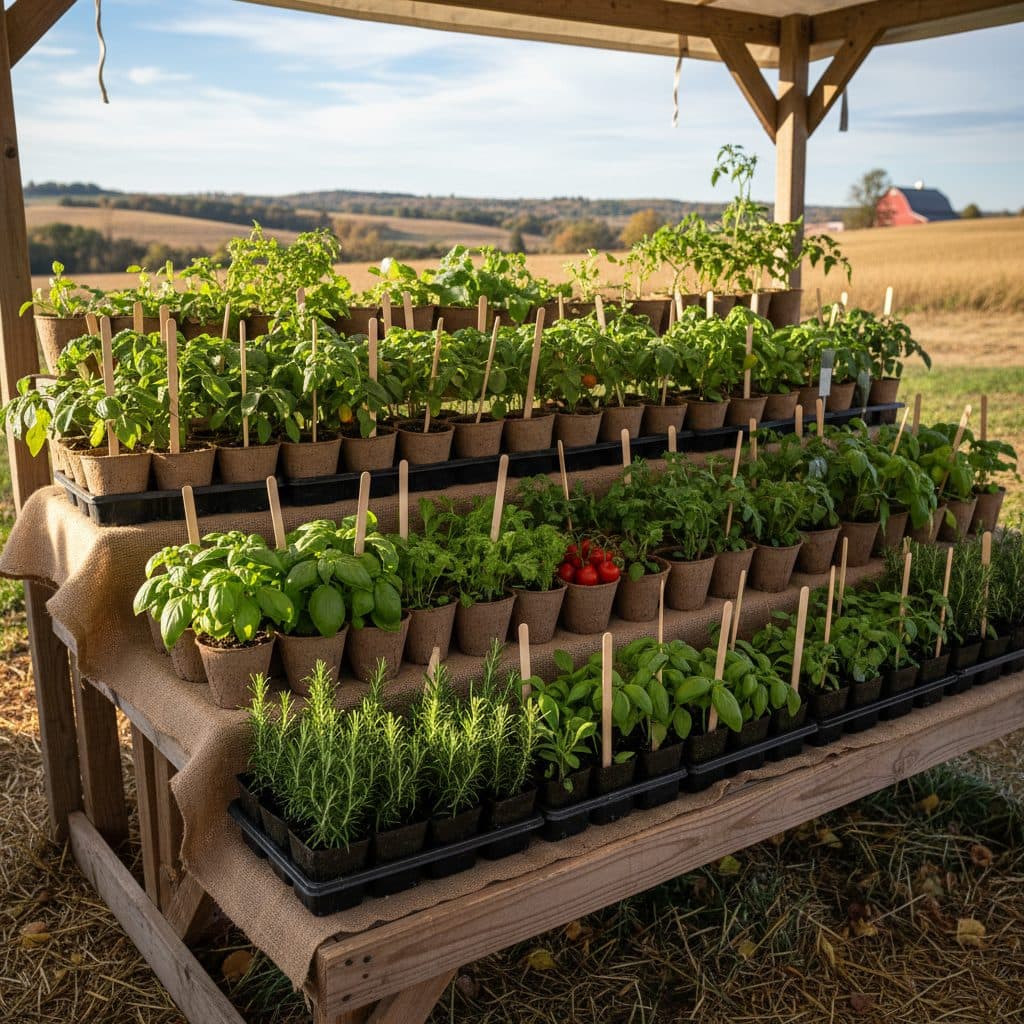
Your market stall is your storefront, and its presentation can significantly influence sales. A clean, organized, and visually appealing display can attract customers from 15 feet away. Arrange plants by type, color, or use, and ensure they are well-watered and free of pests. Presentation is one of the biggest draws at a market stall, close behind the quality of the plants themselves. Use clear, legible signage that includes plant names, varieties, and key growing information, such as mature size or sun requirements.
Building relationships and gathering feedback
Farmers’ markets are more than just sales venues; they are community hubs. Engaging with customers, answering their questions, and sharing your growing knowledge builds trust and loyalty. Research in 2018 examined farmers’ networks and how direct interaction encourages repeat business [4]. Ask customers what plants they’re looking for, what challenges they face in their gardens, or what they successfully grew last season. This feedback is invaluable for planning future propagation efforts, potentially identifying new popular varieties for next season. Offer a simple loyalty program, like a punch card for a free plant after five purchases. A well-organized display and active engagement lift sales.
- Clear signage: Include plant name, variety, and basic care instructions.
- Organized display: Group plants by type, color, or intended use.
- Healthy plants: Ensure plants are well-watered, pest-free, and sturdy.
- Engage customers: Answer questions, offer tips, and gather feedback.
- Loyalty program: Consider a punch card for a free plant after a certain number of purchases.
Regrowing from scraps and seed saving for cost reduction
Reducing your input costs is another path to higher profits. Regrowing certain vegetables from kitchen scraps can be a fun and virtually free way to produce some starts for sale or personal use. For example, the base of a romaine lettuce or a spring onion (Allium fistulosum) can sprout new growth when placed in a shallow dish of water, providing fresh greens within one to two weeks. This is a fun way to produce a few plants for your own kitchen, but it is not a market product: a regrown romaine base gives one small, bitter flush before it bolts, and many farmers' markets run producer-only rules that limit what you can sell from bought-in material.
Seed saving and propagation techniques
Saving seeds from open-pollinated varieties is a significant cost-saver. For instance, if you grow heirloom tomatoes, you can save seeds from your best fruits, effectively eliminating seed costs for the following season. This practice, when done carefully to maintain genetic purity, can reduce your seed budget by 20% to 50%. For more complex propagation, consider using a reflective indoor grow tent to create an optimal environment for seed germination and early growth. This controlled environment is especially useful for sensitive crops or those requiring specific temperature and humidity levels, such as peppers, which germinate best at 80-85°F.
- Lettuce and celery bases: Regrow in water for fresh greens.
- Spring onions: Place white ends in water for continuous harvest.
- Herbs (basil, mint): Root cuttings in water or moist soil.
- Heirloom tomatoes: Save seeds from mature, disease-free fruits.
- Beans and peas: Allow pods to dry on the plant, then harvest seeds.
Managing inventory and post-market care
Effective inventory management helps minimize waste and balance sales. Keep a detailed record of what you planted, what germinated, and what sold. If you started 200 tomato seeds and only 150 germinated, that 25% loss needs to be accounted for in your pricing. After a market day, assess your remaining inventory. Plants that didn’t sell might need some care before the next market. This could involve an extra watering, a light feeding with a balanced liquid fertilizer, or even potting up into a slightly larger container if they are becoming root-bound. For example, plants that are stressed can lose 10% to 20% of their market value by the next sale day.
Donating and repurposing unsold plants
Unsold plants don’t have to be a complete loss. Consider donating healthy plants to local community gardens, schools, or food banks. This builds goodwill within your community. Alternatively, repurpose some plants for your own garden or for a late-season sale. For example, if you have excess pepper plants in late June in USDA Zone 7, you can plant them in your garden for a late summer harvest, or pot them into larger containers for a ‘late season starter’ sale at a reduced price. The USDA Natural Resources Conservation Service encourages such resourcefulness, noting its benefits for local food systems [6]. Always ensure plants are kept in optimal conditions, such as a shaded area with consistent moisture, to maintain their health and value.
- Track inventory: Record planted, germinated, and sold quantities.
- Post-market care: Water, fertilize, or pot up unsold plants as needed.
- Donate: Give healthy surplus plants to community gardens or schools.
- Repurpose: Plant unsold starts in your own garden for later harvest.
- Discount: Offer late-season plants at a reduced price to clear inventory.
Comparison of Plant Sale Pricing Strategies
Strategy | Description | Example Price (Tomato Plant) | Potential Impact |
|---|---|---|---|
Individual Pricing | Selling plants one by one at a standard rate. | 1 plant for $5 | Simple, good for high-value or specialty items. Lower average transaction value. |
Volume Discount | Offering a lower per-unit price for buying multiple plants. | 3 plants for $12 | Encourages larger purchases and moves more stock per customer. |
Bundling | Grouping complementary plants together for a set price. | Pizza Garden (3 plants) for $15 | Adds perceived value, helps move slower-selling items, boosts average sale by 15%. |
Market Special | Temporary discount on a specific plant type or category. | 10% off all pepper plants | Attracts attention, generates buzz, can clear excess inventory by 25%. |
Profit Target: Aim for a minimum 30% profit margin on your plant sales to ensure sustainable growth and cover unforeseen costs.
Seedling Health: Plants with 4-6 true leaves and a strong root ball are ideal for sale and fetch noticeably more than smaller starts.
Customer Engagement: Direct interaction and feedback from customers can help identify new popular varieties.
Frequently asked questions
How far in advance should I start seeds for spring plant sales?
For most warm-season crops like tomatoes and peppers, start seeds indoors 8-10 weeks before your last expected frost date. Cool-season crops like lettuce can be started 4-6 weeks before, allowing them to be ready for sale by mid-April in many USDA Zone 6 areas.
What’s a good profit margin to aim for on plant sales?
After accounting for all costs, including labor at $20 per hour, aim for a minimum profit margin of 30%. This ensures you cover variable expenses and have funds for reinvestment, making your operation sustainable.
What size pots are best for selling seedlings at farmers’ markets?
For most vegetable and herb starts, 3.5-inch or 4-inch square pots are ideal. These sizes allow for good root development and present a healthy, appealing plant to customers, often selling for $4-$5 each.
How can I reduce my plant production costs?
Reduce costs by saving seeds from open-pollinated varieties, which can cut seed expenses by 20-50%. Additionally, propagate some plants from cuttings or regrow scraps, effectively eliminating seed costs for those items.
What should I do with unsold plants after a market?
Provide post-market care like watering and light fertilization to maintain health. Consider donating healthy plants to community gardens for goodwill, or repurpose them into your own garden. You can also offer a 15% discount for late-season sales.
References
- Pricing and Costing Strategies (2014). Pricing and Costing Strategies.
- Dark Markets (2012). Dark Markets.
- Group pricing and personalized pricing (2023). Group pricing and personalized pricing.
- Farmers’ markets, farmers’ networks (2018). Farmers’ markets, farmers’ networks.
- Farmers’ Markets, Farmers’ Perspective (2015). Farmers’ Markets, Farmers’ Perspective.
- USDA Natural Resources Conservation Service (2024). USDA Natural Resources Conservation Service.