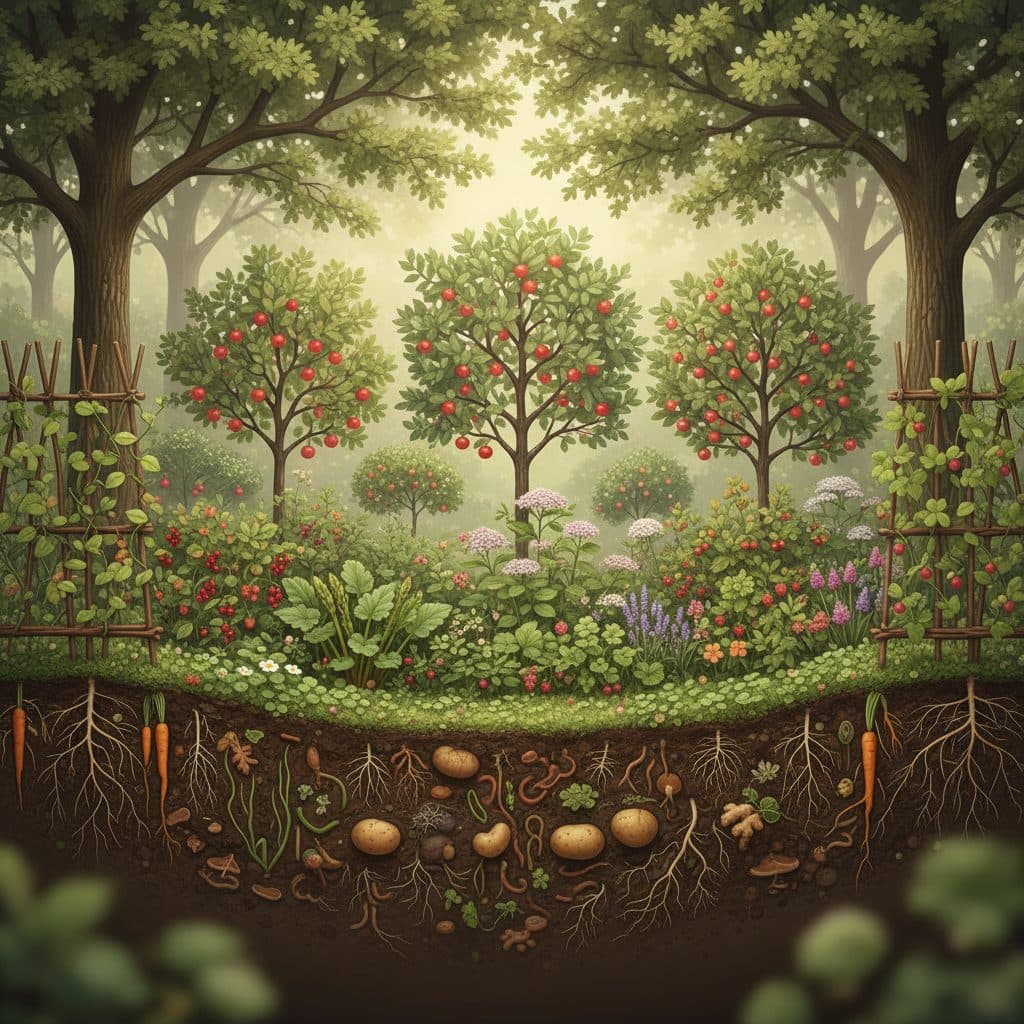
Key takeaways
- A temperate forest garden mimics natural woodland ecology by stacking perennial edible plants across seven distinct vertical tiers.
- The design philosophy was developed by Robert Hart on his Shropshire smallholding from the 1970s onwards and set out in his 1991 book Forest Gardening.
- The canopy and sub-canopy layers harvest overhead sunlight, producing staple tree crops, top fruit, and shelter for understory tiers.
- Comfrey is a deep-rooted dynamic accumulator in the herbaceous layer, mining subsoil minerals for chop-and-drop mulch.
- Ground covers and rhizosphere root crops protect soil biology, greatly reduce weeding, and produce continuous harvests.
Quick answer: Forest garden layers are a permaculture design system that stacks perennial edible plants into seven vertical tiers: canopy trees, sub-canopy fruit trees, shrub bushes, herbaceous perennials, rhizosphere root crops, soil ground covers, and vertical climbers. This multi-tiered arrangement maximizes solar capture, builds self-feeding soil fertility, and produces food with minimal ongoing labor.
Natural deciduous woodlands in Britain thrive without synthetic fertilizers, mechanical cultivation, or chemical pesticides. By observing how natural forest edges capture sunlight at multiple levels, ecological growers can create cultivated food forests that mirror natural woodland architecture. Mastering the forest garden layers allows growers to transform open plots and orchards into highly productive, multi-tiered perennial ecosystems.
The concept of adapting multi-layered agroforestry to cool temperate climates was developed by Robert Hart on his Shropshire smallholding from the 1970s onwards and set out in his 1991 book Forest Gardening. Hart observed that by substituting wild woodland species with edible, medicinal, and nutrient-accumulating perennials, a compact plot could yield abundant fruit, nuts, salads, and culinary herbs with minimal physical toil.
Rather than planting crops in isolated single-species monocultures, a layered forest garden integrates deep-rooted dynamic accumulators, nitrogen-fixing companion shrubs, and shade-tolerant ground covers into self-sustaining plant guilds. Understanding each tier ensures every plant occupies its optimal ecological niche without choking out adjacent species.
The seven forest garden layers explained
A complete temperate forest garden functions through seven distinct vertical strata that harvest sunlight from the treetops down to the soil surface:
+-------------------------------------------------------------+
|               THE SEVEN FOREST GARDEN LAYERS                |
|                                                             |
|  1. CANOPY (OVERSTORY)        Sweet Chestnut, Walnut (8-15m)|
|  2. SUB-CANOPY (UNDERSTORY)   Dwarf Apple, Pear, Hazel(3-6m)|
|  3. SHRUB LAYER               Currants, Gooseberries(1-2.5m)|
|  4. HERBACEOUS LAYER          Comfrey, Sweet Cicely(0.5-1.5m|
|  5. RHIZOSPHERE (ROOT)        Horseradish, Wild Garlic (<0m)|
|  6. GROUND COVER (SOIL)       Wild Strawberry, Thyme (<0.2m)|
|  7. VERTICAL (CLIMBER)        Hops, Hardy Kiwi (Climbing)   |
+-------------------------------------------------------------+- Canopy (Tall tree layer): Large standard trees (8 to 15 meters) forming the uppermost sun-catching umbrella.
- Sub-Canopy (Low tree layer): Semi-dwarf top fruit, medlars, and coppiced nut trees (3 to 6 meters) occupying filtered light.
- Shrub layer: Woody fruit and berry bushes (1 to 2.5 meters) adapted to dappled understory light.
- Herbaceous layer: Non-woody perennial vegetables, culinary herbs, and mineral-mining taproots (0.5 to 1.5 meters).
- Rhizosphere (Root layer): Edible root crops, bulbs, and tubers expanding within the topsoil horizon.
- Soil surface (Ground cover layer): Creeping, prostrate plants that carpet the earth, preserving soil moisture and suppressing weeds.
- Vertical layer (Climbers and vines): Climbing perennial vines that weave through trunks and lower branches.
For foundational design context, reviewing our guide on what is a food forest explains how these biological tiers interact across diverse regional climates.
Canopy and sub-canopy: the tree tiers
The upper two tree layers establish the microclimate, wind protection, and primary biomass for the entire forest garden.
+-------------------------------------------------------------+
|               UPPER TREE TIERS (UK EXAMPLES)                |
|                                                             |
|  CANOPY LAYER (Standard Height):                            |
|  - Sweet Chestnut (Castanea sativa): Carbohydrate nut crop  |
|  - Persian Walnut (Juglans regia): Oil-rich nut crop        |
|  - Oak (Quercus robur): Wildlife anchor & mushroom logs     |
|                                                             |
|  SUB-CANOPY LAYER (Semi-Dwarf Height):                      |
|  - Apples on MM106 rootstock & Pears on Quince A            |
|  - Medlar (Mespilus germanica) & Quince (Cydonia oblonga)   |
|  - Cobnuts & Filberts (Corylus avellana & C. maxima)        |
|  - Damson & Bullace Plums on St. Julien A rootstocks        |
+-------------------------------------------------------------+
Managing canopy density
In cool temperate climates like the UK, full forest canopy closure creates dense shade that inhibits fruit ripening in lower tiers. Unlike tropical food forests where harsh sun demands heavy shade, temperate forest gardens require wide canopy tree spacing (leaving 8 to 12 meters between large trees) to create open glades and sunny woodland edges.
When selecting canopy species, buy UK-grown, plant-passported sweet chestnut (Castanea sativa) due to sweet chestnut blight and gall wasp, and expect poor nut set outside the warmer south and east. Persian walnut (Juglans regia) produces oil-rich nuts, but its roots, leaves, and husks release juglone; site walnut on the edge of the garden, or keep juglone-sensitive plants out of its root zone — the layered guild does not work underneath a walnut.
Productive sub-canopy selections
The sub-canopy layer carries the bulk of domestic fruit production. Apples, European pears, damsons, and medlars thrive in the sheltered, frost-buffered microclimate created by outer windbreak trees. Cobnuts (Corylus avellana) and filberts (Corylus maxima, including 'Kentish Cob') produce abundant nuts in dappled light. If your plot connects with broader community plantings, incorporating concepts from community orchard helps ensure proper cross-pollination across tree tiers.
Shrub and herbaceous layers: berry bushes and dynamic accumulators
The middle tiers generate heavy summer harvests while regulating soil nutrient cycles.
+-------------------------------------------------------------+
|               SHRUB & HERBACEOUS STRATA                     |
|                                                             |
|  SHRUB TIER (Soft Fruits):                                  |
|  - Blackcurrants, Redcurrants, & Whitecurrants (Ribes)      |
|  - Gooseberries & Jostaberries (Shade-tolerant soft fruit)  |
|  - Native Elderberry (Sambucus nigra): Flowers & berries    |
|  - Sea Buckthorn (Hippophae rhamnoides): Nitrogen fixer     |
|                                                             |
|  HERBACEOUS TIER (Nutrient Miners & Perennial Veggies):     |
|   - Russian Comfrey (Symphytum x uplandicum 'Bocking 14')   |
|  - Sweet Cicely (Myrrhis odorata): Anise-flavored foliage   |
|  - Babington Leek (Allium ampeloprasum var. babingtonii)    |
|  - Turkish Rocket (Bunias orientalis): Perennial brassica   |
+-------------------------------------------------------------+
Soft fruit bushes in dappled shade
Members of the genus Ribes (including blackcurrants, redcurrants, and gooseberries) evolved naturally as woodland understory shrubs. They produce bountiful crops of tart, vitamin-rich berries in partial shade where full-sun annual vegetables struggle. Sea buckthorn (Hippophae rhamnoides) is an effective nitrogen fixer, but it is dioecious (requiring a male pollinator for berry set) and suckers aggressively; for smaller plots, Italian alder (Alnus cordata) or ground-layer clovers are more manageable fixers.
The role of comfrey in the herbaceous layer
Russian comfrey ('Bocking 14') is the cornerstone of temperate forest garden fertility. Rather than functioning as a creeping ground cover, comfrey is a robust, upright herbaceous perennial that grows up to 1 meter tall. Its powerful taproot penetrates 2 to 3 meters into the subsoil, mining locked-up potassium, calcium, and trace minerals. Cutting comfrey foliage three to four times per season provides nutrient-dense organic mulch directly beneath fruit trees.
Ground cover, root layer, and vertical climbers
The lower three layers occupy micro-niches, protecting soil biology and expanding the harvest surface vertically.
Ground cover layer
Living ground covers replace the need for constant weeding or plastic mulch:
- Wild strawberry (Fragaria vesca): Forms a dense, spreading evergreen carpet under fruit trees, producing sweet berries from June to September.
- Creeping thyme (Thymus serpyllum): A drought-tolerant edge cover and a heavy nectar source for bees.
- Lesser periwinkle (Vinca minor) and checkerberry (Gaultheria procumbens): Evergreen prostrate covers that prevent winter soil erosion. Note that Vinca is non-edible and toxic, while Gaultheria requires acidic, humus-rich soil (avoid planting invasive Gaultheria shallon).
Rhizosphere root layer
The subterranean zone houses perennial root crops that can be harvested without destroying the forest garden ecosystem:
- Wild garlic / Ramsons (Allium ursinum): Carpet woodland floors in spring with garlic-flavored greens and edible white star flowers.
- Horseradish (Armoracia rusticana): Deep-rooted culinary perennial grown in contained corners.
- Jerusalem artichoke (Helianthus tuberosus): Produces crunchy, inulin-rich tubers alongside 3-meter autumn flower stalks; grow in contained corners or designated beds as every tuber fragment left behind regrows aggressively.
Vertical climber layer
Vines utilize tree trunks and sturdy trellis wires to reach overhead light:
- Hops (Humulus lupulus): Vigorous perennial bine; only female plants bear the aromatic cones used in brewing.
- Hardy kiwi (Actinidia arguta): Produces smooth-skinned, grape-sized kiwi fruits that tolerate UK frosts; requires a male vine for pollination unless choosing a self-fertile cultivar like 'Issai'.
- Tayberry and loganberry: Bramble hybrids trained along lower sub-canopy branches.
Designing for light penetration and guild synergy
Successful layered planting requires arranging species so that taller tiers do not cast excessive shade over sun-loving understory crops.
+-------------------------------------------------------------+
|               LIGHT DESIGN PROFILE (SOUTH TO NORTH)         |
|                                                             |
|      SOUTH (SUNNY) -------------------> NORTH (SHADED)      |
|                                                             |
|                                                    [CANOPY] |
|                                       [SUB-CANOPY] Chestnut |
|                         [SHRUB]        Dwarf Apple          |
|          [HERBACEOUS]  Blackcurrant                         |
|  [GROUND]   Comfrey                                         |
|  Strawberry                                                 |
|  ========================================================== |
+-------------------------------------------------------------+- Orient by sun aspect: Position the tallest canopy trees on the northern and north-eastern boundaries of your plot. Step plant heights downward toward the south to create a bowl-shaped sun trap that captures maximum warmth.
- Stack plant functions: Ensure every plant guild combines a primary food crop (apple tree), a nitrogen fixer (sea buckthorn or clover), dynamic nutrient accumulators (comfrey), and insectary flowers (sweet cicely, fennel) to attract predatory hoverflies and parasitic wasps.
- Syntropic succession: Understanding plant succession over time through syntropic farming and monitoring understorey during the secondary stage ensures your garden transitions smoothly as canopies mature over decades.
Stacking perennial crops across all seven forest garden layers builds a resilient, self-nourishing ecosystem, and agripure's forest gardening guides can help British growers plan one.