Key takeaways
- A food forest mimics natural forest ecosystems, providing perennial food, fiber, and medicine with minimal annual input.
- Successful design begins with thorough site assessment, understanding sun, wind, water, and soil patterns across permaculture zones.
- The seven layers of a food forest (canopy, understory, shrub, herbaceous, groundcover, rhizome, and vertical) maximize space and yield.
- Plant guilds, or beneficial plant communities, improve soil health, deter pests, and increase overall productivity.
- Effective water management, such as swales and rainwater harvesting, is essential for resilience and cuts irrigation needs.
- Starting small, perhaps with a single guild, allows for learning and gradual expansion over five to ten years.
Quick answer: To start a food forest, begin with a thorough site assessment to understand sun, wind, water, and soil patterns. Then, design using the seven layers (canopy, understory, shrub, herbaceous, groundcover, rhizome, and vertical) to maximize space and yield with perennial plants.
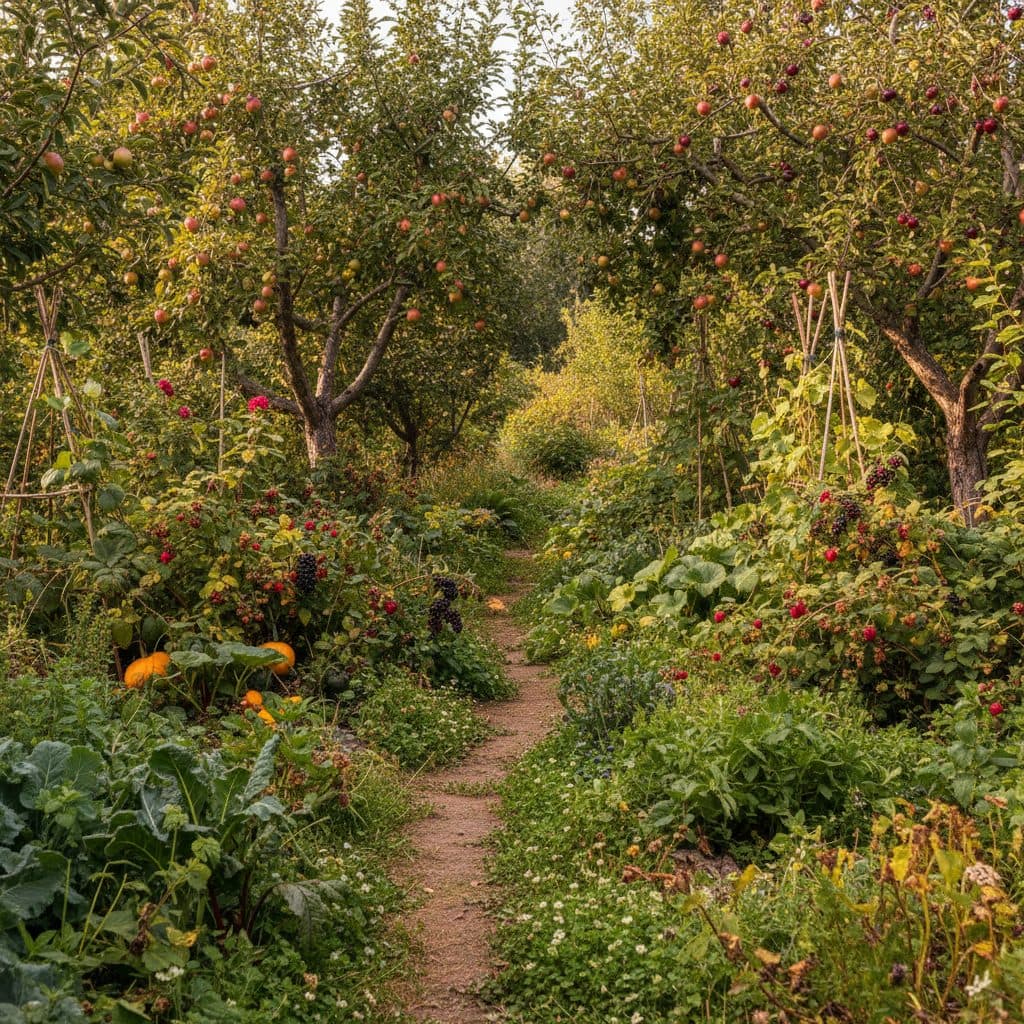
Across the American Midwest, from Ohio to Iowa, many homeowners are planting food forests. Unlike a traditional annual garden that requires replanting every spring, a food forest is a perennial system designed to produce food, medicine, and other useful products for decades with significantly less effort once established. Imagine a system where your harvest increases year after year, providing diverse edibles like apples, pawpaws, blueberries, and perennial herbs, all while building healthy soil and supporting local wildlife.
This guide will walk you through the practical steps of establishing a productive food forest in your US backyard, focusing on the seven-layer permaculture design. We’ll cover everything from reading your site to selecting appropriate plants for USDA zones 3 through 9, to help establish a productive and resilient planting.
Understanding the food forest concept for US backyards
A food forest is a deliberately designed ecosystem that mimics the structure and function of a natural forest, but with a focus on edible and useful plants. It’s a system that builds fertility over time, requiring less human intervention than conventional gardening after its initial establishment. In US backyards, this means selecting species appropriate for your local climate and soil conditions, often focusing on native or well-adapted perennial plants. For instance, a food forest in USDA zone 6 might feature chestnuts, persimmons, and elderberries, providing a diverse harvest from late summer into fall. This approach supports biodiversity, improves soil health, and generally needs less watering than a lawn once the trees and mulch layer are established.
The benefits of a perennial system
The primary benefit of a food forest is its long-term sustainability and productivity. Once established, these systems require minimal tilling, weeding, or pest control, relying instead on natural processes. For example, a well-designed food forest can provide consistent yields for 20 years or more, offering a stable food source. The USDA Natural Resources Conservation Service (NRCS) promotes similar principles for conserving resources and improving agricultural land. By choosing perennial plants, you’re investing in a system that grows and strengthens with each passing season, often yielding a greater diversity of foods than a typical vegetable patch.
- Reduced labor and maintenance over time
- Increased biodiversity and habitat for beneficial insects
- Improved soil health and water retention
- Year-round harvests of diverse foods
- Enhanced aesthetic appeal of your property
Site assessment and permaculture zones for your backyard
Before planting anything, a thorough site assessment is necessary. This involves observing your land over a full year to understand its unique characteristics. Pay attention to sunlight patterns, prevailing wind directions, water flow, and existing vegetation. For example, a south-facing slope in USDA zone 7 will receive significantly more sun exposure than a north-facing area, influencing plant selection. Mapping these elements helps you place plants where they will thrive and design systems like swales effectively. A detailed assessment can save you years of trial and error, ensuring your initial investment of time and resources, potentially 40 to 60 hours in the first year, is well spent.
Reading your site’s natural patterns
Understanding your site also means identifying its permaculture zones, which dictate the intensity of human interaction. Zone one is closest to your home, reserved for plants needing daily attention, like culinary herbs or salad greens. Zone two, slightly further out, might house small fruit trees and perennial vegetables requiring weekly visits. As you move to zones three, four, and five, the frequency of visits decreases, with zone five being a wild, unmanaged area. This zoning principle, detailed in resources like Permaculture design: how to read a site before you plant it, ensures that high-maintenance plants are easily accessible, while lower-maintenance species are placed further away, optimizing your effort. For a typical US backyard of 0.25 acres, zones one and two will likely encompass 70% to 80% of the cultivated area.
- Observe sun exposure throughout the day and seasons
- Map water flow and potential for pooling or runoff
- Identify existing soil type and health (e.g., sandy, clay, loam)
- Note prevailing wind patterns and potential for windbreaks
- Document existing plants, structures, and hardscapes
Designing with the seven layers for a diverse yield
The seven layers of a food forest are the backbone of its productivity and resilience. By stacking plants vertically, you maximize the use of sunlight and space, creating a dense, multi-functional ecosystem. This layering approach allows for a greater diversity of species and yields compared to a single-story garden. For example, in a 500 square foot space, you could grow a dozen fruit trees, two dozen berry bushes, and hundreds of herbaceous plants and groundcovers. This layered design also creates microclimates, offering protection from harsh weather and supporting a wider range of beneficial insects. Think of it as a living pantry, constantly producing.
Integrating each layer into your design
Each layer plays a distinct role. The canopy layer consists of large fruit or nut trees like apples, pears, or pecans, providing the primary structure and shade. Below that, the understory layer includes smaller fruit trees such as pawpaws or serviceberries, thriving in partial shade. The shrub layer features berry bushes like blueberries, raspberries, or currants. The herbaceous layer is home to perennial vegetables and herbs like rhubarb, asparagus, and sorrel. Mint belongs here too, but only in a sunken bottomless pot or a corner you are willing to lose; it runs by rhizome and will take the whole layer. The groundcover layer includes spreading plants like strawberries or creeping thyme, protecting the soil. The rhizosphere (root) layer offers root crops like sunchokes or groundnuts. Finally, the vertical (climber) layer utilizes vines such as hardy kiwi or grapes, growing up existing structures or trees. For more details on this structure, see What is a food forest? A beginner’s guide to perennial edible ecosystems.
- Canopy layer: Large fruit and nut trees (e.g., apple, pecan)
- Understory layer: Smaller fruit trees (e.g., pawpaw, persimmon)
- Shrub layer: Berry bushes (e.g., blueberry, elderberry)
- Herbaceous layer: Perennial vegetables and herbs (e.g., rhubarb, asparagus; mint only if you sink it in a bottomless pot)
- Groundcover layer: Spreading plants (e.g., strawberry, creeping thyme)
- Rhizosphere layer: Root crops (e.g., sunchokes, groundnuts)
- Vertical layer: Climbing vines (e.g., hardy kiwi, grape)
Plant guilds and water management for resilience
Plant guilds are communities of plants that mutually support each other, mimicking the beneficial relationships found in natural ecosystems. For example, a fruit tree guild might include a central apple tree, surrounded by nitrogen-fixing plants like white clover (Siberian pea shrub fixes nitrogen too, but it seeds freely and is listed as invasive in parts of the upper Midwest and the northern prairies, so check your state’s noxious weed list before planting it), deep-rooted plants like sterile Bocking 14 comfrey (Symphytum × uplandicum, cut several times a season for mulch; never plant seed-setting common comfrey, and treat comfrey as mulch only, not food or fodder, since its pyrrolizidine alkaloids are hepatotoxic), and pest-deterring herbs like chives. This cooperative planting can improve plant health, lower pest pressure by giving predatory insects somewhere to live and breed, and build overall soil fertility. Designing guilds thoughtfully is a cornerstone of permaculture, ensuring each plant contributes to the health of the whole system. For ideas on specific layouts, refer to A permaculture garden plan: zones, guilds, and a first-year layout.
Implementing swales and rainwater harvesting
Effective water management is important for a resilient food forest, especially in regions experiencing drought or heavy rainfall. Swales (level ditches dug along contours) slow, spread, and sink water into the landscape. This passive irrigation technique cuts how much supplemental water young plants need, especially during dry spells in summer. The EPA’s “Soak Up the Rain” initiative notes that these practices help manage stormwater and recharge groundwater. Rainwater harvesting, using rain barrels or cisterns, can capture hundreds of gallons of water from your roof, providing a ready supply for young plants or dry periods. A 50-gallon rain barrel can collect about 30 gallons from a 100 square foot roof during a 0.5-inch rainfall event.
- Nitrogen fixers: Add nitrogen to the soil (e.g., white clover, hairy vetch; Siberian pea shrub works too, but it self-seeds and is listed as invasive in parts of the upper Midwest and the northern prairies)
- Dynamic accumulators: Deep-rooted plants whose cut leaves make a mineral-rich mulch (e.g., sterile Bocking 14 comfrey, dandelion). Plant only Bocking 14 (common comfrey seeds itself through a bed) and use comfrey as mulch, never as food or fodder, since its pyrrolizidine alkaloids are hepatotoxic.
- Pest deterrents: Discourage unwanted insects (e.g., garlic, chives, marigolds)
- Pollinator attractors: Support beneficial insects (e.g., borage, lavender)
- Groundcovers: Suppress weeds and retain soil moisture (e.g., strawberries, creeping thyme)
Long-term maintenance and evolution of your food forest
While a food forest is designed for low maintenance, it’s not a ‘plant it and forget it’ system, especially in its first three to five years. Initial tasks include regular watering for young plants, especially during dry spells when they may need one to two gallons of water per week. Pruning fruit trees for structure and yield is also important, typically performed annually in late winter. Over time, as the system matures, these tasks diminish. For instance, a mature food forest in USDA zone 5 might only require 10 to 20 hours of maintenance per month during peak growing season, compared to 30 to 40 hours for a similar-sized annual garden.
Observing and adapting your system
A key aspect of food forest management is continuous observation and adaptation. You’ll need to watch how your plants interact, how water moves, and where sunlight falls as trees grow. If a plant isn’t thriving, consider its placement or soil conditions. If a pest problem arises, use biological controls within the guild design before applying external inputs. This iterative process allows the food forest to become more resilient and productive over five to ten years. Remember, starting small, perhaps with a single guild, lets you learn what works on your site before you commit the whole yard to it.
- Monitor soil moisture, especially for young plants (use a Soil Moisture Meter)
- Prune fruit trees annually for health and production
- Harvest regularly to encourage further growth and prevent waste
- Replenish mulch layers every one to two years to suppress weeds and build soil
- Observe plant health and adjust species or placement as needed
Food Forest vs. Traditional Vegetable Garden (0.25 acre backyard)
Feature | Food Forest | Traditional Vegetable Garden |
|---|---|---|
Planting Frequency | Mostly perennial (once every 10-20 years) | Mostly annual (every year) |
Water Use Reduction | Lower after establishment | Minimal reduction, often increased |
Pest Control | Integrated biological control | Often requires chemical or manual intervention |
Soil Health | Continuously improving | Can degrade without constant amendments |
Labor (after 5 years) | 10-20 hours/month (peak season) | 30-40 hours/month (peak season) |
Yield Diversity | High (fruits, nuts, berries, herbs, roots) | Moderate (seasonal vegetables) |
Water Savings: Once a food forest is established, deep perennial roots and a standing mulch layer hold soil moisture, so it needs less supplemental irrigation than a conventional garden.
Increased Yield: Using all seven layers puts more crops over the same ground than a single-story annual garden does.
Frequently asked questions
How long does it take for a food forest to become productive?
A food forest typically begins to yield noticeable harvests within three to five years, with significant production often achieved after seven to ten years as the canopy and understory layers mature. Some groundcovers and herbs may produce within the first year.
What is the minimum size required for a backyard food forest?
You can start a small food forest in an area as compact as 100 square feet, focusing on a single fruit tree guild. Even a 20×20 foot (400 sq ft) space can support several layers and provide a diverse yield for a small family.
Do food forests attract more pests?
A well-designed food forest, with its high biodiversity and plant guilds, often attracts beneficial insects and predators that help control pests naturally. This tends to mean fewer pest problems than a monoculture garden, though it does not eliminate them.
Can I integrate chickens or other animals into my food forest?
Yes, chickens can be integrated into a food forest, especially in zones three and four, to help with pest control, weeding, and fertilization. A rotation system can prevent overgrazing, allowing them to forage for up to 30 minutes in specific areas.
What are some good starter plants for a US food forest?
Excellent starter plants for many US zones include apple trees (canopy), pawpaw trees (understory), blueberry bushes (shrub), rhubarb (herbaceous), and strawberries (groundcover). These offer a good mix of layers and relatively easy establishment.
How much water does a food forest need?
Once established, a food forest typically needs noticeably less supplemental irrigation than a traditional garden, thanks to improved soil moisture retention and passive water harvesting systems like swales. Young plants, however, may need one to two gallons of water per week for the first year.
References
- USDA Natural Resources Conservation Service (2024). USDA Natural Resources Conservation Service.
- EPA — Soak Up the Rain (2024). EPA — Soak Up the Rain.