Key takeaways
- Starting a community orchard transforms underutilized public land into a shared sanctuary of local food, wildlife habitat, and social connection.
- Form a simple community group with a constitution to secure council land leases and apply for UK grant funding.
- Select semi-vigorous rootstocks (such as MM106 for apples) to keep fruit within reach of volunteers, staking trees for four to five years.
- Heritage varieties preserve local genetic diversity, but disease resistance varies enormously between cultivars — check scab, canker and mildew susceptibility against your local rainfall before ordering.
- Protect young orchard trees from rabbits, deer, and municipal lawnmowers using sturdy wooden stakes and appropriate wire mesh guards.
Quick answer: To start a community orchard in the UK, form a local steering group, partner with your local council or parish trust to secure a long-term land lease, and apply for green community grants. Design a diverse layout of heritage top fruit grafted onto semi-vigorous rootstocks, organize a community planting day in winter, and maintain trees with annual mulch rings, formative pruning, and communal harvest events.
Across towns, villages, and cities in the United Kingdom, communities are turning unused green spaces into community orchards. A community orchard can supply free, fresh heritage fruit, bring back varieties that had gone out of use, and give pollinators, birds, and other wildlife a place to live.
Unlike private home gardens, a community orchard requires coordinating between local residents, parish or borough councils, and environmental funding bodies. Successful projects depend on clear legal agreements, appropriate rootstock choices, and structured long-term maintenance plans that keep volunteers engaged throughout the seasons.
From selecting well-adapted British heritage apples to organizing festive winter wassailing and autumn Apple Days, community orchards unite neighborhoods around practical food production. By following structured planning steps, your group can establish a flourishing orchard that feeds and inspires the community for generations.
Securing land and forming a community orchard group
Establishing a lasting public orchard begins with community organization and formal land access agreements:
+-------------------------------------------------------------+
|               COMMUNITY ORCHARD LAUNCH STAGES               |
|                                                             |
|  1. FORM A COMMITTEE: Elect officers & adopt constitution   |
|  2. IDENTIFY LAND: Parks, allotment edges, school grounds   |
|  3. COUNCIL LEASE: Secure 10 to 25 year land agreement      |
|  4. SECURE FUNDING: Grants from Tree Council / Lottery Fund |
|  5. SITE SURVEY: Check soil drainage, sunlight, & access    |
+-------------------------------------------------------------+
Constituting your steering group
Form a small, dedicated committee consisting of a chairperson, secretary, and treasurer. Adopting a standard un-incorporated community group constitution with a dedicated community bank account is necessary to sign council leases, obtain public liability insurance, and apply for grant funding.
Land tenure agreements
Potential sites include council-owned public parks, surplus allotment margins, church grounds, village greens, and school fields. Approach your parish council, town council, or local borough authority to request a formal lease or Memorandum of Understanding (MOU). Aim for a minimum lease term of 10 to 25 years to protect the orchard's longevity as trees mature into production.
UK funding avenues
Check current funding rounds before applying — schemes and their names change over time:
- The Tree Council (Branching Out Fund): Offers grants specifically for community tree and orchard plantings.
- National Lottery Community Fund (Awards for All): Provides funding for local community food and green space initiatives.
- Local Authority Green Infrastructure Grants: Many UK county councils allocate climate biodiversity funds for community orchards.
Selecting UK rootstocks and heritage fruit varieties
Choosing the correct rootstock determines tree size, lifespan, and ease of harvest in a public space.
+-------------------------------------------------------------+
|               COMMON UK ORCHARD ROOTSTOCKS                  |
|                                                             |
|  ROOTSTOCK          VIGOUR / HEIGHT     SUITABILITY         |
|  ---------------------------------------------------------  |
|  M27 (Apples)       Extremely dwarf (1.2-1.8m) Permanent stake|
|  M9 (Apples)        Dwarfing (2.5-3m)   Permanent stake     |
|  M26 (Apples)       Semi-Dwarf (2.5-3m) Small gardens/school|
|  MM106 (Apples)     Semi-Vigorous(4-4.5m) Ideal for orchard |
|  M25 (Apples)       Standard (6-8m+)    Large parks, 100yr+ |
|  Quince A (Pears)   Semi-Vigorous (3-4m)Standard pear choice|
|  St. Julien A(Plums)Semi-Vigorous (4-5m)Plums, gages, damson|
+-------------------------------------------------------------+
Why MM106 is the community standard
Semi-vigorous rootstocks like MM106 are the premier choice for public community orchards. They produce manageable bush trees reaching 4 to 4.5 meters in height on average soil, allowing volunteers to pick fruit without requiring tall ladders. MM106 is prone to collar rot on wet, heavy soils; on poorly drained sites use MM111 or plant on a low mound. Keep the stake for four to five years, longer on exposed sites, and slacken and check the ties every year so they do not constrict the trunk.
Celebrating regional heritage cultivars
Select traditional British varieties suited to your geographic region. Heritage varieties preserve local genetic diversity, but disease resistance varies enormously between cultivars — check scab, canker and mildew susceptibility against your local rainfall before ordering:
- Dessert apples: 'Discovery' (mid-to-late August sweet apple), 'Egremont Russet' (nutty, hardy), 'Blenheim Orange' (dual-purpose Victorian classic), and 'Adam's Pearmain'.
- Culinary cooking apples: 'Bramley's Seedling' (vigorous, exceptional baking), 'Arthur Turner' (beautiful blossom), and 'Grenadier'. Note that 'Bramley's Seedling' and 'Blenheim Orange' are triploids — they set no useful pollen, so plant two other diploid varieties from a compatible group alongside them.
- Pears and stone fruits: 'Conference' and 'Doyenné du Comice' pears; 'Victoria' and 'Czar' plums; and 'Merryweather' damson.
Orchard layout and spacing for public spaces
A community orchard layout must balance tree spacing with human footpaths and public accessibility.
+-------------------------------------------------------------+
|               COMMUNITY ORCHARD LAYOUT (GRID SPACING)       |
|                                                             |
|       (T) -------- 5.0m -------- (T) -------- 5.0m -------- (T)
|        |                          |                          |
|        |                          |                          |
|       5.5m                       5.5m                       5.5m
|        |                          |                          |
|        |                          |                          |
|       (T) -------- 5.0m -------- (T) -------- 5.0m -------- (T)
|                                                             |
|   [ WIDE WHEELBARROW PATH ]  ==== 2.5m Central Mown Track   |
+-------------------------------------------------------------+- Grid spacing: For semi-vigorous trees (MM106 / Quince A), maintain at least 4.5 to 5.5 meters between trees and rows. This allows ample sunlight to reach all sides of the canopy and leaves room for mowers to pass easily between trees.
- Pollination partner grouping: Apples are divided into flowering pollination groups (Groups 1 to 6). Ensure each tree has at least one companion tree from the same or adjacent pollination group planted within 15 meters to guarantee cross-pollination. 'Bramley's Seedling' and 'Blenheim Orange' are triploids — they set no useful pollen, so plant two other diploid varieties from a compatible group alongside them.
- Communal access tracks: Design wide grass tracks (at least 2.5 meters wide) through the orchard center. For path design principles that withstand winter foot traffic, consult our guide on allotment paths.
Organizing a community planting day and tree protection
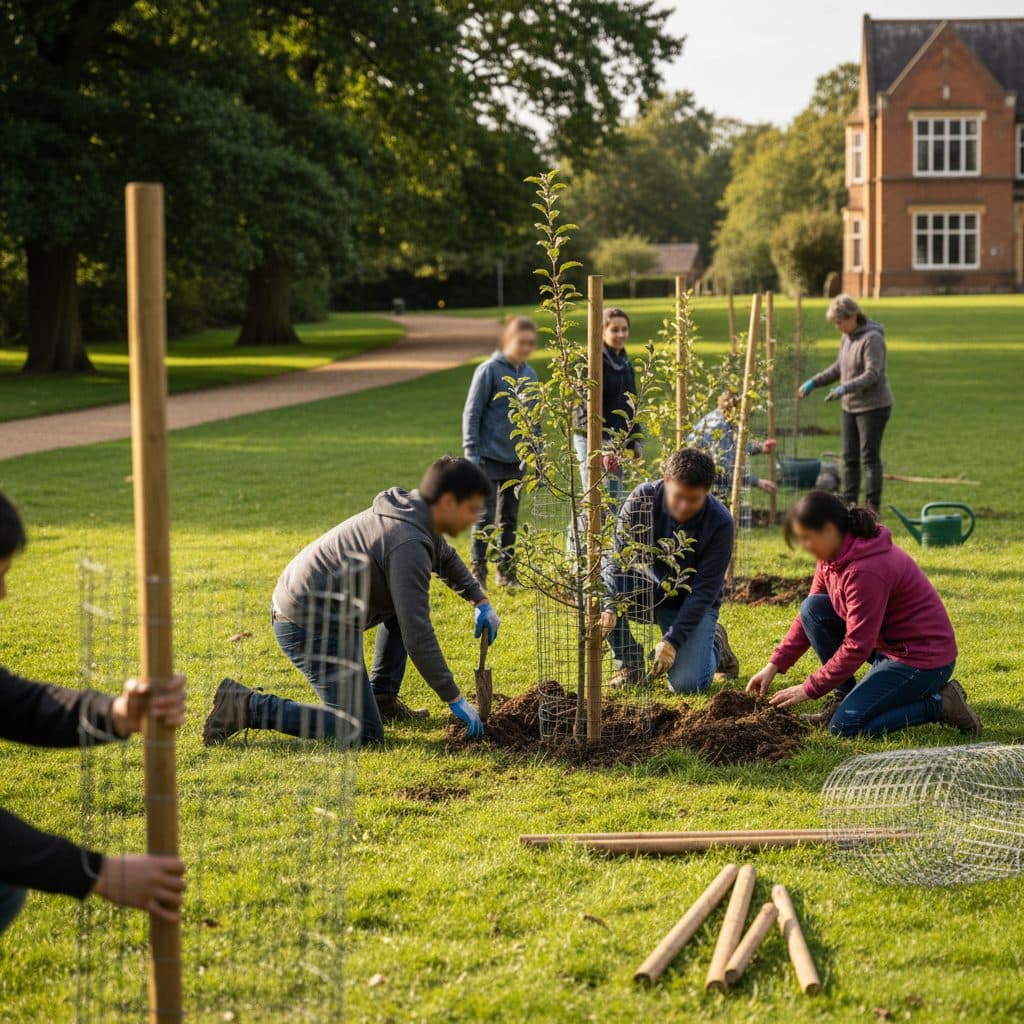
Winter (November through February) is the bare-root planting season in the UK, making it the ideal time to host a community planting event.
+-------------------------------------------------------------+
|               COMMUNITY PLANTING DAY CHECKLIST              |
|                                                             |
|  - Bare-Root Trees kept moist in burlap sacks under tarps   |
|  - Round machined wooden tree stakes (1.5m length, 75mm dia)|
|  - Adjustable rubber tree ties with spacer pads             |
|  - Wire tree guards (1.2m rabbit/roe; 1.8m/fence fallow/red)|
|  - Wheelbarrows, spades, sledgehammers, and watering cans   |
|  - 10cm Wood chip mulch rings (1m diameter around each tree)|
+-------------------------------------------------------------+
Tree planting procedure
- Dig a circular hole twice the width of the root spread, keeping the turf topsoil separated from the subsoil.
- Drive the wooden stake firmly into the base of the hole on the south-west (windward) side before setting the tree in place.
- Position the tree so the nursery mark sits level with the ground surface, ensuring the graft union remains 10 cm above soil level.
- Backfill with native soil, firming gently with boots to remove air pockets, and secure the trunk to the stake using an adjustable rubber tie.
- Install a sturdy wire mesh guard around the trunk: 1.2 m guards for rabbits and roe; where fallow or red deer are present use 1.8 m guards or fence the orchard.
- Apply a 10 cm thick ring of wood chips in a 1-metre diameter circle around the tree, keeping mulch 5 cm clear of the trunk to prevent fungal collar rot.
For complementary understory planting ideas, studying forest garden layers provides inspiration for nitrogen-fixing comfrey and pollinator borders beneath orchard canopies.
Seasonal maintenance, wassailing, and Apple Days
Community involvement throughout the year turns a tree-planting project into a lasting local tradition.
+-------------------------------------------------------------+
|               ORCHARD COMMUNITY CALENDAR                    |
|                                                             |
|  JANUARY: Old Twelfth Night Wassailing ceremony             |
|  FEBRUARY: Formative winter pruning workshop (Apples/Pears) |
|  MAY / JUNE: Mulch replenishment & summer weed clearing     |
|  JULY: Summer pruning of stone fruits (Plums / Cherries)    |
|  OCTOBER: Apple Day festival, fruit pressing, & cider making|
+-------------------------------------------------------------+- Winter pruning workshops: Organize hands-on volunteer pruning sessions in January and February. Follow structured techniques in formative pruning young fruit trees and how to prune fruit trees to develop open-centered goblet canopies.
- Wassailing: Revive the ancient British tradition of wassailing on Old Twelfth Night (January 17th). Community members gather with cider, songs, and noise to bless the trees and awaken the orchard for the upcoming spring.
- Autumn Apple Days: Host an annual community Apple Day in October. Families bring apples for communal cider pressing, conduct blind taste tests, and share homemade pies and chutneys.