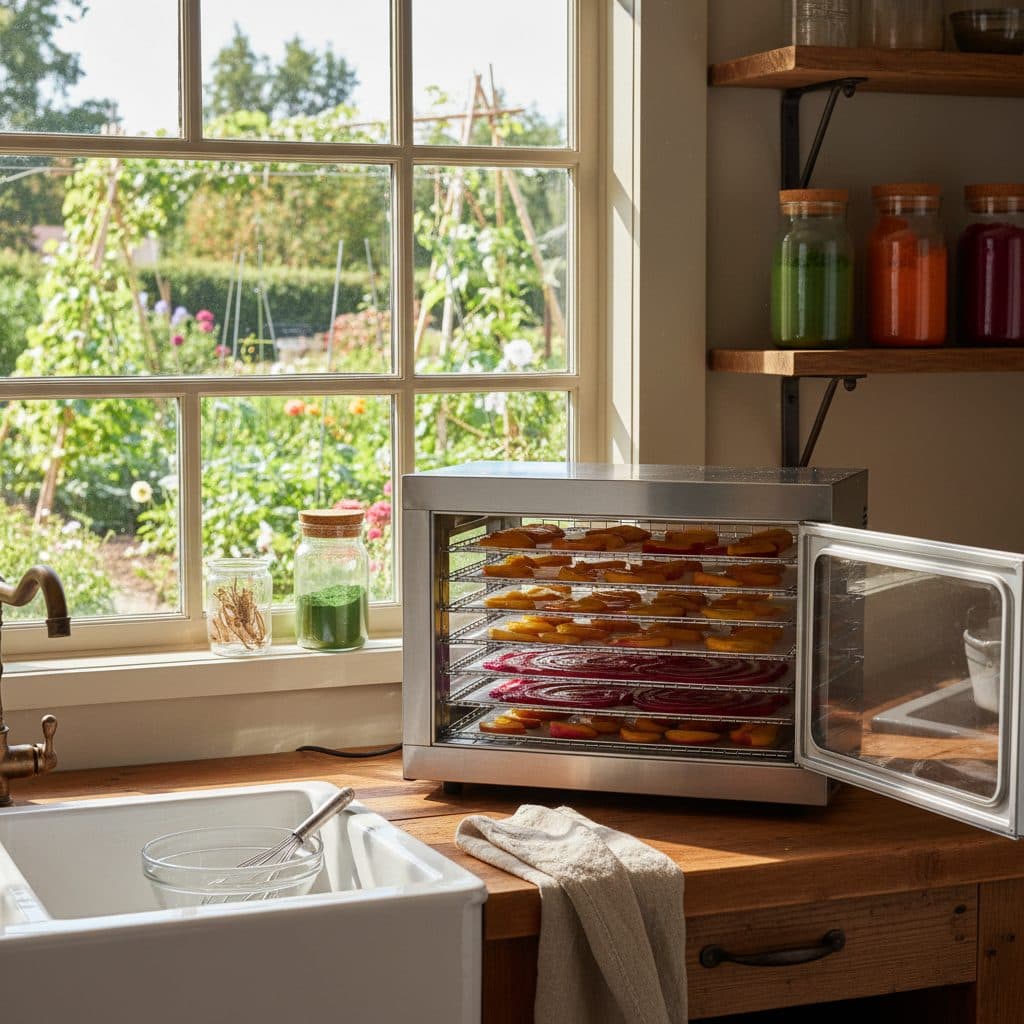
Key takeaways
- Dehydration reduces food waste by converting excess produce into shelf-stable forms.
- Fruit leathers are made by pureeing ripe fruit and drying it to a flexible consistency with less than 15% moisture.
- Vegetable powders are created by drying blanched vegetables and grinding them into a fine, concentrated powder.
- Proper drying temperatures, typically 135°F for fruit and 125°F for vegetables, matter for safety and quality.
- Store dehydrated products in airtight containers in a cool, dark place for up to 12-24 months.
- Utilize vegetable powders to boost nutrition and flavor in soups, sauces, and baked goods.
Quick answer: To dry summer produce for fruit leather and vegetable powders, puree ripe fruit for leathers and blanch vegetables for powders. Dry fruit at 135°F and vegetables at 125°F until pliable or brittle, then store in airtight containers.
In the fertile valleys of California’s Central Valley, a single tomato plant can yield 15 to 25 pounds of fruit in a good season. Across the humid South, a robust zucchini patch might produce 10 pounds per week, quickly overwhelming any household. When the garden delivers more than you can eat fresh, freezing and canning are common solutions, but dehydrating offers a space-saving alternative that transforms excess into shelf-stable ingredients.
Making homemade fruit leather and vegetable powders extends the life of your harvest, turning perishable produce into versatile staples. This process reduces food waste and preserves nutrients and flavors for months, sometimes even years, so you get a taste of summer long after the first frost hits USDA zone 6. With a little effort, you can convert 50 pounds of tomatoes into a compact powder or a dozen pounds of berries into delicious, portable fruit leathers.
The basics of dehydration for preservation
These takeaways points carry into this section, too.
Dehydration is one of the oldest methods of food preservation, effectively removing moisture to inhibit microbial growth. For home growers, a food dehydrator offers the most consistent results, maintaining temperatures between 100°F and 160°F. Air circulation is as important as heat; a good dehydrator pushes air evenly across trays for uniform drying. For example, a typical batch of sliced apples might take 8 to 12 hours at 135°F to reach the desired moisture content below 20%.
Preparing produce for drying
Proper preparation matters for successful dehydration. Most fruits and vegetables benefit from a thorough washing and removal of any bruised or damaged spots. Blanching vegetables for one to three minutes in boiling water before drying helps to preserve color, flavor, and nutrients, as well as inactivating enzymes that cause spoilage. For fruits, a light dip in lemon juice or ascorbic acid solution can prevent browning, especially for lighter-colored varieties like apples or pears. Aim for uniform slices, typically one-quarter inch thick, to ensure even drying times across all pieces.
- Reduces food spoilage by removing water
- Concentrates natural flavors and sugars
- Extends shelf life significantly, often 12+ months
- Saves storage space compared to canning or freezing
- Preserves many vitamins and minerals
Crafting fruit leathers from summer abundance
That work on basics of dehydration sets up what follows here.
Fruit leathers are a delightful way to preserve a summer glut of berries, stone fruits, or apples. The process begins by pureeing ripe fruit, often with a small amount of added sweetener or lemon juice to brighten flavors. For instance, five pounds of ripe strawberries can yield enough puree for several sheets of leather. The puree should be smooth, without large chunks, which can hinder even drying. Spread the puree thinly, about one-eighth to one-quarter inch thick, onto dehydrator trays lined with parchment paper or silicone sheets.
Drying and storing fruit leather
Drying fruit leather typically takes 6 to 12 hours at a temperature of 135°F. The leather is ready when it is pliable, not sticky, and peels easily from the drying surface. It should have a moisture content below 15% to prevent mold growth. Once dry, allow the leather to cool completely before rolling it up and storing it in airtight containers. Properly stored fruit leather can last for 6 to 12 months in a cool, dark pantry. Consider making a batch of apricot leather from your harvest in USDA zone 8, where stone fruits thrive, or using wild berries from the Pacific Northwest for a unique flavor. For more general advice on drying various foods, see our guide on dehydrating food.
- Use ripe, flavorful fruit for best results
- Puree fruit until very smooth
- Spread puree thinly and evenly, 0.125-0.25 in thick
- Dry at 135°F until pliable but not sticky
- Store in airtight containers for 6-12 months
Making nutrient-dense vegetable powders
Vegetable powders are a concentrated way to add nutrients and flavor to meals, especially during the colder months. Start by blanching vegetables like spinach, kale, or carrots for one to three minutes to set their color and stop enzymatic action. After blanching, cool the vegetables rapidly in ice water, then pat them thoroughly dry to remove as much surface moisture as possible. Spread the prepared vegetables in a single layer on dehydrator trays, ensuring good air circulation around each piece. A dehydrator set at 125°F is ideal for most vegetables, drying them until they are brittle and easily crumbled.
Grinding and using vegetable powders
Once completely dry, the vegetables should snap easily. Grind them into a fine powder using a spice grinder, coffee grinder, or high-speed blender. For example, 10 pounds of fresh spinach can reduce to less than one pound of potent powder. Dried vegetable powders retain a good share of their antioxidant capacity, though retention varies with the vegetable and the drying temperature. Store the finished powder in airtight containers away from light and heat. These powders can be added to soups, sauces, smoothies, or even homemade pasta dough. While dehydrating is effective, exploring other methods like fermenting and pickling vegetables also offers great preservation options.
- Blanch vegetables for 1-3 minutes before drying
- Dry vegetables until they are completely brittle
- Grind dried vegetables into a fine powder
- Store powders in airtight, opaque containers
- Use within 12-24 months for best quality
Storage and practical uses in the kitchen
Proper storage is critical for maintaining the quality and safety of your homemade fruit leathers and vegetable powders. Once completely cool, store fruit leathers rolled in parchment paper within airtight containers, such as glass jars or vacuum-sealed bags. Vegetable powders should be stored in opaque, airtight containers to protect them from light, which can degrade nutrients and color. A cool, dark pantry with a consistent temperature below 70°F is ideal. Under these conditions, fruit leathers can last 6 to 12 months, while vegetable powders often maintain their potency for 12 to 24 months.
Integrating powders and leathers into meals
Fruit leathers make excellent portable snacks for hikers, school lunches, or quick energy boosts. They are also a good way to use up 3 to 5 pounds of overripe fruit. Vegetable powders are incredibly versatile; a tablespoon of tomato powder can replace a small can of tomato paste in a soup, or a teaspoon of kale powder can be added to a smoothie for an extra nutritional punch. Consider adding one to two tablespoons of beet powder to homemade pasta dough for vibrant color and earthy flavor. For other long-term storage solutions that don’t rely on electricity, explore root cellaring.
- Store leathers and powders in airtight containers
- Keep containers in a cool, dark pantry below 70°F
- Fruit leathers last 6-12 months; powders 12-24 months
- Use fruit leather as a snack or dessert
- Incorporate vegetable powders into soups, sauces, and baked goods
Comparison of Fruit Leather vs. Vegetable Powder
Feature | Fruit Leather | Vegetable Powder |
|---|---|---|
Preparation Complexity | Medium (pureeing, spreading) | Medium-High (blanching, drying, grinding) |
Drying Time (approx.) | 6-12 hours | 10-24 hours |
Typical Texture | Chewy, pliable sheet | Fine, concentrated powder |
Primary Use | Portable snack, dessert | Flavoring, nutrient boost, thickener |
Shelf Life (optimal) | 6-12 months | 12-24 months |
Moisture Content: Fruit leather should come off the tray below 15% moisture. Vegetable powders must be far drier than that - dried until the pieces snap, then ground - or they will cake and mold in the jar.
Nutrient Retention: Drying preserves fiber and most minerals well. Heat-sensitive vitamins such as vitamin C drop noticeably, while a good share of the phenolic compounds survives.
Frequently asked questions
What kind of dehydrator is best for home use?
For home use, a dehydrator with an adjustable thermostat and a fan for even air circulation is ideal. Models with 5 to 9 trays are common and can process several pounds of produce at once, typically costing between $80 and $200.
Can I use an oven to make fruit leather or vegetable powders?
Yes, an oven can be used, but it’s less efficient. Set your oven to its lowest temperature, often around 150°F to 200°F, and prop the door open slightly with a wooden spoon to allow moisture to escape. Drying times will be longer, potentially 10 to 18 hours for fruit leather, and energy consumption will be higher.
How do I know when my fruit leather is done?
Fruit leather is done when it’s pliable and slightly tacky, but not sticky. It should peel easily from the drying surface and have no wet spots. A good test is to fold a piece in half; it should not crack or stick to itself. This usually occurs when moisture content is below 15%.
What are the best vegetables for making powders?
Leafy greens like spinach, kale, and beet greens are excellent, as are root vegetables like carrots and beets. Tomatoes, bell peppers, and mushrooms also make flavorful powders. A single pound of fresh kale can yield about one ounce of concentrated powder.
How long do homemade fruit leathers and vegetable powders last?
When stored properly in airtight containers in a cool, dark place, fruit leathers typically last 6 to 12 months. Vegetable powders can last even longer, often retaining quality for 12 to 24 months, especially if vacuum-sealed.
Do fruit leathers and vegetable powders retain their nutrients?
Yes, while some heat-sensitive vitamins like Vitamin C may decrease, many minerals, fiber, and other compounds are well-preserved. Much of the phenolic content survives drying, though retention varies widely with the vegetable and the drying temperature.
References
- Fruit and vegetable powders (2013). Fruit and vegetable powders.
- Total Phenolic Compounds of Fruit and Vegetable Powders in Thailand (2020). Total Phenolic Compounds of Fruit and Vegetable Powders in Thailand.
- USDA Natural Resources Conservation Service (2024). USDA Natural Resources Conservation Service.