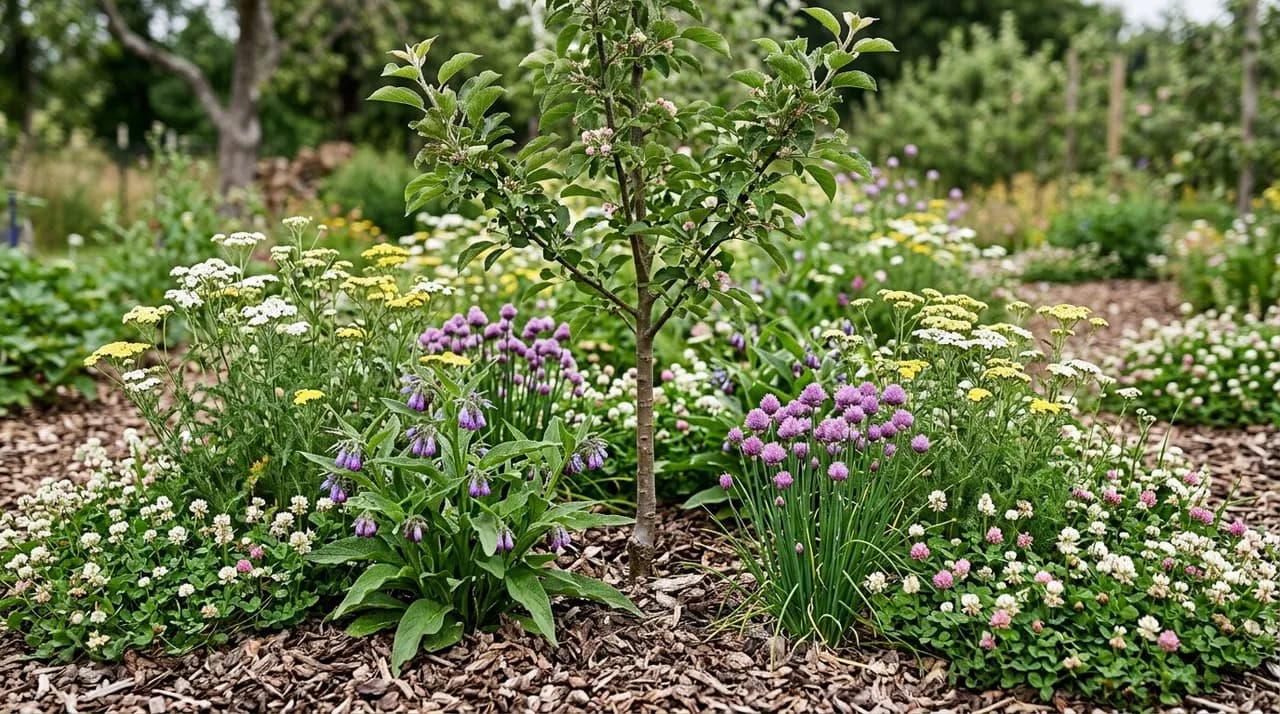
Key takeaways
- A fruit tree guild arranges complementary companion plants around a central tree to cycle nutrients and control pests naturally.
- Key ecological functions include nitrogen fixation, dynamic mineral accumulation, pollinator forage, and grass root suppression.
- Apple tree guilds serve as the classic temperate template, adaptable to pears, plums, citrus, and figs across global regions.
- Planting deep taproots like comfrey at the drip line creates a self-replenishing on-site mulch source.
- Proper spacing prevents companion understory plants from directly competing with shallow fibrous feeder roots.
Quick answer: A fruit tree guild is an ecological polyculture of mutually supportive companion plants established around a central fruit or nut tree. By combining nitrogen-fixing legumes, mineral-accumulating taproots, aromatic pest deterrents, pollinator-attracting flowers, and living ground covers, guilds reduce maintenance and improve fruit yields without chemical inputs.
Conventional orchard management isolates fruit trees in strips of bare dirt or mowed grass lawns. This setup forces fruit trees to compete with aggressive grass roots for moisture while requiring heavy applications of synthetic fertilizers and chemical sprays. Building a fruit tree guild replaces this vulnerable monoculture with a diverse community of cooperative plants.
In permaculture guilds, every plant is chosen for the functional ecological work it performs. Guild planting techniques create biological synergies: dynamic accumulators mine subsoil minerals, flowering herbs sustain beneficial predator insects, and fungal networks share moisture.
Whether establishing an apple tree guild in a cool climate or planting a citrus guild in the subtropics, understanding how to balance these functional niches creates a resilient, high-yielding food system.
What are the essential functional roles in fruit tree guild plants?
When selecting fruit tree guild plants, choose species for the ecological work they perform alongside their ornamental value. A balanced guild includes five core categories:
1. Nitrogen fixers
Fruit trees require substantial nitrogen to produce leafy shoots and swell fruit. Leguminous shrubs and herbaceous perennials partner with soil microbes (Rhizobium or Frankia) to convert atmospheric nitrogen into bioavailable soil nutrients. When pruned, their root nodules and foliage release nitrogen directly into the root zone.
- Temperate selections: Siberian peashrub (Caragana arborescens), goumi (Elaeagnus multiflora), white clover, lupines.
- Subtropical selections: Pigeon pea (Cajanus cajan), ice cream bean (Inga edulis), sunn hemp.
2. Dynamic mineral accumulators
Plants with deep taproots penetrate compacted subsoils where shallow tree roots cannot reach. They extract micronutrients (including potassium, calcium, magnesium, and phosphorus) and store them in their fleshy leaves. Cutting this foliage two to three times a year yields nutrient-rich green mulch.
- Key species: Russian comfrey (Symphytum x uplandicum), horseradish, dandelion, chicory, borage.
3. Insectary and pollinator plants
Pollination enables fruit set, while predatory insects keep pest outbreaks below economic injury thresholds. Flowers with open, umbrella-shaped nectar glands (umbels) support beneficial parasitoid wasps, hoverflies, ladybugs, and lacewings.
- Key species: Yarrow (Achillea millefolium), dill, fennel, sweet alyssum, echinacea, coriander.
4. Grass suppressors and pest repellers
Aggressive turf grasses rob young trees of shallow moisture and produce biochemical inhibitors that stunt root growth. Planting a dense barrier of bulbous species around the outer perimeter blocks spreading sod while aromatic oils confuse pest insects.
- Key species: Garlic chives, daffodils, culinary alliums, leeks, horseradish.
5. Living ground covers
Low-sprawling plants shade the soil surface, preventing weed germination, reducing water evaporation, and maintaining cool soil temperatures during hot summers.
- Key species: Alpine strawberries, creeping thyme, nasturtiums, sweet potato vines.
How do you build a classic apple tree guild step by step?
The temperate apple tree guild is the most widely tested polyculture model in permaculture fruit tree guilds. Follow this step-by-step planting sequence:
Step 1: Plant the central tree
Plant your bare-root or potted apple tree into native soil. Ensure the root flare is level with the soil surface and the graft union sits 5 to 8 cm (2 to 3 in) above grade. For foundational canopy structure care, read our guide on formative pruning for young fruit trees.
Step 2: Establish the grass-suppressing perimeter
Mark the projected mature drip line of the tree, typically a circle with a radius of 1.5 to 2.5 m (5 to 8 ft) for semi-dwarf trees. Plant a continuous ring of daffodils, chives, and garlic around this perimeter spaced 10 to 15 cm (4 to 6 in) apart.
Step 3: Lay down organic sheet mulch
Cover the entire circle inside the bulb ring with overlapping cardboard, thoroughly saturated with water, and top with 10 cm (4 in) of woodchips or compost. For application details, review sheet mulching for soil moisture.
Step 4: Install accumulators and nitrogen fixers
Cut holes through the mulch layer to plant three to five comfrey crowns 60 to 90 cm (24 to 36 in) away from the trunk. Place a nitrogen-fixing shrub (like goumi) on the southern or sun-facing quadrant where it will receive adequate light.
Step 5: Fill open gaps with insectary ground covers
Scatter creeping thyme and plant alpine strawberries across the bare mulch areas, interplanting yarrow and sweet alyssum near the sunny outer edges.
How does guild planting fruit trees adapt to different climates?
While the functional framework remains universal, plant selections shift across regional zones:
In cool temperate climates (UK/US north/Central Europe): Focus on cold-hardy deciduous combinations. Apple, pear, plum, and sour cherry trees pair effectively with comfrey, horseradish, currants, red clover, and spring bulbs. Ensure adequate spacing to prevent shade from stunting understory berry shrubs.
In subtropical and dry Mediterranean climates (AU/IN/Mediterranean/US south): Focus on heat-tolerant evergreen or drought-adapted fruit trees such as citrus, fig, olive, pomegranate, and loquat. Pair with pigeon pea, vetiver grass, lemongrass, rosemary, creeping oregano, and sweet potato ground covers that tolerate intense summer solar radiation.
To understand how these guilds integrate into broad multi-tiered landscapes, explore our structural guide to food forest layers.
What are common mistakes when designing permaculture fruit tree guilds?
Avoiding these frequent installation pitfalls ensures long-term orchard health:
- Planting too close to the trunk: Keep all companion plants at least 30 to 45 cm (12 to 18 in) away from the main tree trunk. Packing wet foliage against the bark invites fungal cankers, crown rot, and rodent damage.
- Introducing aggressive vining crops too early: Training vigorous vines like grapevines (Vitis vinifera) or kiwi onto young saplings will choke out tender upper branches. Wait until the tree is five to seven years old before introducing climbers.
- Using invasive spreading root crops: Aggressive root spreaders like mint should be grown in sunken containers or kept at the outer orchard border instead of planted directly into the tree's primary root zone.
- Ignoring sunlight angles: Placing tall shrubs on the south or sunny side of a dwarf fruit tree will cast unwanted shade on lower fruit-bearing wood.
How do you maintain and manage a fruit tree guild across seasons?
Ongoing management of companion planting guilds differs substantially from conventional orchard care. Instead of following rigid chemical spraying calendars, you manage growth dynamically through observation and organic pruning.
During early spring, inspect the base of your central fruit tree to ensure mulch has not migrated against the trunk bark. As perennial companions like comfrey and borage emerge vigorously, monitor their spread to ensure they do not smother newly planted ground covers.
In late spring and mid-summer, perform "chop-and-drop" pruning on dynamic accumulators. Cut comfrey foliage back to 5 cm (2 in) above the crown two to three times per season, laying the harvested leaves flat beneath the tree's drip line. This green mulch rapidly breaks down, releasing potassium, calcium, and organic nitrogen directly into the active feeding zone of tree roots during peak fruit sizing.
During autumn, allow insectary perennials to stand without aggressive deadheading. Dried seed heads and hollow stems provide essential overwintering habitat for predatory insects, including ladybugs and parasitic wasps, that will emerge early the following spring to suppress aphids and caterpillar larvae.
To see how fruit guilds scale across residential yards, read our tutorial on backyard food forest layout and design, or start from the ground up with how to start a food forest.