Key takeaways
- Green manure consists of fast-growing cover crops sown to protect bare soil, fix atmospheric nitrogen, suppress weeds, and build soil humus.
- Sow winter-hardy varieties like grazing rye, winter tares (vetch), and field beans in late summer or autumn to prevent winter nutrient leaching.
- Utilise fast spring and summer varieties like phacelia, crimson clover, and buckwheat to fill temporary gaps between crop successions.
- Terminate green manures before they form woody stems or set viable seed, ideally 3 to 4 weeks prior to planting your next vegetable crop.
- Choose between traditional shallow digging or no-dig chop-and-drop surface mulching under cardboard or compost to incorporate biomass.
Quick answer: Green manure is a fast-growing cover crop sown in UK gardens to protect bare soil from erosion, suppress weeds, and add organic matter. Overwintering crops like grazing rye and winter tares fix nitrogen and lock in nutrients, while spring crops like phacelia boost soil structure and feed beneficial pollinators.
Green manure is an effective organic practice for allotments and vegetable gardens in the United Kingdom. In the British climate, leaving cultivated vegetable beds bare over winter or between summer crop rotations leads to soil degradation: heavy winter rains leach soluble nitrates and potassium deep into the subsoil, cold gales erode fine topsoil, and annual weeds quickly claim unoccupied ground.
In the UK, the term green manure refers to what North American growers often call cover crops. Gardeners sow specific species of legumes, grasses, and broadleaf plants to keep soil covered. As these plants grow, their dense root systems aerate compacted earth, capture fleeting soil minerals, and produce large amounts of green organic matter.
Integrating green manure strategies builds long-term soil fertility naturally without relying on artificial chemical fertilisers.
Green manure benefits for British allotment soil
Cultivating green manures provides several practical advantages:
+---------------------------------------------------------+
|                  [Green Manure Functions]               |
|                                                         |
|  [Nitrogen Fixation]         [Winter Leaching Shield]   |
|  Clovers, Vetch, & Beans     Dense fibrous roots trap   |
|  convert air into nitrogen   soluble nitrates in soil   |
|                                                         |
|  [Weed Suppression]          [Soil Crumb Improvement]   |
|  Dense living canopy blocks  Decomposing organic matter |
|  sunlight from weed seeds    feeds worms and soil fungi |
+---------------------------------------------------------+
1. Fixing atmospheric nitrogen
Leguminous green manures (such as clovers, vetches, and field beans) form symbiotic associations with native Rhizobium bacteria in the soil. These bacteria colonise the plant's root nodules, converting inert atmospheric nitrogen into bio-available ammonium and nitrates that feed subsequent vegetable crops.
2. Preventing winter nutrient leaching
British autumn and winter rains frequently wash soluble minerals out of the upper topsoil. Fast-growing overwintering green manures act as a living biological sponge, absorbing free nitrogen and potassium into their plant tissues and locking them in place until incorporated in spring.
3. Smothering weeds and pest disruption
A thick carpet of green manure casts dense shade over the soil, depriving annual weed seeds of the light required to germinate. It also disrupts continuous crop families, breaking the life cycles of specific soil-borne pests.
4. Soil crumb structure and organic humus
When chopped down and returned to the earth, leafy biomass and root networks decompose rapidly, feeding beneficial earthworms, mycorrhizal fungi, and aerobic bacteria. This process forms stable soil humus that improves water retention in sandy soils and improves drainage in heavy clay.
To explore the organic decomposition cycle in greater depth, review our walkthrough on hot composting methods.
Selecting green manure seeds: species and seasonal timing
Selecting the right green manure seeds depends on whether you are sowing for quick summer gap-filling or overwinter protection:
+-------------------+--------------------+------------------+-------------------------+
| Green Manure      | Botanical Name     | Sowing Window    | Primary Benefit         |
+-------------------+--------------------+------------------+-------------------------+
| Grazing Rye       | Secale cereale     | Aug - Nov        | Massive root system;    |
| (Hungarian Rye)   |                    | (Overwinter)     | super winter weed block |
+-------------------+--------------------+------------------+-------------------------+
| Winter Tares      | Vicia sativa       | Aug - Oct        | Excellent cold-season   |
| (Vetch)           |                    | (Overwinter)     | nitrogen fixation       |
+-------------------+--------------------+------------------+-------------------------+
| Field Beans       | Vicia faba         | Sep - Nov        | Deep taproots; breaks   |
| (Tick Beans)      |                    | (Overwinter)     | up heavy winter clay    |
+-------------------+--------------------+------------------+-------------------------+
| Phacelia          | Phacelia           | Apr - Aug        | Outstanding pollinator  |
|                   | tanacetifolia      | (Spring/Summer)  | magnet; fast biomass    |
+-------------------+--------------------+------------------+-------------------------+
| Crimson Clover    | Trifolium          | Mar - Aug        | Rapid nitrogen fixer;   |
|                   | incarnatum         | (Spring/Summer)  | brilliant red flowers   |
+-------------------+--------------------+------------------+-------------------------+
| Buckwheat         | Fagopyrum          | May - Aug        | Ultra-fast summer cover;|
|                   | esculentum         | (Frost-sensitive)| phosphate accumulator   |
+-------------------+--------------------+------------------+-------------------------+
| White Mustard     | Sinapis alba       | Mar - Sep        | Rapid brassica cover;   |
|                   |                    | (Quick filler)   | bio-fumigates soil      |
+-------------------+--------------------+------------------+-------------------------+
Top overwintering green manures (autumn sowing)
- Grazing Rye (Secale cereale): The most rugged overwintering cover crop for the UK. It grows actively even in cold weather, developing an extensive root network that holds soil together on windy, exposed allotment plots.
- Winter Tares / Vetch (Vicia sativa): A hardy trailing legume that thrives on heavy clay soils, fixing substantial nitrogen over winter. Often sown in a 50/50 seed blend alongside grazing rye.
- Field Beans (Vicia faba): Large-seeded winter legumes whose thick taproots pierce heavy clay subsoils, aerating compacted earth.
Top spring and summer green manures
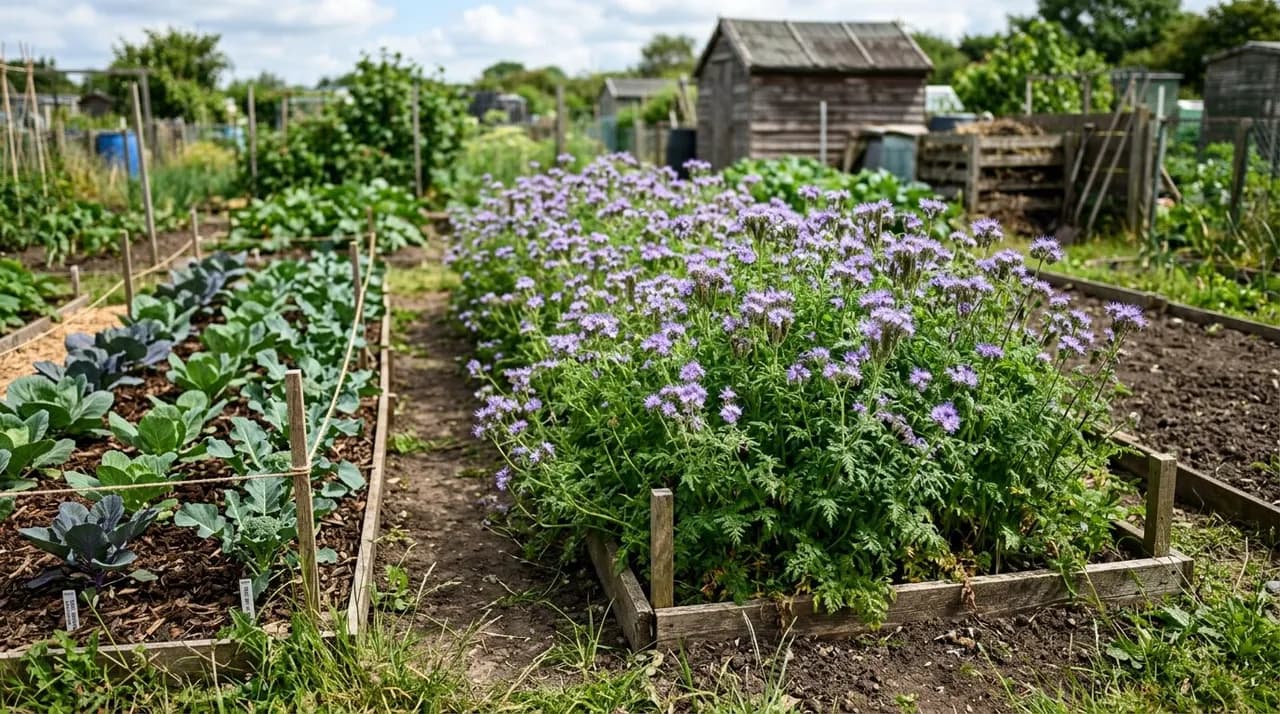
- Phacelia (Phacelia tanacetifolia): Known as fiddleneck, phacelia produces beautiful ferny foliage and fragrant purple-blue flowers that attract thousands of hoverflies, bumblebees, and honeybees. Its fine, dense root system leaves soil crumbly and friable.
- Crimson Clover (Trifolium incarnatum): Fast-growing annual clover producing vivid crimson flower spikes. Fixes high levels of nitrogen on lighter, slightly acidic soils.
- Buckwheat (Fagopyrum esculentum): Highly frost-sensitive, but exceptionally fast in warm summer weather (ready in 4 to 6 weeks). Scavenges insoluble soil phosphorus and makes it available to subsequent crops.
Step-by-step sowing green manure in your plot
Sowing green manure is straightforward and requires minimal soil disturbance:
+---------------------------------------------------------+
|                  [Sowing Green Manure]                  |
|                                                         |
|   1. Clear spent summer crops and rake to a fine tilth  |
|   2. Broadcast seeds evenly across the bed              |
|   3. Rake lightly to 1 cm - 2 cm depth (5 cm for beans) |
|   4. Tamp down soil surface with back of rake and water |
+---------------------------------------------------------+- Bed preparation: Remove spent vegetable crops, coarse weeds, and large stones. Rake the soil surface into a reasonably level, crumbly seedbed.
- Broadcasting seed: Scatter seeds evenly across the entire surface by hand. Sowing rates vary by seed size: fine seeds like clover or phacelia require roughly 2 to 3 grams per square metre, while large seeds like field beans require 20 to 30 grams per square metre.
- Covering and tamping: Rake the bed lightly so seeds are covered by 1 cm to 2 cm of soil (plant large field beans 5 cm deep with a trowel). Tamp the soil surface down gently with the flat back of your rake to ensure good seed-to-soil contact.
- Watering: Water thoroughly with a fine rose on your watering can until seedlings emerge.
For early spring sowing ideas on UK plots, check our monthly calendar for what to plant in March in the UK.
Termination methods: digging in vs. no-dig chop and drop
Terminating your green manure correctly ensures the green biomass enriches your soil without turning into an unwanted weed:
Timing: terminate before seed set
Never allow your green manure to drop mature seeds on the plot, or it will become an ongoing weed in subsequent vegetable crops. Always terminate the crop when flowers first begin to open (the peak nitrogen stage), and at least 3 to 4 weeks before planting your next vegetable crop.
Method 1: traditional digging in
- Cut down the tall foliage with hedge shears, a scythe, or a rotary lawnmower.
- Allow the cut green matter to wilt on the surface for 2 to 3 days.
- Dig the wilted foliage into the top 15 cm of soil with a garden spade, turning the sod so the green material is buried.
- Allow soil microbes 3 to 4 weeks to break down the material before sowing seeds or planting transplants.
Method 2: no-dig chop and drop (recommended)
If you follow no-dig allotment practices, avoid inverting soil layers:
- Shear green manure plants at ground level, leaving the root system undisturbed in the earth to decompose naturally.
- Lay the cut leafy tops across the bed as a rich organic green mulch.
- Cover the bed with 2 cm to 3 cm of mature organic compost, or lay unprinted cardboard weighted with compost over the residue (occultation) for 3 weeks to complete termination.
- To explore mulching mechanics across seasonal cycles, review sheet mulching for soil moisture across seasons.
Understanding the allelopathic effect of grazing rye
Grazing rye exudes natural biochemical compounds from its roots that inhibit weed seed germination (allelopathy). While effective for weed suppression, this effect can also hinder tiny vegetable seeds (such as carrots and parsnips). Always wait 3 to 4 weeks after terminating grazing rye before direct-sowing small seeds, or plant sturdy transplants (such as courgettes, brassicas, or leeks) instead.
Coordinate your green cover crops with seasonal allium planning in how to grow shallots and perennial weed clearing in how to get rid of bindweed.