
Key takeaways
- Clay is naturally fertile (high CEC of 25–50+ meq/100g); your real target is soil structure (macropore aggregation), never replacing mineral texture.
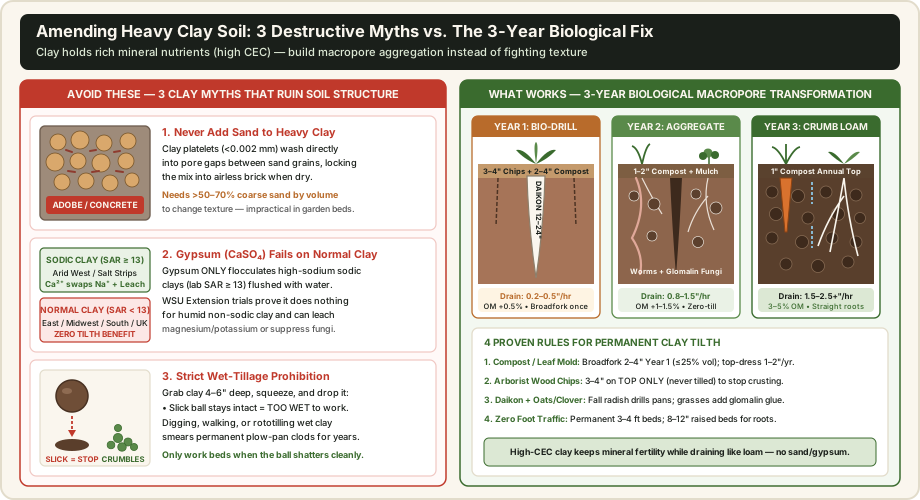
- Never mix sand into clay: below 50–70% coarse sand by volume, clay platelets (<0.002 mm) fill the voids between sand grains and bake into adobe brick.
- Skip gypsum (CaSO₄) on normal Eastern, Midwest, Southern, or UK clay: WSU Extension trials prove gypsum only flocculates sodic clay (SAR >= 13) flushed with leaching water.
- Obey the wet-tillage squeeze test: if clay dug 4–6 inches deep forms a slick ball that stays intact when dropped, never walk on, dig, or rototill it.
- Rebuild crumbs biologically: broadfork 2–4 inches of compost or leaf mold once in Year 1 (<=25–30% vol), top-dress 1–2 inches yearly, layer 3–4 inches of surface-only wood chips, and sow fall Daikon radish.
- Use 8–12 inch raised beds or 6-inch mounded rows for Year-1 carrots, beets, and parsnips while native clay loosens underneath.
Quick answer: Heavy clay holds rich mineral fertility (high CEC); it only lacks open macropore structure. Never add sand to clay (below 50–70% coarse sand by volume, clay packs between grains into adobe concrete) and skip gypsum unless a lab test proves sodic clay (SAR >= 13). Stay off wet clay whenever a squeezed ball fails to shatter on drop, broadfork Year-1 beds once with 2–4 inches of finished compost or leaf mold, keep 3–4 inches of arborist wood chips strictly on top, and sow fall Daikon tillage radish plus mycorrhizal oats or clover. Across 3 seasons, organic matter rises 1.5–3% and drainage triples into crumbly garden loam.
Soil Texture vs. Structure: Why Heavy Clay Is Worth Saving
Heavy clay bends shovels in July and clings to boots in April, yet soil scientists at Cornell University, Colorado State Extension, and the Royal Horticultural Society treat clay as a fertility asset. Clay particles measure under 0.002 millimeters across and carry a strong negative electrical charge across vast surface area.
That charge gives clay a cation exchange capacity (CEC) of 25 to 50+ meq/100g, versus 3 to 8 meq/100g in sandy ground. Calcium, magnesium, potassium, ammonium, and trace minerals cling tightly to clay platelets instead of leaching away in storms. Once aerated, structured clay out-yields sand on half the water and fertilizer.
Unamended clay fails on structure, never texture. Texture is your permanent mineral ratio of sand, silt, and clay—practically impossible to replace across a yard. Structure is how platelets group into rounded crumbs (aggregates) separated by wide macropores. Compacted clay stacks like wet playing cards: full of tight water-holding micropores, starved of oxygen. Every reliable fix pushes platelets apart into water-stable crumbs.
Run 3 Quick Checks Before Buying Amendments
- 2-Inch Ribbon Test: Moisten soil from 4–6 inches deep like putty and press upward between thumb and forefinger. Smooth, shiny ribbons exceeding 2 inches confirm heavy clay (>40% clay). Time drainage with our soil percolation test.
- Squeeze-Drop Moisture Test: Squeeze a handful from digging depth into a ball and drop it from waist height. A slick lump staying intact means stay off; only dig when the dropped ball shatters cleanly into dry-edged crumbs.
- Extension Lab Test ($15–$30): Skip unreliable $15 garden-center prong meters. Mail a sample to your state extension lab (US soil testing guide; how to read a soil test) for exact pH, organic matter, nutrients, and—in arid Western states or near road salt—Sodium Adsorption Ratio (SAR).
Two Clay Soil Myths Destroyed by University Proof
Two stubborn remedies sold in garden aisles either lock clay harder than before or waste cash with zero measurable gain.
Myth 1: Adding Sand Loosens Clay (It Engineers Adobe Concrete)
Mixing play sand or river sand into clay fails on basic particle geometry. Microscopic clay platelets (<0.002 mm) wash directly into the open pores between sand grains, packing denser than pure clay. Add rain and summer sun, and you have made traditional adobe brick.
Colorado State Extension (CMG GardenNotes) and Clemson HGIC confirm that changing clay texture with sharp coarse sand requires replacing more than 50% to 70% by volume with sand—roughly 4 to 5 cubic yards (5 to 7 tons) for a single 10-by-20-foot bed worked 8 inches deep. Dumping ten bags of sand into clay beds guarantees harder clods and worse drainage.
Myth 2: Gypsum Breaks Up All Heavy Clay
Pelletized gypsum (calcium sulfate, CaSO₄) is widely sold as a universal clay breaker. In Washington State University Extension's peer-reviewed bulletin The Myth of Gypsum Magic, Dr. Linda Chalker-Scott reviews decades of field trials proving gypsum delivers zero tilth improvement on normal, non-sodic clay.
Gypsum has one narrow valid use: reclaiming sodic clay overloaded with sodium (Na⁺), defined by soil labs as SAR >= 13 (or ESP >= 15%, often with pH > 8.5)—seen mainly in arid Western basins or salt-drenched roadsides. Excess sodium causes clay platelets to repel and disperse into a sealed crust. There, divalent calcium (Ca²⁺) from gypsum swaps out sodium so clay can flocculate, provided deep low-salt irrigation then flushes freed sodium below the root zone.
Skip Gypsum on Humid-Region Clay: Across the Midwest, Northeast, Southeast, Pacific Northwest, and UK, rainfall leaches sodium naturally and lab SAR sits near 0.5–3. On normal non-sodic clay, gypsum adds zero drainage or tilth, leaches magnesium and potassium downward, and can suppress mycorrhizal fungi. See our breakdown of gypsum on sodic vs. non-sodic clay.
What Actually Fixes Clay: The 5-Part Biological Rebuild
Stable clay tilth comes from living soil biology, not chemical shortcuts. Bacteria, earthworms, and arbuscular mycorrhizal fungi (AM fungi) bind fine platelets into water-stable crumbs via biological aggregation (distinct from electrochemical flocculation). USDA ARS research shows AM fungi coat soil crumbs in glomalin—a sticky, water-insoluble glycoprotein that keeps macropores open through heavy storms.
1. Finished Compost & Leaf Mold: Broadfork Year 1, Top-Dress Annually
Mature compost and rotted autumn leaves (leaf mold) drive crumb formation fastest. In Year 1—strictly when soil passes the squeeze-drop test—spread 2 to 4 inches of finished compost or leaf mold across new beds. Drive a broadfork 10 to 12 inches deep every 6 inches, rock back slightly to crack subsurface compaction without inverting horizons, and rake lightly so humus trickles into vertical fissures.
Respect Colorado State Extension's ceiling: keep incorporated compost at or below 25% to 30% volume (2 inches into 6 inches of soil, or 3 inches into 8–10 inches) so excess manure salts or phosphorus never stress roots or mycorrhizae. After Year 1, stop digging completely and top-dress 1 to 2 inches of compost or free leaf mold each fall or spring. Nightcrawlers pull humus down while fungal networks stay intact.
2. Arborist Wood Chips: 3–4 Inches on Top ONLY
Raindrops hitting bare clay hammer platelets flat into an impermeable surface crust. A 3- to 4-inch layer of coarse arborist wood chips (whole-tree bark, wood, and leaf chippings—often free from local tree crews) halts surface sealing immediately. WSU Extension studies by Dr. Linda Chalker-Scott confirm surface wood chips beat dyed bark, rock, and landscape fabric at buffering clay moisture, curbing summer cracking, and feeding wood-decay fungi that loosen topsoil from above.
Never Till Raw Wood Chips Into Clay: Leave arborist wood chips strictly on the surface. Surface chips immobilize nitrogen only along the millimeter-thin contact line (harmless to roots), whereas tilling fresh wood fragments into clay locks up plant-available nitrogen for a full season. Pull chips aside before sowing fine vegetable seeds; see sourcing free wood chips safely and building beneficial soil fungi with mulch.
3. Biological Tillage: Daikon Radish Plus Mycorrhizal Cover Crops
Rototillers smear horizontal plow pans 6 to 8 inches down. Daikon tillage radish (*Raphanus sativus*, sold as 'GroundHog' or 'Nitro') drills straight through compacted clay pans vertically. Sow seed in late summer—roughly 6 to 8 weeks before your first hard freeze (<20°F)—so fleshy white taproots push 12 to 24+ inches deep while capturing leftover fall nitrogen.
In USDA Zones 3–7, winter frost kills Daikon cleanly and roots rot into open spring drainage shafts. In warm Zones 8–10, hoe crowns 1 inch deep before flowering to prevent woody weeds. One biological nuance most guides miss: Brassicas are non-mycorrhizal. Interplant Daikon with winter-killed oats or follow with mycorrhizal red clover or cereal rye so AM fungi pump glomalin into those new channels. Read our steps on cover crops and broadforking for compaction and home-garden cover crops.
4. Strict Wet-Tillage Prohibition & Tree-Hole Bathtub Rule
Penn State Extension warns that walking on or tilling wet clay smears macropores into fired-brick clods that take years of freeze-thaw cycles to undo. Frame permanent 3- to 4-foot beds bordered by 18- to 24-inch wood-chipped walkways so boots never press growing soil. When planting trees or shrubs in clay, never amend the individual planting hole: NC State Extension notes that rich compost inside tight clay creates a buried bathtub that floods roots. Backfill with native clay, set the root flare 1–2 inches proud of grade, and mulch wide over the surface.
5. Year-1 Raised Beds & Mounded Rows for Root Crops
Straight taproots like carrots, beets, and parsnips fork badly in Year-1 clay. Build 8- to 12-inch raised beds or rake 6-inch mounded rows capped with 3 inches of screened compost directly over broadforked native clay (zero landscape fabric underneath!) so drainage improves on Day 1 while roots mine deeper soil below. See no-dig clay adaptations, fixing waterlogged clay beds, and raised bed gardening.
Seasonal Timing, Builder Subsoil & pH Buffering
Schedule major bed prep in autumn rather than early spring. Autumn clay sits drier and more crumbly after summer evapotranspiration, and winter freeze-thaw cycles naturally fracture coarse clods into frost tilth before April planting. If your home sits on a newer suburban subdivision where bulldozers scraped away native topsoil and left dense yellow or red construction subsoil with under 1% organic matter, double down on Year-1 broadforking plus 4 inches of compost topped with wood chips—or start vegetable production immediately in 12-inch raised beds while Daikon radishes work the subsoil underneath.
Keep clay's high pH buffering capacity in mind before applying limestone or elemental sulfur. Because clay surfaces hold huge reservoirs of exchangeable hydrogen or calcium ions, raising acidic Piedmont or Northeast clay by one pH unit takes far more lime than sandy soil—and lowering alkaline Western clay takes repeated elemental sulfur applications over multiple seasons. Rely strictly on your university lab's buffer-pH recommendation and split large lime doses across fall and spring.
Clay Amendment Reality Check: What Works vs. What Fails
Comparison of Clay Soil Amendments (Rates per 100 sq ft)
Amendment | Effect on Heavy Clay | Rate & Method | Verdict |
|---|---|---|---|
Finished Compost | Feeds worms & AM fungi; builds glomalin crumb aggregates | 2–4" Year 1 (<=25–30% vol); 1–2" top-dress/yr | Top Choice. Use mature plant compost; avoid salty raw manure. |
Leaf Mold | Fungal-rich humus; opens spongy topsoil pores | 2–4" Year 1; 1–2" annual surface top-dress | Top Choice. Free autumn leaves; low salt, zero weed seeds. |
Arborist Wood Chips | Stops rain crusting; feeds decomposer fungi from top down | 3–4" surface mulch ONLY (refresh yearly) | Top Choice (Surface). Never till into clay—causes N tie-up. |
Daikon + Oats/Clover | Taproots drill 12–24" channels; oats/clover add glomalin | Sow 6–8 wks before <20°F hard freeze | Best Subsoil Fix. Fractures deep pans with zero smear. |
Gypsum (CaSO₄) | Ca²⁺ replaces Na⁺ to flocculate sodic clay ONLY | Lab rate ONLY if SAR >= 13 + deep leaching | Skip on Normal Clay. Zero benefit on humid East/Midwest/UK clay. |
Lime / Sulfur | Adjusts acidic (<6.0) or alkaline (>7.5) pH | Strictly per university soil lab buffer-pH report | pH Tool Only. Clay buffers pH strongly; never guess rates. |
Coarse / Play Sand | Clay fills pores between sand grains, baking into adobe | Do not add (needs >50–70% total soil volume) | Never Use. Destroys tilth and worsens spring drainage. |
Honest 3-Year Clay Transformation Timeline & Starter Crops
Realistic organic matter climbs roughly 0.5% to 1.0% per year under steady top-dressing and living roots. Match your crops to each stage so beds produce heavily from the first spring onward.
3-Year Heavy Clay Renovation Timeline (Tilth, Infiltration & Best Crops)
Timeline | Annual Actions | Organic Matter & Drainage | Tilth Feel & Best Starter Crops |
|---|---|---|---|
Year 1 (Crack Pan) | Lab test; dry broadfork pass; 2–4" compost; permanent 3–4 ft paths; 3–4" surface chips; fall Daikon + oats | OM +0.5% (~1–2% -> ~2–2.5%); drainage ~0.2–0.5"/hr (slow spring dry-down) | Workable top 4", cloddy deeper. Plant vigorous rooters: squash, tomatoes, brassicas, bush beans, sweet corn, comfrey. Grow carrots in raised/mounded rows. |
Year 2 (Bio-Channels) | Zero rototilling; 1–2" compost or leaf mold on top; keep 3" mulch; seed fall red clover or winter rye | OM +1.0–1.5% (~2.5–3.5%); drainage rises to ~0.8–1.5"/hr via decayed radish shafts | Top 6" darkens and crumbles cleanly; heavy earthworm castings. Add peppers, lettuce, spinach, onions, garlic, potatoes, and short Chantenay carrots. |
Year 3+ (Crumb Loam) | 1" annual surface compost; continuous roots or mulch; broadfork only if spot compaction returns | OM hits 3.5–5.0%; drainage reaches 1.5–2.5+"/hr; beds dry workable days earlier | Dark, springy glomalin-bound crumbs 8–12" deep with zero summer cracking. Direct-sow full crop range in-ground, including long Nantes carrots and parsnips. |
Around food beds, plant ornamental species naturally wired for moisture-retentive clay rather than fighting winter-wet rot in Mediterranean herbs like lavender. Explore our tested list of plants for clay soil that thrive to build productive borders alongside your maturing vegetable beds.