pioneer
Phacelia
Phacelia tanacetifolia
International hardiness
- USDA 7-10
- RHS H4
- AU: Cool temperate, Warm temperate
Where it grows — regional guide
| Zones / rating | Regional notes |
|---|---|
USDA 7-10 | Popular across northern and Pacific Northwest states as a quick cover crop; broadcast in early spring or late summer to build soil tilth and attract pollinators. |
| Zones / rating | Regional notes |
|---|---|
H4 (-10 to -5C) | Highly effective autumn or spring green manure across Britain; sow from April to August for summer bloom or September to overwinter before spring cultivation. |
| Zones / rating | Regional notes |
|---|---|
Cool temperate, Warm temperate | Grown across cool-temperate areas of Victoria, Tasmania, and South Australia; sow in autumn for winter cover or early spring for abundant bee forage. |
| Zones / rating | Regional notes |
|---|---|
USDA 7-10 (USDA scale) Canada uses its own zone system; Canadian zones run roughly one lower than USDA. | Reliable warm-season annual in southern Ontario, Quebec, and British Columbia; sow in spring after severe frost to suppress weeds and condition garden soil. |
| Zones / rating | Regional notes |
|---|---|
No region-specific data yet | No region-specific data yet |
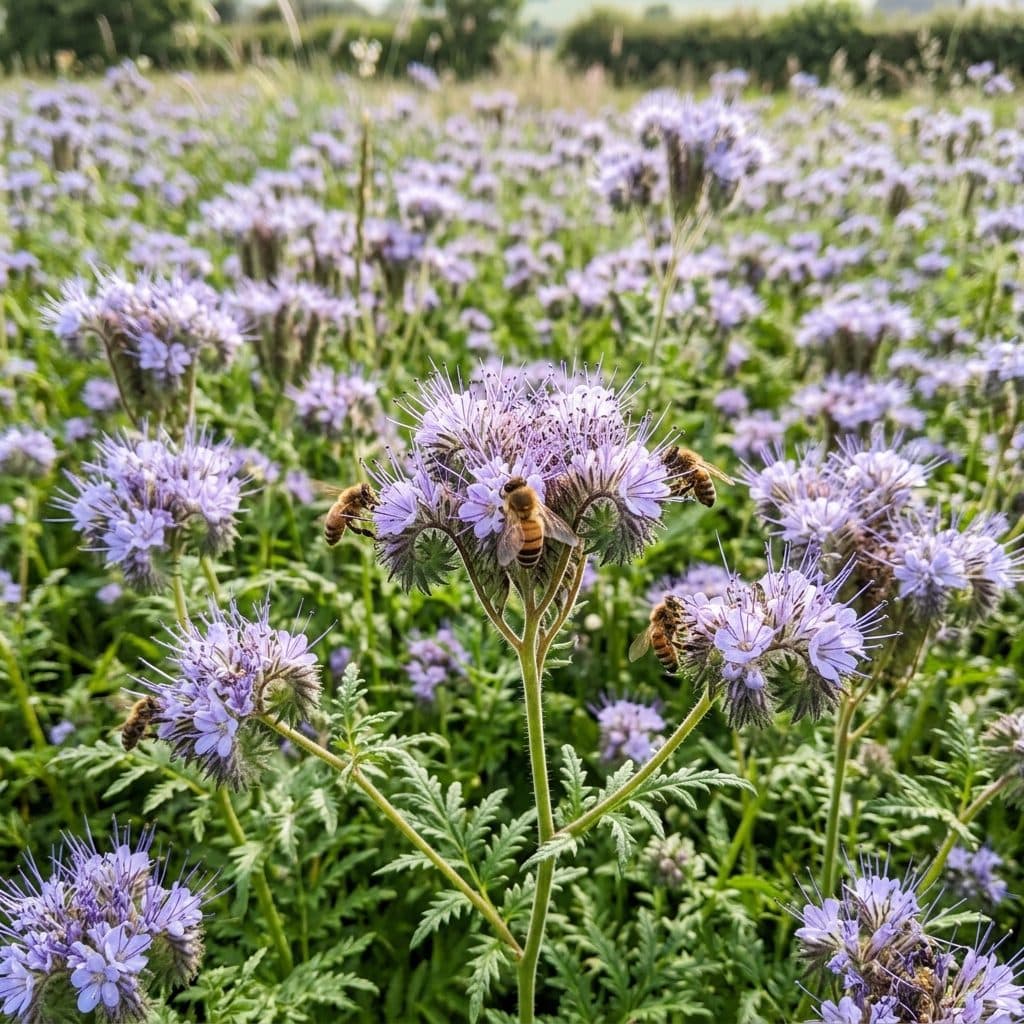
Phacelia (Phacelia tanacetifolia), commonly known as lacy phacelia, purple tansy, or fiddleneck, is an annual forb in the borage family (Boraginaceae). Cultivated widely as a high-performance green manure and insectary plant, phacelia forms feathery rosettes before producing coiled cymes of lavender-blue blossoms rich in nectar and violet-blue pollen.
Native to dry valleys of California and northern Mexico, Phacelia tanacetifolia has become a staple of temperate organic farming. In syntropic designs, it is a fast pioneer species whose fibrous roots aerate compacted subsoils and scavenge residual nitrates. Unrelated to common garden vegetables unlike brassicas such as canola, phacelia is a clean break crop. Strips planted near sunflower and white clover create multi-tiered foraging corridors that shelter hoverflies, predatory wasps, and bees from late spring until autumn frosts.
Growing phacelia
Phacelia thrives across various soil types, from sandy loams to moderately heavy clay, provided drainage is adequate. Optimal soil pH ranges between 6.0 and 7.5. Supplementary fertiliser is unnecessary; high nitrogen causes excessive stem growth at the expense of root density and bloom.
Full sunlight is essential for rapid canopy closure and flowering. Site beds in open areas receiving at least six hours of direct sun daily. Shaded stands become weak, prone to lodging, and less visited by pollinators.
Moisture needs are modest once roots establish. Phacelia tolerates dry spells during cool weather, but regular moisture during early growth increases biomass. In dry regions, occasional irrigation during early stem elongation ensures continuous flowering. Avoid waterlogged conditions that invite crown decay.
Propagation is exclusively from seed. Because seeds require darkness to germinate, sow them 1 to 2 cm (0.4 to 0.8 in) deep. For broadcast cover cropping, sow at 1 to 1.5 g per square metre (roughly 10 to 15 kg per hectare), raking lightly and firming the bed. Seedlings emerge in 7 to 14 days at 10 to 18 °C (50 to 64 °F). Temperatures exceeding 22 °C (72 °F) induce seed dormancy, making spring and late summer the best sowing windows.
In the United Kingdom, spring sowings from late March through May flower from June to August. Autumn sowings in August or September overwinter as rosettes in USDA Zones 7 to 10, protecting soil from winter rain before flowering early the following May. In colder zones, winter freezes below -8 °C (18 °F) winter-kill the top growth into a protective surface mulch.
Plants reach 60 to 90 cm (24 to 36 in) within six to eight weeks. When using as green manure, cut the crop at 10 to 20 percent flowering when succulent tissue and nitrogen content peak. Incorporate the chopped biomass into the top 10 to 15 cm (4 to 6 in) of soil, or leave it as surface mulch, allowing two to three weeks for decomposition before planting delicate crops.
Harvest and uses
Phacelia is harvested primarily for green manure biomass and pollinator forage rather than food. Cutting at early bloom ensures succulent, easily degraded tissue. If plants mature fully and set seed, stems turn fibrous and slow to decay, temporarily tying up available soil nitrogen.
For beekeepers, phacelia provides high-grade nectar over six to eight weeks. Pure phacelia honey is light amber with a mild, floral flavour. Yields can reach 200 to 500 kg per hectare under favourable conditions, with blossoms secreting nectar continuously throughout daylight hours.
Flower spikes can also be cut for indoor floral displays when lower buds on the curled cyme begin to open; conditioned stems last seven to ten days in water. In livestock systems, young herbage can be grazed or cut as fresh forage for sheep and cattle before stems toughen.
Identifying phacelia
Phacelia is recognised by distinct morphological traits:
- Habit: Erect annual herb reaching 60 to 90 cm (24 to 36 in) in height.
- Stems: Stout, hollow, succulent, pale green to reddish-purple, covered in stiff glandular hairs.
- Leaves: Alternate, deeply pinnatifid (fern-like), 10 to 20 cm (4 to 8 in) long and 5 to 10 cm (2 to 4 in) wide, resembling common tansy (Tanacetum vulgare).
- Inflorescences: Dense scorpioid cymes that uncurl as flowers open sequentially.
- Flowers: Bell-shaped, 8 to 12 mm (0.3 to 0.5 in) across, with five lavender-blue petals and five long protruding stamens with violet anthers.
- Fruit: Small capsules containing two to four wrinkled brown seeds roughly 3 mm (0.12 in) long.
It is distinguished from true tansy (Tanacetum vulgare) by its blue bell-shaped blossoms rather than yellow button composites, and from related waterleafs by its deeply divided foliage and long protruding stamens.
Cautions
Growers should observe several practical cautions with phacelia:
- Contact dermatitis: Stems and leaves bear glandular hairs containing geranylhydroquinone, which can trigger allergic contact dermatitis and blistering skin rashes in sensitive individuals. Always wear gloves and protective sleeves when handling or scything mature stands.
- Self-seeding: Phacelia produces abundant viable seed. If stands complete their cycle and drop seed, phacelia can persist as an unwanted volunteer weed in subsequent vegetable beds. Cut or incorporate stands before seed heads ripen to prevent self-seeding.
- Nitrogen tie-up: Incorporating old, fibrous stems into soil causes temporary microbial nitrogen immobilization, which can stunt subsequent vegetable crops. Chop stands while stems are still soft and succulent.
- Human consumption: The foliage and roots are not edible for humans and can irritate the digestive tract if consumed.
- Pest harbourage: Dense, humid stands in damp climates can shelter garden slugs and snails, which feed on nearby seedlings.
Sources
- Royal Botanic Gardens, Kew. Phacelia tanacetifolia Benth. Plants of the World Online.
- Royal Horticultural Society. Phacelia tanacetifolia
- NC State Extension Plant Toolbox. Phacelia tanacetifolia
- Plants For A Future. Phacelia tanacetifolia - Benth.