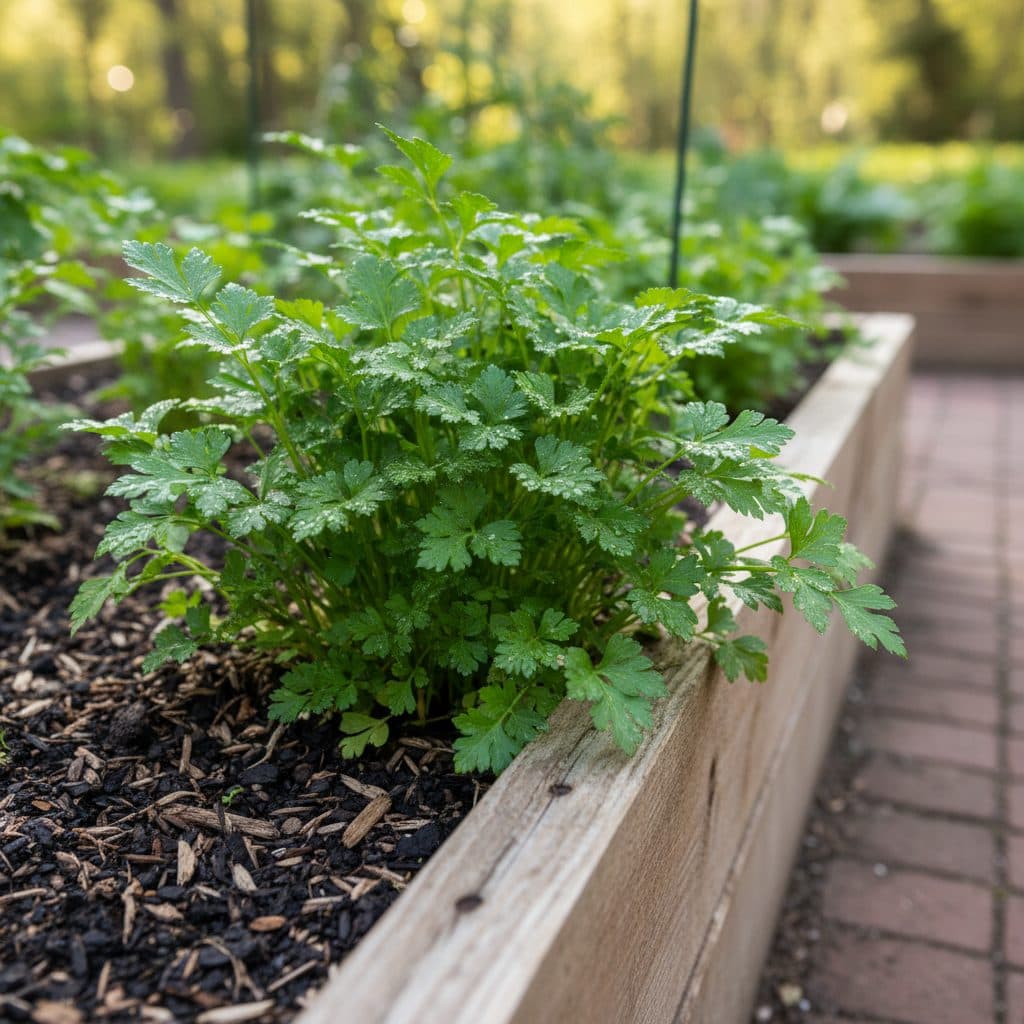
Key takeaways
- Parsley seeds benefit from pre-treatment like soaking in warm water or a weak gibberellic acid solution to overcome dormancy.
- Optimal soil temperatures between 68-75°F are crucial for successful parsley germination, which can otherwise take up to three weeks.
- Plant parsley in well-draining soil with a pH of 6.0-7.0, spacing plants 6-8 inches apart for best growth.
- Harvest outer leaves regularly to encourage continuous production and prevent premature bolting in the first year.
- Overwintering parsley in USDA zones 5-9 with a 4-6 inch layer of mulch can extend its harvest into a second year.
- Save seeds from second-year plants by allowing flower stalks to mature and dry, then storing seeds in a cool, dry place at 35-40°F.
Quick answer: Speed parsley seed germination by pre-treating seeds in warm water or a weak gibberellic acid solution, then planting in soil at 68-75°F. Proper care and overwintering can extend the harvest to two years.
In many parts of the United States, from the fertile valleys of California to the humid plains of the Midwest, parsley is a kitchen staple. This biennial herb, often treated as an annual, offers a rich, fresh flavor that enhances a wide range of dishes. However, growing parsley from seed can test a grower’s patience; its germination is notoriously slow, sometimes taking up to three weeks or even longer under suboptimal conditions. For instance, in a typical USDA zone 6 garden, direct seeding in early spring might see uneven stands due to fluctuating soil temperatures.
The good news is that with a few targeted strategies, you can significantly speed up parsley seed germination and cultivate healthy plants that provide a consistent harvest for two growing seasons. By understanding the specific needs of parsley seeds and plants, growers can establish productive patches, yielding fresh leaves from spring through fall, and even into the next year. We’ll cover techniques that have proven effective in diverse US growing environments, from the Pacific Northwest to the Mid-Atlantic to help you get more from your parsley patch.
Overcoming parsley’s stubborn germination
Parsley seeds are known for their slow and often erratic germination, a trait usually attributed to germination inhibitors in the seed coat, including furanocoumarins and volatile oils. Without intervention, it’s common for seeds to take 14 to 21 days to sprout, and sometimes even longer, especially if soil temperatures are below the ideal range of 68-75°F. This dormancy mechanism is a natural survival strategy, but it can be a source of frustration for growers aiming for a timely crop. In regions like the northern Great Plains, where spring soil warms slowly, this delay can significantly shorten the growing season.
seed pre-treatment methods for faster sprouting
To accelerate germination, pre-treating parsley seeds is a highly effective step. One common method involves soaking the seeds in warm water (around 100°F) for 24 hours, changing the water every 8-12 hours. This helps to leach out the germination inhibitors. Another approach is a soak in dilute gibberellic acid (GA3). Mix it strictly to the seed-soak rate printed on the product label; GA3 is active at very low concentrations, and an over-strong soak produces weak, stretched seedlings. Research indicates that GA3 can effectively break seed dormancy in many species, including parsley. After soaking, seeds should be dried slightly before planting to prevent clumping. For growers in USDA zone 7, starting seeds indoors four to six weeks before the last frost date, after pre-treatment, can give plants a head start.
- Soak seeds in warm water (100°F) for 24 hours.
- Change soaking water every 8-12 hours.
- If using gibberellic acid, mix to the product label’s stated seed-soak rate.
- Dry seeds slightly before planting to improve handling.
- Plant pre-treated seeds 0.25 inches deep for optimal contact.
Optimal planting and early growth conditions
Once your parsley seeds are pre-treated, the next critical step is providing the right environment for successful germination and robust early growth. Parsley thrives in well-draining soil rich in organic matter, with a pH level between 6.0 and 7.0. In many parts of the Pacific Northwest, where soils can be acidic, adding lime might be necessary to raise the pH by 0.5 to 1.0 points. Direct sow seeds outdoors after the last spring frost, when soil temperatures consistently reach at least 60°F. For growers in USDA zone 5, that is usually late May rather than April. Plant seeds about 0.25 inches deep and 1 inch apart in rows spaced 12-18 inches apart. Lightly cover the seeds with fine soil or vermiculite, and gently water them in.
watering and thinning for strong plants
Consistent moisture is vital during the germination phase and for young seedlings. The soil should remain evenly moist, but not waterlogged, which can lead to damping-off disease. Using a fine mist sprayer or bottom watering can help prevent disturbing the tiny seeds. Once seedlings emerge and reach about 2 inches tall, thin them to a final spacing of 6-8 inches apart. This provides adequate air circulation and reduces competition for nutrients, leading to stronger, more productive plants. For instance, a 10-foot row of parsley, thinned correctly, can yield approximately 15-20 healthy plants. Consider planting a small patch for parsley microgreens with some of your extra seeds.
- Ensure soil pH is between 6.0 and 7.0 for best growth.
- Plant seeds 0.25 inches deep and 1 inch apart.
- Maintain consistent soil moisture, avoiding waterlogging.
- Thin seedlings to 6-8 inches apart once they are 2 inches tall.
- Provide full sun to partial shade, especially in hotter climates like the Southwest.
Cultivating for a two-year harvest
Parsley is a biennial plant, meaning it completes its life cycle over two years. In its first year, it produces lush foliage, which is what we typically harvest. In the second year, it flowers, sets seed, and then dies. Many growers treat parsley as an annual, especially in colder climates, but with proper care, you can often enjoy a second year of harvest, even in USDA zone 5. The key is to prevent the plant from bolting (going to seed) prematurely in its first year and to protect it through winter. Regular harvesting of the outer leaves encourages more foliage production, keeping the plant in its vegetative state.
overwintering and managing second-year growth
To encourage a second-year harvest, especially in colder regions like the upper Midwest, protect your parsley plants over winter. Once temperatures consistently drop below 30°F, apply a 4-6 inch layer of organic mulch, such as straw or shredded leaves, around the base of the plants. This insulates the roots and crown from freezing temperatures and freeze-thaw cycles. In USDA zone 6, this can extend the harvest well into winter and allow for regrowth in early spring. In the second year, parsley plants will typically produce a flush of new growth before sending up a flower stalk. While the leaves are still edible, they may become slightly bitter once the plant begins to flower. At this point, focus on harvesting seeds if desired, or allow the plant to provide pollen for beneficial insects. A successfully overwintered bed gives an early flush of leaves well ahead of a spring-sown crop, though it runs to seed once the flower stalk rises.
- Harvest outer leaves regularly to delay bolting.
- Apply a 4-6 inch layer of mulch for winter protection.
- Ensure plants are well-watered before the first hard freeze.
- Expect a flush of new growth in early spring of the second year.
- Monitor for bitterness in leaves once flowering begins.
Harvesting and seed saving for future crops
Consistent harvesting is key to maintaining a productive parsley patch throughout its first year. Begin harvesting when plants are about 6 inches tall, usually 70-90 days after planting. Always cut the outer stems near the base of the plant, leaving the inner stems to continue growing. This technique encourages more vigorous growth and extends the harvest period. Avoid cutting more than one-third of the plant at any one time to ensure it has enough foliage for photosynthesis. For a large planting in a USDA zone 8 garden, you might harvest several pounds of fresh parsley per week during peak season. Fresh parsley can be stored in the refrigerator for up to 10 days by placing stems in a glass of water and covering loosely with a plastic bag.
saving parsley seeds for next season
If you’ve successfully overwintered your parsley, in its second year, it will send up tall flower stalks topped with clusters of small, greenish-yellow flowers (umbels). These flowers are a food source for beneficial insects and pollinators. Allow these umbels to mature and dry on the plant. The seeds will turn from green to brown and become hard. In late summer or early fall, when the seed heads are completely dry and brittle, cut the stalks and place them upside down in a paper bag to catch any falling seeds. You can then gently rub the seed heads to release the remaining seeds. Store collected seeds in a cool, dry, dark place at a consistent temperature of 35-40°F and low humidity (below 35%) for up to three years. This practice allows you to maintain your favorite varieties, much like saving heirloom seeds from other crops.
- Harvest outer stems near the base, taking no more than one-third of the plant.
- Allow second-year plants to flower and set seed for collection.
- Wait until seed heads are completely dry and brown before harvesting.
- Store seeds in a cool, dry place, ideally at 35-40°F.
- Properly stored parsley seeds can remain viable for up to three years.
Parsley varieties for US gardens
Variety | Leaf Type | Best Use | USDA Zones |
|---|---|---|---|
Moss Curled | Curly | Garnish, mild flavor | 3-9 |
Italian Plain Leaf (Flat Leaf) | Flat | Cooking, strong flavor | 3-9 |
Hamburg (Root Parsley) | Flat (edible root) | Soups, stews, root vegetable | 4-8 |
Giant of Italy | Flat | Cooking, robust flavor | 3-9 |
Germination time: Parsley seeds can take 14-21 days to germinate, but pre-treatment can reduce this to 7-10 days under ideal soil temperatures of 68-75°F.
Overwintering success: Applying a 4-6 inch layer of mulch allows parsley to successfully overwinter in USDA zones 5-9, extending the harvest into a second year.
Frequently asked questions
Why does parsley take so long to germinate?
Parsley seeds contain natural germination inhibitors, specifically furanocoumarins, in their seed coats. These compounds cause a natural dormancy, which can delay sprouting for 14 to 21 days or more without pre-treatment. Soaking seeds in warm water for 24 hours can help leach out these inhibitors and speed up the process.
Can I grow parsley indoors?
Yes, parsley can be grown indoors, especially in colder climates or for a year-round supply. Provide at least five hours of direct sunlight or use grow lights for 12-14 hours daily. Maintain an indoor temperature between 65-70°F and keep the soil consistently moist. You can harvest outer leaves once plants are 6 inches tall.
What is the best soil for parsley?
Parsley thrives in well-draining, fertile soil rich in organic matter. An ideal soil pH range is between 6.0 and 7.0. Amending heavy clay soils with compost at a 3:1 ratio can improve drainage, while adding a balanced organic fertilizer can support vigorous growth throughout the season.
How do I prevent parsley from bolting?
To prevent parsley from bolting prematurely in its first year, consistently harvest the outer leaves, which encourages vegetative growth. Ensure adequate moisture and provide some afternoon shade in hot climates, especially when temperatures exceed 85°F. Bolting is a natural process in the second year, but can be delayed in the first.
How much parsley should I harvest at once?
When harvesting parsley, it’s best to cut the outer stems near the base of the plant. Avoid removing more than one-third of the plant’s foliage at any single harvest. This practice allows the plant to continue photosynthesizing efficiently and encourages new growth, ensuring a continuous supply of fresh leaves for many weeks.
How long do parsley seeds remain viable?
Properly stored parsley seeds can remain viable for up to three years. For optimal longevity, store cleaned, thoroughly dried seeds in an airtight container in a cool, dark place with low humidity, ideally at a consistent temperature between 35-40°F. This significantly extends their germination potential compared to room temperature storage.
References
- USDA Natural Resources Conservation Service (2024). USDA Natural Resources Conservation Service.