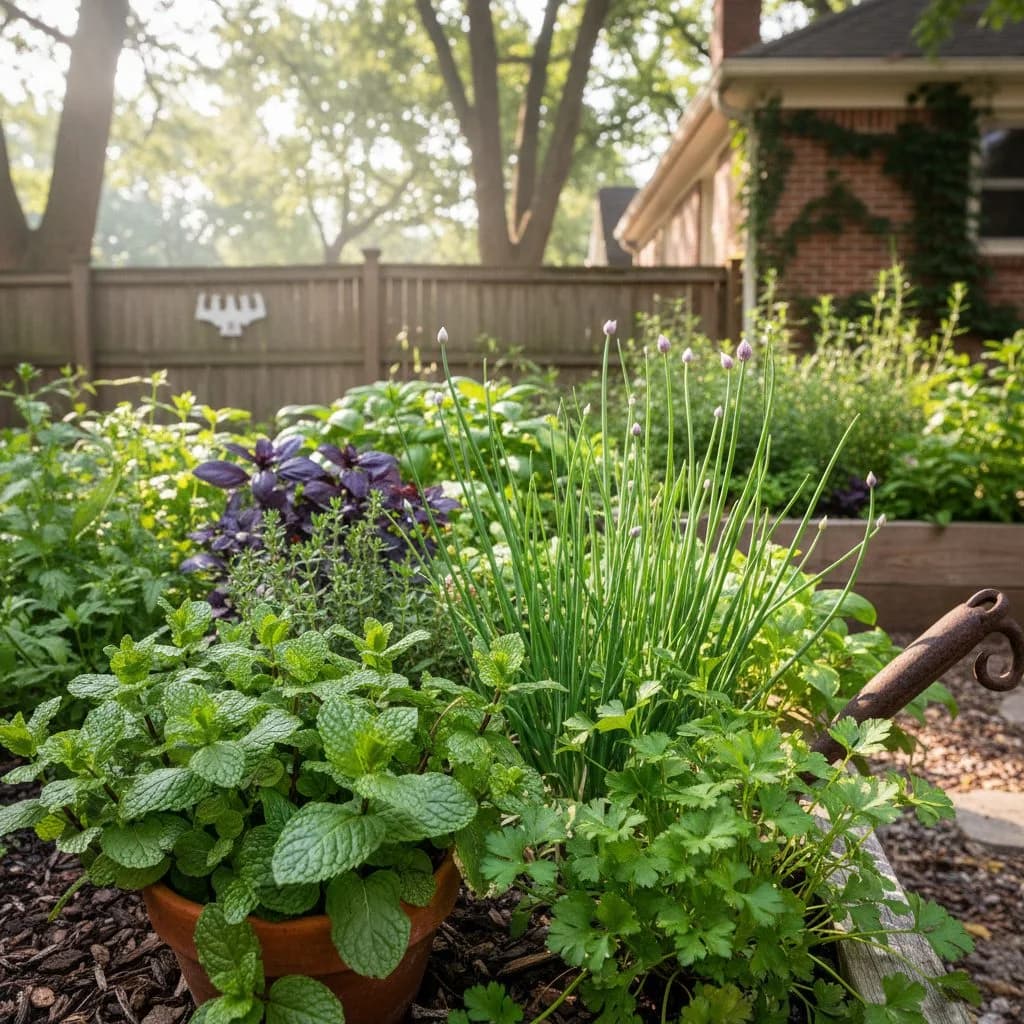
Key takeaways
- Woody Mediterranean herbs (rosemary, sage, lavender, oregano) require >=6 hours of direct sun to fuel glandular trichomes and monoterpene oil synthesis; under 4 hours they stretch weak and drop flavor potency.
- Nine tender-leaf herbs—chervil, cilantro, flat-leaf parsley, lemon balm, Mentha, sweet cicely, sorrel, garlic chives, and sweet woodruff—invest carbon into broad thin leaf blades that thrive and bolt slower in 2–4 hours of shade.
- Outdoor north-wall bright shade, dappled deciduous woodland edges, and indoor windowsills operate as distinct light venues: glass and screens slash indoor PAR so windowsills often need 14–16 hours of LEDs placed 6–12 inches overhead.
- Bottomless buckets fail to trap aggressive Mentha stolons that dive 8–12 inches deep; sink a solid-bottom 12–16 inch pot with mesh-lined side drain holes 2 inches off the floor and a 2–3 inch lip above grade.
- Widen spacing 25–30%, water at root level between 6:00 and 9:00 AM, leave a 2-inch bare gravel collar against nocturnal slugs, and cap each leaf cut at one-third of canopy growth.
Quick answer: Growing culinary and medicinal herbs with under 4 hours of direct sun depends on matching harvest tissue to light physics rather than forcing sun-loving shrubs into dim soil. Mediterranean woody herbs—rosemary, garden sage, lavender, and Greek oregano—rely on high photon flux to drive MEP-pathway terpene synthesis, so below 4–6 hours they etiolate, lose volatile oils, and rot in cool damp soil. By contrast, tender-leaf herbs including chervil, cilantro, flat-leaf parsley, lemon balm, Mentha species, sweet cicely, sorrel, garlic chives, and sweet woodruff stay lush, mild, and slow-bolting in 2–4 hours of light, provided mint grows in a buried solid-bottom pot with a 2–3 inch rim, spacing widens 25–30% for mildew and slug airflow, and harvests stay at or below one-third of the canopy.
Why Mediterranean Terpene Herbs Fail Below 4–6 Hours While Tender Leaves Thrive
Most shade herb failures trace back to plant biochemistry rather than soil fertility. If you need broader vegetable DLI targets, root crops, and berry pairings under canopies, see our companion shade-tolerant vegetables and herbs guide; here we focus strictly on culinary and medicinal herb essential-oil physiology when direct sun drops below 4 hours.
Clemson Cooperative Extension (HGIC 1311) confirms that volatile fragrance oils—the terpenes and phenolics delivering culinary punch—peak under >=6 hours of direct sun. Controlled light-intensity trials documented on NIH PubMed Central (`PMC11514805`) testing Origanum across `20%`, `50%`, `70%`, and `100%` natural sunlight show why: dropping light intensity lowers soluble sugars, dry biomass, and expression of key plastidial MEP-pathway monoterpene genes (`DXR` and cytochrome P450 enzymes). When rosemary, garden sage, English lavender, or oregano sit in `<4 hours` of shade, auxin elongation stretches weak internodes (etiolation), glandular trichomes stay sparse, aroma turns flat, and slow-drying cool soil triggers root and crown rot. Keep woody shrubs in sunny containers per our full-sun Mediterranean herbs guide.
Tender-leaf culinary and medicinal herbs follow the opposite physiological rule. Because we harvest leaves rather than woody oil glands or sun-cured flower spikes, shade-adapted species channel scarce photons into wider, thinner, chlorophyll-dense leaf blades that stay crisp and mild. Even better, afternoon shade keeps leaf temperatures cool and suppresses gibberellin-triggered bolting in cilantro and cool herbs, adding `2–6 weeks` to usable harvest windows compared to blazing western exposures.
Physiological Split: Sun-Obligate Terpene Herbs vs. <4-Hour Tender-Leaf Shade Herbs
Herb Physiology Class | Representative Species | Min Direct Sun | Metabolic & Structural Response in <4 hr Shade | Correct Garden Placement |
|---|---|---|---|---|
Woody Lamiaceae Oil Producers | Rosemary, Sage, Lavender, Greek Oregano, Thyme | 6–8+ hr | MEP monoterpene drop, sparse trichomes, leggy stems, root rot in wet shade | Full-sun gravel beds or south balconies; never <4 hr outdoor shade |
Delicate Woodland & Cool Annuals | Chervil, Sweet Woodruff, Sweet Cicely | 2–3 hr or dappled | Broad thin leaves retain delicate anise/coumarin aroma; full sun scorches foliage | North walls, deciduous understory, cool east courtyards |
Cool-Season Leafy Culinary Crops | Cilantro, Flat-Leaf Parsley, Sorrel | 3–4 hr (AM sun best) | Afternoon cooling delays seed-stalk bolting and prevents bitter or tough leaves | Morning sun with afternoon building or canopy shelter |
Vigorous Shade-Adapted Perennials | Peppermint, Spearmint, Lemon Balm | 2–4 hr | Vigorous lateral stolons and dense leafy shoots; variegated leaves resist sunburn | Solid-bottom buried pots in bright shade; shear pre-bloom |
Adaptable Clumping Alliums | Garlic Chives, Common Chives | 3–5 hr | Steady mild onion/garlic blades with fewer blooms; avoid heavy waterlogged clay | Bright edges, north patios, or south/southwest windowsills |
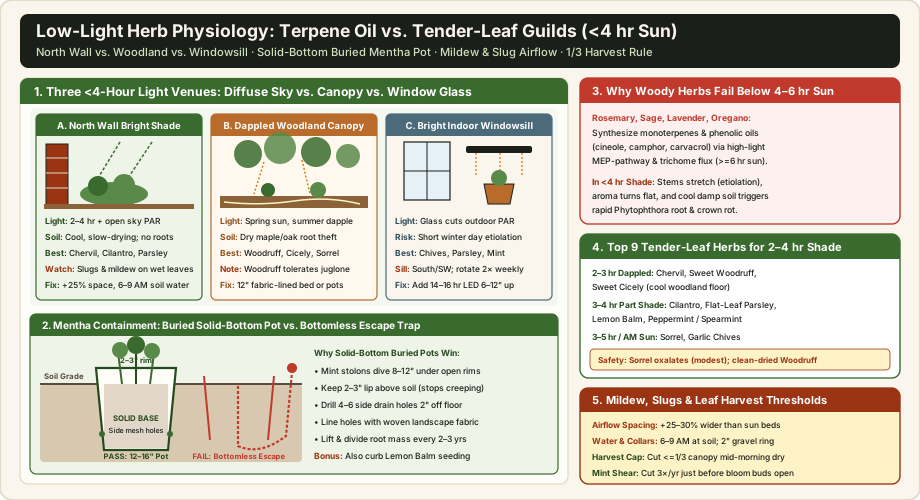
Outdoor North Walls vs. Dappled Woodland vs. Bright Indoor Windowsills
Not all `<4-hour` spots deliver usable photosynthetic light. Map hourly sun angles with our balcony sun-exposure mapping guide and separate three distinct low-light environments before buying plants.
Microclimate Comparison Across Three Low-Light Herb Venues (<4 Hours Direct Sun)
Venue Type | Light Spectrum & Duration | Soil Moisture & Root Reality | Top Herb Picks | Primary Engineering Fix |
|---|---|---|---|---|
Outdoor North Wall (Open Sky) | 0–3 hr angled sun + rich diffuse blue sky light overhead | Cool, slow-drying loam; zero competing tree roots; high slug risk | Chervil, cilantro, parsley, sorrel, garlic chives | Widen spacing 25–30%; amend clay with pine bark/gravel; water 6–9 AM |
Dappled Woodland Canopy | Strong early spring PAR before May leaf-out, then 2–4 hr moving dapple | Dry shade: shallow maple/oak roots steal water & N (plus walnut juglone) | Sweet woodruff, sweet cicely, lemon balm, contained mint | Never till root flares; set 12 in fabric-lined beds or buried pots |
Bright Indoor Windowsill | Double-pane glass + screens strip 30–50%+ PAR; short winter day length | Warm dry room air (65–70°F) + fast pot dry-down; spider mite risk | Chives, parsley, mint, cilantro (rosemary/sage need LEDs) | Use south/SW sill, rotate pots 2× weekly, add 14–16 hr LED 6–12 in up |
Why indoor windowsills fool growers more than outdoor shade
An outdoor north-facing wall open to the clear sky still bathes leaves in steady blue-shifted diffuse skylight, whereas Penn State Extension and Iowa State University Extension warn that residential window glass, UV coatings, insect screens, and overhanging eaves strip away over one-third to half of outdoor Photosynthetic Active Radiation. Add short December days and indoor herbs quickly turn pale and spindly. On an unlit windowsill, stick to chives, parsley, or rooted mint sprigs at a south or southwest pane and rotate containers twice weekly. If you want rosemary, thyme, or sage indoors through winter, suspend dual-tube cool-white or full-spectrum LEDs 6–12 inches above foliage for 14–16 hours daily—or test compact hydroponic jars via our winter windowsill Kratky guide and potted indoor perennial herb care.
Solving dry tree-root shade and walnut zones in woodland gardens
Mature maples, oaks, and beeches pack dense moisture-robbing feeder roots into the top `6–12 inches` of soil. Never rototill under tree canopies or pile dirt against trunk flares. Instead, site `10–12 inch` fabric-lined raised garden beds near canopy drip edges filled with homemade potting mix and finished compost. Under black walnuts (Juglans nigra), Penn State Extension notes that sweet woodruff tolerates toxic juglone naturally; keep sensitive herbs isolated inside lined beds per our black walnut guild plants guide.
Top 9 Culinary & Medicinal Herbs for 2–4 Hour Shade
University of Georgia Extension (Bulletin 1170), Purdue Extension (HO-28), and Penn State Extension trials consistently separate soft-leaved shade performers from sun-craving shrubs. Pair these nine verified species to build an aromatic kitchen and home-apothecary bed without relying on blazing afternoon sun.
Verified Cultivation & Harvest Guide for 9 Shade-Adapted Culinary and Medicinal Herbs
Herb & Botanical Name | Min Direct Sun | USDA Zones | Flavor / Phytochemical Niche | Spacing, Sowing & Harvest Threshold |
|---|---|---|---|---|
Chervil (Anthriscus cerefolium) | 2–3 hr dappled | 3–7 (cool annual) | Delicate anise-parsley; fines herbes staple ruined by heat | Direct-sow taproot (10–12 in spacing); keep 50–70°F; snip outer sprigs |
Cilantro (Coriandrum sativum) | 3–4 hr AM sun | 2–11 (cool annual) | Bright citrus leaf aroma; shade stops quick summer bolting | Direct-sow 'Slow Bolt'/'Santo' every 2–3 wk; space 6–8 in; cut outer stems |
Flat-Leaf Parsley (Petroselinum crispum) | 3–5 hr AM sun | 4–9 (biennial) | Rich chlorophyll & clean savory flavor; afternoon shade stops bitterness | Soak seed 12–24 hr (14–21d sprout); space 12 in; harvest outer 1/3 stalks |
Lemon Balm (Melissa officinalis) | 2–4 hr shade | 4–9 (perennial) | Citral & rosmarinic acid calming tea herb; lush un-scorched leaves | Space 20–24 in; shear flower spikes before seed set; cut top 1/3 pre-bloom |
Peppermint & Spearmint (Mentha spp.) | 2–4 hr shade | 3–9 (-20°F roots) | Menthol/carvone oils stay steady; variegated forms burn in full sun | Buried solid-bottom pot (12–16 in); cut 3×/yr 1–2 in up just before bloom |
Sweet Cicely (Myrrhis odorata) | 2–4 hr woodland | 3–7 (perennial) | Natural sweet anise in leaves, stalks & green seeds; sweetens tart fruit | Deep rich moist loam; space 24–30 in; needs cold stratification for seed |
Garden & French Sorrel (Rumex acetosa / R. scutatus) | 3–5 hr shade | 4–8 (perennial) | Sharp lemony oxalic-acid tang for soups, eggs & sauces | Space 15–18 in; strip seed stalks early; pick young tender inner blades |
3–5 hr shade | 3–9 (perennial) | Savory garlic/onion blades & edible blooms; adaptable across bright shade | Space 10–12 in; snip 2 in above crown; divide clumps every 3–4 years | |
Sweet Woodruff (Galium odoratum) | 2–3 hr shade | 4–8 (perennial) | Woodland groundcover (6–12 in); coumarin hay-vanilla scent after drying | Space 15 in; walnut-juglone tolerant; harvest right after May white blooms |
Establish taprooted parsley from seed or succession-sow cilantro to beat heat bolting directly in shaded beds rather than disturbing roots via transplanting. Combine perennial clumps of chives and garlic chives with calming lemon balm tea plantings, or add native woodland wild mint in large shaded pots alongside edible understory companions covered in our part-shade edible perennials guide.
Culinary Safety — Oxalates in Sorrel and Coumarin in Sweet Woodruff: Both perennial shade herbs carry bioactive compounds requiring sensible kitchen limits. Sorrel's lemony tang comes from oxalic acid, so consume modest culinary portions and avoid heavy daily servings if prone to calcium-oxalate kidney stones. Sweet woodruff (Galium odoratum) releases vanilla-like coumarin upon wilting or drying; dry sprigs cleanly at `95–115°F` in a dehydrator or airy dark bundle (Penn State Extension) and discard any damp or moldy batches—fungal spoilage converts coumarin into dicoumarol, an anticoagulant compound—while keeping teas or May-wine infusions occasional and avoiding use alongside blood-thinning medications.
Buried Solid-Bottom Pot Containment for Mentha and Spreading Shade Herbs
Many gardening articles advise burying a bottomless nursery bucket or cut-out 5-gallon pail to contain mint and lemon balm spread. In cool, moist shade soil, bottomless collars fail within two summers: vigorous Mentha rhizomes dive 8–12 inches downward, snake underneath the open plastic edge, and erupt across neighboring chervil and parsley crowns.
- Pick a solid-bottom 12–16 inch container: Use a rigid 5-gallon nursery pot or thick UV-stable planter with an intact solid base (no large open bottom drainage slits directly touching garden dirt).
- Drill side drain holes 2 inches up from the floor: Bore `4–6` half-inch drain ports around the lower perimeter side wall `2 inches` above the base, and glue or tuck a double layer of woven landscape fabric inside over those holes so excess rain escapes without letting white stolons thread out.
- Leave a 2–3 inch rim proud above soil grade: Sink the pot into your shaded bed so its upper plastic lip protrudes 2–3 inches above surrounding soil and mulch—blocking creeping above-ground runners from arching over the rim and rooting outside.
- Lift, divide, and refresh every 2–3 years: Once dense mint rhizomes circle tightly inside the buried pot, vigor drops and powdery mildew rises. Every second or third spring, haul the buried pot up, saw the root ball into quarters, replant one fresh division in crisp potting mix, and compost trimmed runners (never toss live rhizomes into cold backyard compost).
Monitor lemon balm and sweet woodruff closely as well: lemon balm spreads mostly by prolific self-seeding unless flower spikes are sheared right as tiny white blooms appear, while sweet woodruff sends shallow slender rhizomes `1–2 feet` wide across woodland leaf mold and produces tiny bristled bur fruits that hitchhike on sleeves and pet fur.
Foliar Mildew, Slug Airflow & Leaf Harvesting Thresholds in Low Light
Shaded air stays cooler and more humid near ground level, turning crowded herb beds into prime habitat for powdery mildew, mint rust, and nocturnal slugs that shred tender chervil and lemon balm overnight. Utah State University Extension also notes that heavy nitrogen fertilizing and soggy soil accelerate mint rust while dropping aromatic oil quality.
- Widen plant spacing by 25–30%: Give parsley `12 inches` instead of `8–9 inches` and lemon balm `20–24 inches` so gentle cross-breezes strip stagnant boundary-layer humidity from leaf undersides.
- Fix drainage and keep 2-inch gravel collars: Target well-drained soil at pH 6.0–7.0 (Clemson HGIC recommends working `2–3 inches` of fine pine bark, cracked pea gravel, or coarse compost `8–12 inches` deep into heavy clay). Pull damp bark or straw mulch back 2 inches from herb crowns, surround delicate stems with coarse pea gravel or crushed eggshells, and lift outdoor containers on pot feet.
- Water at root level between 6:00 and 9:00 AM: Check the top `1–2 inches` of soil with a finger before watering—shade beds lose half as much moisture as sun rows. Use drip lines or a narrow watering spout at the root zone (`~1 inch/week` total) rather than evening overhead sprinkling that feeds fungal spores; combine with tactics from our powdery mildew treatment guide, PNW slug and snail control, and organic crawling pest control.
- Cap leaf harvests at one-third (1/3) per cut: Under `<4 hours` of sun, plants rebuild leaves slower than full-sun herbs. Never strip more than one-third of total active foliage in a single harvest, snip mid-morning once dew has dried (avoiding wet spore transfer while capturing peak morning volatile oils), and shear Mentha cleanly within `1–2 inches` of soil three times per season just before bloom per USU Extension guidelines.
- Hold light fertilizer and stop late cuts: Purdue HO-28 notes established perennial herbs rarely need fertilizer unless harvested heavily. If growth slows in pots, apply half-strength balanced organic liquid every `4–6 weeks` through mid-summer only, stop fertilizing and hard-shearing perennials `4–6 weeks` before first autumn frost, and preserve bumper summer cuts via air or low-temp dehydrator drying and airtight dried herb storage.