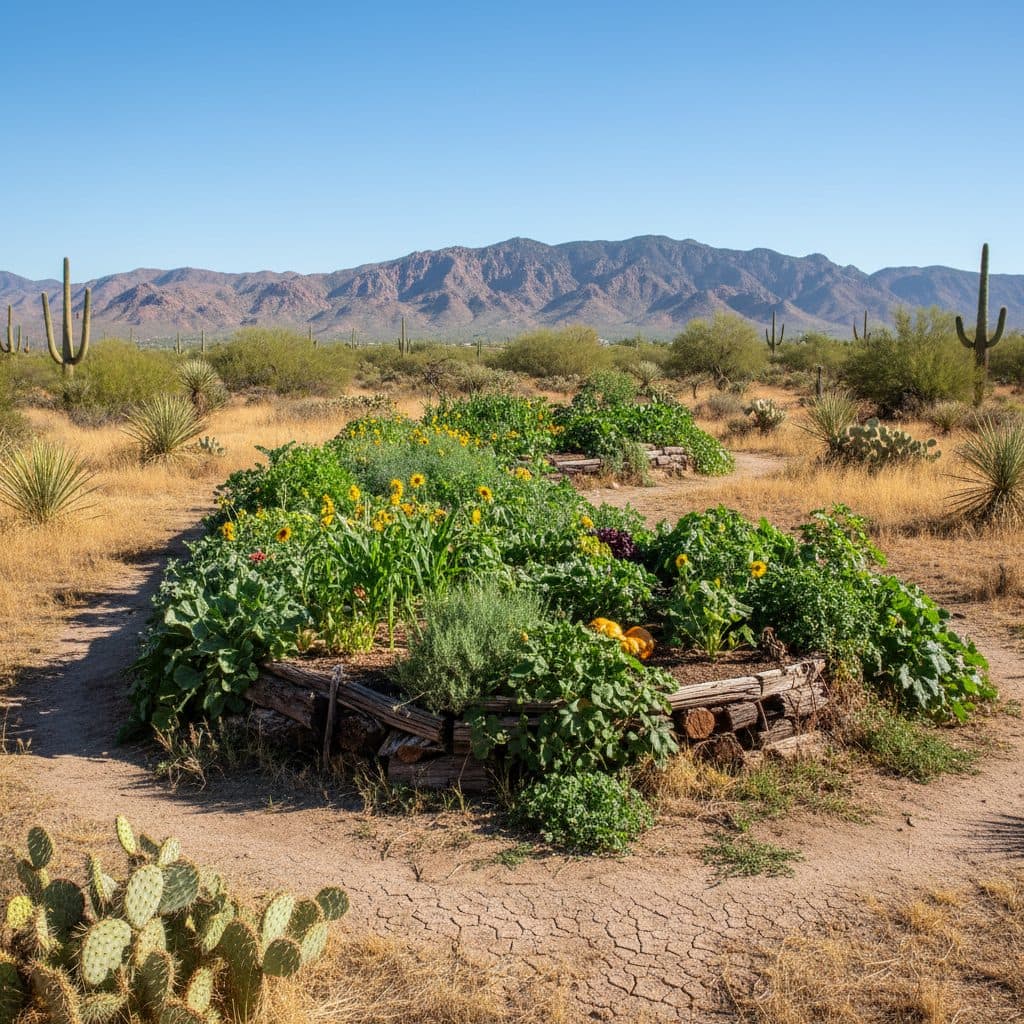
A hugelkultur garden mound in a dry, sunny US desert landscape supports plant life in arid conditions.
Key takeaways
- Hugelkultur beds significantly increase water retention in hot, dry climates by burying wood, which acts like a sponge.
- Decomposing wood in hugelkultur beds enriches soil, provides slow-release nutrients, and creates a stable, long-term growing environment.
- Proper construction, including layering and strategic placement, helps maximize water harvesting and minimize evaporation in arid regions.
- Integrating hugelkultur with passive irrigation techniques like swales, ollas, and wicking beds can reduce water usage by 30% to 50%.
- Selecting drought-tolerant plants and appropriate mulching further improves the water efficiency and productivity of hugelkultur systems.
- These beds can remain productive for 10 to 20 years, offering a sustainable solution for challenging growing conditions across the US Southwest.
Quick answer: Hugelkultur beds increase water retention in hot, dry climates by burying wood that acts like a sponge, absorbing and slowly releasing moisture. This method enriches soil, provides nutrients, and can reduce irrigation needs by 30-50% in arid regions.
In regions like the American Southwest, where annual rainfall can be as low as 8 to 15 inches, and summer temperatures regularly exceed 100 degrees Fahrenheit, water is the most precious resource for any grower. Traditional gardening often struggles, demanding constant irrigation that strains local water supplies and budgets. However, an ancient European technique, hugelkultur (German for ‘hill culture’ or ‘mound culture’), offers an effective approach for these arid conditions.
Hugelkultur beds leverage buried wood to create self-watering, nutrient-rich growing environments that thrive with significantly less irrigation. This method isn’t just for temperate zones; when adapted for hot, dry US climates, it transforms challenging landscapes into productive gardens, demonstrating up to a 50% reduction in water needs compared to conventional beds in similar environments, according to some field observations from Arizona and New Mexico growers.
Understanding hugelkultur’s drought resilience in arid lands
Hugelkultur mimics natural forest decomposition processes. The bed is built around a mound of decomposing wood, covered with layers of organic material and soil. This buried wood acts like a sponge, absorbing and storing rainwater during wet periods and slowly releasing it back into the surrounding soil as conditions dry out. In USDA zones 7-10, where soil moisture evaporates rapidly, this internal water reservoir is invaluable. Research from SARE indicates that healthy soil organic matter, which hugelkultur significantly boosts, can hold up to 20 times its weight in water, helping plants survive during extended dry spells [3].
The science of water retention
The decomposition process within the mound creates a dynamic environment. As wood breaks down, it releases nutrients slowly over many years, feeding the plants above. This process also generates heat, which can extend the growing season in cooler climates, but more importantly for arid regions, it creates a rich, fungal-dominated soil structure that retains moisture far better than compacted or sandy soils. The mound’s shape itself helps to increase surface area for planting while creating microclimates (cooler, shadier spots on the north side and warmer, sunnier spots on the south side) that can be used for different plant needs. This natural water cycling and soil building reduces the need for external irrigation, often by 30% or more in a well-established bed.
- Increased water storage: Buried wood absorbs and holds significant amounts of water.
- Slow nutrient release: Decomposing wood provides long-term fertility.
- Improved soil structure: Fungal networks improve water infiltration and aeration.
- Microclimate creation: Mound shape offers varied growing conditions.
- Reduced evaporation: Organic layers and shade help retain soil moisture.
Cross-section diagram illustrating the layered construction of a hugelkultur bed, with large logs at the base, topped by smaller branches, green waste, and soil, demonstrating water absorption and slow release.
Building your drought-resistant hugelkultur bed
Constructing a hugelkultur bed for hot, dry climates requires careful planning, especially regarding site selection and materials. Choose a location that receives at least six to eight hours of direct sunlight for most fruiting vegetables, but consider partial shade for heat-sensitive plants during the hottest parts of the day. Digging a trench 12 to 24 inches deep before mounding can further increase water harvesting, allowing the bed to capture more runoff. The ideal wood for the core is untreated, partially decomposed hardwood like oak, maple, or fruit tree trimmings. Avoid cedar, black walnut, or redwood, which can inhibit plant growth or decompose too slowly. The USDA Natural Resources Conservation Service recommends using locally sourced, untreated wood to avoid introducing contaminants [1].
Layering for maximum water capture
Start by placing the largest logs at the bottom of your trench, ensuring good contact with the soil. Fill gaps with smaller branches and twigs. Next, add a layer of nitrogen-rich material like green waste, grass clippings, or fresh manure; this helps kickstart decomposition and balances the high carbon content of the wood. Follow with a layer of inverted sod, if available, or a mix of compost and topsoil. The final layer should be 6 to 12 inches of good quality topsoil, amended with compost. The finished mound should be 3 to 6 feet wide at the base and 3 to 5 feet high, tapering to a rounded top to minimize erosion. After building, water the bed thoroughly for several days to settle the materials and initiate decomposition. This initial saturation establishes the bed’s water-holding capacity, especially in arid climates where the first rains might be months away.
- Site selection: Choose a location with appropriate sun exposure for your desired plants.
- Wood choice: Use untreated, partially decomposed hardwoods; avoid inhibitory woods.
- Layering sequence: Logs, green waste, sod/compost, then topsoil.
- Mound dimensions: Aim for 3-6 feet wide, 3-5 feet high for optimal volume.
- Initial watering: Saturate thoroughly to kickstart decomposition and water retention.
Integrating passive irrigation and water harvesting
While hugelkultur beds excel at water retention, combining them with other passive irrigation and water harvesting techniques can create an even more resilient system in hot, dry climates. For example, placing hugelkultur beds within a swale system (a shallow ditch on contour) allows them to capture and slowly infiltrate rainwater runoff from a larger area. The EPA’s Soak Up the Rain initiative notes that decentralized stormwater management can significantly reduce runoff and increase groundwater recharge [2]. This approach is particularly effective in regions like the high desert of Arizona, where intense, short-duration rain events are common, but much of the water is lost to flash flooding and evaporation.
Ollas and wicking beds for targeted hydration
Ollas, unglazed clay pots buried in the soil, are an ancient and effective method for targeted, low-tech irrigation. When filled with water, they slowly release moisture directly to plant roots, minimizing evaporation. Integrating ollas into a hugelkultur bed can provide consistent hydration to specific plants, reducing surface watering needs by up to 70%. Similarly, wicking beds, which have a reservoir of water at the bottom that wicks up into the soil, can be adapted for hugelkultur. While more complex to build, a wicking layer beneath or around the hugelkultur mound can ensure a constant moisture supply. For larger-scale water collection, consider rainwater harvesting from rooftops, which can provide hundreds to thousands of gallons of free water to supplement your hugelkultur and olla systems. A 1,000 square foot roof can collect approximately 620 gallons of water for every one inch of rainfall.
- Swales: Direct runoff towards hugelkultur beds for increased infiltration.
- Ollas: Provide targeted, slow-release irrigation directly to plant roots.
- Wicking beds: Maintain consistent soil moisture through capillary action.
- Rainwater harvesting: Collect roof runoff to supplement irrigation needs.
- Strategic placement: Position beds to intercept natural water flows.
Planting and managing your hugelkultur for success
Plant selection determines success in a hugelkultur bed in hot, dry climates. Focus on drought-tolerant plants that thrive with minimal water once established. In USDA zones 8-10, consider species like native desert gourds, various squashes, melons, okra, sweet potatoes, and many herbs such as rosemary and thyme. Even some fruit trees, particularly those on drought-resistant rootstock, can flourish on the sides of larger hugelkultur mounds, benefiting from the consistent moisture and nutrients. The ATTRA / NCAT Sustainable Agriculture program consistently promotes the use of adapted species for resilience in challenging environments [4].
Long-term care and benefits
Initial watering is essential for the first few weeks or months until the plants establish and the wood begins to absorb and release moisture. After establishment, monitor soil moisture by hand; you’ll likely find the bed stays moist much longer than surrounding soil. Apply a thick layer of organic mulch, 3 to 6 inches deep, over the entire bed to further suppress weeds, regulate soil temperature, and drastically reduce evaporation, sometimes by 25% or more. As the wood decomposes over 10 to 20 years, the mound will gradually settle, and the soil will become incredibly rich and dark. This long-term fertility and water retention make hugelkultur a truly sustainable solution, requiring less effort and fewer external inputs over time. Even after two decades, the decomposed wood continues to contribute to soil health, acting as a permanent carbon sink and a living soil ecosystem.
- Drought-tolerant crops: Select plants like squash, melons, okra, and native herbs.
- Initial establishment: Water regularly for the first few weeks to months.
- Mulching: Apply 3-6 inches of organic mulch to conserve moisture.
- Long-term fertility: Decomposing wood provides nutrients for decades.
- Reduced inputs: Less need for irrigation and synthetic fertilizers over time.
Water retention comparison: Hugelkultur vs. other bed types in arid climates
Feature | Hugelkultur Bed | Traditional Raised Bed | In-Ground Garden |
|---|---|---|---|
Water Retention | Excellent (buried wood acts as sponge, 30-50% less irrigation) | Good (if well-mulched, but no internal reservoir) | Fair (highly dependent on soil type, high evaporation) |
Soil Fertility | Excellent (long-term, slow-release nutrients from decomposition) | Good (requires regular compost additions) | Variable (requires consistent amendments) |
Soil Structure | Excellent (aerated, fungal-rich, resists compaction) | Good (can compact over time without proper care) | Poor to Fair (prone to compaction, poor drainage in heavy soils) |
Lifespan | 10-20+ years (as wood decomposes) | 5-10 years (structure may degrade, soil depletes) | Ongoing (requires yearly amendment and care) |
Initial Effort | High (gathering wood, layering) | Moderate (building frame, filling with soil) | Low (tilling, planting) |
Water Savings: Hugelkultur beds can reduce irrigation needs by 30% to 50% in hot, dry US climates compared to conventional gardening.
Soil Moisture: A well-constructed hugelkultur bed can maintain consistent soil moisture for 10 to 20 days longer than flat ground after rainfall in arid zones.
Frequently asked questions
How long does it take for a hugelkultur bed to become self-sufficient in terms of water?
A hugelkultur bed typically takes one to three months to establish its full water-retention capabilities. During this initial period, consistent watering is necessary, especially in hot, dry climates, to help the wood absorb moisture and kickstart decomposition processes.
What types of wood should I avoid for hugelkultur in arid regions?
Avoid using woods that are allelopathic, meaning they release chemicals that inhibit plant growth, such as black walnut or eucalyptus. Also, steer clear of woods that decompose very slowly, like cedar or redwood, as they won’t provide the same water retention benefits in the short to medium term. Untreated, partially decomposed hardwoods are best.
Can hugelkultur beds be built on slopes in dry areas?
Yes, hugelkultur beds are excellent for slopes, especially when built on contour. This design helps to slow down rainwater runoff, allowing more water to infiltrate the bed instead of eroding the soil. A gentle slope of one to five degrees is ideal for maximizing water capture and minimizing erosion.
Do hugelkultur beds attract pests or termites in dry climates?
While any wood can potentially attract insects, healthy hugelkultur beds, with their active decomposition and active soil ecosystem, tend to attract beneficial organisms instead of destructive pests. Using partially decomposed wood and ensuring the mound is covered with sufficient soil (at least 6 inches) minimizes the risk of termites or other wood-boring insects becoming a problem.
How deep should the buried wood layer be for optimal water retention?
For optimal water retention in hot, dry climates, the buried wood layer should be substantial, ideally 18 to 36 inches deep at its thickest point. This depth allows for a significant volume of wood to act as a sponge, storing hundreds of gallons of water over time and sustaining plants through extended dry periods.
References
- USDA Natural Resources Conservation Service (2024). USDA Natural Resources Conservation Service.
- EPA — Soak Up the Rain (2024). EPA — Soak Up the Rain.
- SARE — Sustainable Agriculture Research & Education (2023). SARE — Sustainable Agriculture Research & Education.
- ATTRA / NCAT Sustainable Agriculture (2023). ATTRA / NCAT Sustainable Agriculture.
- USDA National Agroforestry Center (2023). USDA National Agroforestry Center.