Key takeaways
- Ollas are unglazed clay pots, buried to provide passive, subsurface irrigation, often reducing water use by 50% to 70%.
- Drip irrigation delivers water directly to plant root zones, achieving over 90% efficiency and 30% to 70% water savings.
- Initial costs for ollas are lower per plant, ranging from $10 to $30 per pot, while drip systems for a small garden might cost $100 to $500.
- Ollas excel in small, dense plantings, raised beds, and areas without consistent water pressure, requiring manual refilling every 3 to 10 days.
- Drip systems are ideal for larger areas, row crops, and sloped terrain, offering automation and precise water delivery.
- Both methods conserve significant water, which matters for growers in arid regions like the Southwest or during drought.
Quick answer: Ollas excel in small, dense plantings and raised beds, offering passive, subsurface irrigation with 50-70% water savings. Drip irrigation is ideal for larger areas, row crops, and sloped terrain, providing automated, precise water delivery with over 90% efficiency.
In the arid landscapes of the American Southwest, where water is a precious commodity, growers constantly seek efficient irrigation methods. For instance, in parts of Arizona, annual rainfall can be as low as 8 inches, making every drop count for successful cultivation. Two prominent techniques for conserving water in gardens and small farms are ollas and drip irrigation systems. Each offers distinct advantages and disadvantages concerning installation, cost, and water delivery.
Understanding the nuances of these systems can help you make an informed decision for your growing needs, whether you are tending a small vegetable patch in USDA zone 7 or managing a larger plot in the drier climates of California. Drip irrigation, for example, can reduce water use by 30% to 70% compared to traditional methods, according to research from 1999 [1]. Ollas, while ancient, also offer substantial water savings and a low-tech approach to plant hydration.
Understanding ollas: ancient wisdom for modern gardens
Ollas, pronounced ‘oy-yahs,’ are unglazed, porous clay pots buried in the soil near plants. These vessels have been used for over 4,000 years, originating in regions like North Africa and China, to provide a slow, consistent release of water directly to plant roots. The principle is simple: water seeps through the pot’s walls into the surrounding soil, driven by soil moisture tension and root demand. This method ensures that plants receive water precisely when and where they need it, minimizing evaporation and runoff, which can be significant in surface irrigation.
how ollas work and their benefits
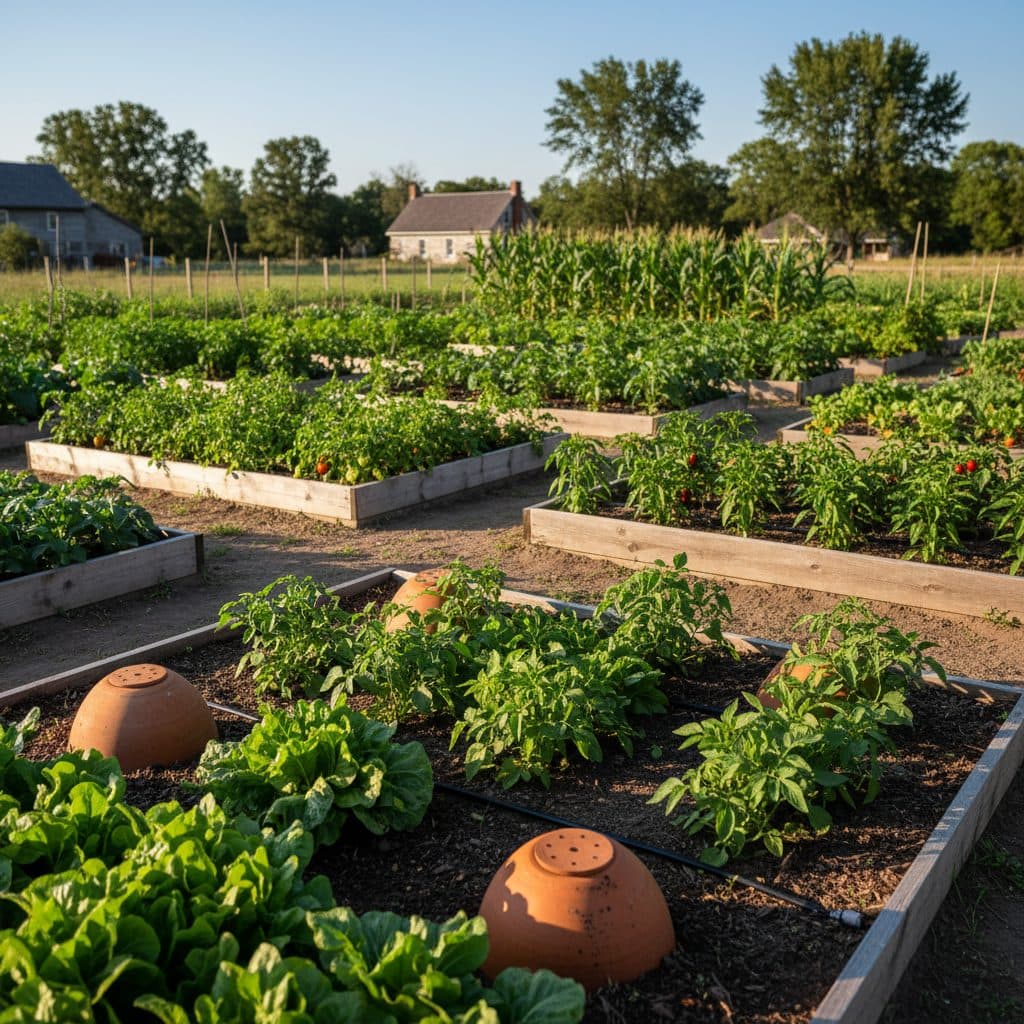
When an olla is filled with water, the moisture slowly diffuses through the porous clay. Plant roots grow towards the olla, drawing water as needed. This passive irrigation system is highly efficient, often reducing water consumption by 50% to 70% compared to conventional surface watering, especially in sunny, windy environments like those found in central Texas during summer. A typical olla might hold 1 to 5 gallons of water and require refilling every 3 to 10 days, depending on plant size, soil type, and weather conditions. For a small 4-foot by 8-foot raised bed, you might use three to five 1-gallon ollas.
- Subsurface delivery minimizes water loss from evaporation, a common issue in hot climates.
- Consistent moisture helps prevent plant stress from irregular watering.
- Reduced weed growth because the soil surface remains drier, discouraging weed seed germination.
- Simple installation requires burying the pot with only its neck exposed.
- Low pressure system works without pumps or complex plumbing.
Drip irrigation: precision and automation
Drip irrigation, also known as trickle or micro-irrigation, is a modern watering method that delivers water directly to the plant’s root zone through a network of tubes, emitters, and valves. This system minimizes water waste by avoiding overspray and reducing evaporation, making it highly efficient. Drip systems can achieve water application efficiencies exceeding 90%, significantly outperforming traditional sprinkler or flood irrigation methods [2]. In a typical home garden in USDA zone 6, a drip system can save hundreds of gallons of water over a growing season.
components and advantages of drip systems
A basic drip system includes a water source, a filter to prevent clogging, a pressure regulator to maintain optimal operating pressure (often between 5 and 20 psi [2]), mainlines, laterals, and emitters that release water at a controlled rate, such as 0.5 to 4.0 gallons per hour (GPH) [3]. These systems can be automated with timers, allowing for precise watering schedules even when you’re away. For larger areas or row crops, such as a 1-acre field of tomatoes in California’s Central Valley, drip irrigation provides consistent moisture across thousands of plants. You can learn more about setting up these systems by reviewing resources on designing a drip irrigation system.
- High water efficiency reduces water use by 30% to 70% compared to conventional methods [1].
- Automated operation saves labor and ensures consistent watering schedules.
- Reduced disease risk as foliage stays dry, minimizing fungal issues.
- Precise nutrient delivery through fertigation, applying fertilizers directly to roots.
- Adaptable to various terrains, including sloped gardens, without significant runoff.
Water savings and cost comparison
Both ollas and drip irrigation offer significant water savings over traditional watering methods. Drip irrigation systems can reduce water consumption by 30% to 70% compared to overhead sprinklers [1], while ollas are often reported by growers to save 50% to 70% of water in similar applications. For a typical vegetable garden in a hot climate like southern California, this difference can translate to hundreds of gallons saved each month during peak growing season. The USDA NRCS provides technical and financial assistance for irrigation improvements, including drip systems, across 50 states [6].
initial investment and ongoing expenses
The initial cost is a major differentiator. A typical small-scale drip irrigation system for a home garden might cost $100 to $500 for materials, including tubing, emitters, and a pressure regulator [4]. However, larger, more complex systems for multiple garden beds or small farms can easily run into thousands of dollars. Ollas, on the other hand, are generally much less expensive per unit, ranging from $10 to $30 per olla, depending on size and material quality. For a 100 square foot garden, you might need 10 to 15 ollas, totaling $100 to $450.
Ongoing costs for drip systems include replacement emitters, filters, and potential repairs to tubing, which can be damaged by rodents or gardening tools. Energy costs for pumping water, if not using gravity feed, also contribute. Ollas require no electricity and minimal maintenance, primarily refilling with water and occasional cleaning. However, they can break if exposed to freezing temperatures or impact. For those interested in off-grid solutions, exploring options like drip without electricity or solar water pumps for wells and irrigation can further reduce operational costs for drip systems.
- Ollas: Lower initial cost per unit (e.g., $10-$30) but higher labor for refilling.
- Drip Systems: Higher initial investment ($100-$500 for small gardens, more for larger) but lower daily labor.
- Water Savings: Both offer 30% to 70% reduction in water use compared to traditional methods.
- Maintenance: Ollas need refilling and protection from frost; drip needs filter cleaning, emitter checks, and occasional repairs [5].
- Energy: Ollas require none; drip systems may need electricity for pumps or timers.
When each method wins: matching irrigation to your needs
Choosing between ollas and drip irrigation often comes down to the scale of your operation, available resources, and specific plant needs. Ollas are particularly effective for small, densely planted areas, such as raised garden beds or container gardens, where individual plant watering is preferred. They are also excellent for perennial plants and shrubs that benefit from consistent, deep watering over long periods. In a 4-foot by 4-foot raised bed in USDA zone 8, two to three 2-gallon ollas can adequately water a variety of vegetables like peppers and eggplants for several days.
ideal scenarios for ollas and drip systems
Ollas are a strong choice for gardeners who prefer a low-tech, passive system and don’t have access to consistent water pressure or electricity. They integrate well with rainwater harvesting systems, as collected rainwater can be easily used to refill them. However, their manual refilling requirement can be a drawback for larger gardens. Drip irrigation, conversely, shines in larger gardens, row crops, and commercial applications where automation and precise control over water delivery are paramount. For a 0.25-acre market garden growing leafy greens, a drip system can efficiently water thousands of plants with minimal labor, delivering 0.5 GPH per emitter to each plant.
- Ollas win for: Small beds, container gardens, perennial plants, areas without electricity or pressure, and when integrating with simple rainwater collection.
- Drip wins for: Large gardens, row crops, sloped terrain, automated watering, precise nutrient delivery, and when consistent water pressure is available.
- Mixed Systems: Combining both can be effective; ollas for established trees and drip for annual rows.
- Soil Type: Ollas work best in well-draining soils; drip is adaptable to most soil types.
- Plant Density: Ollas are good for dense planting; drip is flexible for various spacings.
Maintenance and longevity
Proper maintenance ensures the longevity and effectiveness of both ollas and drip irrigation systems. For ollas, the primary maintenance task is regular refilling, typically every 3 to 10 days, depending on plant water demand and local climate conditions, such as the hot, dry summers in New Mexico. It’s also important to protect ollas from freezing temperatures in winter, especially in USDA zones 6 and below, as absorbed water can expand and crack the clay. Removing them or draining them completely before the first hard frost, usually when temperatures drop below 32°F, is crucial for their survival. A well-maintained olla can last for 5 to 10 years or even longer.
ensuring system health and efficiency
Drip irrigation systems require more routine checks. Filters need cleaning regularly, sometimes weekly during peak season, to prevent clogging of emitters, which can have flow rates as low as 0.5 GPH [3]. Emitters should be inspected for clogs, damage, or dislodgement. Flushing the lines periodically, perhaps once a month or at the end of the season, helps remove sediment. Pressure regulators should be checked to ensure they maintain the optimal 5 to 20 psi [2]. Rodents can chew through tubing, and UV exposure can degrade plastic components over 5 to 10 years, necessitating repairs or replacements. According to the USDA, proper maintenance is key to maximizing the lifespan and water savings of these systems [5].
- Olla Maintenance: Regular refilling, winter protection from freezing (below 32°F), occasional cleaning.
- Drip System Maintenance: Frequent filter cleaning, emitter checks, line flushing, and repair of damaged tubing [5].
- Lifespan (Ollas): 5 to 10 years or more with care, especially if protected from frost.
- Lifespan (Drip): 5 to 10 years for plastic components, depending on UV exposure and material quality.
- Winterization: Ollas must be drained or removed; drip systems need to be drained to prevent freeze damage in cold climates.
Ollas vs. Drip Irrigation: A Side-by-Side Comparison
Feature | Ollas | Drip Irrigation |
|---|---|---|
Water Efficiency | 50%–70% water savings | 30%–70% water savings, >90% application efficiency [0, 1] |
Initial Cost (Small Garden) | $10–$30 per olla ($100–$450 for 10-15 pots) | $100–$500 for materials [4] |
Automation | Manual refilling (every 3–10 days) | Can be fully automated with timers |
Best Use Cases | Small beds, containers, dense planting, perennials, areas without pressure | Larger gardens, row crops, sloped terrain, precise watering |
Maintenance | Refilling, winter protection (below 32°F) | Filter cleaning, emitter checks, line flushing, repairs [5] |
Water Pressure Required | None | 5–20 psi typically [2] |
Lifespan | 5–10+ years (if protected from frost) | 5–10 years (plastic components) |
Water Savings: Drip irrigation can reduce water use by 30% to 70% compared to traditional methods, saving hundreds of gallons per season in a 500 sq ft garden [1].
Olla Refill Cycle: Ollas typically need refilling every 3 to 10 days, delivering 0.5 to 1 gallon of water per day depending on soil and plant needs.
Drip System Pressure: Most drip systems operate efficiently at low pressures, usually between 5 and 20 pounds per square inch (psi) [2].
Frequently asked questions
Can ollas be used in any soil type?
Ollas work best in well-draining soils, such as sandy loams, where water can move freely. In heavy clay soils, the pores might clog more easily, reducing their effectiveness and requiring more frequent cleaning, potentially every 2-3 months.
How often should I refill ollas?
The refill frequency for ollas depends on several factors, including plant size, soil type, and climate. Typically, ollas need refilling every 3 to 10 days. A 2-gallon olla might last 5 days for a mature tomato plant in a hot, dry climate like southern Arizona.
Are drip irrigation systems difficult to install for a home gardener?
Installing a basic drip irrigation system for a home garden is generally straightforward and can be completed in a few hours for a 100 square foot area. Kits are available, and most components connect easily with little more than a pair of scissors and a hole punch.
What is the lifespan of a typical drip irrigation system?
The lifespan of a drip irrigation system’s plastic components, like tubing and emitters, is typically 5 to 10 years. This can be extended with proper maintenance, such as flushing lines annually and protecting components from UV degradation and freezing temperatures below 32°F [5].
Can I use rainwater with my drip irrigation system?
Yes, rainwater can be used with a drip irrigation system, but it’s crucial to include a robust filter to remove debris and sediment from the collected water. Rainwater harvesting systems, especially those collecting from roofs, can introduce fine particles that would quickly clog drip emitters, which often have small orifices delivering 0.5 to 4.0 GPH [3].
References
- Practical Applications of Drip Irrigation (1999). Practical Applications of Drip Irrigation.
- Principles of Drip/Trickle or Micro Irrigation (2012). Principles of Drip/Trickle or Micro Irrigation.
- Drip Irrigation Components (2022). Drip Irrigation Components.
- Drip Irrigation—Planning Factors (2022). Drip Irrigation—Planning Factors.
- Maintenance and Operation of Drip Irrigation Systems (2022). Maintenance and Operation of Drip Irrigation Systems.
- USDA Natural Resources Conservation Service (2024). USDA Natural Resources Conservation Service.