Key takeaways
- Water in containers acts as an effective thermal mass, absorbing solar energy during the day and releasing it slowly overnight, raising ambient temperatures by 5-10°F.
- Manure hot beds, especially those made with horse manure, can generate internal temperatures of 120-160°F for several weeks, allowing for planting up to six weeks earlier in spring.
- Dense materials like stone, concrete, and earth store significant heat, stabilizing temperatures in structures and greenhouses, which can reduce heating demands.
- Strategically placed thermal mass can extend the growing season by 30-60 days in temperate climates like USDA zone 5, improving crop yields and variety.
- Insulation matters for retaining passive heat, with proper sealing and material choices significantly reducing heat loss in cold frames and greenhouses.
- Combining multiple passive heating methods, such as water barrels and a manure hot bed, creates a more resilient and energy-independent off-grid growing system.
Quick answer: You can extend your growing season by 30-60 days in temperate climates like USDA Zone 5 using passive heat strategies such as water thermal mass, manure hot beds, and proper insulation. These methods capture and store solar energy to moderate temperature swings without electricity.
In northern Michigan and other USDA zone 5 regions, extending the growing season by even a few weeks can mean the difference between a meager harvest and a bountiful one. Relying solely on the sun’s direct warmth isn’t always enough, especially during the shoulder seasons when nights dip below freezing. That’s where passive heat strategies come into play, allowing growers to capture and store solar energy without relying on electricity or fossil fuels. These methods, from simple water jugs to carefully constructed manure hot beds, can add 30 days or more to the productive season, making off-grid living more self-sufficient.
The principle is straightforward: use materials that absorb heat during the day and slowly release it at night, moderating temperature swings. This approach is fundamental to passive solar design for homes and greenhouses alike, and it’s something every grower, especially those living off-grid, should understand. We’re talking about practical, low-cost solutions that leverage natural processes to create more stable microclimates for our plants, often increasing internal temperatures by 5-15°F during critical periods.
Water jugs and barrels as thermal batteries
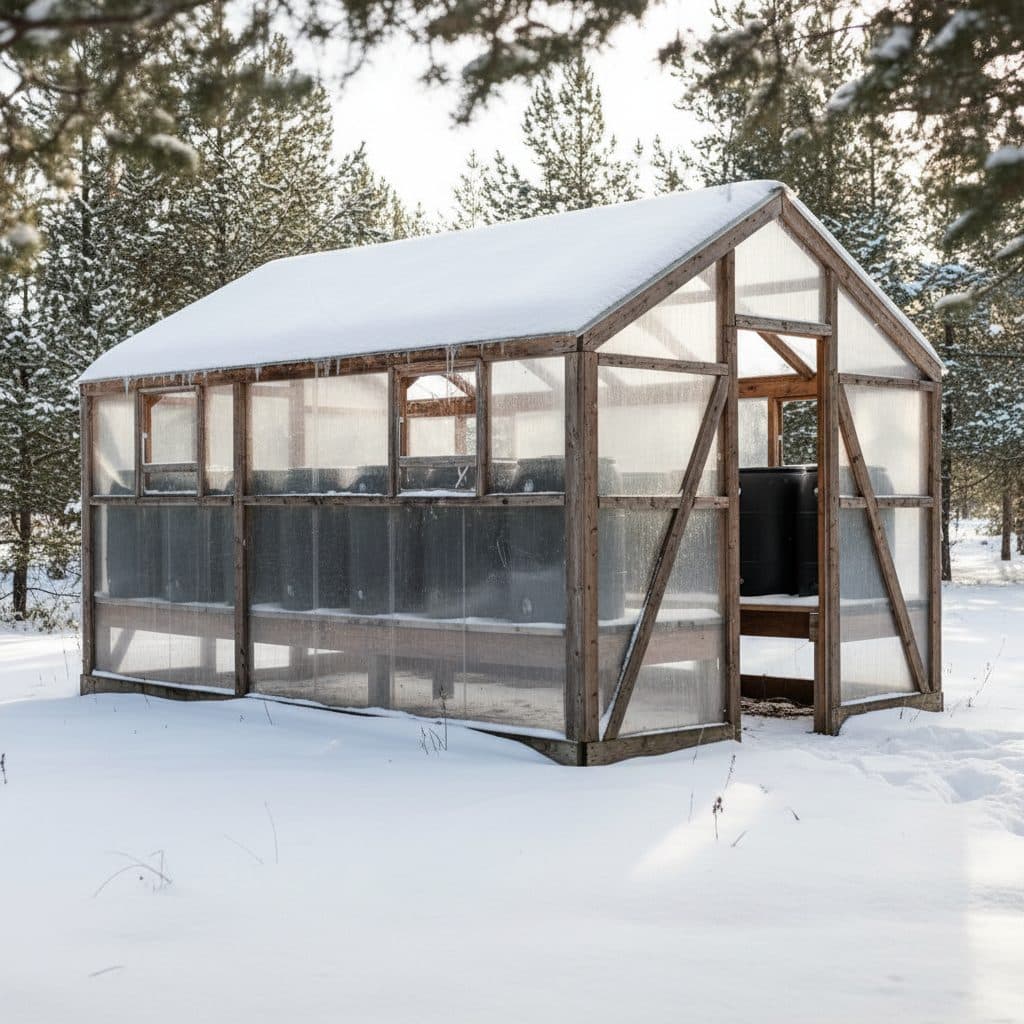
One of the simplest and most effective ways to add passive heat to a greenhouse or cold frame is by using water as a thermal mass. Water has a high specific heat capacity, meaning it can absorb a significant amount of heat energy before its temperature rises, and then release that heat slowly as its surroundings cool. In a 10-foot by 20-foot hoop house, placing fifty 5-gallon black-painted water jugs along the north wall can raise the overnight temperature by up to 7°F on a clear, cold night, helping prevent frost damage to early tomatoes.
Maximizing water’s heat retention
To get the most out of water as a thermal mass, consider several factors. First, paint the containers a dark color, preferably black, to maximize solar absorption; a black 55-gallon drum can absorb a significant amount of incident solar radiation. Second, position them where they will receive direct sunlight for the longest part of the day, typically along north-facing walls in northern hemisphere structures. Third, ensure good air circulation around them to facilitate heat transfer. For optimal performance, a minimum of 2 gallons of water per square foot of floor space is recommended for significant temperature moderation, according to studies on thermal storage in greenhouses. This can help reduce heating costs in a typical growing season.
- Use dark-colored containers, such as black 5-gallon jugs or 55-gallon drums.
- Place containers in direct sunlight, often along the north wall of a greenhouse.
- Ensure adequate air circulation around the containers for efficient heat exchange.
- Aim for at least 2 gallons of water per square foot of greenhouse floor area.
- Consider insulating the outside of the containers in extreme cold to slow heat release.
Manure hot beds for early season starts
For centuries, growers have used the heat generated by decomposing organic matter to warm soil and germinate seeds long before the last frost. A manure hot bed is essentially a large, insulated compost pile topped with a layer of growing medium. A well-built hot bed can maintain soil temperatures of 70-85°F for four to six weeks, even when ambient air temperatures are below 40°F. This allows growers to start heat-loving crops like peppers and eggplants in late February, gaining a full month on the traditional planting schedule.
Building an effective hot bed
The key to a successful hot bed lies in the type of manure and its preparation. Fresh horse manure, especially when mixed with bedding like straw, is ideal because it’s rich in carbon and nitrogen, promoting rapid decomposition and heat generation. A bed constructed with 24-36 inches of fresh horse manure, compacted and moistened, can reach internal temperatures of 120-160°F within 72 hours. After the initial intense heat subsides (usually after 7-10 days), the temperature stabilizes in the optimal range for plant growth. Growers typically cap the manure layer with 6-8 inches of good quality potting soil so plant roots are protected from direct contact with the hottest manure while still benefiting from the warmth below. This method is particularly effective for off-grid operations looking to maximize their growing potential without external energy inputs.
- Use fresh, nitrogen-rich manure, preferably horse manure with straw bedding.
- Construct the bed with a minimum of 24 inches of compacted manure for sustained heat.
- Moisten the manure thoroughly to initiate decomposition and heat generation.
- Allow 7-10 days for initial intense heating to subside before planting.
- Top the manure with 6-8 inches of well-draining growing medium for planting.
Thermal mass beyond water and manure
While water and manure are excellent for specific applications, other dense materials can also serve as significant thermal mass, particularly in permanent structures like greenhouses or even off-grid homes. Materials such as stone, concrete, brick, and even compacted earth can absorb and store substantial amounts of heat. In a passive solar greenhouse, a 12-inch thick concrete floor and an internal stone wall can absorb enough solar energy to keep night temperatures 10-15°F warmer than outside, even when it drops to 20°F. This significantly reduces the need for supplemental heating, matching principles of solar for tiny homes.
Incorporating dense materials into design
Integrating dense thermal mass into building design involves careful planning. South-facing walls can be constructed as Trombe walls—a dark, heat-absorbing material separated from the living space by a small air gap and a glass pane—which can contribute 20-30% of a building’s heating needs. For greenhouses, a north-facing earth berm or a stack of concrete blocks painted black can effectively store heat. The key is to expose these materials to direct sunlight during the day and ensure they are well-insulated from the outside to minimize heat loss at night. Research suggests that proper insulation can significantly reduce heat loss in various applications, which is critical for these passive systems. For those considering off-grid and hybrid solar systems, reducing heating loads through passive design is a primary goal.
- Utilize dense materials like stone, concrete, brick, or compacted earth.
- Design south-facing elements (e.g., Trombe walls) to maximize solar gain.
- Ensure thermal mass is exposed to direct sunlight for several hours daily.
- Insulate the exterior of thermal mass elements to prevent heat escape.
- Consider using recycled materials like old concrete blocks or tires filled with earth.
Integrating passive heat for resilient off-grid growing
For the off-grid homesteader, every watt of energy saved is a win. Integrating multiple passive heat strategies creates a system that can withstand colder temperatures and extend your growing season significantly. Combining a south-facing greenhouse with black water barrels, a north-facing earth berm, and a small manure hot bed for seed starting allows growers to raise cold-hardy greens through winter and start warm-season crops up to two months early. This multi-pronged approach can significantly reduce reliance on external energy sources for greenhouse heating.
Designing for year-round thermal stability
Effective integration means considering the specific needs of your climate and crops. In USDA zone 4, where winter temperatures can drop to -30°F, a well-insulated structure is paramount. Double-layer polycarbonate glazing, for example, gives an R-value of 1.7-2.0, significantly outperforming single-pane glass. Pairing this with substantial thermal mass, such as a sufficient volume of water in a greenhouse, can help prevent freezing inside even during prolonged cold snaps. The USDA Natural Resources Conservation Service stresses the importance of soil health and organic matter, which also contributes to a stable thermal environment in garden beds. For those looking at solar water heaters or solar livestock water heaters, understanding these passive principles can also inform more efficient system designs so water stays warm with minimal energy input.
- Combine multiple passive heat sources like water barrels, manure beds, and dense materials.
- Ensure excellent insulation for all structures to retain captured heat, aiming for R-values of 2.0 or higher.
- Orient structures to maximize winter solar gain, typically with a south-facing aspect.
- Design for proper ventilation to prevent overheating during sunny days, especially in spring.
- Monitor internal temperatures daily to fine-tune your passive heating strategy and placement.
Comparison of passive heat methods for homesteads
Method | Primary Material | Typical Temp Increase | Season Extension (days) | Cost (relative) |
|---|---|---|---|---|
Water Jugs/Barrels | Water, plastic/metal containers | 5-10°F overnight | 15-30 | Low |
Manure Hot Beds | Fresh manure, straw, soil | 20-40°F soil temp | 30-60 | Low (if manure is free) |
Dense Thermal Mass (e.g., Concrete, Stone) | Concrete, stone, brick, earth | 10-15°F overnight | 20-45 | Moderate to High |
Trombe Wall | Glass, dark masonry, air gap | 15-25°F (interior) | N/A (structure heating) | High |
Water’s Heat Capacity: Water can absorb 1 BTU per pound per degree Fahrenheit, making it an excellent thermal storage medium.
Manure Bed Heat: Fresh horse manure hot beds can reach internal temperatures of 120-160°F within 72 hours of construction.
Insulation Savings: Proper insulation can significantly reduce heat loss in cold frames and greenhouses.
References
- Improve the strength, heat resistance, and barrier performance of polyurethane by adding graphene oxide (2025).
- Passive heat transfer enhancement in heat exchanger with tubes (2025).
- Adding Surface While Minimizing Downtime (2003).
- Horizontal Heat Exchanger Design and Analysis for Passive Heat Removal Systems (2005).
- Practice for Estimation of Heat Savings by Adding Thermal Insulation to Bare Valves and Flanges (2023).
- USDA Natural Resources Conservation Service (2024).