Key takeaways
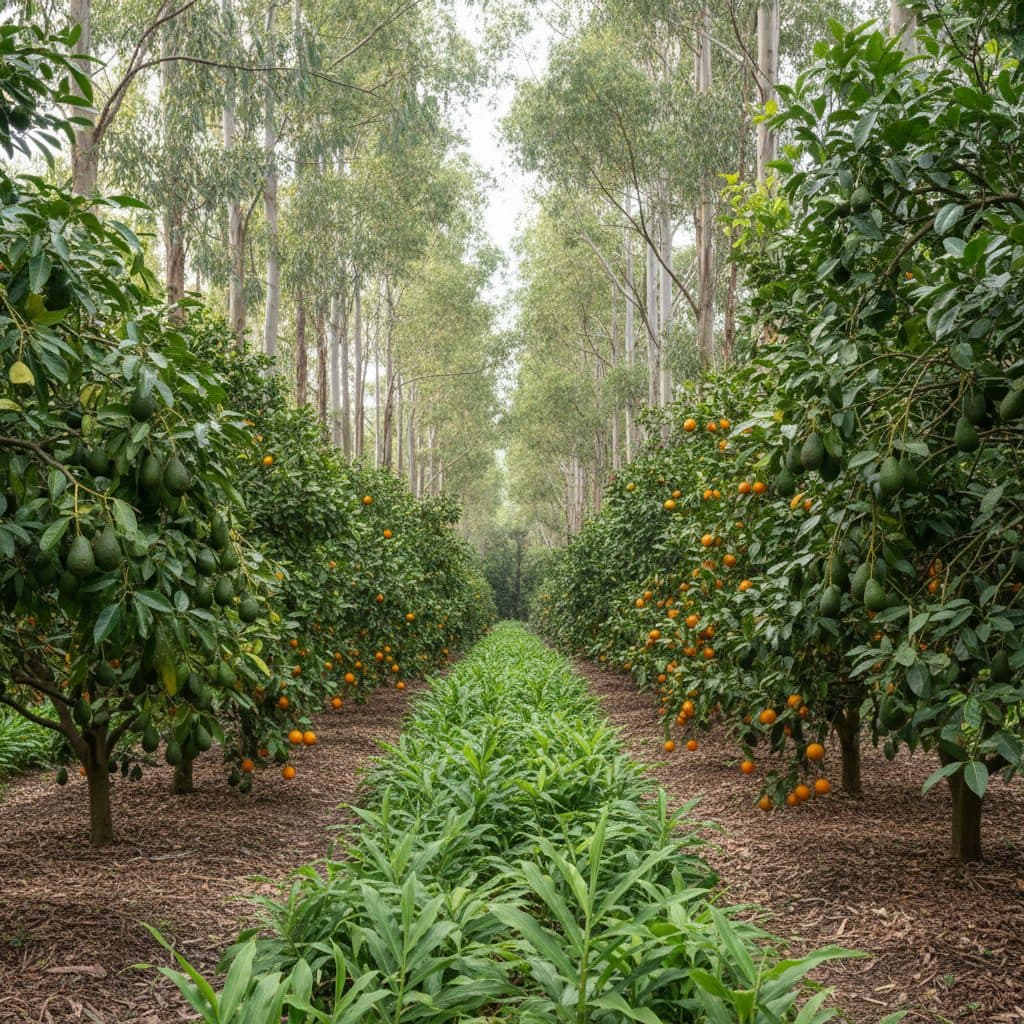
- Syntropic agriculture organizes polyculture plantings across four distinct vertical strata: emergent, high, medium, and low.
- Stratification is based on the specific percentage of direct sunlight each species is genetically adapted to receive within the forest profile.
- Emergent species occupy the top tier requiring full sunlight, while low stratum crops thrive in twenty to forty percent diffuse light.
- Combining species from different strata allows exceptionally high planting densities, with competition managed by pruning rather than avoided by spacing.
- Natural succession (time) and stratification (space) operate simultaneously to drive system maturity and soil fertility.
- Periodic synchronization pruning (chop-and-drop) pulses systemic growth hormones throughout the consortium while creating thick soil mulch.
Quick answer: Syntropic farming layers, known as strata, organize plants vertically into emergent (full sun), high (80% light), medium (60% light), and low (20–40% light) canopy tiers. By placing species with complementary light and root requirements in the same footprint, syntropic agroforestry maximizes total photosynthesis, accelerates soil regeneration, and keeps competition manageable at densities that would otherwise stall.
In conventional monoculture agriculture, plants of the same species compete aggressively for identical light angles, root zones, and soil nutrients. To avoid this competition, industrial farming relies on wide row spacing, synthetic fertilizers, and chemical weed suppression.
Syntropic agroforestry, developed by Swiss farmer and researcher Ernst Götsch on his farm in Bahia, Brazil, operates on the opposite principle: syntropy, or the natural tendency of living systems to accumulate energy, complexity, and biomass over time. Rather than spacing plants far apart, syntropic farming places high concentrations of diverse plants in close proximity by organizing them into complementary vertical strata.
By understanding how light filters through the four strata and coordinating pruning cycles with ecological succession, growers can cultivate self-sustaining, high-yielding agroforests across diverse climate zones.
The four strata of syntropic agroforestry
In syntropic systems, stratification defines how species occupy space vertically. Every plant evolved to occupy a specific light niche in its native ecosystem.
+-------------------------------------------------------------+
|                     SYNTROPIC STRATA MODEL                  |
+-------------------------------------------------------------+
| EMERGENT STRATUM (100% Light)                               |
| Pecan, Poplar, Willow, Hickory, Eucalyptus                  |
+-------------------------------------------------------------+
               \       |       /       (Filters ~20% of Light)
+-------------------------------------------------------------+
| HIGH STRATUM (~80% Light)                                   |
| Avocado, Mango, Cassava, Apple, Fig, Pomegranate, Corn      |
+-------------------------------------------------------------+
               \       |       /       (Filters ~20% of Light)
+-------------------------------------------------------------+
| MEDIUM STRATUM (~60% Light)                                 |
| Citrus, Cacao, Coffee, Guava                                |
+-------------------------------------------------------------+
               \       |       /       (Filters ~20-40% Light)
+-------------------------------------------------------------+
| LOW STRATUM (~20-40% Light)                                 |
| Ginger, Turmeric, Sweet Potato, Cardamom, Comfrey           |
+-------------------------------------------------------------+
1. Emergent stratum (100% sunlight)
The emergent layer consists of tall, narrow-canopied trees and fast-growing biomass species that rise above the main forest canopy to capture full, unfiltered solar radiation.
- Light dynamics: Emergent species capture intense overhead sunlight but possess light, open, or feathery foliage that filters light downward rather than creating dense, impenetrable shade.
- Representative species: In Brazilian systems the emergent tier is usually eucalyptus, and in the humid tropics coconut. In the US, choose regionally appropriate emergents — pecan (Carya illinoinensis), hickory, poplar or willow for fast biomass — and check your state's invasive list before planting eucalyptus or Grevillea robusta: both are listed or regulated in parts of California, Hawaii and Florida, and neither is hardy below about zone 9.
- Ecosystem function: Provides upper-canopy wind buffering, deep mineral cycling from subsoils, and massive biomass production during pruning events.
2. High stratum (roughly 80% sunlight)
The high stratum occupies the space immediately below the emergent canopy. These plants require abundant light but perform best with slight overhead buffering during peak summer heat.
- Light dynamics: Adapted to roughly eighty percent of ambient solar radiation.
- Representative species: Avocado, mango, sweet chestnut, apple, pear, fig, pomegranate, cassava, jackfruit, and sun-loving annual grains like corn and sorghum during early establishment phases.
- Ecosystem function: Delivers primary staple tree crops and mid-level structural canopy architecture.
3. Medium stratum (roughly 60% sunlight)
The medium stratum encompasses small trees, large shrubs, and understory crops adapted to filtered, sub-canopy sunlight.
- Light dynamics: Thrives on approximately sixty percent light exposure, often suffering sunburn or leaf curl if exposed to unfiltered afternoon desert or tropical sun.
- Representative species: Citrus species (oranges, lemons, limes), cacao (Theobroma cacao), arabica coffee (Coffea arabica), and guava.
- Ecosystem function: High-value fruit and beverage production, structural wind dissipation, and microclimate moderation.
4. Low stratum (20% to 40% sunlight)
The low stratum occupies the shaded lower tier near the forest floor, thriving beneath the multiple overstory layers.
- Light dynamics: Highly shade-tolerant species adapted to diffuse light levels between twenty and forty percent.
- Representative species: Ginger (Zingiber officinale), turmeric (Curcuma longa), sweet potato (Ipomoea batatas), cardamom, arrowroot, shade-tolerant ferns, black pepper vines climbing tree trunks, and deep-rooted dynamic accumulators like comfrey (Symphytum officinale).
- Ecosystem function: Soil moisture preservation, dense ground-level carbon capture, and aromatic spice harvests.
Stratification vs succession: space and time
To design functional syntropic systems, growers must balance two complementary dimensions: stratification (space) and natural succession (time). Foundational concepts in the syntropic farming guide outline how these principles operate in tandem.
       Syntropic Space-Time Matrix

 [STRATIFICATION (Space)]        [SUCCESSION (Time)]
- Emergent Strata (100% Light)  - Placenta (Short-Lived)
- High Strata     (80% Light)   - Secondary (Medium-Lived)
- Medium Strata   (60% Light)   - Climax (Long-Lived Canopy)
- Low Strata (20-40% Light)- Senescence & Regeneration- Stratification (vertical space): How plants occupy different height tiers and light percentages at any given moment in time.
- Succession (lifecycle duration): How plant communities naturally replace one another over months, years, and decades.
- Placenta: species that complete their cycle within a season or two.
- Secondary: species that reach their peak in a few years to a couple of decades; explore dynamics in understory during secondary stage for transition management.
- Climax: long-lived canopy species that dominate the mature system.
When establishing new tree rows, learning what is a food forest provides helpful context on how multi-layered perennial guilds develop stable ecological balance over time.
Planting density and consortium design
A defining feature of syntropic agriculture is high initial planting density. By combining seeds and saplings of emergent, high, medium, and low strata in the exact same planting hole or continuous tree line, growers create mutually supportive plant consortia.
       Cross-Section of a Syntropic Tree Line (Consortium)

   [Emergent: Eucalyptus]   [High: Avocado]   [Medium: Citrus]
             \                     |                     /
              \                    |                    /
    ===========+===================+===================+===========
    | Low Stratum: Ginger & Turmeric Root Zone (0-20 cm)          |
    | Medium Root Zone: Citrus Feeder Roots (20-50 cm)            |
    | Deep High/Emergent Taproots: Eucalyptus & Avocado (50+ cm)  |
    ~~~~~~~~~~~~~~~~~~~
Because each species occupies a distinct stratum above ground and taps into different soil depths below ground, direct competition is reduced. It is never removed — which is why a syntropic planting that stops being pruned collapses into a thicket. Instead, they can share mycorrhizal partners, increase humidity within the crop row, and shade out opportunistic weed seeds.
When establishing initial garden beds, using sheet mulching with cardboard suppresses persistent pasture grasses while establishing the rich fungal foundation required by perennial consortia.
Light management through synchronization pruning
Pruning is the primary engine of syntropic agroforestry. In nature, trees undergo disturbance through wind, animal browse, or lightning, which triggers new flushes of growth. Syntropic growers replicate and channel this disturbance through deliberate chop-and-drop pruning.
The physiological pulse of pruning
Hard pruning removes the shoot tips that hold apical dominance, so the pruned plant itself pushes vigorous regrowth. Neighbours benefit from what follows — light reaching lower strata, a thick pulse of mulch, and fine roots dying back and feeding soil biology. Syntropic practitioners also describe a systemic 'rejuvenation' running through the consortium, but that remains a practitioner observation, not a demonstrated mechanism.
       Chop-and-Drop Biomass Cycling

 [Emergent & High Strata Pruning]
                |
                v
 [Woody Branches: Placed Parallel Along Tree Line]
 [Leafy Biomass: Packed Tightly Over Soil Surface]
                |
                v
 [Fungal Decomposition -> Mycorrhizae & Humus Formation]
                |
                v
 [Continuous Moisture & Nutrient Feed to Lower Strata]
Applying chop-and-drop biomass
Pruned material is never removed from the site or sent to compost piles. It is processed directly where it falls:
- Thick woody branches are aligned lengthwise along the tree line to form continuous carbon soil sponges.
- Leafy green biomass is packed tightly over the wood, shielding the soil from direct solar radiation and conserving moisture.
- Reviewing syntropic chop and drop species by climate helps identify fast-growing biomass producers adapted to your specific hardiness zone.
Worked consistently over years, these methods rebuild soil on ground that has been farmed hard. At agripure, ecological growing principles demonstrate that working with natural forest architecture creates abundance while restoring the living earth.