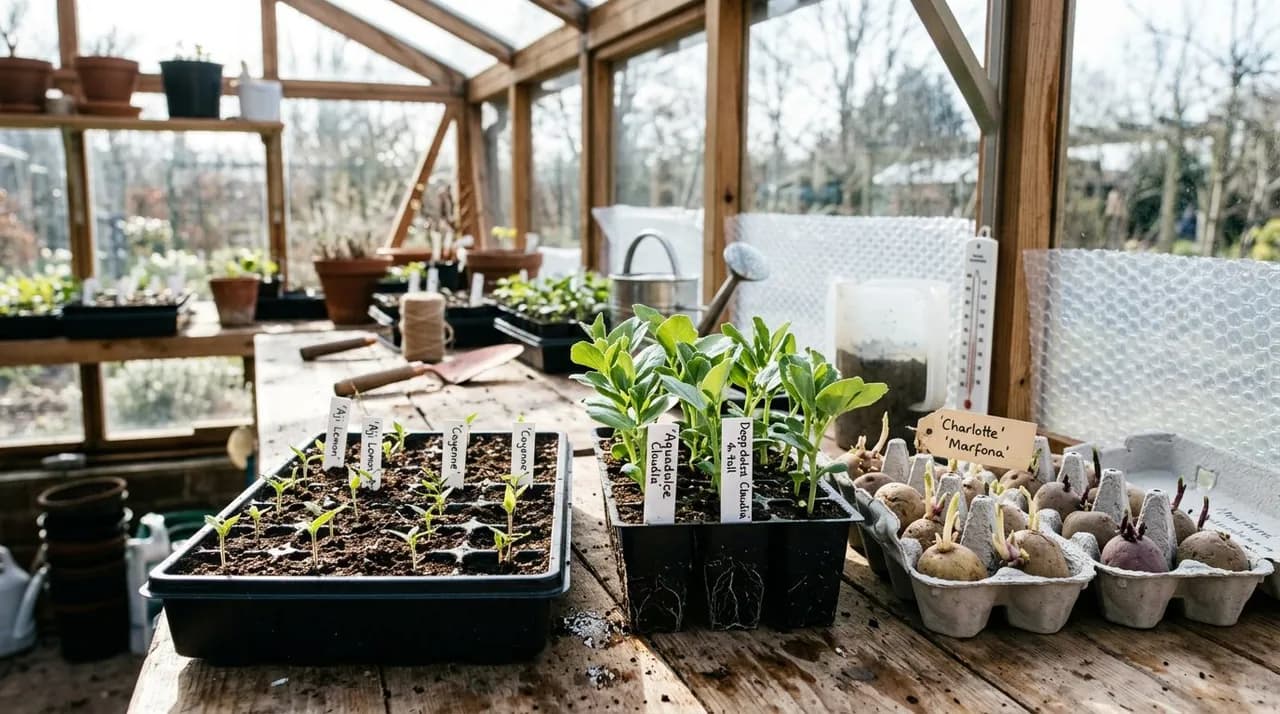
Key takeaways
- February marks the beginning of the UK growing season, focusing primarily on indoor sowings that require a long summer development period.
- Start chillies, sweet peppers, aubergines, and early tomatoes indoors on a heated propagator mat or warm windowsill at 20°C to 24°C.
- Sow hardy broad beans, sweet peas, and early brassicas in unheated cold frames or modular trays within a sheltered greenhouse.
- Direct sow garlic, shallot sets, and hardy peas outdoors only when garden soil is workable, frost-free, and not waterlogged.
- Plant dormant bare-root fruit trees, raspberry canes, gooseberry bushes, and rhubarb crowns before spring bud burst.
Quick answer: February in the UK is the time to sow slow-maturing, heat-loving crops indoors (such as chillies, aubergines, and greenhouse tomatoes) and hardy vegetables in cold frames (including broad beans, peas, and leeks). Outdoors, plant bare-root fruit canes, shallot sets, and garlic whenever the soil is neither frozen nor waterlogged.
Knowing what to plant in February UK plots gives growers an early start on the gardening calendar. While February weather across the British Isles remains cold, damp, and unpredictable, the lengthening daylight hours signal that the winter slumber is ending. For allotment holders and kitchen gardeners, February is a transitional month where preparation meets early indoor propagation.
The primary objective during late winter is to nurture crops that demand an extended growing season. Plants native to warm tropical climates require several months of steady vegetative growth before they can flower and ripen fruit during the relatively short British summer. Starting these seeds indoors now ensures sturdy, well-developed plants ready for transplanting once the danger of spring frost passes in May.
At the same time, hardy perennial edibles and cool-weather roots can be planted outdoors or sheltered under glass. By balancing indoor seed trays, cold frame protection, and essential dormant season allotment tasks, you lay the groundwork for a productive, continuous harvest throughout the entire year.
Indoor sowings: crops that need heat and time
Because outdoor British soils are far too cold for germination in February, indoor sowings must take place on a warm, bright windowsill or within a thermostatically controlled heated propagator.
Chillies and sweet peppers
Chillies (Capsicum annuum and Capsicum chinense) and sweet peppers have the longest germination and maturation cycles of any garden vegetable. Sowing them in early to mid-February ensures they develop heavy flowering branches before midsummer.
- Sowing technique: Surface sow seeds into a fine, peat-free seed compost, covering them with a 3 mm layer of vermiculite.
- Temperature: Chilli and sweet pepper seeds germinate slowly and erratically below 20°C; a heated propagator at 22°C to 25°C gives much faster, more uniform results (typically 10 to 21 days).
- Light management: Once seedlings emerge, move them immediately to the brightest south-facing windowsill available or position them under LED grow lights for 12 to 14 hours daily to prevent leggy growth.
Aubergines (eggplants)
Like chillies, aubergines require steady heat and a long season to produce glossy, tender fruit in the UK. Start seeds in modular trays in early February at 22°C to 24°C. Keep the compost evenly moist but never sodden.
Early greenhouse tomatoes
If you possess a heated greenhouse or a warm conservatory, sow early cordon tomato varieties (such as 'Gardener's Delight' or 'Shirley') in mid-to-late February. If you only grow tomatoes outdoors or in an unheated polytunnel, hold off on sowing until late March to avoid holding overgrown, root-bound plants indoors during cold April weather.
Onions, shallots, and leeks from seed
Growing alliums from seed instead of sets offers greater variety selection and better winter storage. Sow exhibition onions and hardy winter leeks in deep seed trays during early February at 15°C to 18°C. Once the grass-like cotyledons straighten up, grow them on in cool, bright conditions.
To ensure tender seedlings develop strong, disease-free root systems without succumbing to fungal damping off, follow the foundational techniques in seed starting for beginners and our practical advice on preventing damping off seedling failure.
Greenhouse and cold frame sowings: cold-hardy edibles
An unheated greenhouse, polytunnel, or garden cold frame provides shelter from biting winds and driving rain, elevating soil temperatures by several degrees compared to open ground.
Broad beans in deep modules
Sowing hardy broad bean varieties (such as 'The Sutton' or 'Aquadulce Claudia') in deep root trainers or modular cell trays inside an unheated greenhouse protects large seeds from rotting in cold, waterlogged outdoor mud. Modules develop robust root plugs within four to six weeks, ready for planting out into garden beds in March. For full seasonal cultivation guidelines, consult our in-depth guide on how to grow broad beans.
Early peas and mangetout
Round-seeded, cold-hardy pea cultivars (such as 'Meteor' or 'Feltham First') germinate reliably in cool conditions. Sow seeds 2 cm deep in modular trays or along recycled lengths of plastic guttering filled with compost. When seedlings reach 8 cm tall in early spring, slide the entire row directly into a shallow garden trench without disturbing the roots.
Early salad leaves and radishes
In a sheltered cold frame or greenhouse border, sow fast-growing salad crops such as winter-hardy lettuce, rocket, mizuna, and quick radishes ('French Breakfast'). These cool-season greens provide crisp, fresh pickings throughout April while outdoor beds remain bare.
Sweet peas (Lathyrus odoratus)
For magnificent early summer fragrance and cut flowers, sow sweet pea seeds in tall pots or cardboard root tubes during February. Pinch out the growing tips once seedlings develop three sets of true leaves to encourage bushy, multi-stemmed growth.
When preparing homemade potting blends for early module trays, review our formula for a budget friendly DIY seed starting mix.
What to direct sow and plant outdoors in February
Direct outdoor planting in February is strictly dictated by local soil conditions rather than fixed calendar dates. In southern England, soils may warm up several weeks earlier than in Scotland or northern upland plots.
- Check the soil condition first: Never walk on, dig, or sow into frozen ground or soil that squelches underfoot. Working wet clay destroys delicate soil aggregates and creates dense, anaerobic clods that stunt root expansion.
- Warming the soil with cloches: Two weeks before outdoor sowing, cover target planting rows with clear plastic cloches, horticultural fleece, or black polythene. This raises soil temperature by 2°C to 4°C and keeps spring rain from saturating the bed.
Garlic cloves and shallot sets
If you missed planting garlic and shallots during autumn, early February is your last reliable window. If planting garlic in February, choose a spring-planting softneck variety (like 'Picardy Wight' or 'Solent Wight') or pre-chill autumn varieties in the fridge for 3 to 4 weeks to ensure they get enough cold to form separate cloves. Plant individual cloves and firm shallot sets into well-draining soil with their pointed tips just beneath the surface.
Bare-root fruit trees and soft fruit canes
February is peak season for planting dormant bare-root fruit stock:
- Fruit trees: Apple, pear, plum, and cherry trees on dwarfing rootstocks establish strong root networks when planted in late winter.
- Cane and bush fruits: Raspberry canes, blackcurrants, redcurrants, and gooseberries should be planted into soil enriched with well-rotted manure or compost.
- Rhubarb and asparagus: Set out dormant rhubarb crowns into deeply enriched beds. Order asparagus crowns in February for planting out in late March or April once the soil begins to warm. (Planting into cold, waterlogged February soil risks crown rot.) Prepare the trench now with plenty of well-rotted manure or compost. Learn how permanent crops build resilience in our guide to perennial vegetables for UK gardens.
Essential February allotment and garden maintenance jobs
February is an ideal month for physical infrastructure maintenance, soil preparation, and orchard hygiene before the spring planting rush consumes your time.
- Chitting Seed Potatoes: Purchase first early and second early seed potatoes ('Swift', 'Rocket', 'Charlotte') in early February. Arrange them upright with the 'eyes' facing upwards in clean egg boxes or shallow trays on a cool, bright, frost-free windowsill. Over four to six weeks, they will develop sturdy, dark green sprouts 2 cm long, accelerating emergence after planting in March or April.
- Winter Fruit Tree Pruning: Complete the dormant pruning of apple and pear trees before buds begin to swell. Remove dead, diseased, crossing, or crowded branches to create an open, goblet-shaped canopy that lets sunlight into the centre. Avoid pruning stone fruits (plums, cherries, damsons, peaches) in winter, as open cuts expose the wood to silver leaf fungal spores; prune stone fruits only in midsummer. Learn proper branch geometry with our guide on how to prune fruit trees.
- Bed Preparation and Mulching: Top-dress empty garden beds with a 5 cm layer of garden compost or well-rotted farmyard manure. Earthworms will work these organic nutrients into the topsoil over the coming weeks without disrupting soil structure.
- Greenhouse Glass Cleaning: Scrub greenhouse glass and polytunnel plastic with warm water to remove winter algae and soot. Maximising light transmission helps young February seedlings growing under low winter sun angles.
Starting the right seeds in February under cover and preparing beds for spring gives your plot an early start for the growing year.