Key takeaways
- Thermal mass materials like firebrick absorb and radiate steady heat for hours.
- Effective insulation, including ceramic fiber and perlite, significantly reduces heat loss and keeps oven temperatures steady for extended periods.
- Oven design, including dome height, hearth thickness, and door seal, affects heating efficiency and retention.
- Different baking tasks, from 900°F pizza to 300°F roasts, require specific heat management and understanding of residual heat.
- Monitoring internal oven temperature with a reliable thermometer is essential for consistent, high-quality baking results.
- Utilizing natural and recycled materials for insulation can provide effective, homestead-appropriate thermal performance.
Quick answer: Managing wood oven heat retention involves using thermal mass materials like firebrick to store heat, effective insulation such as ceramic fiber and perlite to prevent loss, and strategic oven design for sustained performance.
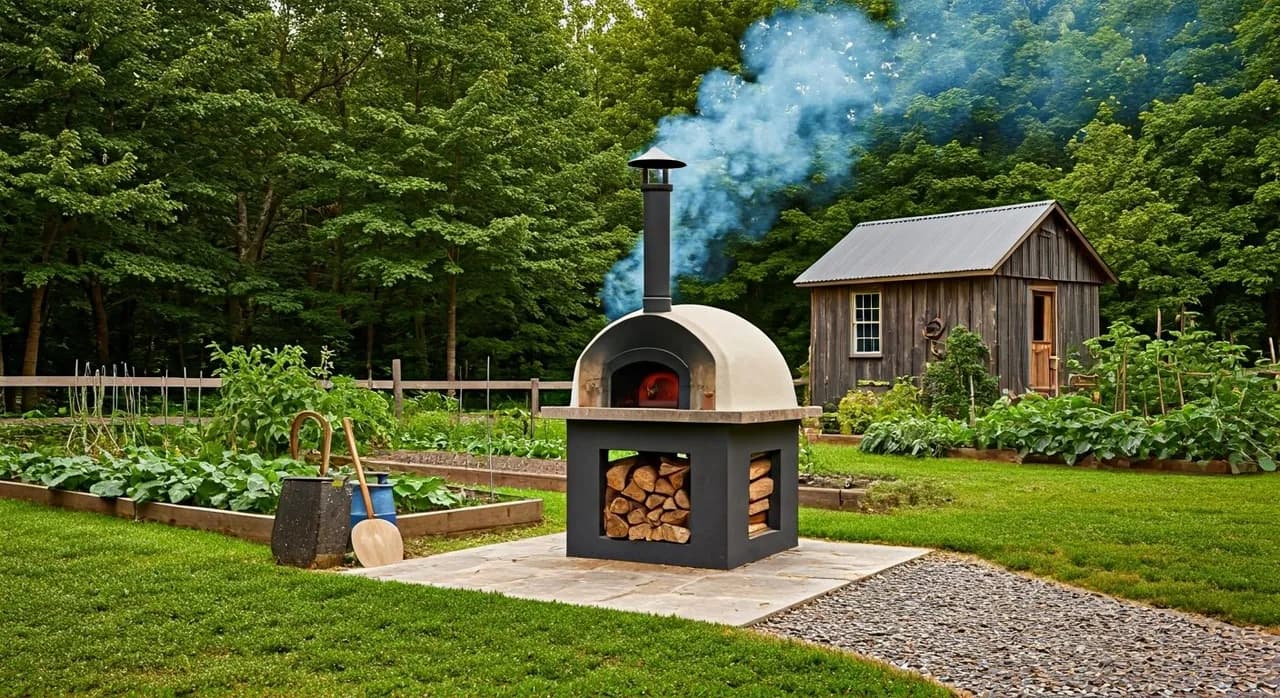
On our homestead in northern Vermont, where winter temperatures can drop to -20°F, a wood-fired oven isn’t just a luxury; it’s a central part of our off-grid cooking strategy. We’ve learned that building and managing one effectively means understanding heat retention inside and out. A well-built oven can hold baking temperatures for 4-6 hours, allowing for multiple batches of bread, pizzas, and even slow-roasted meats, all from a single firing.
The ability of your wood oven to hold heat is the difference between a quick pizza party and a full day of diverse baking. This isn’t just about throwing more wood on the fire; it’s about the materials you choose, how you construct the oven, and how you manage its internal environment. We’ll explore the science and practical application of thermal mass and insulation so your wood oven delivers consistent results, whether you’re aiming for a 900°F pizza crust or a 350°F slow-cooked stew.
The foundation of heat: understanding thermal mass
Thermal mass is the bedrock of any efficient wood-fired oven. It refers to a material’s ability to absorb, store, and then slowly release heat. Think of a thick firebrick hearth: it soaks up a tremendous amount of energy from the fire, then radiates that heat back into the oven chamber for hours after the flames have died down. Without adequate thermal mass, your oven will heat up quickly but cool down just as fast, making sustained baking impossible. For instance, a typical firebrick, made from refractory clay, can withstand very high temperatures and has a specific heat capacity that allows it to store significantly more thermal energy than common building bricks.
Choosing the right materials for thermal mass
The best materials for thermal mass are dense and have high specific heat capacities. Firebricks are the industry standard for oven domes and hearths, often laid 2.5 to 4 inches thick. In our USDA zone 5 homestead, we used 4-inch thick firebricks for the hearth, which provides enough stored heat for baking multiple loaves of sourdough bread after firing. Cob, a mixture of clay, sand, and straw, is another excellent, traditional material for the oven dome, offering a natural and cost-effective alternative. A cob dome can be built 8 to 12 inches thick, providing substantial thermal storage. Even dense concrete, especially if formulated with refractory aggregates, can contribute to thermal mass in the oven’s foundation, and it supports the hearth and adds stability for decades.
- Firebrick: Excellent heat storage, high temperature resistance up to 2,500°F.
- Cob: Natural, cost-effective, good thermal mass when built 8-12 inches thick.
- Dense concrete: Good for structural support and foundation thermal mass.
- Soapstone: High specific heat, often used for smaller, specialized baking surfaces.
- Clay-based mortar: Binds firebricks while aiding overall thermal performance.
Insulation: keeping the heat where it belongs
In a climate like ours in northern Vermont, where dampness can exacerbate heat loss, sturdy insulation is non-negotiable.
Layering for maximum thermal efficiency
Insulation is typically applied in layers around the thermal mass. Below the hearth, a 4- to 6-inch layer of insulating concrete, made with perlite or vermiculite, is common. This prevents heat from sinking into the ground. Over the dome, multiple layers are applied: first, a 2-inch layer of ceramic fiber blanket, which can withstand temperatures up to 2,300°F, is wrapped tightly around the firebrick or cob dome. On top of this, a 4- to 6-inch layer of a perlite-cement or vermiculite-cement mix provides additional R-value and protection. Finally, a weather-resistant outer shell, like stucco or a natural plaster, encases the entire structure, protecting the insulation from moisture and physical damage. This multi-layered approach can achieve a high effective R-value so heat stays within the oven for optimal baking performance.
- Ceramic fiber blanket: High R-value, withstands extreme temperatures up to 2,300°F.
- Perlite/Vermiculite concrete: Lightweight, good insulating properties for hearth and dome.
- Rockwool: High R-value, fire-resistant, often used in external insulation layers.
- Glass bottles/cans: Recycled materials, can create insulating air pockets in cob structures.
- Straw/clay slip: Natural, breathable insulation for outer layers of cob ovens.
Strategic design for sustained performance
Beyond materials, the actual design of your wood oven plays a significant role in its heat retention capabilities. A well-designed oven balances the need for efficient heating with the desire for prolonged heat stability. For instance, the ratio of the oven’s dome height to its door opening height is critical. A common recommendation is to have the door opening be a specific proportion of the interior dome height. This specific ratio, often referred to as the ‘golden ratio’ in oven building, helps to create a heat trap, preventing hot air from spilling out too quickly while drawing in cooler air for combustion. Our oven, built with a 16-inch door opening and a 26-inch interior dome, adheres closely to this 61.5% ratio, and we’ve observed excellent heat retention, allowing us to bake bread for 4 hours after a single firing.
Optimizing oven geometry and airflow
The thickness of the oven walls and hearth is another critical design element. A hearth typically 3-4 inches thick, supported by 4-6 inches of insulation, provides a stable, hot baking surface. The flue and chimney design also impact heat retention. A well-placed flue, usually at the front of the oven, ensures smoke exits efficiently without excessive heat loss. Incorporating a damper system allows you to control airflow and seal off the oven once the fire is out, trapping residual heat. For off-grid homesteads, considering how the oven integrates with other structures, perhaps even using its residual heat to warm a nearby space, can be a smart design choice, much like how we consider efficient energy use for our solar for tiny homes. This holistic approach ensures that every BTU generated is put to good use.
- Dome-to-door ratio: 60-63% helps trap heat effectively.
- Hearth thickness: 3-4 inches of firebrick for stable baking temperatures.
- Insulation thickness: 4-6 inches under hearth, 6-8 inches over dome.
- Flue placement: Front-mounted flue with a damper system for heat control.
- Door seal: A tightly sealing door prevents heat escape during baking and cooldown.
Baking with retained heat: mastering the sequence
The beauty of a well-built wood oven lies in its ability to provide a gradient of temperatures as it cools. This allows for a sequence of baking tasks, maximizing the efficiency of each firing. Once the initial high-temperature fire has burned down and the coals are swept out, the oven is typically at its peak, often between 700°F and 900°F. This is the prime window for baking Neapolitan-style pizzas, which cook in just 90 seconds to 2 minutes [5]. We can usually get 10-12 pizzas done in about an hour at these temperatures, using only the stored heat in our 4-inch thick hearth.
Optimizing for bread, roasts, and more
After the pizza phase, the oven temperature will gradually drop. When the temperature drops to a suitable range, typically a few hours after sweeping, it’s perfect for baking bread. The sustained, radiant heat from the thermal mass creates a fantastic crust and even crumb. We often bake 4-6 loaves of sourdough during this phase, which lasts for 2-3 hours. As the oven continues to cool, usually falling to 300°F to 400°F after 6-8 hours, it becomes ideal for slow-roasting meats, vegetables, or even making granola. This residual heat can last for many hours, sometimes even overnight, making it possible to cook a pot roast for 4-6 hours without adding more fuel. This efficient use of energy is a core principle of off-grid living, much like planning for your off-grid and hybrid solar systems to meet varying energy demands throughout the day.
- Pizza: 700-900°F, quick bake (90 seconds to 2 minutes).
- Bread: 450-550°F, sustained bake (45-60 minutes per loaf).
- Roasts: 300-400°F, slow cook (3-6 hours).
- Casseroles/Stew: 250-350°F, long cook (4-8 hours).
- Drying herbs/fruit: 150-200°F, overnight drying.
Common Wood Oven Insulation Materials
Material | R-value per inch (approx.) | Temperature Limit (°F) |
|---|---|---|
Ceramic Fiber Blanket | 3.5-4.0 | 2300 |
Perlite-Cement Mix | 2.0-2.5 | 1800 |
Vermiculite-Cement Mix | 1.5-2.0 | 1800 |
Rockwool Batts | 3.0-3.7 | 1200 |
Hearth Heat Storage: A thick firebrick hearth, properly heated, can store enough thermal energy to bake multiple pizzas quickly.
Insulation Efficiency: Applying a thick layer of high-quality insulation over the oven dome can significantly reduce heat loss.
Discover off-grid living guides
References
- Bioactive ingredients during mini-bread baking (2023).
- Baking bread (2025).
- Perfecting the Crust- A Technical Insight into Thermal Design of Pizza Baking Systems (2026).
- Bread (2001). Bread.
- The physics of baking good pizza (2018).
- USDA Natural Resources Conservation Service (2024).