Key takeaways
- Cocopeat is a lightweight byproduct of coconut husks, low in weed seeds and soil-borne pathogens (not sterile), with exceptional water retention and natural porosity.
- A standard 5 kg compressed block absorbs 20 to 25 litres of water to yield 60 to 75 litres of fluffy growing medium.
- Always wash unbuffered, raw cocopeat two to three times with clean water to leach out harmful residual sodium and potassium salts.
- Cocopeat supplies almost no nitrogen, phosphorus or calcium but is naturally high in potassium and sodium, so it must be blended with compost or manure instead of used alone.
- Ideal terrace potting mixes combine 40% washed cocopeat, 40% compost or vermicompost, and 20% soil or sand with neem cake.
Quick answer: To use cocopeat for plants, expand compressed blocks in clean water and wash thoroughly to remove natural salts. Because cocopeat supplies almost no nitrogen or phosphorus, blend it with vermicompost, garden soil, and coarse sand instead of planting in pure coir, creating a lightweight, moisture-retentive mix for terrace containers.
Cocopeat (also known as coco coir or coir pith) is widely used for urban gardening across India. Sourced from the fibrous outer husks of coconuts processed across southern India (including Tamil Nadu, Kerala, Karnataka, and Andhra Pradesh), it has become the default growing medium for rooftop terrace gardens and balcony plants.
Traditional garden soil is heavy, compacts easily in containers, and bakes into a brick-like crust under intense Indian summer temperatures exceeding 40°C. Heavy soil also adds thousands of kilograms of dead weight to residential concrete roof slabs. Cocopeat solves these challenges by providing a lightweight, sponge-like medium that holds about eight times its dry weight in water while maintaining generous root aeration.
However, using cocopeat incorrectly can lead to yellowing leaves, salt toxicity, and stunted growth. Because pure cocopeat contains virtually no inherent nitrogen, phosphorus, or micronutrients, learning how to properly expand, wash, and blend it with organic amendments is essential for thriving potted plants.
What is cocopeat: benefits and characteristics
Cocopeat is the corky pith that sits between the long coir fibres in a coconut husk. It is what is left over once the fibre has been pulled out for ropes and mattresses, sieved and pressed into blocks:
- Exceptional Water Retention: Cocopeat acts like a biological reservoir, absorbing and holding moisture within its cellular matrix while releasing it gradually to plant feeder roots.
- Superior Air Porosity: Cocopeat retains roughly 10% to 15% air space even when fully saturated (more if you blend in coarse coir chips or sand), helping prevent root suffocation.
- Lightweight Structure: Dry cocopeat weighs a fraction of garden soil, reducing total structural load on rooftop slabs and allowing easy rearrangement of large grow bags.
- Ideal pH Range: Quality washed cocopeat naturally maintains a slightly acidic to neutral pH between 5.8 and 6.8, perfectly suited for the vast majority of vegetables, herbs, and flowering plants.
- A byproduct, not a mined resource: Unlike peat moss, which is stripped from peat bogs, cocopeat is a waste stream from coconut fibre processing, and it breaks down slowly over several years in the soil.
For growers setting up fresh container spaces across rooftops, see our selection of resilient species in terrace garden plants.
Step-by-step: how to expand and wash cocopeat blocks
Most commercial cocopeat is sold in tightly compressed 650-gram bricks or 5-kg blocks for easy transportation. Preparing the block correctly prevents salinity issues and ensures maximum volume expansion.
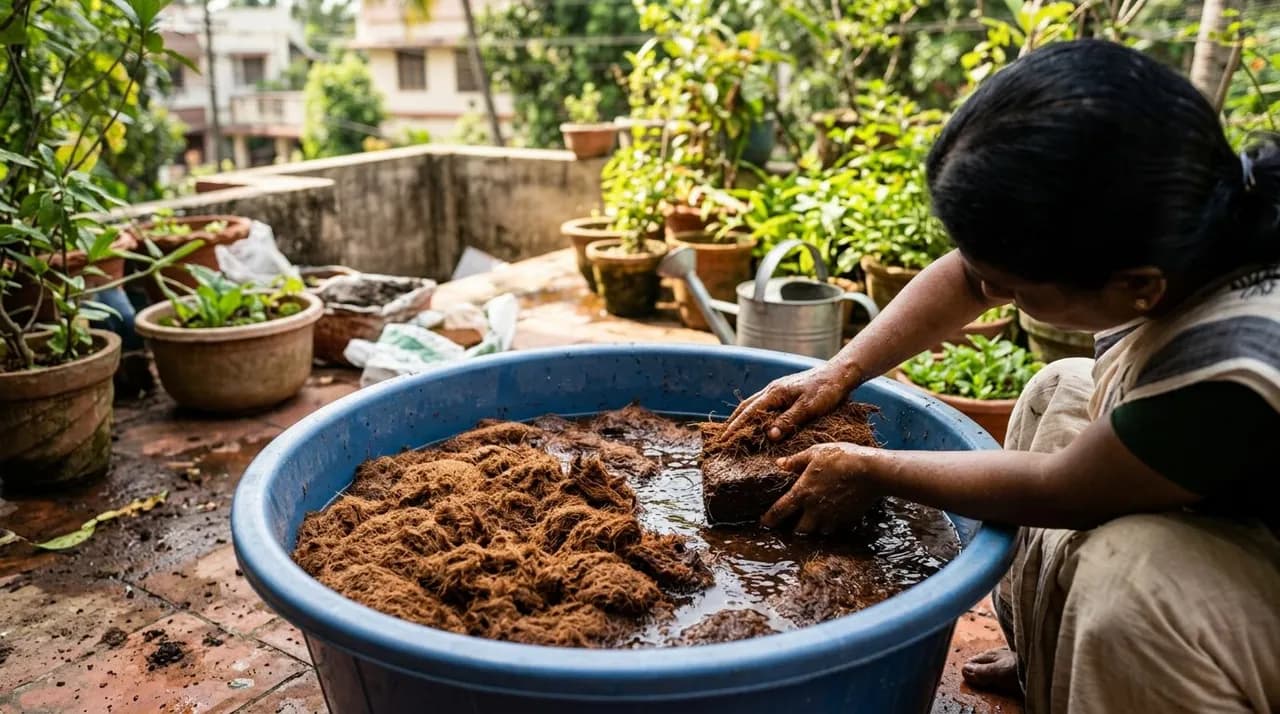
Step 1: Hydrating and expanding the block
- Place a 5 kg cocopeat block into a large plastic tub, drum, or wheelbarrow (minimum 100-litre capacity).
- Slowly pour 20 to 25 litres of clean, lukewarm water over the compressed block.
- Allow the brick to absorb water for 15 to 20 minutes. As the fibres swell, break apart the softening block with your hands or a small garden hand fork until the entire mass becomes loose, fluffy, and free of hard dry lumps. A single 5 kg block will yield approximately 60 to 75 litres of moist coir.
Step 2: The critical washing step (removing natural salts)
Coconut husk is naturally high in potassium, and most coir is retted (soaked for weeks) in brackish or sea water, which loads the pith with sodium chloride. Raw, unwashed cocopeat often has a high electrical conductivity (EC > 2.0 mS/cm), which causes severe leaf tip burn and stunts young seedling roots.
- Fill the tub with excess clean water until the expanded cocopeat is completely submerged.
- Stir thoroughly with your hands, then let the medium settle for 10 minutes.
- Scoop handfuls of cocopeat, squeeze out the brown, saline water firmly, and transfer the washed coir into a second clean container or basket.
- Repeat this rinsing process two to three times until the runoff water transitions from murky dark brown to pale, clear amber.
To prepare custom seedling flats and propagation media, compare these steps with our recommendations in diy seed mix for budget pots and our guide on seed starting for beginners.
Cocopeat vs garden soil: understanding the disadvantages
While cocopeat offers outstanding physical properties, it is not a direct substitute for fertile, living soil. Recognizing its limitations helps you avoid common growing mistakes.
Horticultural Trait | Washed Cocopeat | Traditional Garden Soil |
|---|---|---|
Nutrient Content | Unbalanced (no N or P; naturally high in K and Na) | Variable (contains natural minerals) |
Weight | Extremely lightweight | Heavy (dense mineral mass) |
Water Retention | High (about 8x dry weight) | Low to moderate (prone to runoff) |
Drainage & Aeration | High porosity | Low in clay; prone to compaction |
Microbial Life | Low in pathogens and microbial life | Rich in native microorganisms |
Common disadvantages of pure cocopeat
- Zero Natural Nutrition: A plant potted in 100% pure cocopeat will starve within weeks unless you provide complete synthetic or organic liquid fertigation.
- Cation Exchange Binding: Cocopeat naturally holds strong chemical bonding sites that bind calcium and magnesium ions while releasing excess potassium. This can induce calcium deficiency (manifesting as blossom end rot on tomatoes and capsicums) if not balanced with compost or bone meal.
- Over-Retention in Winter: During cold, damp periods of the rabi season, pure cocopeat remains wet for too long, potentially causing root chill and fungal diseases if plants are overwatered.
Ideal potting mix formulas for Indian gardens
To harness the moisture retention of cocopeat while providing rich, biological plant nutrition, always blend washed coir into balanced potting formulas:
1. General vegetable grow bag formula (tomatoes, brinjal, bhindi, chillies)
- 40% Washed Cocopeat: Provides moisture holding and keeps the mix light.
- 40% Aged Vermicompost or Well-Rotted Cow Dung Manure (Gobar ki Khaad): Supplies living microbes, humic acids, and balanced macro/micronutrients.
- 20% Quality Garden Soil or Coarse River Sand: Adds mineral structure and trace clay particles.
- Organic Additives: Blend in two cups of neem cake powder (neem khali) and 100 grams of steamed bone meal per 50 litres of mix to deter root-knot nematodes and deliver slow-release phosphorus.
2. Seed starting and microgreens blend
- 80% Washed Fine Cocopeat: Provides a soft, resistance-free medium for delicate emerging radicles.
- 20% Fine Sifted Vermicompost: Delivers a gentle starter nutrient charge.
3. Container fruit tree formula (lemons, guavas, dragon fruit)
- 20% to 30% Washed Cocopeat: Retains summer moisture without waterlogging.
- 40% Sandy Loam Garden Soil: Provides physical anchorage and mineral ballast for tall trees.
- 30% Aged Organic Compost and Manure: Fuels heavy fruit set.
Learn how to integrate this formula for heavy-yielding citrus in how to grow a lemon tree in a pot in India and for climbing cacti in how to grow dragon fruit at home.
Reusing, refreshing, and managing cocopeat
Cocopeat holds its pore structure for roughly two to four years in container culture before it slumps and needs replacing, particularly in the heat of an exposed terrace.
Rejuvenating spent potting mix between crops
When an annual crop (such as monsoon tomatoes or winter cauliflower) finishes its productive cycle, refresh the growing medium instead of discarding it:
- Empty the container and gently shake out large old root balls.
- Spread the used mix onto a clean tarpaulin, moisten it, and cover it with clear plastic sheet for three to four weeks in the summer sun. Trapped heat knocks back fungal spores and insect eggs. A couple of days loose in the sun only dries it out.
- Sift out dead root fragments using a wide garden sieve.
- Re-enrich the mix by adding 25% to 30% fresh vermicompost, one cup of neem cake powder, and a light dusting of agricultural lime or rock phosphate to replace calcium and phosphorus; the vermicompost restores organic carbon.
- Moisten the blended medium and refill your grow bags for the next seasonal sowing.
Using cocopeat as surface mulch
During peak summer (zaid) when concrete terrace temperatures soar past 42°C, apply a 3 cm to 5 cm layer of lightly moistened cocopeat across the surface of potted plants. It insulates the root zone, keeps soil temperatures down and slows evaporation. Keep it damp: coir that dries out completely turns water-repellent and sheds irrigation over the side of the pot.
By taking the time to thoroughly expand and wash compressed coir, balancing its structure with rich organic composts, and recharging spent mixes between seasons, cocopeat gives you a reliable base for a productive Indian terrace garden.