Key takeaways
- West-facing balconies in India receive the harshest solar exposure of the day, with direct, scorching afternoon sunshine from 1:00 PM to 6:30 PM.
- Avoid thin black plastic nursery pots that absorb radiant heat and cook delicate root balls; choose porous terracotta, thick ceramic, or light-coloured HDPE grow bags.
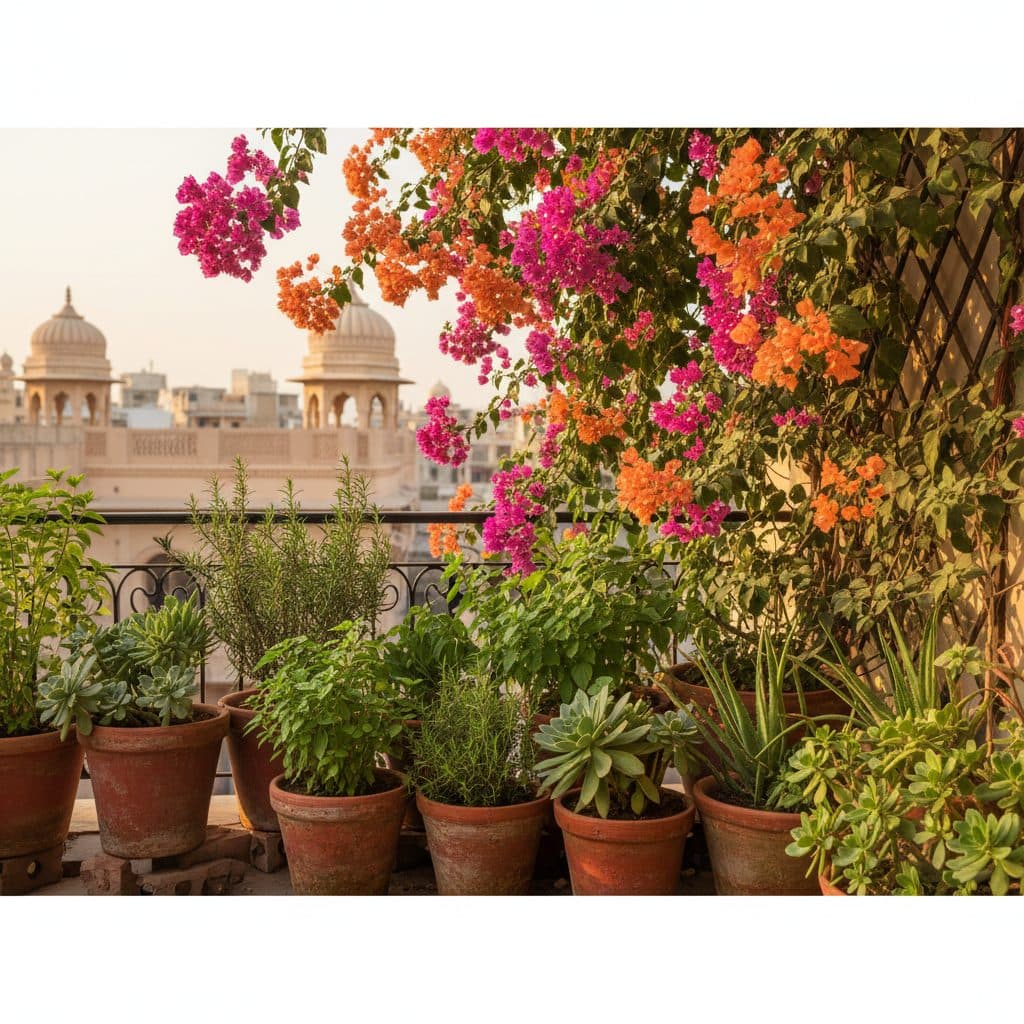
- Select sun-hardy flowering species such as Bougainvillea, Adenium (Desert Rose), Portulaca, and Plumeria (Champa) that thrive under intense solar radiation.
- Grow heat-resilient edibles and herbs including chillies (mirchi), brinjal, okra (bhindi), lemongrass, and sacred basil (Tulsi).
- Apply a 3 cm layer of coco coir chips, dried leaf mulch, or river pebbles over container soil to suppress surface evaporation and buffer root temperatures.
- Water thoroughly early in the morning before 8:00 AM, checking moisture again in the evening after concrete walls have cooled.
Quick answer: For a west-facing balcony in India, choose heat-tolerant plants capable of withstanding harsh afternoon sun and radiated concrete heat, such as Bougainvillea, Adenium, Portulaca, Tulsi, curry leaf, chillies, and brinjal. Use terracotta or light-coloured grow bags, add a moisture-retentive coco peat potting mix, mulch the surface, and water deeply in early morning.
A west-facing apartment balcony is often considered one of the most challenging growing environments for urban Indian gardeners. While east-facing balconies receive gentle morning light, west-facing balconies bear the full brunt of blazing afternoon solar radiation when ambient temperatures peak.
Selecting suitable west facing balcony plants means choosing species whose foliage and root systems are biologically adapted to intense heat, dry winds, and reflective concrete glare. In cities like Delhi, Ahmedabad, Hyderabad, or Mumbai, summer afternoon temperatures easily climb past 40°C, baking uninsulated pots and evaporating soil moisture within hours.
Selecting heat-adapted flowering shrubs, resilient herbs, hardy vegetables, and thermal-buffering containers helps keep plants productive even on a hot west-facing balcony.
+-------------------------------------------------------------+
|              WEST-FACING BALCONY THERMAL PROFILE            |
|                                                             |
|   TIME OF DAY       CONDITIONS             PLANT STRESS     |
|   -----------       ----------             ------------     |
|   Morning (8-12)    Cool, indirect shade   Low stress       |
|   Afternoon (1-5)   Blazing direct sun     Extreme heat & UV|
|   Evening (5-8)     Wall radiant heat      Slow cooling     |
+-------------------------------------------------------------+
Why are west-facing balconies challenging in Indian climates?
Understanding the microclimate of a west-facing balcony explains why standard shade-loving houseplants quickly develop scorched leaf margins and wither:
+-------------------------------------------------------------+
|                 WEST-FACING STRESS FACTORS                  |
|                                                             |
|   FACTOR            IMPACT ON PLANTS       SOLUTIONS        |
|   ------            ----------------       ---------        |
|   Late Sun Angle    Penetrates deep into   Erect vertical   |
|                     balcony interior       trellis & shades |
|   Thermal Radiation Concrete walls & floor Elevate on stands|
|                     bake pots after sunset Use terracotta   |
|   Hot Wind Exposure Accelerates moisture   Apply top mulch  |
|                     loss via transpiration Morning watering |
+-------------------------------------------------------------+- Intense afternoon UV radiation: The angle of the setting sun allows rays to penetrate deeply under balcony roofs, striking foliage at the hottest hour of the day.
- The concrete heat-sink effect: Concrete balcony slabs, brick parapets, and glass railings absorb heat all afternoon and slowly radiate that thermal energy back into container root systems well into the night.
- Container root baking: Thin plastic pots act as heat conductors, raising internal root ball temperatures above 45°C, causing root hair desiccation.
To plan broader layout strategies across urban spaces, explore our kitchen garden layout for Indian homes.
Which flowering and ornamental plants thrive in afternoon heat?
These resilient ornamental species love intense sunshine and bloom profusely under west-facing conditions:
+-------------------------------------------------------------+
|              HEAT-LOVING FLOWERING BALCONY PLANTS           |
|                                                             |
|   PLANT SPECIES     COMMON NAME      KEY ATTRIBUTE          |
|   -------------     -----------      -------------          |
|   *Bougainvillea*   Bougainvillea    Loves baking heat & dry|
|   *Adenium obesum*  Desert Rose      Thick caudex stores H2O|
|   *Portulaca grand* 9 O'Clock Flower Vibrant ground carpet  |
|   *Plumeria rubra*  Champa           Fragrant, drought hardy|
|   *Tagetes erecta*  Marigold (Genda) Attracts pollinators   |
|   *Euphorbia milii* Crown of Thorns  Year-round blooms      |
+-------------------------------------------------------------+
1. Bougainvillea (Bougainvillea spectabilis)
Bougainvillea thrives in hot sunshine and handles irregular watering well in Indian gardens, producing cascades of magenta, crimson, orange, and white papery bracts. Prune lightly after blooming to encourage dense branching.
2. Desert Rose (Adenium obesum)
A sculptural succulent shrub with a swollen water-storing base (caudex) and trumpet-shaped blossoms in shades of red, pink, and white. Thrives in porous terracotta pots with fast-draining gritty soil.
3. Portulaca / Moss Rose (Portulaca grandiflora)
Known across India as the "9 o'clock flower," these trailing succulents open bright blossoms every sunny morning and grow well in hanging baskets along sunny balcony railings.
4. Marigold (Tagetes erecta / Genda)
Marigolds thrive in full sunshine, providing continuous bright orange and yellow blossoms while deterring garden pests. Learn seed starting in how to grow marigold from seeds.
Which vegetables and culinary herbs tolerate harsh afternoon sun?
You can cultivate a productive edible garden on a west-facing balcony by selecting sun-loving Indian culinary staples:
+-------------------------------------------------------------+
|              EDIBLE CROPS FOR WEST-FACING SPACES            |
|                                                             |
|   CROP CATEGORY     RECOMMENDED SPECIES    POT SIZE (MIN)   |
|   -------------     -------------------    --------------   |
|   Fruiting Veg      Chillies, Brinjal, Okra 30x30 cm grow bag|
|   Climbing Gourds   Bottle Gourd, Karela   45x45 cm grow bag|
|   Aromatic Herbs    Tulsi, Curry Leaf,     25x25 cm pot     |
|                     Lemongrass, Ajwain                      |
|   Hardy Succulents  Aloe Vera, Sansevieria 20x20 cm pot     |
+-------------------------------------------------------------+- Chillies (Capsicum annuum / Mirchi): Chillies require intense solar energy to synthesize capsaicin and set abundant fruit. Grow in 30x30 cm pots in full sun.
- Brinjal (Solanum melongena / Baingan): A sun-loving Solanaceous heavy feeder that crops heavily when provided with regular moisture and nutrients. For potting techniques, see how to grow brinjal at home.
- Okra (Abelmoschus esculentus / Bhindi): Develops strong, deep taproots and thrives through peak 40°C summer heat without wilting.
- Sacred Basil (Tulsi - *Ocimum tenuiflorum) and Curry Leaf (Murraya koenigii / *Kadi Patta): Traditional Indian essentials that thrive in warm afternoon sunshine once root systems establish.
- Bottle gourd (Lagenaria siceraria / Lauki): Direct vigorous climbing vines along balcony railings for lush vertical greenery and fresh gourds. Follow our step-by-step method in how to grow bottle gourd.
For cool-season shallow herbs that can be grown along shaded balcony edges, explore how to grow methi in pots.
What container materials and potting mixes survive baking heat?
Container selection directly determines whether root systems survive the afternoon heat:
+-------------------------------------------------------------+
|                 CONTAINER MATERIAL EVALUATION               |
|                                                             |
|   MATERIAL          HEAT BEHAVIOUR         RECOMMENDATION   |
|   --------          --------------         --------------   |
|   Terracotta / Clay Porous; evaporative    EXCELLENT for all|
|                     cooling (dries fast)   balcony plants   |
|   White/Green HDPE  Reflective; fabric     EXCELLENT for veg|
|   Grow Bags         allows root aeration   and climbers     |
|   Thin Black Pot    Absorbs heat rapidly;  AVOID - Cooks    |
|                     root zone exceeds 45°C tender roots     |
+-------------------------------------------------------------+
The thermal-buffering potting mix
Standard garden soil turns into rock-hard clay under blistering sun. Use an aerated, moisture-retentive blend:
- 40% Washed Coco Peat: Holds up to eight times its weight in water, acting as a moisture reservoir for root hairs.
- 30% Aged Organic Manure: High-humus cow dung fertilizer (gobar khad) or vermicompost provides biological nutrients and improves soil texture.
- 28% to 29% Red Soil / Loam: Supplies mineral body and micronutrients.
- 1% to 2% Neem Cake Powder: Repels subterranean pests and fungal root pathogens (avoid high doses that can burn hot container roots).
+-------------------------------------------------------------+
|                 MULCHED CONTAINER CROSS-SECTION             |
|                                                             |
|   [ 3 cm Coco Chip / Pebble Mulch Layer (Moisture Lock) ]   |
|   -------------------------------------------------------   |
|   [ Aerated Potting Mix: Coco Peat + Gobar Khad + Neem ]    |
|   =======================================================   |
|   [ Porous Terracotta Pot on Brick Stand ]                  |
+-------------------------------------------------------------+
How should you schedule watering and sun protection?
Managing water and temperature stress during peak summer months (April to June) requires a consistent routine:
- Early morning watering: Water plants thoroughly before 8:00 AM. This ensures plants are fully turgid and hydrated before the afternoon heat arrives. Avoid watering foliage during peak midday heat; watering leaves in hot sun increases humidity around stressed tissue and can promote fungal problems, while applying cold water to baking soil causes root thermal shock; water the soil at the base early in the morning or in the evening.
- Evening soil check: Check pots again after 6:30 PM once concrete walls begin cooling down. If the top 2 cm of soil feels dry, apply a gentle drink of water.
- Surface mulching: Spread a 3 cm layer of coco coir chips, dried grass clippings, or smooth pebbles over the soil surface in every container. Mulching blocks direct sun rays from baking the potting soil and reduces daily evaporation by over 40%.
- Green shade nets (50%): During intense heatwaves in May and June when temperatures surpass 42°C, tie a 50% green agro-shade net across the western balcony opening to filter the harshest UV rays while maintaining ventilation.