secondary
Dragon fruit cactus
dragon fruit
Selenicereus undatus
- punjab plains
- sindh coast
International hardiness
- USDA 10-11
- RHS H1c
- AU: Tropical, Subtropical, Warm temperate
Where it grows — regional guide
| Zones / rating | Regional notes |
|---|---|
USDA 10-11 | Grown outdoors in southern Florida, southern California, and Hawaii; protect from winter frosts below 0 °C (32 °F) and intense desert sun scald. |
| Zones / rating | Regional notes |
|---|---|
H1c (5 to 10C) | No region-specific data yet |
| Zones / rating | Regional notes |
|---|---|
Tropical, Subtropical, Warm temperate | Cultivated across Queensland, the Northern Territory, and coastal New South Wales; monitor climbing vines to prevent smothering native remnant vegetation. |
| Zones / rating | Regional notes |
|---|---|
USDA 10-11 (USDA scale) Canada uses its own zone system; Canadian zones run roughly one lower than USDA. | No region-specific data yet |
| Zones / rating | Regional notes |
|---|---|
Punjab plains, Sindh coast | Pakistan:Commercial production expanding in coastal Sindh and southern Punjab; provide overhead shade cloth during extreme summer heatwaves exceeding 40 °C (104 °F). |
Dragon fruit cactus (Selenicereus undatus), historically classified as Hylocereus undatus, is a fast-growing, climbing succulent in the cactus family (Cactaceae). Commonly known as white-fleshed pitahaya, pitaya, or strawberry pear, the plant is indigenous to southern Mexico and Central America, though tropical cultivation has dispersed it across South America, Southeast Asia, northern Australia, and warm-temperate zones worldwide. The species is celebrated for its nocturnal flowers—among the largest in the plant kingdom—and its oblong fruits encased in bright pink peel with fleshy green scales.
In permaculture guilds and syntropic designs, dragon fruit is an understorey or mid-stratum climber. It ascends support trees or posts via adventitious aerial roots. Because the succulent stems store water and photosynthesise through Crassulacean Acid Metabolism (CAM), the plant conserves moisture efficiently. Integrated into multi-tiered orchards alongside deep-rooted companions like pigeon pea or ground succulents like aloe vera, Selenicereus undatus yields significant fruit biomass without competing heavily for deep soil moisture, provided strong supports carry its substantial weight.
Growing dragon fruit cactus
Dragon fruit prospers in tropical, subtropical, and mild warm-temperate climates within USDA Zones 10 through 11, holding an RHS rating of H1c. While established vines survive brief dips to 0 °C (32 °F), hard frosts kill succulent tips and prolonged cold causes stem collapse. Optimum growth occurs between 20 and 32 °C (68 and 90 °F). Temperatures exceeding 38 to 40 °C (100 to 104 °F) induce heat stress and severe sun scald, particularly in exposed desert environments. In such regions, providing 30 percent shade cloth during midsummer prevents tissue scorching and preserves floral buds.
Soil must be well-drained. The species tolerates sandy loams, volcanic soils, and limestone substrates across a pH range of 5.5 to 7.5. It cannot withstand waterlogging. Poorly drained clays lead directly to anaerobic conditions and root rot. Growers should amend beds with compost, decomposed leaf litter, and coarse grit. While drought-resistant once established, regular irrigation is vital for fruit sizing. Irrigate moderately during flowering, allowing the upper 5 cm (2 in) of soil to dry between waterings, and reduce applications during winter dormancy.
Because Selenicereus undatus is a heavy vine, it cannot support itself. Stems snap under their own mass if allowed to sprawl unsupported. Train one to four main stems up a reinforced concrete or rot-resistant timber post measuring 1.5 to 1.8 m (5 to 6 ft) in height, topped with a tyre frame or steel support ring. As stems reach the top, they cascade outward into an umbrella-shaped crown. A mature four-stem clump can weigh 50 to 100 kg (110 to 220 lb) at maturity, necessitating posts set in concrete footings. Space trellis posts 2.5 to 3 m (8 to 10 ft) apart within rows, with 3.5 to 4 m (11.5 to 13 ft) between rows.
Propagation relies predominantly on stem cuttings. Select healthy, mature cladode segments measuring 30 to 50 cm (12 to 20 in) in length. Allow the cut basal end to callous in a shaded space for seven to ten days before inserting the bottom 5 to 8 cm (2 to 3 in) into well-aerated potting media. Keep the substrate barely damp until roots form, usually within three to five weeks. Cuttings establish rapidly and produce initial fruit within 12 to 18 months, whereas seed-grown plants require three to five years.
Harvest and uses
Selenicereus undatus produces fruit throughout summer and early autumn in multiple flushes, ripening roughly 30 to 45 days after anthesis. The fruit is an oblong berry measuring 10 to 15 cm (4 to 6 in) long and weighing 300 to 800 g (0.66 to 1.76 lb). Harvest commences when the peel transitions from green to bright rose-pink, and the triangular bracts begin to soften. Because dragon fruit is non-climacteric and does not accumulate sugar after removal, harvest only when fully ripe. Sever the fruit flush with the stem using sharp pruning shears to avoid tearing skin.
Inside, the pulp is snow-white, translucent, juicy, and studded with hundreds of minute, edible black seeds that impart a pleasant crunch similar to kiwi. The flavour is mildly sweet with subtle floral notes, typically registering 12 to 16 degrees Brix in sunny conditions. The pulp is eaten fresh by slicing the fruit longitudinally and scooping out the flesh, or blended into smoothies, sorbets, and fruit salads.
Beyond fresh dessert use, unopened flower buds can be cooked as a vegetable in stir-fries or dried for infusions. The thick outer peel, while inedible raw due to bitter tannins, is sometimes pickled or extracted for natural betacyanin pigments. Mature trellis plantings yield 15 to 30 kg (33 to 66 lb) of fruit per post annually under diligent management.
Identifying dragon fruit cactus
Dragon fruit cactus is recognised by its distinctive architecture and nocturnal blossoms:
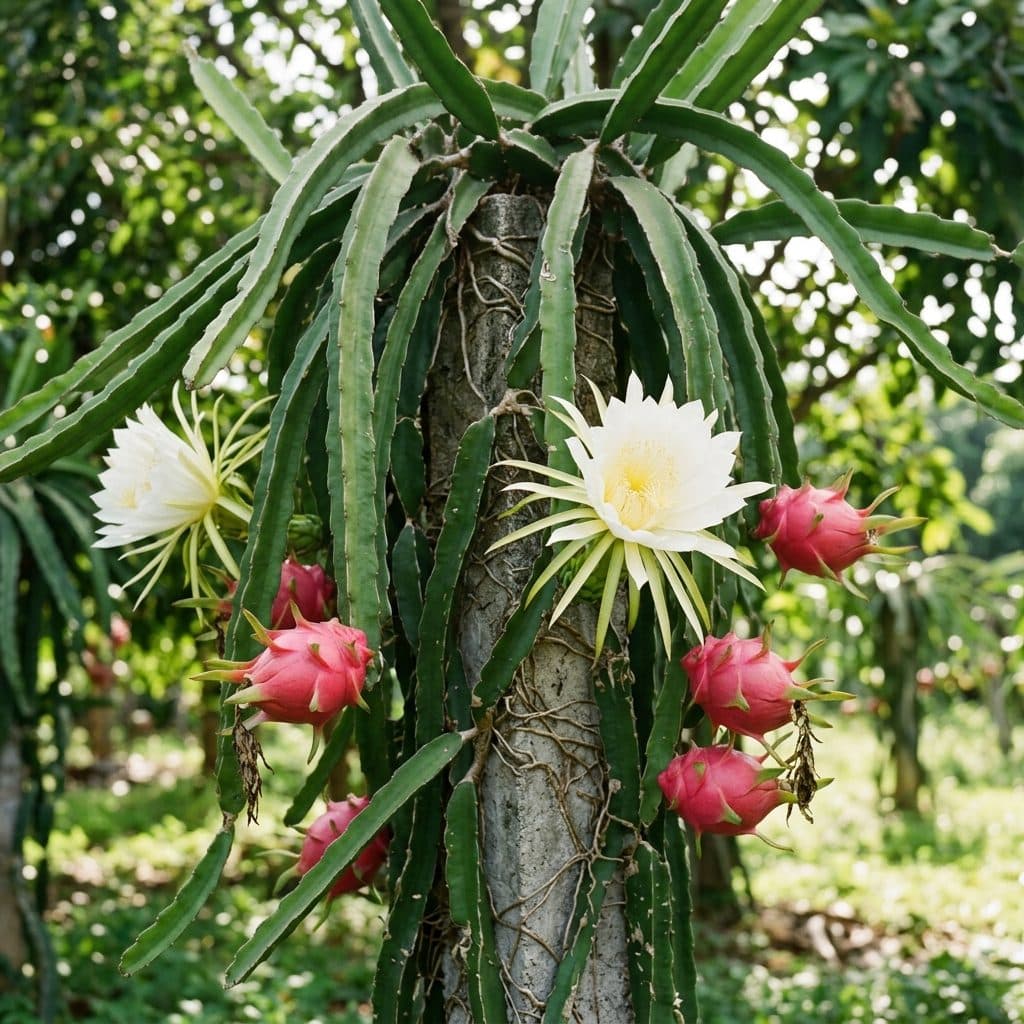
- Stems: The vegetative stems are segmented, fleshy, three-winged cladodes measuring 3 to 7 cm (1.2 to 2.8 in) across, with wavy, scalloped margins. In colour, they range from bright green to glaucous green. Aerial roots emerge from the underside of stems to anchor against supports.
- Areoles: Positioned along the winged margins at intervals of 3 to 5 cm (1.2 to 2 in), areoles bear 1 to 3 short spines measuring 2 to 4 mm (0.08 to 0.16 in) in length, which are greyish-brown to black.
- Flowers: Solitary nocturnal blossoms open at dusk and wilt by mid-morning. They are bell-shaped and enormous, measuring 25 to 30 cm (10 to 12 in) in length and up to 20 cm (8 in) across, with pale yellow-green outer sepals, broad white inner petals, and a central brush of hundreds of creamy stamens. They emit a sweet, vanillic fragrance to attract hawk moths and bats.
- Fruit: Large, oval, vibrant pink to red berries covered in fleshy, triangular green-tipped scales.
The species is distinguished from yellow dragon fruit (Selenicereus megalanthus), which possesses yellow skin and prominent spines on immature fruit, and from Selenicereus costaricensis, which features deep crimson-purple pulp.
Cautions
Growers cultivating Selenicereus undatus must observe several agronomic and structural cautions:
- Trellis collapse hazard: The rapid biomass accumulation of mature dragon fruit presents a serious mechanical hazard. A standard three- or four-stem trellis carries 50 to 100 kg (110 to 220 lb) of succulent vegetative mass, increasing substantially after rainfall. Lightweight wooden poles rot at the soil line, resulting in catastrophic collapse that shatters the vine. Always build supports using heavy reinforced concrete posts or treated steel tubing anchored in deep concrete.
- Stem rot diseases: Succulent cladodes are vulnerable to fungal and bacterial stem rots, predominantly caused by Neoscytalidium dimidiatum (stem canker), Colletotrichum gloeosporioides (anthracnose), and Enterobacter cloacae (soft rot). Symptoms include circular yellow-orange lesions that turn sunken, brown, and necrotic, leading to watery stem dissolution. Prevent infection by ensuring unhindered air circulation, avoiding overhead irrigation, and pruning out diseased branches with sterilised tools during dry weather.
- Puncture injury: The areoles along stem ridges produce short, sharp spines that easily pierce skin, causing painful puncture wounds that risk secondary bacterial infection. Wear heavy leather pruning gloves when handling cuttings and harvesting fruit.
- Sunburn and heat damage: In arid inland climates, solar radiation and ambient temperatures exceeding 38 °C (100 °F) cause severe sun scald, rendering stem tissue white, dry, and permanently necrotic. Erecting 30 percent shade netting during the hottest midsummer months is necessary in desert zones to maintain photosynthetic efficiency.
- Environmental weed potential: In warm, frost-free, humid island environments (such as parts of Hawaii and northern Australia), abandoned vines can climb native forest canopies, forming dense mats that shade out and break native trees. Check regional biosecurity guidelines and avoid planting adjacent to natural bushland corridors.
Sources
- Royal Botanic Gardens, Kew. Selenicereus undatus (Haw.) D.R.Hunt Plants of the World Online.
- University of Florida IFAS Extension. Pitaya Growing in the Florida Home Landscape EDIS Publication HS303.
- USDA PLANTS Database. Selenicereus undatus (Haw.) D.R. Hunt
- Missouri Botanical Garden. Hylocereus undatus