support
Perennial pinto peanut
Arachis pintoi
- sindh coast
International hardiness
- USDA 8-11
- RHS H2
- AU: Tropical, Subtropical, Warm temperate
Where it grows — regional guide
| Zones / rating | Regional notes |
|---|---|
USDA 8-11 | Thrives in Florida, the Gulf Coast, and Hawaii (USDA 8b–11); foliage freezes back under frost but stolons regenerate vigorously in early spring. |
| Zones / rating | Regional notes |
|---|---|
H2 (1 to 5C) | No region-specific data yet |
| Zones / rating | Regional notes |
|---|---|
Tropical, Subtropical, Warm temperate | Extensively sown in Queensland and northern New South Wales orchards and coastal pastures; highly tolerant of heavy grazing and mechanical mowing. |
| Zones / rating | Regional notes |
|---|---|
USDA 8-11 (USDA scale) Canada uses its own zone system; Canadian zones run roughly one lower than USDA. | No region-specific data yet |
| Zones / rating | Regional notes |
|---|---|
Sindh coast | Pakistan:Suitable as an orchard understorey in frost-free coastal Sindh; requires consistent moisture during hot summer dry spells to maintain stolon density. India:Used as an understorey cover crop in coffee, coconut, and rubber plantations to control soil erosion and suppress aggressive perennial weeds. |
Perennial pinto peanut (Arachis pintoi), also known as forage peanut, yellow peanut grass, or pinto peanut, is a low-growing, stoloniferous perennial legume in the family Fabaceae. Native to the Cerrado and seasonal river basins of central and eastern Brazil, this wild relative of the common groundnut was collected and developed for tropical and subtropical agriculture by agronomist Geraldo Pinto. It forms a dense, interlocking carpet with golden-yellow pea blossoms, and it is a widely used living mulch and high-protein forage legume across warm regions.
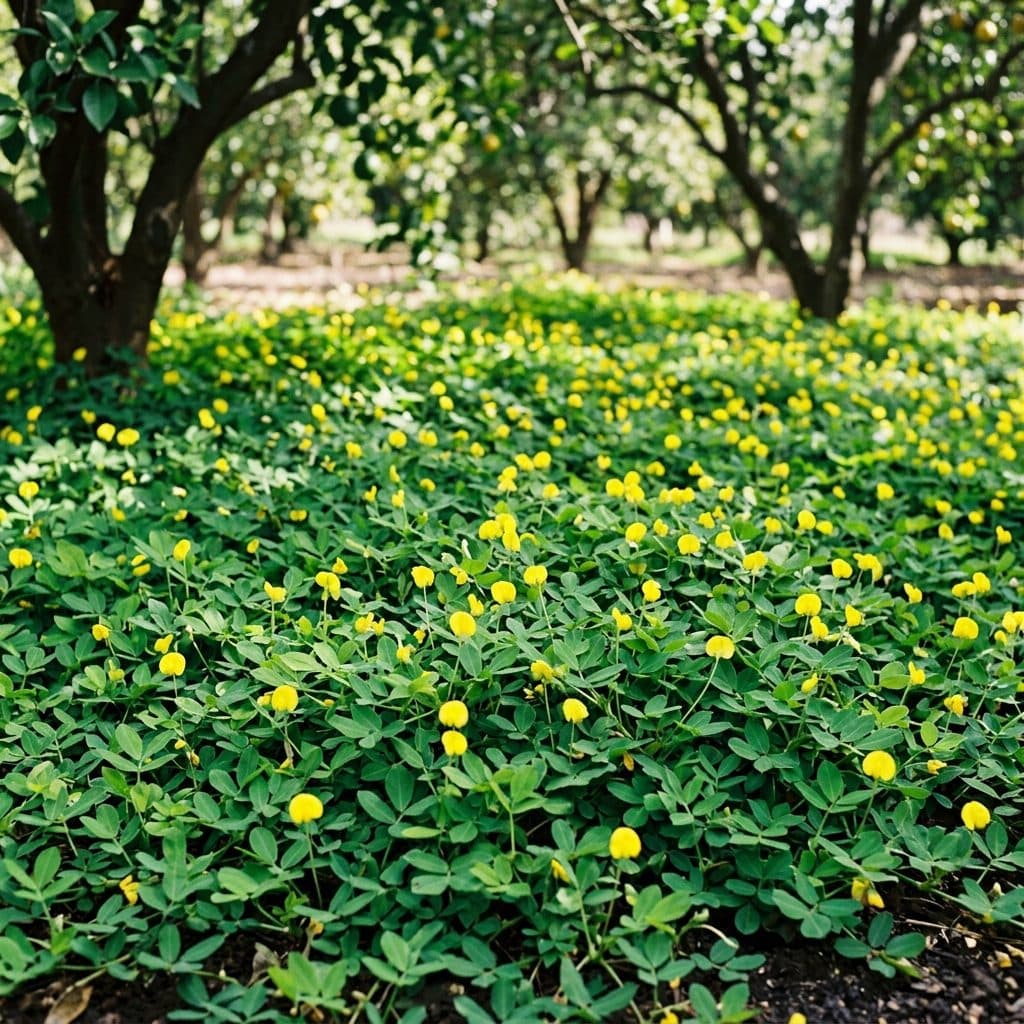
In orchard and agroforestry systems, Arachis pintoi delivers exceptional syntropic support. The prostrate stolons root adventitiously at every node, forming an impenetrable, carpet-like groundcover that smothers aggressive weeds and stabilises sloping topsoil against intense tropical rainfall. Its root nodules associate with Bradyrhizobium bacteria, fixing 150 to 250 kg of atmospheric nitrogen per hectare annually. This biological fertility directly benefits overstorey companion trees like banana or guava, cutting synthetic fertiliser needs while keeping soil temperatures cool and moist.
Growing perennial pinto peanut
Pinto peanut thrives in humid tropical, subtropical, and warm-temperate regions, performing reliably in USDA Zones 8b through 11 and rated RHS H2. Above-ground foliage is sensitive to frost, scorching and dying back when temperatures fall below -2 °C (28 °F). However, the protected stolons and subterranean crowns withstand brief freezes down to -6 °C (21 °F), regenerating new leaves rapidly once spring warmth returns. It requires warm soil temperatures above 18 °C (64 °F) for vigorous active growth, flourishing where annual rainfall ranges from 1,000 to 3,000 mm (40 to 120 in).
Soil adaptability is one of its greatest strengths. The plant grows successfully in nutrient-poor, acid oxisols and ultisols with high aluminium saturation, as well as neutral alluvial loams and sandy soils across a pH range of 4.5 to 7.2. It tolerates low available phosphorus better than most tropical legumes. While it requires good internal drainage to avoid root rot, it survives temporary waterlogging and seasonal inundation for several days without harm. In contrast to many sun-obligate legumes, Arachis pintoi exhibits remarkable shade tolerance, retaining 80 percent of its yield under 30 to 50 percent tree canopy shade.
The ground cover forms a dense mat 10 to 20 cm (4 to 8 in) deep, with individual creeping stolons extending 1 to 1.5 m (3.3 to 5 ft) across the surface in a single season. Establishment is achieved through vegetative stolon cuttings or scarified pod segments. For rapid orchard coverage, plant unrooted stolon runners 15 to 20 cm (6 to 8 in) long at a spacing of 30 to 50 cm (12 to 20 in) in moist soil at the start of the rainy season. Seed establishment requires shallow drilling of podded seeds at 8 to 12 kg per hectare (7 to 11 lb per acre) into clean seedbeds. Once rooted, it forms an interlocking turf within three to five months.
Harvest and uses
In livestock systems, perennial pinto peanut provides high-value forage. The foliage contains 16 to 22 percent crude protein and displays dry matter digestibility of 60 to 70 percent. It is grazed by cattle, sheep, goats, horses, and free-range poultry without causing bloat. Its stolons stay low to the ground and root deeply, allowing it to withstand heavy, continuous grazing and close mechanical mowing down to 5 cm (2 in) height without stand depletion.
In orchards and food forests, it is a persistent living mulch. Rather than harvesting the plant, growers allow it to continuously carpet the understorey beneath citrus, avocado, and macadamia groves. Periodic mowing with a mulching deck deposits high-nitrogen clippings around tree drip lines, releasing potassium and nitrogen precisely when trees undergo fruit swell. Furthermore, in residential homesteads, Arachis pintoi is increasingly planted as a flowering lawn alternative that requires zero synthetic nitrogen fertiliser and substantially less mowing than conventional turf grasses.
Like its cultivated relative Arachis hypogaea, Arachis pintoi produces small underground pods via geocarpic pegs. After pollination, the flower stem elongates downward, pushing the young pod 2 to 5 cm (0.8 to 2 in) beneath the soil surface. The subterranean seeds are small, measuring 8 to 10 mm (0.3 to 0.4 in) long; while technically edible if extracted and roasted, their tiny size and dispersed underground habit make human food harvesting impractical.
Identifying perennial pinto peanut
Arachis pintoi is easily recognised by the following morphological details:
- Growth form: A prostrate, herbaceous perennial forming a dense, creeping mat 10 to 20 cm (4 to 8 in) high. The green to purplish cylindrical stolons root firmly at each node upon contacting moist earth.
- Leaves: Alternate, tetrafoliolate compound leaves consisting of two pairs of broadly obovate to elliptic leaflets. Leaflets measure 2.5 to 5 cm (1 to 2 in) long and 1.5 to 3 cm (0.6 to 1.2 in) wide, with smooth margins, a rounded apex, and fine marginal hairs. Leaves close upward along the rachis at night.
- Flowers: Bright canary-yellow, pea-like papilionaceous flowers measuring 1.2 to 2 cm (0.5 to 0.8 in) across, held 2 to 5 cm (0.8 to 2 in) above the foliage on slender tubular hypanthia. Blooming continues steadily from spring through late autumn whenever moisture is present.
- Underground fruit: One- or two-segmented, cylindrical geocarpic pods measuring 1 to 1.5 cm (0.4 to 0.6 in) long and 0.5 cm (0.2 in) wide, connected by a thin subterranean peg. Each pod segment contains a single cream to light-brown oblong seed.
It is distinguished from common groundnut (Arachis hypogaea) by its perennial creeping stolons (cultivated peanut is an erect or spreading annual) and much smaller, single-segmented subterranean pods.
Cautions
Growers should consider the following management constraints before establishing Arachis pintoi:
- Winter frost limits: The plant cannot survive frozen ground. In USDA Zone 8a and colder, prolonged freezing of topsoil kills crowns and stolons. In marginal frost zones (USDA 8b and 9a), foliage turns brown and dies back during winter, leaving exposed soil subject to winter weed invasion until warm spring regrowth begins.
- Competition with low-growing vegetables: The dense, creeping stolons spread relentlessly over adjacent soil. If planted too close to annual vegetable beds, it will overgrow and smother low-growing, non-competitive vegetables and shallow-rooted herbs. Install physical borders or edge regularly with a spade.
- Slow early establishment: While extremely aggressive once established, initial growth from seed or cuttings is slow during the first two months. During this establishment window, weeds must be hand-pulled or suppressed with temporary organic mulch to prevent young stolons from being shaded out.
- Pest susceptibility: In light, sandy subtropical soils, the root system is susceptible to root-knot nematodes (Meloidogyne species), which can cause localised stunting. Rhizoctonia foliar blight occasionally affects dense, un-mown mats during extended periods of hot, stagnant, waterlogged humidity.
Sources
- Royal Botanic Gardens, Kew. Arachis pintoi Krapov. & W.C.Greg. Plants of the World Online.
- USDA PLANTS Database. Arachis pintoi Krapov. & W.C. Greg. - Pinto peanut
- University of Florida IFAS Assessment. Arachis pintoi
- Feedipedia. Pinto peanut (Arachis pintoi)
- Plants For A Future. Arachis pintoi