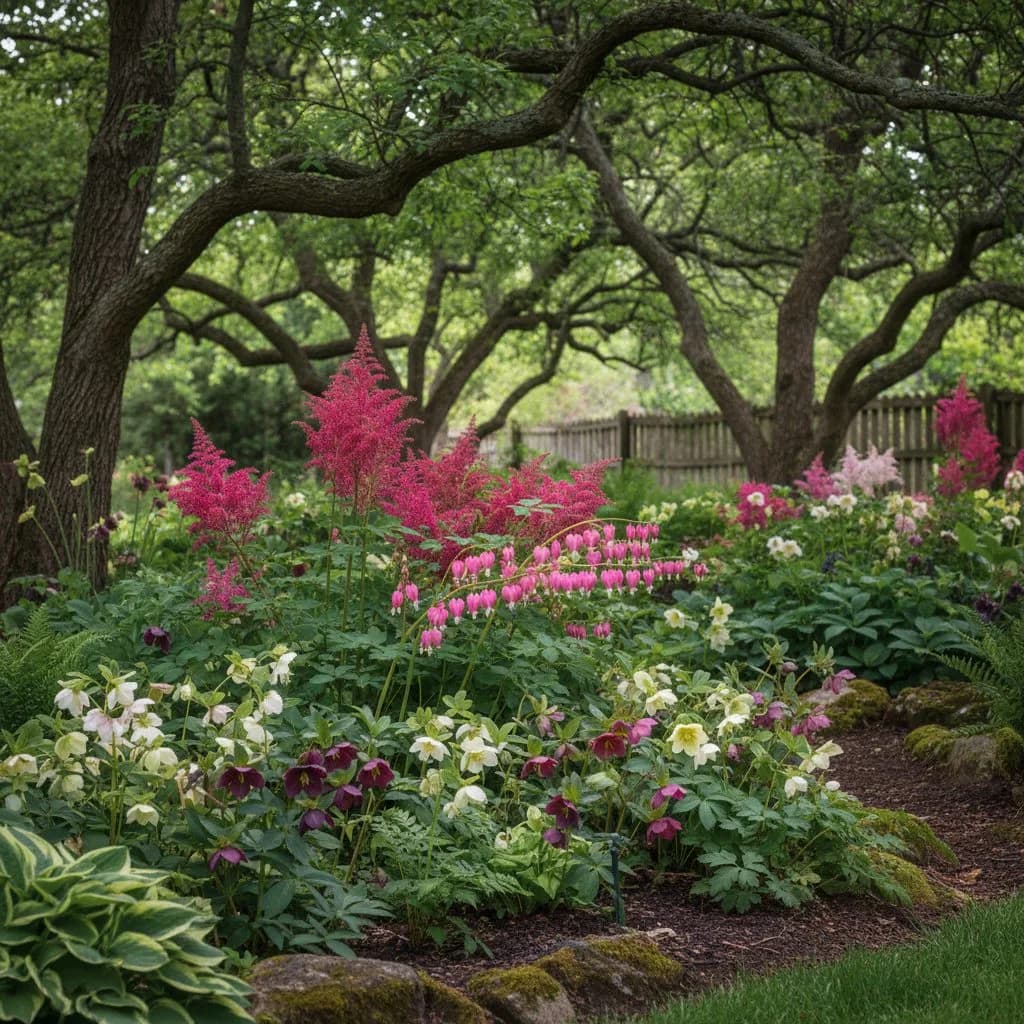
Key takeaways
- Split deep shade into two distinct habitats before buying plants: dry root-competed shade under maples and beeches (DLI 2–5 mol/m²/d) versus cool, damp north-wall or woodland shade (DLI 3–8 mol/m²/d).
- Never rototill or dig 6–8 inches deep under mature shade trees: severing shallow feeder roots stresses the tree, so tuck small starter plugs into root gaps and top-dress with 1–2 inches of leaf mold kept clear of the trunk flare.
- Pair summer-dormant spring ephemerals (Mertensia virginica, Dicentra) with persistent structural companions (Helleborus, Brunnera, Tiarella, Heuchera, Polystichum) and later bloomers (Astilbe, Aruncus) so July beds never show bare gaps.
- Ban toxic and invasive shade spreaders: Convallaria majalis carries lethal cardiac glycosides across every part plus aggressive rhizomes, while Vinca minor and Lamium galeobdolon escape into native woods.
- Skip Hosta (Rutgers Category D: frequently severely damaged) in heavy deer corridors and build around Category A and B performers such as Helleborus, Epimedium, Brunnera, Dicentra, Polystichum, Astilbe, and Heuchera.
Quick answer: True deep shade delivers less than 2 hours of direct sun and a Daily Light Integral (DLI) below 5 to 8 mol/m²/d, so flower output depends on separating dry root-competed tree shade from moist north-wall shade. Under shallow-rooted maples and beeches, plant small plugs of Epimedium, Helleborus, and Christmas fern (Polystichum acrostichoides) into natural root pockets rather than tilling. In moist, humus-rich north-side beds, bridge spring ephemerals like Virginia bluebells (Mertensia virginica) and bleeding heart (Dicentra) with season-long Brunnera, Tiarella, Heuchera, Astilbe, and Aruncus—while banning toxic Convallaria majalis (cardiac glycosides), invasive Vinca minor and Lamium galeobdolon, and deer-candy Hosta where white-tailed deer roam.
Why Deep Shade Is Two Different Habitats (DLI Below 5–8 mol/m²/d)
Most shade gardening advice treats every dark corner alike, prescribing the same compost depth and a blanket inch of weekly water. In reality, US yards across USDA Zones 3 through 9 experience two physically opposite versions of deep shade, both receiving fewer than 2 hours of direct sun and a Daily Light Integral (DLI) below 5 to 8 mol/m²/d.
DLI measures cumulative photosynthetically active photons hitting a square meter across 24 hours. Open midday summer sun delivers 40 to 60 mol/m²/d, dappled tree light drops to 10 to 15 mol/m²/d, and dense deep shade falls to 2 to 8 mol/m²/d. Inside that low-photon band, open sky exposure against a north brick wall still supplies bright ambient diffuse light (4–8 mol/m²/d), whereas a tight canopy of sugar maples, Norway maples, or American beeches filters out over 90% of sky light (dropping DLI to 2–5 mol/m²/d) while intercepting summer rain.
Dry Root-Competed Tree Shade vs. Moist North-Wall and Woodland Deep Shade
Site Factor | Dry Root-Competed Deep Shade (<2 hr Sun) | Moist North-Wall / Woodland Deep Shade |
|---|---|---|
Typical Location | Under mature maples, beeches, oaks, or dense conifers | North house walls, alleyways, bottomland woodland edges |
DLI Light Band | 2–5 mol/m²/d under summer canopy; higher in March–April | 4–8 mol/m²/d from unobstructed northern overhead sky |
Root Competition & Moisture | Severe: dense feeder mats drink rain before perennials root | Low to moderate; slow evaporation holds spring/fall dampness |
Soil Prep Rule | Never till 6–8 in deep; plant 2–3 in plugs in root pockets + 1–2 in leaf mold | Top-dress 2–3 in leaf mold or compost; crown-check winter drainage |
Primary Failure Mode | Desiccation wilt in July–August (Astilbe and Brunnera scorch) | Winter crown rot in wet clay; slug grazing on tender shoots |
Top Perennial Anchors | Epimedium, Helleborus, Polystichum acrostichoides, Carex, Asarum | Astilbe, Brunnera, Tiarella, Mertensia, Dicentra, Aruncus, Heuchera |
Protect mature tree feeder roots: Do not rototill or bury shallow maple and beech roots under 6 inches of raised bed soil. Severing surface feeder roots invites decline, and burying the trunk flare cuts off root oxygen. Instead, nest small landscape plugs into soil gaps between roots, water deeply during year one, and maintain only 1 to 2 inches of shredded tree-leaf mold.
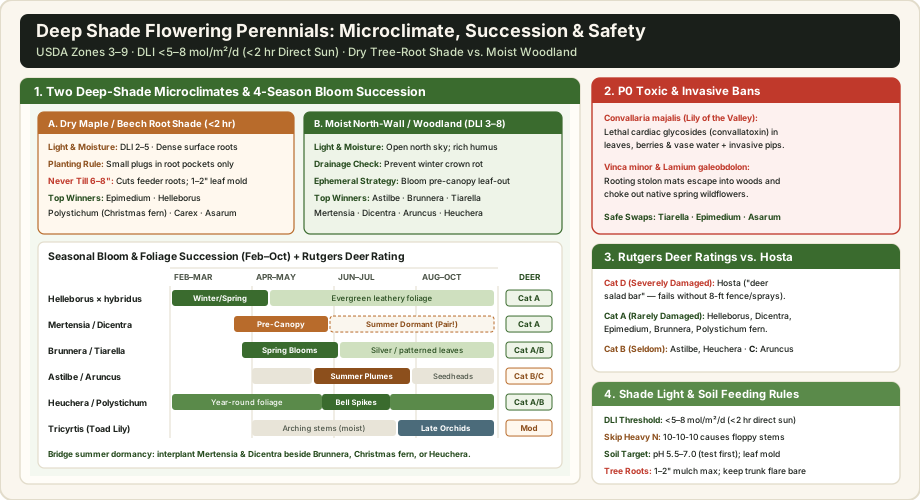
Pairing Spring Ephemerals With Season-Long Flowers and Foliage
Under deciduous trees, deep shade has a bright spring window before oak and maple leaves unfurl in May. Spring ephemerals evolved to exploit that brief 10 to 15 mol/m²/d surge—emerging, flowering, setting seed, and retreating underground before July canopy closure. Planting ephemerals alone leaves bare dirt for five months, so pair every spring ephemeral with persistent foliage perennials as outlined in our woodland shade garden guide.
Early bloomers that vanish by midsummer vs. multi-season anchors
Old-fashioned bleeding heart (Lamprocapnos spectabilis) and native Virginia bluebells (Mertensia virginica) deliver unmatched April–May flowers in rich woodland beds, yet their leaves yellow and disappear by early July, especially south of USDA Zone 6. Native fringed bleeding heart (Dicentra eximia) holds lacy foliage longer into summer when soil stays moist, making it a strong bridge between pure ephemerals and late-season perennials.
Interplant Mertensia and Lamprocapnos directly beside expanding mounds of Helleborus × hybridus, silver-veined Brunnera macrophylla, and evergreen Christmas fern (Polystichum acrostichoides). As bluebells melt back in June, Brunnera leaves reach 15 to 18 inches wide and cover the dormant crown naturally without disturbing underground roots. Add Astilbe plumes in June–July and towering Aruncus dioicus (goat's beard) or late-summer toad lily (Tricyrtis hirta) to push blooms into autumn.
Deep-Shade Flowering & Foliage Perennials: Moisture Fit, Bloom Window & Rutgers Deer Rating
Species / Genus | USDA Zones | Habitat Fit | Bloom & Foliage Window | Mature Size (H × W) | Rutgers Deer Rating |
|---|---|---|---|---|---|
Helleborus × hybridus (Lenten Rose) | 4–9 | Dry shade once established; well-drained neutral soil | Feb–Apr flowers; leathery evergreen leaves year-round | 12–18 in × 18–24 in | A (Rarely damaged) |
Epimedium spp. (Barrenwort) | 4–8 | Champion of dry maple & beech root-competed shade | Apr–May spurred flowers; semi-evergreen bronzed foliage | 8–15 in × 15–24 in | A (Rarely damaged) |
Mertensia virginica (Virginia Bluebells) | 3–8 | Moist deciduous woodland floor; pre-canopy sun | Apr–May sky-blue bells; goes dormant by July | 12–24 in × 12–18 in | A (High resistance) |
Dicentra eximia / Lamprocapnos spectabilis | 3–9 | Moist humus-rich woodland shade; cool roots | Apr–Jun heart lockets; native eximia persists longer | 12–36 in × 15–36 in | A (Rarely damaged) |
Brunnera macrophylla (Siberian Bugloss) | 3–8 | Moist north-wall or rich shade (scorches if bone dry) | Apr–May blue sprays; silver heart leaves to Oct | 12–18 in × 18–24 in | A (Rarely damaged) |
Tiarella cordifolia (Foamflower) | 3–8 | Moist to average acidic woodland shade (pH 5.5–6.5) | Apr–Jun white bottle-brush spikes; lobed groundcover | 6–12 in × 12–24 in | High (rarely grazed) |
Heuchera spp. (Coral Bells, green/woodland) | 4–9 | Well-drained partial to deep shade; avoid wet winter crown | May–Jul airy wands; semi-evergreen scalloped mounds | 8–18 in × 12–20 in | B (Seldom damaged) |
Astilbe × arendsii / chinensis | 3–8 | Consistently moist north walls & damp edges | Jun–Aug feathery plumes; fern-like summer leaves | 14–36 in × 15–24 in | B (Seldom damaged) |
Aruncus dioicus (Goat's Beard) | 3–7 | Moist deep woodland shade; shrub-sized backdrop | Jun–Jul creamy white panicles; bold compound foliage | 48–72 in × 36–60 in | C (Occasionally damaged) |
Polystichum acrostichoides (Christmas Fern) | 3–9 | Dry or moist deep shade; tolerates tree root competition | Non-flowering evergreen fronds year-round | 15–24 in × 18–24 in | A (Rarely damaged) |
When choosing Heuchera for deep shade under 5 mol/m²/d, avoid ultra-dark purple cultivars that fade muddy green in low light. Pick green-leaved eastern natives (Heuchera americana, Heuchera villosa hybrids) or chartreuse cultivars paired with silver Brunnera ('Jack Frost', 'Looking Glass') and spotted Pulmonaria (lungwort) so foliage reflects scattered sky light across dark corners. See best plants for full shade and dry shade plants for maples and pines for expanded shrub and fern combinations.
P0 Safety and Ecological Warnings: Toxic Lookalikes and Invasive Bans
Many legacy shade lists still pitch fast-spreading European groundcovers without flagging severe poisoning hazards or regional invasive bans. In residential yards with kids, pets, or wooded borders, three popular shade plants carry unacceptable risks.
P0 Toxicity & Invasive Alert — Ban Convallaria majalis: Lily of the valley (Convallaria majalis) contains potent cardiac glycosides (including convallatoxin, convallarin, and convallamarin) across its leaves, stems, fragrant white bells, bright red autumn berries, underground rhizomes, and even cut-flower vase water. Ingestion triggers irregular heart rhythm, vomiting, and potentially fatal cardiac toxicity in children and pets, while its dense rhizomatous pips escape beds to smother native woodland ephemerals—never confuse its emerging spring shoots with edible wild ramps (Allium tricoccum), which smell unmistakably of garlic and onion.
Hazardous or Invasive Deep-Shade Groundcovers to Avoid and Safe Native Replacements
Avoid / Ban Species | Primary Hazard or Ecological Harm | Mechanism of Spread | Safe Deep-Shade Replacement |
|---|---|---|---|
Convallaria majalis (Lily of the Valley) | P0 cardiac glycoside toxicity (leaves, berries, vase water) + invasive woodland monoculture | Aggressive underground creeping pips (rhizomes); hard to dig out cleanly | Tiarella cordifolia, Polygonatum biflorum, Epimedium, or edible ramps (Allium tricoccum) |
Vinca minor (Lesser Periwinkle) | Listed invasive across eastern/Midwest woods; forms dense mats choking spring natives | Trailing evergreen stolons rooting at every node + yard-waste dumping | Asarum canadense (wild ginger), Packera aurea, or green-leaved Heuchera |
Lamium galeobdolon / Lamiastrum (Yellow Archangel) | Noxious/invasive weed of concern in Pacific Northwest, Midwest, and Northeast forests | Prostrate runners + tiny stem fragments resprouting when mowed or composted | Brunnera macrophylla (silver-leaf clumps) or non-running Pulmonaria cultivars |
Watch out for variegated cultivars sold under benign-sounding names like Lamiastrum galeobdolon 'Hermann's Pride' or 'Silverfrost': extension weed programs in Washington, Oregon, and Wisconsin warn that even variegated selections root from clipped fragments and escape into adjacent greenbelts. Stick to clumping perennials or native woodland covers highlighted in ground cover for shade and evergreen ground cover.
Deer Resistance vs. Hosta Browse in Deep Shade
Gardeners routinely default to Hosta as the backbone of a shaded border, only to watch white-tailed deer shear plants to bare petioles overnight. Rutgers Cooperative Extension's Landscape Plants Rated by Deer Resistance places Hosta squarely in Category D (Frequently Severely Damaged)—the highest-risk tier on the scale. Because deer travel shaded woodland edges at dawn and dusk, unfenced Hosta beds act as browse magnets across suburban and rural properties.
Substituting Rutgers Category A (Rarely Damaged) and Category B (Seldom Severely Damaged) perennials builds a naturally unpalatable shade garden without constant repellent sprays. Helleborus foliage contains bitter protoanemonin and alkaloids that deer reject year-round; Dicentra carries isoquinoline alkaloids; Epimedium and Brunnera pair tough or bristly leaves with low palatability; and Christmas fern (Polystichum acrostichoides) or ostrich fern fronds stand untouched even during winter scarcity. For high-pressure woodland borders, consult our deer-resistant plants guide and physical barrier specs in deer-proofing fences and plants.
- Category A deep-shade backbone (minimal browse): Helleborus × hybridus, Epimedium spp., Brunnera macrophylla, Dicentra eximia / Lamprocapnos spectabilis, Mertensia virginica, and Polystichum acrostichoides.
- Category B & C choices (light nipping possible under starvation): Astilbe spp. (Category B), Heuchera spp. (Category B), and Aruncus dioicus (Category C—protect young May shoots briefly with liquid repellents).
- If you refuse to give up Hosta: Cluster susceptible Hosta cultivars close to patio doors or inside an 8-foot woven-wire deer exclusion, and read our organic vertebrate pest control guide for rotating scent deterrents.
Soil Preparation, Moisture Matching, and Feeding Rules Without Tree Damage
Before spreading sulfur, lime, or granular fertilizer across a shady yard, run a lab test as detailed in how to read a soil test. Most woodland perennials—including Astilbe, Tiarella, Dicentra, and Aruncus—thrive in slightly acidic soil between pH 5.5 and 6.5, whereas Helleborus performs best in neutral to slightly alkaline soil (pH 6.2 to 7.2). If a test shows strongly acidic clay below pH 5.5 around hellebores, adjust gradually using adding lime to soil or build clay drainage with composted bark fines.
Why heavy fertilizer ruins deep-shade flowers
Under low DLI below 5 to 8 mol/m²/d, plants are carbon-limited by light, not starved of synthetic nitrogen. Dumping high-nitrogen `10-10-10` or `5-10-5` granular feeds onto deep-shade perennials forces weak, elongated, floppy stems that collapse in rain and produce fewer flower stalks. Skip blind synthetic salts altogether. Instead, top-dress each spring with 1 to 2 inches of finished compost or aged leaf mold—paying careful attention to avoid black walnut leaf mold, whose juglone stunts sensitive companion species—and let native mycorrhizal fungi cycle nutrients smoothly.
- Plant small plugs in root zones: Under mature maples and beeches, buy 2-to-4-inch nursery plugs or bare-root crowns rather than heavy 2-gallon pots, slipping roots between tree roots with minimal soil disturbance.
- Water by habitat, not calendar: Check soil 4 inches deep with a finger or trowel. Moist north-wall Astilbe and Brunnera beds need roughly 1 inch of combined rain and drip irrigation weekly during July heat, whereas established Epimedium and Helleborus prefer soil to dry slightly between deep soakings to prevent crown rot.
- Leave shredded fall leaves in place: Shred fallen oak or maple leaves with a mower and return a 1.5-to-2-inch blanket each autumn (keeping crowns clear) as a natural no-dig mulch that mimics forest duff.
- Divide overcrowded clumps selectively: Every 3 to 5 years in early spring or autumn, lift overgrown Astilbe, Heuchera, or Hosta using our perennial division guide; leave deep taprooted Helleborus and Dicentra undisturbed unless relocating.
For chronically waterlogged low spots along north downspouts, match moisture-loving perennials from plants for soggy spots alongside Astilbe and Aruncus, or compare regional heat and winter chill strategies in shade plants for hot south vs. cool north and low-maintenance perennials.
Design Blueprint: Building a 3-Tier Deep Shade Border That Blooms February to October
Rather than scattering one of every plant, arrange deep-shade borders in repeating drifts of three to five across three structural heights. Bright whites, silvers, chartreuse leaves, and pale blues glow in shade under 8 mol/m²/d where deep crimson or dark purple blossoms disappear into shadow after dusk.
- Back structural tier (30–72 in, moist shade): Plant Aruncus dioicus or tall Astilbe chinensis ('Purpurkerze' or 'Visions') behind the bed, or anchor woodland edges with native understory shrubs like pawpaw, elderberry, serviceberry, or shade-tolerant red currant where morning sun filters through.
- Mid flowering & ephemeral tier (12–24 in): Weave Helleborus × hybridus (February–April flowers) alongside Brunnera macrophylla, Dicentra eximia, Mertensia virginica, and late-blooming Tricyrtis hirta so every square foot blooms at least twice across the growing season.
- Front groundcover & dry-edge tier (6–15 in): Edge dry maple roots with Epimedium and Polystichum acrostichoides, or carpet moist soil with Tiarella cordifolia, woodland Heuchera, and non-invasive native wild violets or perennial division offshoots.
Check regional bloom timing and frost hardiness in best perennials and pair ground-plane plantings with north-facing porch containers if shallow concrete slabs or tree roots block in-ground digging near entryways.