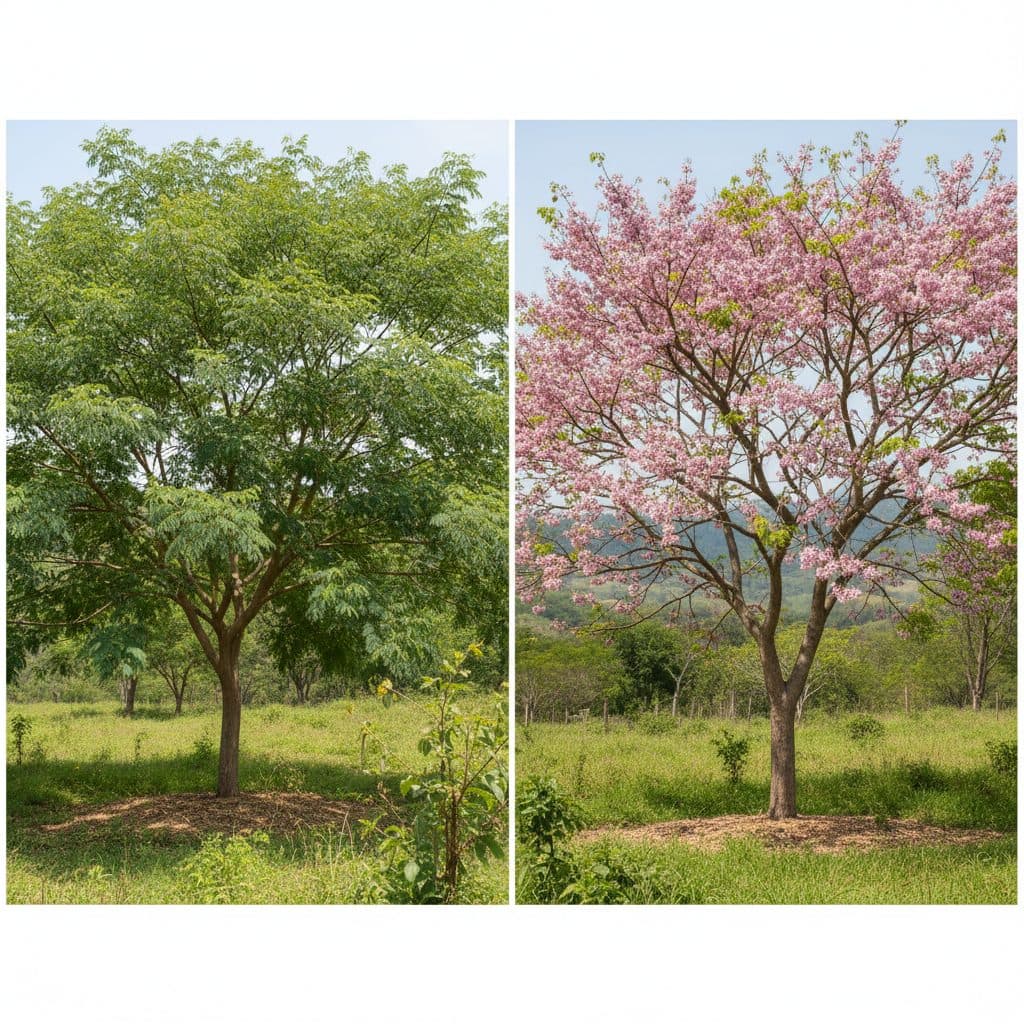
Key takeaways
- Leucaena (Leucaena leucocephala) and Gliricidia (Gliricidia sepium) are two widely planted fast-growing, nitrogen-fixing legume trees in tropical and subtropical agroforestry.
- Leucaena produces high-protein livestock fodder with 25% to 30% crude protein and high digestibility, but contains the non-protein toxic amino acid mimosine.
- Restrict Leucaena intake to less than 30% of total diet in ruminants unless herds carry the detoxifying rumen bacterium Synergistes jonesii; never feed to non-ruminants (horses, pigs, poultry). Synergistes jonesii inoculants can lose viability in storage or fail to persist through long dry seasons, so monitor herds for toxicity signs (salivation, hair loss, poor weight gain) even after inoculation.
- Leucaena is an environmental weed across northern Australia; planting is subject to the Leucaena Code of Practice and local biosecurity regulations.
- Gliricidia is free of mimosine and exhibits remarkable tolerance to acidic, aluminium-toxic, and waterlogged soils (pH 4.5 to 6.5) where Leucaena fails.
- Gliricidia propagates readily from large hardwood truncheons (stakes) placed directly into the ground to establish living fence posts.
- Wilt freshly cut Gliricidia foliage for three to six hours prior to feeding livestock to allow volatile coumarin aromatic compounds to dissipate, significantly improving feed palatability.
Quick answer: In comparing Leucaena vs Gliricidia for tropical agroforestry, Leucaena is a high-protein fodder tree for neutral-to-alkaline soils (subject to weed biosecurity codes in northern Australia and requiring mimosine management), while Gliricidia excels on acidic, low-fertility soils, resists psyllid pests, and easily propagates from large cuttings as living fence posts.
In tropical and subtropical farming systems, woody legume trees provide multiple functions. They fix atmospheric nitrogen in root nodules, cycle deep subsoil nutrients to the surface, provide high-protein livestock forage during dry seasons, and supply rot-resistant timber and fuel.
Choosing between leucaena and gliricidia depends on site conditions and production goals for tropical smallholders, silvopastoral ranchers, and permaculture growers. While both species produce large volumes of green biomass through repeated coppicing, their soil tolerances, toxicity, and propagation methods differ.
Both species serve in contour hedgerows to slow hillside soil erosion, in intensive protein banks for livestock, and as chop-and-drop support trees in food forests.
+-------------------------------------------------------------+
|              LEUCAENA VS GLIRICIDIA COMPARISON              |
|                                                             |
|   FEATURE           LEUCAENA               GLIRICIDIA       |
|   -------           --------               ----------       |
|   Botanical Name    *Leucaena leucoceph.*  *Gliricidia sep.*|
|   Common Names      Subabul, Ipil-ipil     Quickstick, Cacao|
|   Crude Protein     25% to 30% (Very High) 20% to 25% (High)|
|   Toxicity Factor   Mimosine (Toxic to mon)Coumarin (Odor)  |
|   Soil Tolerance    Neutral-Alkaline (6-8) Acid Soils (4.5-6|
|   Propagation       Scarified seed         Hardwood stakes  |
|   Psyllid Pest Res. Highly Vulnerable      Immune to Psyllid|
|   Living Fence Post Poor from stakes       Outstanding root |
+-------------------------------------------------------------+
How do soil, climate, and pest resilience compare?
Soil chemistry is the primary environmental filter determining which species will flourish on your land:
+-------------------------------------------------------------+
|                 ENVIRONMENTAL TOLERANCE MATRIX              |
|                                                             |
|   FACTOR            LEUCAENA LEUCOCEPHALA  GLIRICIDIA SEPIUM|
|   ------            ---------------------  -----------------|
|   Soil pH Range     6.0 to 8.0 (Alkaline)  4.5 to 6.5 (Acid)|
|   Aluminium Toxicity Extremely Sensitive   Highly Tolerant  |
|   Drought Tolerance High (Deep taproot)    High (Deciduous) |
|   Waterlogging      Poor (Needs drainage)  Moderate (Survive|
|   Pest Pressure     Leucaena Psyllid bug   Virtually None   |
+-------------------------------------------------------------+
1. Soil acidity and aluminium saturation
- Leucaena: Thrives in neutral, limestone, and coral-derived alkaline soils with a pH between 6.0 and 8.0. It is severely stunted by acidic soils (pH below 5.5) where soluble aluminium ions inhibit root development.
- Gliricidia: Adapted to weathered tropical Ultisols and Oxisols. It tolerates high aluminium saturation and acidic conditions down to pH 4.5, maintaining active nitrogen fixation where Leucaena perishes.
2. Pest vulnerability: the psyllid threat
In the late 20th century, the global spread of the Leucaena psyllid (Heteropsylla cubana), a tiny sap-sucking insect, devastated monoculture Leucaena stands across Asia, Africa, and the Pacific. While psyllid-tolerant Leucaena hybrids (such as 'KX2' or Leucaena diversifolia) are now available, Gliricidia is completely immune to the psyllid, making it a safer single-species investment in psyllid-prone regions.
For comparing tropical woody legumes with temperate dynamic accumulators, see comfrey vs borage.
How do fodder quality, protein, and toxicity differ?
Both trees provide invaluable green forage during prolonged dry seasons when pasture grasses dry up, but they require different feeding protocols:
+-------------------------------------------------------------+
|                 LIVESTOCK NUTRITION & TOXICITY              |
|                                                             |
|   NUTRITIONAL FACTOR LEUCAENA              GLIRICIDIA       |
|   ------------------ --------              ----------       |
|   Crude Protein      25% to 30%            20% to 25%       |
|   In Vitro Digestion 60% to 70%            55% to 65%       |
|   Palatability       Immediate, very high  Acquired / Wilted|
|   Primary Antinutrient Mimosine (Amino acid)Coumarin & Tannin|
|   Monogastric Safety TOXIC (Mimosine loss) TOXIC (Do not feed)
+-------------------------------------------------------------+
1. Leucaena and the mimosine challenge
Leucaena foliage contains mimosine, a non-protein amino acid that disrupts cell division:
- Non-ruminants (Pigs, Horses, Poultry): Highly toxic. Mimosine causes alopecia (hair and feather loss), poor weight gain, and cataracts. Never feed Leucaena to horses or donkeys, and restrict poultry rations to under 5% of dry matter.
- Ruminants (Cattle, Goats, Sheep): Rumen microbes convert mimosine into DHP (3,4-dihydroxypyridine), a goitrogenic compound. In regions where the specific rumen bacterium Synergistes jonesii is present, DHP is fully degraded, allowing cattle to consume diets containing up to 50% to 60% Leucaena. Without this bacterium, limit Leucaena to less than 30% of daily dry matter to avoid thyroid enlargement and weight loss. Note that Synergistes jonesii cultures can lose viability during transport/storage or fail to persist across extended dry seasons when leucaena is out of diet; monitor herds regularly for hair loss, excess salivation, and goitre.
2. Gliricidia and the coumarin wilting protocol
Gliricidia foliage and bark contain toxic compounds (including coumarins that can convert to dicoumarol if spoiled during wilting or ensiling) and should not be fed to monogastrics (horses, pigs, poultry). Sheep and goats tolerate it well once adapted, and cattle will eat it, though some refuse fresh un-wilted leaves because of the smell:
- The wilting solution: Cut Gliricidia branches in the morning and allow the leaves to wilt in the shade for three to six hours before feeding. Wilting allows volatile coumarins to evaporate, dramatically improving feed intake.
- Rodent toxicity: The bark, seeds, and pulverized roots contain toxic coumarin derivatives historically used as a natural rodent poison (giving rise to its Spanish common name Mata Ratón, or "mouse killer").
+-------------------------------------------------------------+
|                 GLIRICIDIA WILTING PROTOCOL                 |
|                                                             |
|   [ Cut Branches @ Morning ] ---> [ Shade Wilt 3-6 Hours ]  |
|                                         |                   |
|                                         v                   |
|   [ Eager Livestock Intake ] <--- [ Coumarin Odor Dissipated|
+-------------------------------------------------------------+
To incorporate nitrogen-fixing biomass into broader agricultural systems, see syntropic farming principles and syntropic chop-and-drop species by zone.
How do propagation and living fence setups compare?
Establishment speed and labor requirements also differ between the two species:
+-------------------------------------------------------------+
|                 PROPAGATION & ESTABLISHMENT                 |
|                                                             |
|   METHOD            LEUCAENA LEUCOCEPHALA  GLIRICIDIA SEPIUM|
|   ------            ---------------------  -----------------|
|   Primary Method    Seed (Hot water scar.) Large Truncheons |
|   Seedling Speed    Slow initial root dev. Instant canopy   |
|   Living Fence Use  Requires wired posts   POST ITSELF ROOTS|
|   Coppice Regrowth  Rapid (3-4 cuts/year)  Rapid (3-4 cuts) |
+-------------------------------------------------------------+
1. Gliricidia: living fence posts ("Quickstick")
Gliricidia earned its common name "Quickstick" from how readily its vegetative cuttings root:
- Cut mature, straight hardwood branches (truncheons) 1.5 to 2.0 metres (5 to 6.5 feet) long and 5 to 10 cm (2 to 4 inches) in diameter during the dormant season.
- Drive the cut stakes 30 to 40 cm (12 to 16 inches) vertically into the ground along pasture boundaries at 2-metre intervals.
- The stakes will sprout vigorous root systems and green canopies within four to six weeks, creating living, rot-proof fence posts capable of holding barbed wire while yielding regular fodder harvests.
+-------------------------------------------------------------+
|                 LIVING FENCE POST ANATOMY (GLIRICIDIA)      |
|                                                             |
|                 \   |   /  (Lush Coppice Fodder)            |
|                  \  |  /                                    |
|             [ Hardwood Truncheon (1.5-2.0 m Tall) ]         |
|             |======= Barbed Wire Stapled to Bark ===|       |
|             |                                       |       |
|             |======= Barbed Wire Stapled to Bark ===|       |
|      =======|=======================================|=====  |
|            / \ (Stakes Root Directly into Subsoil) / \      |
+-------------------------------------------------------------+
2. Leucaena propagation
Leucaena seeds possess a hard, waxy, impermeable seed coat:
- Scarification: Immerse seeds in near-boiling water (80°C / 176°F) for two to three minutes, followed by soaking in cool water for 24 hours prior to sowing.
- Leucaena does not root reliably from large truncheons and must be established from seed trays or direct field seeding.
- Biosecurity regulations: Check state and national biosecurity lists before propagating or moving seed of either species. In Australia, unauthorised movement of Leucaena seed or planting outside approved pastoral zones is restricted under the Leucaena Code of Practice.
For multi-tier canopy interactions with nitrogen fixers, see the comparisons in food forest vs orchard and what is a food forest.
How do regional tropical climates guide species selection?
Matching your agroforestry design to regional moisture and soil regimes optimizes production:
In humid tropical lowlands, where soils are weathered, acidic, and subject to high annual rainfall (over 1,500 mm / 60 in annually), Gliricidia sepium performs reliably. It tolerates heavy acid clays, resists psyllid blights, and provides shade and green manure for cocoa, coffee, and vanilla agroforests.
In sub-humid and semi-arid tropics, where soils are neutral to limestone-alkaline and dry seasons span four to six months with under 1,000 mm (40 in) of rain, Leucaena leucocephala grows effectively. Its deep vertical taproots penetrate fractured rock up to 5 metres (16 ft) deep, drawing subsoil moisture and maintaining high-protein green foliage throughout dry seasons.