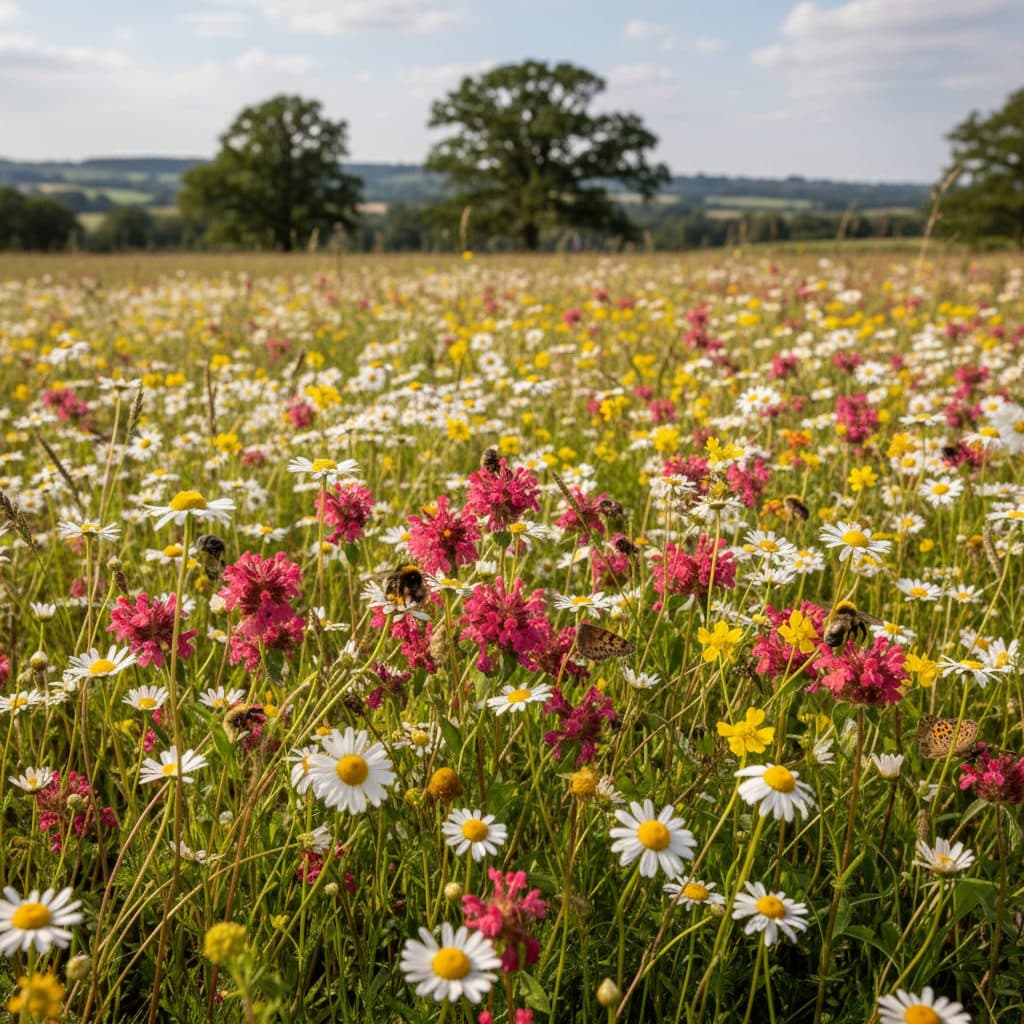
Key takeaways
- Sow perennial wildflower meadows in early autumn (September to October) to allow natural winter frost to break seed dormancy through vernalization.
- Reduce soil fertility before sowing; high-nitrogen soils cause coarse pasture grasses and nettles to outcompete delicate native wildflowers.
- Introduce Yellow Rattle (Rhinanthus minor), a hemi-parasitic annual that taps into grass roots, reducing grass vigor by up to 50 percent.
- Broadcast an 80:20 seed mix (80 percent non-competitive fine grasses, 20 percent native perennial wildflowers) at a rate of 3 to 5 grams per square metre.
- Execute an annual "hay cut" in late August or September, leaving cut stems on the ground for seven days to shed seed before raking off all arisings.
Quick answer: Learning how to create a wildflower meadow in the UK involves selecting low-fertility ground, preparing a fine weed-free seedbed, and sowing native seed mixtures in autumn. Sow a balanced mix containing Yellow Rattle (Rhinanthus minor) to suppress vigorous turf grasses, broadcast seed at 4 grams per square metre, and roll firmly into the surface. Maintain the meadow with a late-summer annual cut-and-collect mowing regime.
Traditional British hay meadows and species-rich chalk grasslands have declined by over 97 percent since the mid-twentieth century due to intensive agricultural pasture improvement and chemical fertilizers.
Creating a mini-meadow or wildflower lawn in a suburban garden, community orchard, or allotment boundary re-establishes critical corridors for native solitary bees, hoverflies, butterflies, and seed-eating finches.
However, establishing a perennial meadow is fundamentally different from growing a flower bed. Wildflowers demand poor, un-manured soil and careful grass management to prevent vigorous rye grasses from swamping delicate native forbs.
Perennial meadow vs annual cornfield display
Before preparing ground, decide whether you want a permanent perennial meadow or a temporary annual cornfield display.
+-------------------------------------------------------------------+
|               MEADOW TYPE ARCHITECTURAL COMPARISON                |
|                                                                   |
| [Perennial Grassland Meadow]        [Annual Cornfield Display]    |
| Permanent, multi-year ecosystem     Single-season annual burst    |
| Oxeye daisy, knapweed, trefoil      Poppy, cornflower, marigold   |
| Requires low-fertility soil         Tolerates fertile garden soil |
| Sown in autumn with Yellow Rattle   Sown in spring on bare earth  |
| Mowed once annually in late summer  Cultivated/dug each spring    |
+-------------------------------------------------------------------+
+------------------------+-----------------------------------+-------------------------+
| Species Class | Representative Native Plants | Ecological Role |
+------------------------+-----------------------------------+-------------------------+
| Semi-Parasitic Forb | Yellow Rattle (*Rhinanthus minor*)| Grass suppression |
| Perennial Wildflowers | Oxeye Daisy, Bird's-foot Trefoil | Nectar & larval food |
| Fine Non-Aggressive Grass| Crested Dogstail, Slender Red Fescue| Structural matrix |
| Cornfield Annuals | Field Poppy, Corncockle, Cornflower| Fast first-year colour |
+------------------------+-----------------------------------+-------------------------+For permanent biodiversity, invest in a true perennial meadow mix supported by fine native companion grasses.
Reducing soil fertility: the foundation of meadow success
Native British wildflowers are adapted to nutrient-poor soils. When sown into fertile garden loam, aggressive turf grasses (like perennial ryegrass) absorb available nitrogen and rapidly shade out slow-growing wildflowers.
+-------------------------------------------------------------------+
|               METHODS TO REDUCE SOIL FERTILITY                    |
|                                                                   |
| 1. Turf Stripping (Small): Remove top 5 cm of nutrient-rich turf; |
|                            sow directly into exposed low subsoil. |
|2. Cut-and-Collect Mowing: Repeated close mowing with all clippings|
|                            removed over 1-2 seasons to draw N out.|
| 3. Nutrient Depletion Crop: Grow unfertilized mustard or brassicas|
|                            and haul away all vegetative growth.   |
+-------------------------------------------------------------------+
Never add garden compost, manure, or fertilisers to a meadow area. For large areas, stripping topsoil is impractical; instead, deplete nutrients through rigorous cut-and-collect mowing or introduce Yellow Rattle into scarified turf. For small garden patches, removing the top 5 cm of turf with a spade or turf cutter before cultivating exposes low-nutrient soil.
For non-chemical ground preparation, follow techniques in weed smart sowing stale seedbed.
The role of Yellow Rattle (Rhinanthus minor)
Yellow Rattle is often called the "meadow maker." It is a native annual plant whose root systems parasitize the roots of surrounding coarse grasses, drawing out water and mineral nutrients to reduce grass biomass by 50 to 60 percent.
+-------------------------------------------------------------------+
|               YELLOW RATTLE GRASS-SUPPRESSION CYCLE               |
|                                                                   |
|   [Autumn Sowing] ---> MUST sow Sep-Nov; needs 12 wks cold (<5°C) |
|           |                                                       |
|           v                                                       |
|   [Spring Sprout] ---> Roots attach to vigorous grass roots       |
|           |                                                       |
|           v                                                       |
|   [Summer Bloom]  ---> Weakens grass canopy; opens soil light gaps|
|           |                                                       |
|           v                                                       |
|   [Late-Summer]   ---> Seed pods rattle; drop seeds for next year |
+-------------------------------------------------------------------+
Always use fresh Yellow Rattle seed harvested within the current year, as seed viability drops significantly after twelve months. Yellow Rattle seed requires cold winter stratification (below 5°C for several months) to break dormancy; spring-sown seed will fail to germinate.
Seedbed preparation, seed mixes and sowing rates
Perennial meadow seed should be sown at a much lower density than domestic lawn turf.
+------------------------+-------------------------------------------------------------+
| Sowing Parameter       | British Meadow Standard                                     |
+------------------------+-------------------------------------------------------------+
| Sowing Density         | 3 to 5 grams per square metre (0.5 oz per sq yd)            |
| Mix Composition        | 80% Fine Fescues & Bents + 20% Native Wildflower Seeds      |
| Ideal Sowing Window    | September to October (Autumn) or March to April (Spring)    |
| Seedbed Tilth          | Firm, fine, level crumb; rolled before and after sowing     |
+------------------------+-------------------------------------------------------------+
+-------------------------------------------------------------------+
| STEP-BY-STEP MEADOW SOWING PROCEDURE |
| |
| 1. Bulk the Seed: Mix seed with clean sharp sand (1:4 ratio) |
| to ensure even broadcasting across the bed. |
|2. Split Batches: Divide seed into two equal portions; broadcast |
| one half north-to-south, the second east-to-west.|
| 3. Surface Press: DO NOT rake seed deep into soil. Wildflower |
| seeds require light to germinate. |
| 4. Firm Roller: Walk over with flat shoes or use a lawn roller |
| to press seed firmly into soil contact. |
+-------------------------------------------------------------------+Autumn sowing is strongly recommended across the UK. Autumn rains keep the seedbed moist without artificial watering, while winter frosts satisfy the chilling requirements of perennial seed coats.
Pair meadow borders with dedicated insect habitats from beetle banks bug hotels overwintering predators and explore overall sanctuary designs in wildlife garden ideas.
Selecting native British wildflower species
Match your seed selection to your site's underlying soil geology.
+--------------------+-------------------------+-------------------------+------------------------+
| Soil Condition     | Top Indicator Species   | Botanical Name          | Flower Colour          |
+--------------------+-------------------------+-------------------------+------------------------+
| Neutral Loam       | Oxeye Daisy             | *Leucanthemum vulgare*  | Crisp white / yellow   |
| Neutral / Calcic   | Common Knapweed         | *Centaurea nigra*       | Purple thistle-like    |
| Heavy Clay / Damp  | Meadow Buttercup        | *Ranunculus acris*      | Glossy yellow          |
| Heavy Clay / Damp  | Cuckooflower (Lady's)   | *Cardamine pratensis*   | Pale lilac             |
| Acidic / Sandy     | Betony, Sheep's Sorrel  | *Betonica officinalis*  | Magenta                |
| Calcareous / Chalk | Wild Marjoram, Field Scabious | *Knautia arvensis*| Pale pink, mauve       |
+--------------------+-------------------------+-------------------------+------------------------+
Include nitrogen-fixing native legumes such as Bird's-foot Trefoil (Lotus corniculatus) and Red Clover (Trifolium pratense), which serve as essential caterpillar food plants for the Common Blue butterfly (Polyommatus icarus).
Discover high-nectar planting strategies in plants for pollinators.
The annual "hay cut" and first-year management
A newly established meadow requires different mowing care during its first twelve months compared to subsequent mature seasons.
+-------------------------------------------------------------------+
|               MEADOW MOWING MANAGEMENT TIMELINE                   |
+-------------------------------------------------------------------+
| [Year 1 Sward]    Cut to 7-10 cm every 6-8 weeks when growth reaches|
|                   15 cm to knock back weeds and strengthen roots  |
| [Year 2+ Spring]  Optional light spring trim (7 cm) in March/April|
| [Year 2+ Summer]  Main flowering season: NO MOWING, allow blooming|
| [Late Aug - Sep]  The Main "Hay Cut": Scythe or strim down to 5 cm|
| [7-Day Rest]      Leave cut hay on ground to shed seed            |
| [Post-Drying]     Rake off and remove ALL arisings from site      |
+-------------------------------------------------------------------+
Why you must remove the cut arisings
Never leave cut grass cuttings to rot down on a wildflower meadow. Decomposing grass releases rich nitrogen and organic mulch back into the soil, raising fertility and encouraging rank weed grasses that will smother next season's wildflowers. Always rake off and remove all dried hay arisings.
+-------------------------------------------------------------------+
|            LIVESTOCK TOXICITY WARNING: MEADOW PLANTS              |
+-------------------------------------------------------------------+
| If hay or meadow grazing is used for horses, cattle, or sheep,    |
| inspect carefully for Common Ragwort (Jacobaea vulgaris).    |
| Ragwort contains pyrrolizidine alkaloids causing irreversible     |
| liver failure in livestock. While bitter when fresh, dried ragwort|
| in hay loses its bitterness while retaining lethal toxicity.      |
| Hand-pull and dispose of all ragwort and Foxglove (*Digitalis*)   |
| before taking a hay cut or admitting grazing livestock.           |
+-------------------------------------------------------------------+
Integrate your meadow with native water features described in building small backyard wildlife pond to build a connected wildlife haven across your garden.