Key takeaways
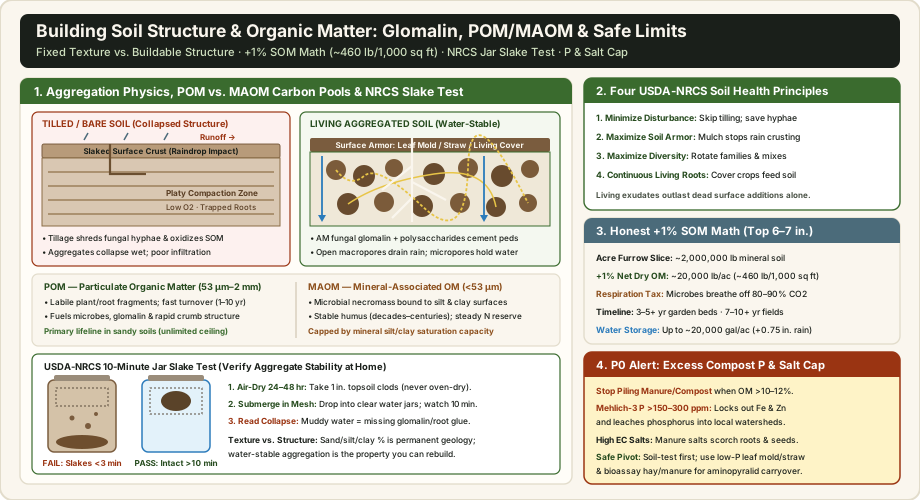
- Mineral soil texture is fixed; buildable soil structure—macro-aggregates glued by AM fungal glomalin, polysaccharides, and living root exudates—drives drainage, aeration, and drought resilience.
- Manage two carbon pools: fast labile POM (53 µm–2 mm) powers microbial glue and sandy-soil porosity, while silt-and-clay-bound MAOM (<53 µm) stores decades-long humus up to mineral saturation.
- +1% SOM in the top 6–7 in. (2,000,000 lb/ac furrow slice) equals ~20,000 lb/ac (~460 lb/1,000 sq ft) dry organic matter—taking 3–5+ years in garden beds after 80–90% microbial respiration while storing up to ~20,000 gal/ac of water.
- P0 Guardrail: piling manure-based compost above 10–12% OM drives Mehlich-3 P past 150–300 ppm (locking out Fe/Zn and polluting watersheds) and spikes soluble salts; test soil first and pivot to low-P fungal leaf mold or straw.
- Verify water-stable crumbs at home with the 10-minute USDA-NRCS Jar Slake Test and protect glomalin networks with the four USDA-NRCS Soil Health Principles.
Quick answer: Soil texture (your sand, silt, and clay ratio) stays permanent, while soil structure—water-stable aggregates cemented by arbuscular mycorrhizal fungal glomalin, bacterial polysaccharides, and root exudates—responds quickly to management. Apply all four USDA-NRCS soil health principles to build fast POM and durable MAOM carbon, budget 3 to 5+ years for a real +1% SOM gain (~20,000 lb/ac or ~460 lb/1,000 sq ft dry organic matter holding up to ~20,000 gal/ac of water), and soil-test before adding manure-rich compost that pushes Mehlich-3 phosphorus past 150–300 ppm.
Soil Texture vs. Soil Structure: Why Glomalin Beats Rototilling
Generic garden advice boils soil building down to piling on compost and tilling deep. In real beds, that habit crusts heavy clay and overloads veteran raised beds with phosphorus and salts. Durable improvement begins by separating permanent soil texture from buildable soil structure.
Soil texture is your fixed geological proportion of sand (`0.05–2.0 mm`), silt (`0.002–0.05 mm`), and clay (`<0.002 mm`) plotted on the soil texture triangle. You cannot alter native texture practically without hauling out your topsoil—mixing play sand into clay packs into concrete rather than loamy soil.
Soil structure is how those mineral particles clump into porous crumbs called aggregates. Wide macropores between aggregates drain storm rain and admit oxygen; fine micropores inside aggregates hold plant-available water. Rebuilding water-stable aggregates solves both improving clay soil and lifting sandy soil water and nutrient retention.
Biological glues: root exudates, polysaccharides, and glomalin
Living roots pump sugars and organic acids into the soil food web. Bacteria digest those exudates and secrete sticky polysaccharides that bind silt and clay into micro-aggregates (`<0.25 mm`). Symbiotic arbuscular mycorrhizal fungi then wrap those clumps in fine hyphae coated with glomalin (glomalin-related soil protein, identified by USDA-ARS in 1996)—a hydrophobic glycoprotein that cements micro-aggregates into water-stable macro-aggregates (`0.25–5 mm`) able to survive heavy raindrop impact.
A single rototiller pass shears fungal hyphae, pulverizes macro-aggregates, and floods soil with oxygen that oxidizes glomalin and carbon into CO2. Switching to a one-season no-till transition keeps those biological glues intact.
POM vs. MAOM: why two carbon pools need different tactics
Current soil science separates soil organic carbon into Particulate Organic Matter (POM) and Mineral-Associated Organic Matter (MAOM). Sandy beds have minimal clay surface area, so their MAOM ceiling saturates low; they rely on steady POM additions (cover-crop roots, shredded leaves, leaf mold) to stay porous and resist hydrophobic soil. Clay-rich loams store far more durable MAOM once continuous living root exudates feed microbial biomass efficiently.
Soil Texture vs. Structure & POM vs. MAOM Carbon Pool Mechanics
Property / Pool | Size & Makeup | Lifespan & Ceiling | Core Function | Garden Management |
|---|---|---|---|---|
Soil Texture | Sand, silt, clay mineral grains | Permanent geological trait | Sets baseline CEC, drainage, surface area | Work with native texture; never add sand to clay |
Soil Structure | Macro-aggregates (0.25–5 mm) | Dynamic; broken in 1 till pass | Macropore aeration + micropore water storage | No-till, living roots, surface armor for glomalin |
POM (Labile) | 53 µm–2 mm root & plant bits | Fast (1–10 yr); no mineral cap | Microbe fuel, crumb stability, sandy porosity | Cover-crop roots, fungal leaf mold, light compost |
MAOM (Stable) | <53 µm humus on silt & clay | Decades–centuries; clay-capped | Long-term N reserve, pH/CEC buffering | Feed via living root exudates; stop erosion |
Honest +1% SOM Accumulation Math and Realistic Water Gains
Penn State Extension and University of Nebraska–Lincoln agronomy math replaces compost hype with mass balance. Topsoil is measured by the acre-furrow slice: the top 6 to 6.7 inches across one acre (`43,560 sq ft`) weighs roughly 2,000,000 lb at `1.33 g/cm³` bulk density. Lifting organic matter by `+1%` (say `2.0%` to `3.0%`) requires a net gain of ~20,000 lb/ac—equal to ~460 lb of net dry stabilized organic matter per 1,000 sq ft.
Put that figure beside real compost deliveries. One cubic yard of finished compost weighs roughly `1,000 to 1,200 lb` moist, sits near 45%–50% water, and measures 35%–50% organic matter on a dry-weight basis (the rest is mineral ash and grit). Spreading 1 inch across `1,000 sq ft` (`~3.1 cubic yards`) delivers roughly `650 to 900 lb` of raw dry organic matter before microbes eat the labile fraction—so expecting bulk SOM to jump 2% in one summer misreads the math.
Because soil microbes respire 80% to 90% of fresh plant carbon back to CO2, only 10%–20% of raw residue (or 25%–40% of finished compost) persists long-term while existing humus slowly mineralizes:
- Mulched garden beds: Expect 3 to 5+ years of no-till cover crops, leaf mold, and measured compost to earn a durable `+1%` SOM without nutrient overload.
- Open fields & hot Southern climates: Fast warm-season oxidation limits annual gains to 0.10%–0.17% SOM/year, making `+1%` a 7-to-10+ year project.
- Water storage nuance: USDA-NRCS and University of Minnesota Extension estimate each `+1%` SOM stores up to ~20,000–27,000 gal/ac (`~0.75–1.0 in.` rain, or `~460–620 gal/1,000 sq ft`). Coarse sands see the sharpest rise in plant-available moisture, whereas clays benefit most from faster storm infiltration—easy to verify with a soil drainage percolation test.
P0 Guardrail: Excess Manure-Compost Phosphorus, Salts & Herbicide Carryover
Extension labs across Minnesota, North Carolina, Colorado, and Utah flag compost and manure over-application as the #1 preventable disorder in established US vegetable gardens. Applying 2 to 4 inches of manure-rich compost every season stacks phosphorus far faster than crops remove it.
P0 Excess Manure-Compost Phosphorus & Soluble Salt Warning: Piling manure or rich compost annually to drive organic matter past 10%–12% routinely pushes Mehlich-3 phosphorus above 150–300+ ppm (far over the 30–50 ppm optimum). Sky-high phosphorus locks out iron (Fe) and zinc (Zn) (causing yellow chlorotic leaves), suppresses mycorrhizal fungi, raises pH, builds root-burning soluble salts (EC), and leaches phosphorus into local watersheds. Always soil-test before adding another layer of P-heavy compost.
Bulk horse/cow manure and hay mulch also risk persistent broadleaf herbicide carryover (`aminopyralid`, `clopyralid`, `picloram`) that survives livestock digestion and hot composting for 1–3+ years, cupping tomato and bean foliage. Screen unfamiliar loads using our persistent herbicide compost contamination bioassay.
US Organic Amendments: C:N Ratio, Biology, Phosphorus/Salt Risk & Safe Annual Rates
Amendment | Typical C:N | Biology & Pool | P & Salt (EC) Risk | Safe Annual Garden Rate |
|---|---|---|---|---|
Plant-Based Compost | 15:1–25:1 | Balanced; POM + humus | Moderate P; low-mod EC | 0.5–1 in. top-dress (pause if OM >8–10% or P Very High) |
Fungal Leaf Mold (1–2 yr) | 30:1–50:1 | Fungal-rich crumb builder | Very low P; minimal salts | 1–2 in. top-dress or mulch (safest high-P pivot) |
Composted Cow / Horse Manure | 15:1–25:1 | Bacterial; fast nutrient flush | High P & EC; herbicide risk | Max 0.5 in. only if lab P Low/Med; never apply raw |
Composted Poultry Manure | 10:1–15:1 | Hot bacterial N-P source | Very high P, ammonia & salts | Fertilize strictly at 5–10 lb/1,000 sq ft; not bulk OM |
Shredded Leaves / Clean Straw | 50:1–80:1 | Saprophytic fungi armor | Very low P; zero salt buildup | 2–4 in. surface mulch only (never till in; avoids N lock) |
Living Cover-Crop Roots | 15:1–45:1 | AM glomalin + POM/MAOM | Zero imported P or salts | Sow every overwinter or 6-week summer bare window |
On raw subsoil under `2.5%` OM with Low/Medium lab P, apply 0.5–1 inch of mature plant compost using no-dig compost top-dressing, or follow home garden manure application rates and pathogen rules for composting manure safely (aged hot or 90–120 days pre-harvest). Once beds hit `4%–6%` OM or High P, pivot to aged fungal leaf mold soil conditioner from deciduous shade-tree leaves and surface mulching with leaves, wood chips, and straw.
Verify Stability with the USDA-NRCS Jar Slake Test & 4 Soil Health Principles
Check real aggregate stability in 10 minutes with the USDA-NRCS Jar Slake Test using two clear glass jars and 1/4-inch hardware-cloth baskets:
- Dig matched clods: Take one 1-inch topsoil clod from your garden bed and a second clod of the same texture from an undisturbed lawn edge or fence line.
- Air-dry 24–48 hours: Dry completely at room temperature (never oven-dry) so sudden water entry mimics a summer downpour striking dry ground.
- Submerge simultaneously: Hang both clods in wire baskets inside clear jars of water without stirring.
- Read at 1, 5, and 10 minutes: Unstable tilled clods lacking glomalin burst from trapped air pressure and melt into muddy water within 1–3 minutes; well-aggregated living soil stays >80% intact past 10 minutes in nearly clear water.
Field & Lab Action Matrix: Slake Scoring, +1% SOM Targets & P/Salt Cutoffs
Metric | Degraded / Risk | Optimal Garden Target | P0 Overload Ceiling | Corrective Action |
|---|---|---|---|---|
NRCS Jar Slake (10 min) | Melts <3 min; muddy jar | >80% intact >10 min; clear | N/A (higher is better) | Stop tilling; add mulch armor + fibrous cover roots |
Bulk SOM (%) | <2.0% (crusted / raw sand) | 4.0%–6.0% (to 8% raised) | >10%–12% (P/salt/slump) | Below 3%: plant compost + covers; >10%: halt compost |
+1% SOM Mass (Top 6 in.) | ~20,000 lb/ac (~460 lb/1k ft²) | +0.2–0.3%/yr steady climb | Forcing +2%/yr via manure | Build over 3–5+ yr; factor 80–90% CO2 respiration |
Mehlich-3 P (ppm) | <20 ppm (deficient) | 30–50 ppm (50–100 High) | >150–300+ ppm (Fe/Zn lock) | Stop all manure/P-compost; use leaf mold & N-only feeds |
Soluble Salts EC (1:1) | >1.5–2.0 dS/m (burn risk) | <0.8 dS/m (safe seedling) | >2.0–4.0 dS/m (root scorch) | Halt manure; flush drained beds deeply with clean water |
Apply all four USDA-NRCS Soil Health Principles together
- 1. Minimize Disturbance: Replace rototilling with occasional broadforking on dry soil and shallow hoeing to increase beneficial fungi with mulch and no-till.
- 2. Maximize Soil Armor: Shield bare ground year-round under 2–4 inches of shredded leaves, leaf mold, or clean straw so raindrops cannot seal pores or bake microbes above 110°F.
- 3. Maximize Biodiversity: Rotate plant families—such as tomatoes, legumes, brassicas, and multi-species covers—so varied root exudates sustain diverse bacterial polysaccharides and AM fungi.
- 4. Maximize Continuous Living Roots: Never leave beds fallow. Sow winter cover crops like oats, field peas, hairy vetch, and daikon radish, or 40-day summer cover crops (buckwheat + cowpeas). Use no-till cover-crop termination so decaying roots leave open water channels.
Soil Testing Cadence and 5-Year Soil-Building Plan
Start with a 6-inch composite sample via your state land-grant lab following our cooperative extension soil testing guide, requesting routine nutrients plus organic matter (%) and soluble salts (EC). Pull 10 to 15 clean vertical slices from 0 to 6 inches deep across the bed into a clean plastic bucket—never use a galvanized metal bucket, which sheds zinc and skews micronutrient readings—discard surface mulch, mix thoroughly, and sample in autumn or early spring rather than right after fertilizing or liming. Review how to read a soil test alongside pH, CEC, and organic matter targets (keep vegetables near pH 6.0–6.8). Retest every 3 years—or every 2 years in raised beds and high tunnels.
- Year 1: Baseline soil test + NRCS Jar Slake Test; broadfork compacted zones once; spread 0.5–1 in. plant compost only if lab P is Low/Medium; apply 2–3 in. leaf/straw armor and sow fall cover crops.
- Years 2–3: Maintain strict no-till; crimp or winter-kill cover crops; fill summer gaps with buckwheat or cowpeas; top-dress 1–2 in. low-P fungal leaf mold each fall; re-run the jar slake test to confirm intact crumbs.
- Years 4–5+: Retest at your extension lab. Once OM holds at 4%–6% and clods pass 10 minutes underwater, sustain structure with living cover-crop roots, clean mulch armor, and nitrogen-only organic feeds instead of piling extra compost.