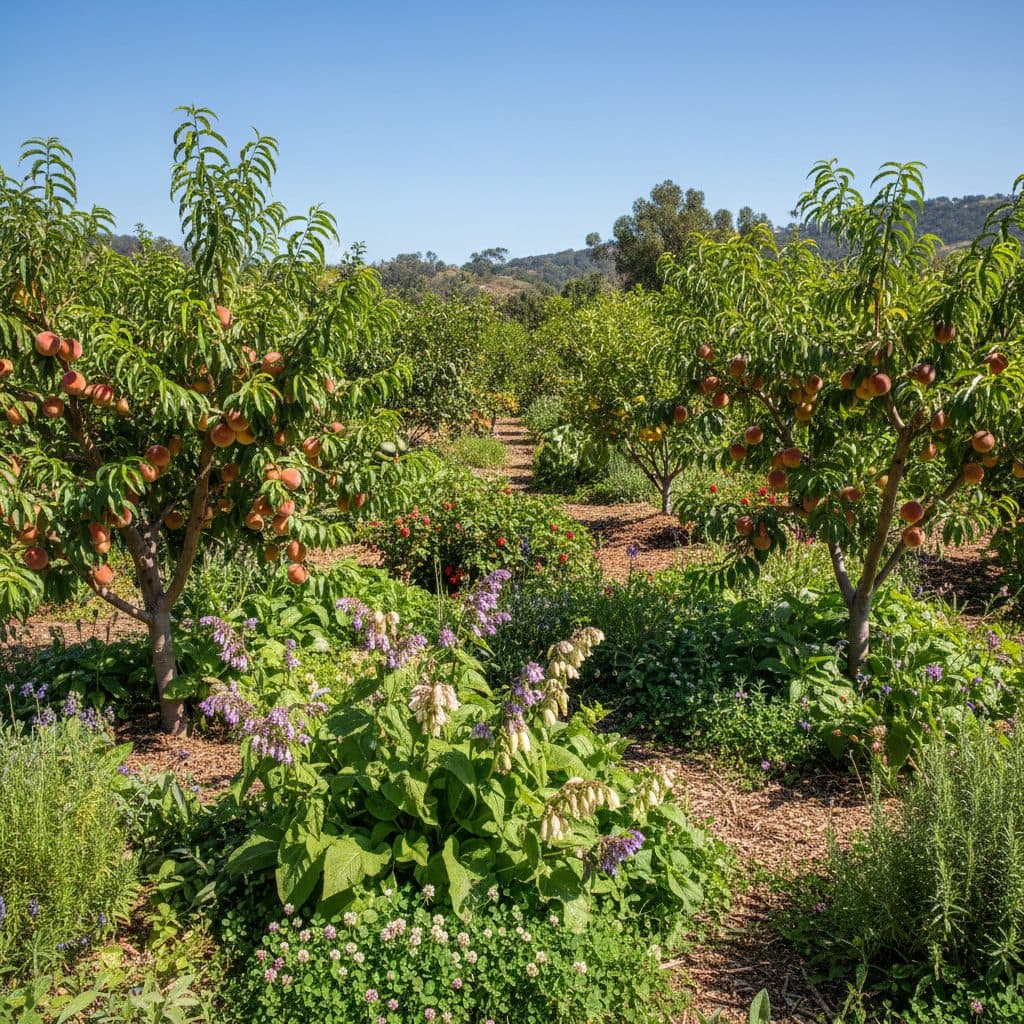
Key takeaways
- Select low-chill stone fruit varieties, such as ‘Florida Prince’ peach (150 chill hours) or ‘Desert Gold’ peach (250 chill hours), suitable for USDA zones 8-10.
- Implement a multi-layered plant guild around each fruit tree to improve nutrient cycling, suppress weeds, attract beneficial insects, and cut how often you have to irrigate.
- Incorporate nitrogen-fixing plants like clover or sesbania, dynamic accumulators such as comfrey, and pest-deterring herbs like garlic or chives into your guild design.
- Prepare your site with swales on contour to capture and distribute rainfall and cut runoff, especially on slopes greater than 5%; plant the trees on the berm, not in the basin.
- Maintain a consistent mulch layer of 4-6 inches around trees to regulate soil temperature, conserve moisture, and build organic matter over time.
- Regularly observe your trees for wilting shoot tips, gummy exudate at the trunk base and mummified fruit — the early signs of brown rot and peach tree borer, which are the real threats to stone fruit in warm, humid US climates.
Quick answer: To design a peach and stone-fruit guild for USDA zones 8-10, select low-chill varieties, implement multi-layered plant guilds with nitrogen-fixers and dynamic accumulators, and incorporate swales for water management.
Growing stone fruit in the warmer regions of the US, particularly in USDA zones 8-10 across states like Florida, Southern California, and parts of Texas, presents unique challenges. Traditional peach and plum varieties often require hundreds of hours of winter chill (temperatures below 45°F) to produce fruit reliably. Without sufficient chill, trees suffer delayed and erratic bud break, poor flowering, and a crop that may not be worth picking at all.
However, with careful selection of low-chill varieties and the strategic implementation of permaculture principles, growers can cultivate thriving stone fruit orchards. A plant guild, a symbiotic community of plants surrounding a central fruit tree, can significantly improve the health and productivity of your trees. This approach creates a resilient ecosystem that supports nutrient cycling, pest management, and water conservation, leading to more consistent harvests and healthier soil over the long term. For example, a well-designed guild with a maintained mulch layer holds moisture in the root zone and stretches the interval between waterings.
Selecting low-chill stone fruit for warm climates
The foundation of any successful stone fruit guild in warm US climates begins with choosing the right varieties. Many traditional stone fruit cultivars, like the ‘Elberta’ peach, demand 700 to 800 chill hours, making them unsuitable for regions where winter temperatures rarely drop below 45°F for extended periods. Fortunately, plant breeders have developed numerous low-chill options specifically adapted for areas with mild winters, such as USDA zones 8, 9, and 10. These varieties require significantly fewer chill hours, often ranging from 100 to 400 hours, allowing for successful fruit set in places like central Florida or the Arizona desert [1].
understanding chill hour requirements
Chill hours are cumulative hours below 45°F (7°C) but above 32°F (0°C) that a deciduous fruit tree needs during its dormant period to break bud and flower normally in spring. For instance, the ‘Florida Prince’ peach needs only 150 chill hours, while the ‘Desert Gold’ peach requires about 250 hours [2]. Understanding the average chill hours for your specific microclimate is essential; local agricultural extension offices often provide this data, sometimes tracked daily during winter months. Planting a tree that needs 600 chill hours in an area that only receives 200 hours will not give you a usable crop at all. Bud break is erratic and delayed, flowers and leaves emerge out of sequence, and the tree declines over successive years. There is no partial credit for getting a third of the chill requirement.
- ‘Florida Prince’ peach (150 chill hours)
- ‘Desert Gold’ peach (250 chill hours)
- ‘Tropic Snow’ peach (200 chill hours)
- ‘Anna’ apple (300 chill hours); needs a low-chill pollinizer such as ‘Dorsett Golden’ nearby, or it will bloom heavily and set almost nothing
- ‘Santa Rosa’ plum (300-400 chill hours); partly self-fruitful, but it sets a far heavier crop with another Japanese plum flowering alongside it
The permaculture guild concept for stone fruit
A permaculture guild is a carefully selected group of plants that work together to support a central element, in this case, a peach or stone fruit tree. This approach mimics natural forest ecosystems, where diverse species cooperate to build soil, manage pests, and conserve resources. Instead of a monoculture orchard, where each tree competes for the same nutrients and is vulnerable to widespread pest outbreaks, a guild creates a resilient and productive mini-ecosystem. A guild is not a yield treatment; fruit load comes from chill, pollination, thinning and light. What a well-built understory does is cut the fertilizer, mulch and weeding a tree needs from outside the system, and support the predators that keep pest damage down.
benefits of a multi-layered guild
The benefits of a multi-layered guild extend beyond simple companionship. Nitrogen-fixing plants capture atmospheric nitrogen and release it into the system as they are mown or die back. Dynamic accumulators, with their deep taproots, bring up minerals from the subsoil, making them available to shallower-rooted fruit trees. Groundcovers suppress weeds and help retain soil moisture, so you water less often. And diverse flowering plants attract predatory insects, which take a real share of the aphid and mite pressure a young orchard would otherwise carry.
- Nutrient cycling and soil building
- Pest and disease management
- Water conservation and retention
- Weed suppression
- Increased biodiversity and habitat
Designing your peach guild: companion plants and layout
When designing a peach guild, consider the specific needs of your central tree and the functions you want the companion plants to provide. A typical peach tree in a warm climate might grow to 12-15 feet tall and spread 10-12 feet wide, so plan your guild radius accordingly. Start by placing your central peach tree to ensure it has adequate sunlight (at least 6-8 hours daily for optimal fruit production). Then, strategically position supporting plants around it, keeping in mind their mature size and root systems to avoid competition. For example, a plum × peach hybrid rootstock can offer disease resistance and vigor, influencing the overall tree size and guild spacing [5].
key companion plant roles
Nitrogen fixers are essential for feeding your peach tree. Plants like clover (Trifolium spp.) or vetch can be sown as groundcover, feeding nitrogen into the root zone as they are mown or die back. In warmer zones a summer legume such as cowpea (Vigna unguiculata) works well as a short-term nitrogen fixer before planting. Avoid sesbania unless you know exactly which species you are buying: Sesbania punicea, rattlebox, has escaped and is listed as invasive across parts of the warm Southeast and California (the same zone 8-10 range this article covers), and sesbania seed is toxic to livestock, poultry and wild birds. Dynamic accumulators such as comfrey have deep taproots that draw nutrients like potassium and calcium up from the subsoil. Use the sterile cultivar Bocking 14 (Symphytum x uplandicum 'Bocking 14'), not seed-setting common comfrey (Symphytum officinale); in the long warm season of zones 8-10 the common form seeds freely, and every root fragment regrows, making it effectively permanent once loose. Comfrey is mulch only: its pyrrolizidine alkaloids are hepatotoxic and it is neither food nor fodder. These nutrients become available when the comfrey leaves are chopped and dropped as mulch, feeding the topsoil as they break down. Pest deterrents, like garlic (Allium sativum) or chives (Allium schoenoprasum), release compounds that can help mask the tree from soft-bodied pests such as aphids. Consider planting 3-4 comfrey plants and 5-6 garlic cloves around each peach tree, approximately 3 feet from the trunk.
- Nitrogen fixers: Clover, vetch, sesbania
- Dynamic accumulators: Comfrey, yarrow, dandelion
- Pest deterrents: Garlic, chives, marigolds
- Beneficial insect attractors: Dill, cilantro, cosmos
- Groundcovers: Strawberry, creeping thyme, sweet potato
Site preparation and ongoing care for guild success
Effective site preparation is paramount for establishing a healthy and productive stone fruit guild, especially in warm climates where water management can be a significant concern. Before planting, conduct a soil test to understand your soil’s composition and nutrient profile; many warm US soils, particularly in the Southeast, can be sandy and low in organic matter, often below 1%. Improving soil structure by adding 2-4 inches of compost or well-rotted manure will improve water retention and nutrient availability. Do not expect your soil test to move far in the first year: organic matter in warm sandy soils climbs slowly and burns off fast, so holding a gain takes repeated annual additions.
water management with swales and mulch
For sites with any slope, even a gentle 2-5% grade, consider installing swales on contour. Swales are shallow ditches dug along the contour lines of the land, with an earthen berm on the downhill side. They are designed to slow, spread, and sink rainwater, preventing runoff and allowing it to infiltrate the soil slowly. A typical swale might be 1-2 feet deep and 3-4 feet wide, holding most of a modest rain event and letting it soak in rather than run off. Plant peaches on the berm or on a raised mound, never in or below the swale basin: peach and its rootstocks are among the least waterlogging-tolerant fruit trees, and standing water invites Phytophthora crown and root rot, which in the humid zone 8-9 Southeast is the commonest way a young peach dies. This passive irrigation system significantly reduces the need for supplemental watering, especially during dry periods common in USDA zones 9 and 10. Once established, maintain a consistent 4-6 inch layer of organic mulch, such as wood chips or straw, around your guild to suppress weeds, regulate soil temperature, and conserve moisture. Regular monitoring with a soil moisture meter can help fine-tune irrigation needs to ensure optimal water levels for your trees.
- Dig swales on contour to capture rainwater.
- Incorporate 2-4 inches of compost into planting areas.
- Apply a 4-6 inch layer of organic mulch.
- Prune stone fruit trees annually to maintain structure and fruit production.
- Monitor for pests and diseases, addressing issues promptly.
Chill Hour Requirements for Common Stone Fruit Varieties
Variety | Chill Hours Required | Typical USDA Zones |
|---|---|---|
Florida Prince Peach | 150-200 | 9-10 |
Desert Gold Peach | 250-300 | 8-9 |
Tropic Snow Peach | 200-250 | 9-10 |
Santa Rosa Plum | 300-400 | 7-9 |
Red Baron Peach | 400-500 | 7-9 |
Elberta Peach | 700-800 | 5-8 |
Chill Hour Definition: Chill hours are accumulated hours between 32°F and 45°F (0°C and 7°C) during dormancy, with ‘Florida Prince’ peaches needing only 150 hours for successful fruit set.
Water: a well-designed plant guild and swales hold rainfall in the root zone rather than letting it run off, stretching the interval between waterings during dry periods.
Soil enrichment: a legume groundcover feeds nitrogen into the system as it is mown or dies back, and a maintained mulch layer builds organic matter year on year.
Frequently asked questions
What are chill hours and why are they important for stone fruit in warm climates?
Chill hours are the total hours a fruit tree spends between 32°F and 45°F during winter dormancy. They are important because insufficient chill (e.g., less than 150 hours for ‘Florida Prince’ peach) leads to poor and erratic bud break, reduced flowering, and a crop that may not be worth picking.
How does a plant guild benefit my peach trees?
A plant guild creates a supportive ecosystem around your peach trees by feeding nitrogen in from a legume groundcover, masking the tree from soft-bodied pests with aromatic plants, and holding soil moisture with groundcovers and mulch. This leads to healthier trees and more consistent fruit production.
What are some good companion plants for a peach guild in USDA zone 9?
For a peach guild in USDA zone 9, consider nitrogen fixers like white clover or dwarf pigeon pea, dynamic accumulators such as comfrey (roots can reach 10 feet deep), and pest deterrents like garlic or chives. Dill and yarrow also attract predatory insects, which take a real share of the aphid and mite pressure.
Should I use swales in my stone fruit orchard?
Yes, if your site has any slope (even 2-5%), swales are highly beneficial. They capture and infiltrate rainwater into the soil, holding it where roots can reach it and reducing runoff, with the trees planted on the berm instead of in the basin. A typical swale is 1-2 feet deep and 3-4 feet wide, effectively managing water flow.
How much mulch should I apply around my peach trees?
Apply a consistent layer of organic mulch, such as wood chips or straw, 4-6 inches deep around your peach trees, extending to the drip line. This smothers most weeds before they emerge, conserves soil moisture, and gradually builds soil organic matter.
What are some common issues for stone fruit in warm climates?
Beyond insufficient chill, warm-climate stone fruit mostly faces brown rot (Monilinia), bacterial spot, and peach tree borer. Watch for shoot tips that wilt and blacken, gummy exudate low on the trunk, and fruit that shrivels and mummifies on the branch. Strip and destroy mummified fruit at the end of the season rather than leaving it in the tree, since that is where brown rot overwinters.
References
- Stone Fruit Species under Warm Subtropical and Tropical Climates (2000). Stone Fruit Species under Warm Subtropical and Tropical Climates.
- Stone Fruit Genetic Pool and Its Exploitation for Growing under Warm Winter Conditions (2000). Stone Fruit Genetic Pool and Its Exploitation for Growing under Warm Winter Conditions.
- NONDESTRUCTIVE PEACH FRUIT FIRMNESS DETERMINATION USING SONIC IMPULSE (1993). NONDESTRUCTIVE PEACH FRUIT FIRMNESS DETERMINATION USING SONIC IMPULSE.
- DETECTION OF EUROPEAN STONE FRUIT YELLOWS PHYTOPLASMA (ESFYP) IN HOMOPTERA INSECTS AND IN WILD STONE FRUIT TREES COLLECTED IN PEACH ORCHARDS IN NORTHERN ITALY (2004). DETECTION OF EUROPEAN STONE FRUIT YELLOWS PHYTOPLASMA (ESFYP) IN HOMOPTERA INSECTS AND IN WILD STONE FRUIT TREES COLLECTED IN PEACH ORCHARDS IN NORTHERN ITALY.
- Diploid Plum × Peach Hybrid Rootstocks for Stone Fruit Trees (1988). Diploid Plum × Peach Hybrid Rootstocks for Stone Fruit Trees.