Key takeaways
- High annual precipitation (40–65+ in/yr, peaking at 60–80 in/yr west of the Cascades) leaches Ca2+, Mg2+, and K+ cations, driving soluble aluminum (Al3+) root-tip toxicity below pH 5.0–5.2 and manganese (Mn2+) leaf injury below pH 5.5.
- Pine needles and oak leaves do NOT acidify garden soil over time: forest conifers thrive on already leached, low-carbonate ground, while microbes neutralize a 2–3 in pine mulch with under 0.3 pH units of lasting shift.
- Water pH only tells whether soil needs lime; Buffer pH (SMP, Modified Mehlich, or Adams-Evans) measures reserve clay and organic acidity to set exact lb/1,000 sq ft rates—never dose lime using cheap 3-in-1 probes.
- Choose calcitic limestone (CaCO3) as your default and apply dolomitic limestone (CaMg(CO3)2) ONLY when a lab report confirms magnesium deficiency; till 4–6 in deep in fall (3–6 month reaction lag) and split doses above 50 lb/1,000 sq ft.
- Enforce P0 safety and crop exclusions: ban caustic hydrated lime Ca(OH)2 and quicklime CaO (severe chemical burns and microbial shock), wear N95 and goggles for dusty amendments, cap hardwood ash at <=15–20 lb/1,000 sq ft/yr, keep potatoes unlimed (pH 5.0–5.5) against common scab, and keep blueberries/azaleas at pH 4.5–5.2.
Quick answer: Soils across the Northeast and Maritime Pacific Northwest naturally drop into acidic territory (pH 4.8–6.0) because 40–65+ inches of annual rainfall leaches basic calcium, magnesium, and potassium cations off soil exchange sites, letting hydrogen and toxic soluble aluminum (Al3+) dominate below pH 5.0–5.2. Use a lab test with both Water pH (which sets direction) and Buffer pH—SMP, Modified Mehlich, or Adams-Evans—which measures reserve acidity to calculate exact limestone doses from 15–30 lb/1,000 sq ft in sand up to 70–100+ lb/1,000 sq ft in heavy clay, incorporated 4–6 inches deep in fall at <=50 lb per single pass. Ban caustic hydrated lime Ca(OH)2 and quicklime CaO, withhold wood ash and heavy lime from potato beds (common scab above pH 5.5), and keep blueberries and azaleas unlimed at pH 4.5–5.2.
Why Northeast and Pacific Northwest Soils Keep Dropping Below pH 5.8
Gardeners from coastal Maine and Vermont to western Oregon and Washington battle the same stubborn trend: unamended vegetable beds slide below pH 5.8 every few seasons. The engine is wet-climate cation leaching. Annual rainfall of 40 to 65+ inches—reaching 60 to 80 inches in wet coastal valleys—percolates steadily downward, stripping positively charged basic cations (`Ca2+`, `Mg2+`, `K+`) from clay and humus surfaces. As those base cations wash away, acidic hydrogen (`H+`) and aluminum (`Al3+`) ions take their place.
Remember that pH is a logarithmic base-10 scale: pH 5.0 is 10 times more acidic than pH 6.0, and 100 times more acidic than pH 7.0. Once soil falls below pH 5.0–5.2, insoluble clay minerals dissolve into toxic soluble aluminum (`Al3+`) that physically stunts root tips, halts elongation, and locks phosphorus into unavailable aluminum phosphates. Between pH 5.0 and 5.5, excess soluble manganese (`Mn2+`) rises into root zones as well, triggering crinkled, speckled leaves while slowing legume nitrogen fixation in peas and clovers.
Northeast glacial till vs. Maritime Pacific Northwest leaching
While both regions share wet acidification physics, their seasonal water patterns and parent rocks differ markedly—affecting when you test, till, and apply amendments.
Regional Soil Acidification Contrast: Northeast Glacial Loams vs. Maritime Pacific Northwest
Regional Feature | Northeast (New England, NY, PA, NJ) | Maritime Pacific Northwest (West of Cascades) |
|---|---|---|
Parent Geology & Soil | Granite, gneiss, sandstone, and shale glacial till low in natural carbonates | Volcanic basalt, marine sediments, and high-organic-matter valley loams |
Typical Unlimed Baseline | pH 4.8–5.8 (woodland pockets down to 4.5) | pH 5.0–6.0 (coastal lowlands dropping below 5.0) |
Rainfall & Leaching Window | 40–50+ in/yr distributed evenly spring through fall; winter freeze-thaw cycles | 40–80 in/yr concentrated Oct–May winter leaching followed by dry July–Aug summers |
Primary Buffer Test Used | Modified Mehlich (PA/ME/NY) or Adams-Evans / Sikora | SMP (Shoemaker-McLean-Pratt) or calibrated Sikora buffer |
Best Liming Window | Late fall after harvest so snowmelt and spring thaw dissolve lime by May planting | Early fall (Sept–Oct) just before autumn rains soak soil without waterlogging clay |
Debunking the conifer and pine-needle acidification myth
Many growers blame white pine needles, Douglas fir duff, or oak leaves for souring backyard beds—getting cause and effect backward. University of New Hampshire and Pacific Northwest extension trials confirm that conifers establish in regions where climate and parent rock already created acidic soil, rather than the needles driving down bed pH. Fresh pine needles test acidic on a bench (`pH 3.2–3.8`), yet soil microbes rapidly oxidize those weak organic acids during decay. Spreading a 2-to-3-inch pine-needle mulch causes less than `0.3` pH unit shift (often zero measurable change) in buffered organic garden soil, making needles a clean, erosion-resistant free mulch rather than an acidifier.
Real gardener-driven acidification comes instead from ammonium-based nitrogen fertilizers. Microbes oxidizing ammonium (`NH4+`) into nitrate (`NO3-`) release pure `H+` ions: Ohio State University extension data shows neutralizing `100 lb` of nitrogen from ammonium sulfate (`21-0-0`) demands 540 lb of pure lime (`~12.4 lb per 1,000 sq ft` per `2.3 lb N`), three times more acidifying power than urea (`180 lb` lime per `100 lb N`). Check your soil test alongside nutrient availability by soil pH before choosing spring fertilizers.
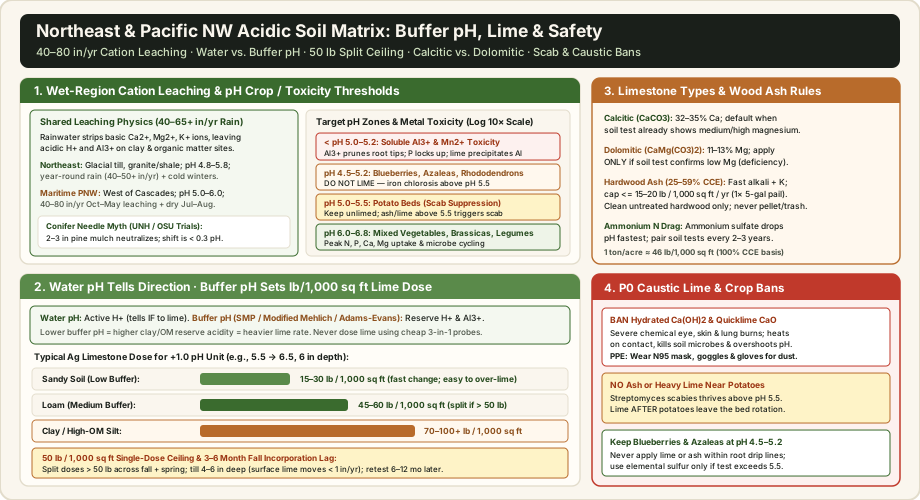
Water pH vs. Buffer pH: Why Two Identical Gardens Need Completely Different Lime Doses
Sending a sample to a Cooperative Extension soil lab typically returns two pH numbers—Water pH (`Soil pH`) and Buffer pH (`BpH` or `Lime Index`). Misreading them wastes money or triggers multi-year micronutrient lockouts. Water pH measures only free `H+` floating in soil water right now (active acidity), telling you which direction pH sits relative to your crop target. It cannot tell you how much lime to buy.
Buffer pH—measured with SMP (common in the PNW), Modified Mehlich (standard at Penn State, UMaine, and Cornell after replacing hazardous barium/nitrophenol waste), or Adams-Evans—measures reserve acidity (`H+` and `Al3+` clung tightly to clay minerals and organic matter). Because reserve acidity continually refills soil water as active acid gets neutralized, clay and humus-rich soils resist pH shifts fiercely. A lower Buffer pH (or larger drop below the reagent baseline) means higher reserve acidity and a much heavier lime dose.
Ditch cheap 3-in-1 probe meters for lime decisions: Pocket metal-prong `pH/moisture/light` meters drift wildly by soil salt content and moisture and measure zero reserve acidity. Always pull `6-to-8-inch` soil cores across 10–15 spots, submit them using our accurate soil sampling checklist, and follow how to read a soil test report or soil test CEC and organic matter decoding.
Typical Agricultural Limestone Needed to Raise Soil +1.0 pH Unit (e.g., 5.5 to 6.5, 6 in Incorporation, 100% CCE)
Soil Texture & Buffer Reserve | Target Dose (lb / 1,000 sq ft) | 50 lb Single-Pass Ceiling Action | Retest & Maintenance Cadence |
|---|---|---|---|
Coarse Sand / Loamy Sand (Low CEC) | 15–30 lb / 1,000 sq ft | Apply in one pass; easy to overshoot above pH 7.0 | Retest every 2 years (leaches fast) |
Sandy Loam to Medium Loam (Moderate Buffer) | 35–60 lb / 1,000 sq ft | If lab rate exceeds 50 lb, split into two applications 4–6 months apart | Retest 6–12 months after liming, then every 2–3 years |
Clay, Clay Loam & High-OM Silt (High Buffer) | 70–100+ lb / 1,000 sq ft | Mandatory split: cap first pass at 50 lb/1,000 sq ft; apply remainder next season | Retest 6–12 months after second pass; holds pH 3–4+ years |
Converting farm extension sheets is simple math: 1 ton/acre equals roughly 46 lb per 1,000 sq ft (`2,000 lb ÷ 43.56`), or `4.6 lb` for a standard `10 × 10 ft` (`100 sq ft`) raised bed. Never dump `80 to 100 lb` onto a `1,000 sq ft` clay patch in one afternoon—exceeding 50 lb per 1,000 sq ft in a single application shocks surface biology, cakes on top of wet soil, and spikes topsoil pH unevenly.
Calcitic vs. Dolomitic Limestone, Incorporation Lag & Hardwood Ash Rules
Once your lab report gives a poundage rate, choose the exact neutralizing mineral rather than grabbing the first bag on the pallet. Two distinct carbonate rocks dominate US garden centers, alongside wood ash from winter stoves—plus two fast-acting caustic industrial chemicals you should exclude completely from home food beds.
Liming Amendments Compared: Chemistry, Neutralizing Power, Lag Time & Crop Rules
Material (Formula) | Key Nutrients & CCE / TNP | Reaction Lag & Incorporation | When to Use — or Ban |
|---|---|---|---|
Calcitic Limestone (`CaCO3`) | 32–35% Ca, 2–5% Mg; 90–99% TNP/CCE | 3–6 months; till 4–6 in deep in fall | Default choice when soil test magnesium is adequate or high |
Dolomitic Limestone (`CaMg(CO3)2`) | 20–22% Ca, 11–13% Mg; 100–110% TNP | 3–6 months; till 4–6 in deep in fall | Use ONLY when soil test explicitly confirms low magnesium (`Mg`) |
Pelletized Ag Lime (bound `CaCO3` / `CaMg(CO3)2`) | Matches parent stone (~90–100% CCE) | 3–6 months (pellets dissolve quickly once wet, stone still reacts slowly) | Clean low-dust spreader option; still requires 4–6 in incorporation for full depth shift |
Clean Hardwood Ash (Ca/K oxides & carbonates) | 25–59% CCE (2–4× weaker than aglime) + high K | Fast surface jump (weeks to months); moisten soil first | Cap at <= 15–20 lb / 1,000 sq ft / yr; BAN near potato beds and blueberries |
Hydrated Lime (`Ca(OH)2`) & Quicklime (`CaO`) | 130–179% CCE (extreme caustic alkali) | Violent immediate spike; heats on contact (`CaO`) | P0 BAN in home gardens: severe chemical burns, root scorch & microbial kill |
Why dolomitic lime is not a harmless default—and why fall tillage matters
Homeowners often buy dolomitic limestone reflexively because the bag mentions both calcium and magnesium. Check your lab's magnesium line first: in western Oregon clays or Northeast loams that already carry plenty of Mg, dumping repeated bags of dolomitic lime drives soil magnesium excessive, interferes with potassium and calcium uptake (magnesium and calcium dynamics), and leaves heavy soils sticky. Reserve dolomitic lime strictly for low-Mg sandy or leached beds; use calcitic limestone everywhere else.
Equally important is physical mixing and patience. Ground agricultural limestone dissolves very slowly in water, moving downward less than 1 inch per year when sprinkled onto undisturbed turf or no-till beds. To shift the root zone of vegetables, spread half in fall and incorporate into the top 4 to 6 inches with a broadfork or shallow cultivation so winter rain and freeze-thaw cycles complete the 3-to-6-month reaction lag before spring planting. Review our full lime application guide and pair fall liming with cold-hardy hairy vetch or red clover winter cover crops to hold leached nitrates.
Hardwood ash ceiling: 15–20 lb/1,000 sq ft/yr maximum
As University of Vermont and UNH extension guides note, clean stove ash carries a variable Calcium Carbonate Equivalent of 25% to 59% alongside soluble potassium. Because wood ash shifts topsoil pH fast, never exceed 15 to 20 lb per 1,000 sq ft per year (about one level 5-gallon bucket, roughly the ash from one cord of firewood). Screen out charcoal chunks, use only untreated natural hardwood—never ash from painted wood, pressure-treated lumber, pellet stoves with binders, or trash bonfires—and follow detailed caps in our wood ash garden guide.
P0 Safety Bans: Caustic Hydrated Lime, Potato Scab & Acid-Loving Berry Beds
Liming mistakes cause two kinds of irreversible seasonal damage: physical chemical burns to gardeners and soil life from caustic industrial lime, and ruined harvests on acid-adapted crops like potatoes and blueberries.
P0 Chemical Burn Warning — BAN Caustic Hydrated Lime Ca(OH)2 & Quicklime CaO: Never use hydrated lime (`Ca(OH)2`, slaked lime) or quicklime (`CaO`, burnt lime) in home gardens. Quicklime reacts exothermically with sweat or damp soil—generating intense heat—while both `CaO` and `Ca(OH)2` are strongly caustic alkalis capable of causing severe chemical eye damage, skin burns, and respiratory tract injury, alongside sterilizing beneficial soil microbes and scorching plant roots. Stick strictly to mild agricultural limestone (`CaCO3` or `CaMg(CO3)2`), spread only on calm days, lightly wet ash before raking, and always wear an N95 dust respirator, safety goggles, long sleeves, and gloves whenever spreading fine lime or dry wood ash.
- Keep lime and wood ash OFF potato beds (Common Scab control): Raising soil above pH 5.5 invites Streptomyces scabies bacterial infection, covering tubers in ugly corky and pitted lesions (growing potatoes). Keep potato plots between pH 5.0 and 5.5, irrigate evenly during the first 3–6 weeks of tuber initiation, and apply required agricultural lime only after potatoes rotate out of that bed toward legumes, cabbage, spinach, or onions.
- Keep blueberries, azaleas, and rhododendrons unlimed at pH 4.5–5.2: Ericaceous shrubs fail fast when limed or hit with drifting wood ash; above pH 5.5 they suffer severe interveinal iron chlorosis and root decline. Maintain dedicated blueberry beds and azalea/rhododendron borders unlimed at pH 4.5–5.2 (using elemental sulfur only where a lab test proves soil sits too sweet), while targeting pH 6.0–6.8 for garden peas, garden sage, strawberries, and general beds (soil pH for vegetable gardens).
Multi-Year Acidic Soil Management Workflow for Northeast & PNW Beds
Long-term pH stability comes from pairing accurate buffer tests with steady organic matter cycling rather than reactive spring over-liming:
- Late Summer / Early Fall: Pull separate `6–8 in` composite soil cores for vegetable zones (target `6.0–6.8`), potato beds (`5.0–5.5`), and acid-loving berries (`4.5–5.2`). Request Buffer pH and magnesium status.
- Fall Incorporation (3–6 Month Window): Spread calcitic or (only if Mg-deficient) dolomitic limestone at your lab rate, capping any single pass at 50 lb per 1,000 sq ft, and fork or till `4–6 in` deep ahead of winter rains or snowmelt.
- Winter Cover & Spring Moisture: Sow white clover or hairy vetch in limed beds to protect structure from Pacific Northwest winter downpours, and use shredded leaves or pine needles as neutral surface mulch.
- 6–12 Month Retest: Retest `6–12 months` after heavy split applications before applying the second half, then drop to a 2–3 year lab testing rhythm.