
Key takeaways
- Run a $20–$50 Cooperative Extension soil test for ESP, SAR, ECe, pH, and free lime before buying gypsum.
- True sodic clay (ESP >= 15% or SAR >= 13) takes 9 to 46 lb pure gypsum per 100 sq ft worked 4–6 inches deep, plus working drainage and staged leaching.
- On non-sodic compacted or high-Mg Midwest and Eastern clays, Ohio State, UW, Iowa State, and WSU trials show zero structural de-compaction.
- Adding gypsum to saline-only soil (SAR < 13, ECe > 4.0 dS/m) worsens salt burn, and heavy rates on sandy-edge beds leach potassium and magnesium.
- Choose 85–92% mined natural or NRCS-333-screened >90% FGD gypsum, factor in 2–4% pellet binders, and avoid EPA-restricted phosphogypsum.
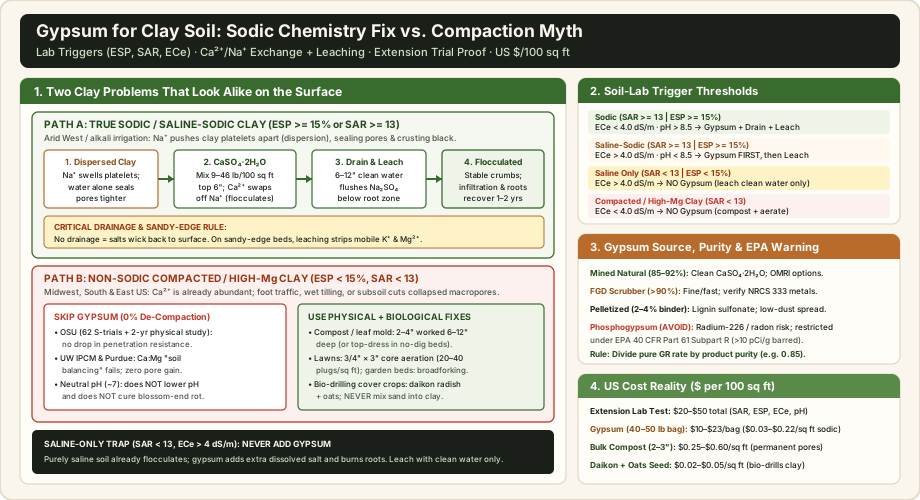
Quick answer: Gypsum (CaSO4·2H2O) only restructures clay when excess sodium disperses particles—confirmed by a soil test showing Exchangeable Sodium Percentage (ESP) >= 15% or Sodium Adsorption Ratio (SAR) >= 13—and only if internal drainage lets 6 to 12 inches of clean water leach displaced sodium below roots. On non-sodic compacted or high-magnesium Midwest and Eastern clays, Ohio, Wisconsin, Iowa, and Washington extension trials show zero de-compaction; use compost, broadforking or core aeration, and daikon radish cover crops instead.
Two Clay Problems That Look Identical in the Yard
Standing puddles after light rain, concrete clods under a spade, and shallow roots appear on both Western alkali flats and Midwest yards. Because surface drainage looks identical, bag labels market gypsum across all 50 states as a universal clay loosener. Soil science splits those beds into two distinct mechanisms.
In physical compaction, foot traffic, wheel loads, or tilling wet clay crushes macropores into dense plates while native calcium remains abundant across Ohio, Indiana, Iowa, and Eastern soils. In chemical sodic dispersion, common in arid Western US basins or fields irrigated with high-sodium water, sodium ions (`Na+`) force clay platelets apart until dispersed fines seal pores tight.
Before spreading mineral salts, check our Cooperative Extension soil testing guide and how to read a soil test.
Soil-Lab Triggers: Separating Sodic, Saline-Sodic, Saline & Compacted Clay
Backyard pH strips cannot separate sodic dispersion from physical compaction, and standard nutrient panels often skip sodium. Request a saturated paste extract ($20–$50 at land-grant labs) measuring SAR, ESP, ECe, pH, CEC, and free lime.
US Laboratory Diagnostic Thresholds and Extension Action Rules for Clay Soils
Soil Class | SAR & ESP Trigger | ECe (dS/m) & pH | Visual / Physical Clues | Corrective Action |
|---|---|---|---|---|
Sodic (Alkali) | SAR >= 13 or ESP >= 15% (damage starts > 6–10%) | ECe < 4.0 dS/m; pH > 8.5 (often 8.8–10.0) | Dark greasy sheen wet; black crust dry (dispersed humus); columnar clods | Apply gypsum (9–46 lb/100 sq ft) + verify drainage + leach 6–12 in water |
Saline-Sodic | SAR >= 13 or ESP >= 15% | ECe > 4.0 dS/m; pH < 8.5 | White salt crust plus sealed, slow-draining subsurface clay | Apply gypsum FIRST before leaching (water alone flushes salt and triggers dispersion) |
Saline Only (Non-Sodic) | SAR < 13 and ESP < 15% | ECe > 4.0 dS/m; pH < 8.5 | White salt efflorescence; soil still aggregates when dry; osmotic leaf scorch | SKIP gypsum (adds more salt); leach root zone with low-EC clean water |
Compacted / High-Mg Clay | SAR < 13 and ESP < 15% | ECe < 2.0 dS/m; pH 5.5–7.8 | Hard spade refusal at 3–6 in; water ponds > 2 hrs after 1 in rain; no crust sheen | SKIP gypsum; broadfork or core aerate + add 2–4 in compost + daikon cover crop |
The saline-sodic water trap: Colorado State Extension warns against flushing a saline-sodic bed before incorporating gypsum. Background salts keep clay clumped temporarily; washing them out first drops ionic strength and makes clay swell and seal tight. Incorporate calcium first whenever ECe > 4.0 dS/m and SAR >= 13.
Watch irrigation quality too: household sodium water softeners replace calcium with sodium and drive SAR upward. Pair lab tests with our guides on plants for saline and alkaline Western soils and greywater-safe soaps for soil SAR.
What University Extension Trials Prove on Non-Sodic & High-Mg Clay
In humid Midwest and Eastern states, catalogs pitch gypsum to loosen tight clay or adjust high magnesium (`Mg2+`) to a Base Cation Saturation Ratio (BCSR) near `65–75% Ca : 10–20% Mg`. Land-grant trials refute both claims:
- Ohio State University Extension (ANR-0153): Across 25 organic site-years at 1 ton/acre gypsum, yield rose in only 1 trial; across 62 sulfur trials (4.5–720 lb S/acre), only 4 improved and 1 corn site declined. A two-year physical study found zero change in penetration resistance (compaction) or unsaturated hydraulic conductivity, and reviewing BCSR data from 1933 to 2008 showed crops thrive across wide Ca:Mg ratios whenever neither nutrient is deficient.
- University of Wisconsin Extension (IPCM): Trials applying `1–3 tons/acre` of FGD gypsum showed no consistent de-compaction, deeper rooting, or moisture gain beyond sulfur or calcium nutrition on deficient soils, calling Ca:Mg balancing scientifically unsound.
- Iowa State & Purdue Extensions: Midwestern limestone clays hold ample native calcium, so gypsum adds negligible structural benefit. Iowa State recommends turf core aerification (`3/4 × 3 in` cores at `20–40 holes/sq ft`) and `8–12 inches` of compost worked into beds.
- Washington State University Extension (Linda Chalker-Scott): Non-sodic clay requires organic matter rather than calcium salts. Pure gypsum is pH-neutral—neither replacing elemental sulfur nor agricultural lime—and rarely cures watering-driven blossom-end rot.
In humid regions, gypsum only helps where tests confirm sulfur deficiency or on acidic, low-CEC potato ground under `400–600 ppm Ca`. See soil amendments demystified and calcium and blossom-end rot before buying.
Sodic Clay Chemistry: Drainage Prerequisites, Leaching & Sandy-Edge Risks
When your lab report genuinely confirms `ESP >= 15%` or `SAR >= 13`, soluble `CaSO4·2H2O` (which dissolves up to roughly `2 grams per liter` in soil water—hundreds of times more soluble than calcitic lime) releases divalent `Ca2+` ions into the soil solution. Each `Ca2+` ion displaces two monovalent `Na+` ions off negatively charged clay surfaces (`2Na-Clay + Ca2+ -> Ca-Clay + 2Na+`), pulling clay sheets back into stable crumbs (flocculation) and reopening pore pathways.
Why gypsum fails without internal drainage and clean leaching water
Exchanging sodium off clay particles leaves soluble sodium sulfate (`Na2SO4`) floating in soil pore water. Displaced sodium does not vanish into thin air. Unless clean water moves downward through the soil profile and exits below the root zone, summer evaporation wicks `Na2SO4` straight back to the surface, dispersing clay all over again while leaving overall salinity worse than before.
- Check percolation and water tables first: Dig an 18-to-24-inch test pit or run a soil drainage percolation test. If shallow hardpan, caliche, or a high perched water table traps water within 24 inches of the surface, fracture the pan mechanically or install subsurface drain tiles or French drains before spreading gypsum.
- Calculate purity-adjusted Gypsum Requirement (GR): Colorado State Extension uses a benchmark of 1.7 tons of 100%-pure gypsum per acre-foot (about 0.85 tons/acre, or 3.9 lb per 100 sq ft, for a 6-inch topsoil depth) for every 1 meq/100 g of exchangeable sodium you need to replace. Across typical Western sodic soils (CEC 15–25 meq/100 g, initial ESP 20–30% targeting 5–10%), that equals 2 to 10 tons/acre—or 9 to 46 lb per 100 sq ft for the top 6 inches. Always divide the pure lab rate by product purity (divide by `0.85` for 85% gypsum).
- Incorporate shallowly and split heavy doses: Broadcast evenly and till, spade, or rotary-hoe into the top 4 to 6 inches so crystals touch dispersed clay. If your lab call exceeds 20 to 25 lb per 100 sq ft (`~5 tons/acre`), split the application across two seasons rather than dumping everything at once; Ohio State trials saw heavy single-shot doses (`2 tons/acre` on continuous corn) depress yields compared with split runs.
- Leach in staged irrigation cycles: Apply 6 to 12 inches of low-SAR irrigation water (`ECw < 1.5 dS/m`) in repeated `2-to-3-inch` pulses over several weeks rather than one flood, letting each pulse infiltrate completely. Full reclamation takes 1 to 2 years and benefits strongly from incorporating compost alongside gypsum to stabilize newly formed crumbs.
Sulfate-leaching risk to potassium and magnesium on sandy-edge beds
Sulfate (`SO4^2-`) behaves like nitrate (`NO3^-`) in soil: negatively charged clay and humus do not hold it, so sulfate washes downward with every rain or leaching pulse—dragging positively charged potassium (`K+`) and magnesium (`Mg2+`) along as paired counter-ions (`K2SO4`, `MgSO4`). WSU and CSU extension bulletins emphasize that on low-CEC sandy-loam transitions, gravel-margin raised beds, or coarse border strips, heavy gypsum plus aggressive leaching strips mobile `K+` and `Mg2+` out of the root zone while saturating roots with `Ca2+` competition. Follow up any reclamation leach on sandy-edge beds with a post-leach soil test and review our potassium and magnesium deficiency guide before planting heavy feeders.
Gypsum Purity, Pelletized Binders & Why Phosphogypsum Stays Off Home Beds
Not every bag labeled soil conditioner or gypsum delivers identical chemistry, dissolution speed, or trace-element safety. Checking the guaranteed analysis and source origin on the bag protects both your soil biology and your household.
Comparison of Commercial Gypsum Sources, Purity, Binders & Regulatory Limits
Gypsum Source | Typical Purity (CaSO4·2H2O) | Particle Size & Dissolution | Binders, Metals & Organic Status | Home Garden Verdict |
|---|---|---|---|---|
Mined Geological (Powder / Granular) | 85–92% (~21% Ca, 15–17% S) | Coarse to fine; moderate dissolution over weeks | Natural mineral; low trace metals; OMRI-listed options available | Top pick for organic and verified sodic beds |
Pelletized Gypsum (Mined or FGD base) | 85–92% active + 2–4% binder | Dust-free 2–4 mm prills; break down on wetting, slightly slower initial contact | Uses water-soluble lignin sulfonate or starch binders; check OMRI tag if certified organic | Best for broadcast spreaders on lawns and larger sodic plots |
FGD Scrubber Gypsum (Power-Plant Synthetic) | 90–96% (very high purity) | Ultra-fine silt-sized powder; dissolves and reacts fastest | Non-organic synthetic; requires USDA NRCS 333 screening for As, Hg, B, Se | Effective conventional sodic reclaim if supplier confirms NRCS 333 metal compliance |
Phosphogypsum (Phosphate Fertilizer Waste) | Variable + phosphate/fluoride impurities | Fine powder stacked at phosphoric acid plants | Contains Radium-226 (decays to carcinogenic radon); regulated under EPA 40 CFR 61 Subpart R (> 10 pCi/g barred) | DO NOT use in home gardens, raised beds, or residential lawns |
Drywall scraps are another risky DIY shortcut: while modern virgin wallboard core is mostly gypsum, demolition drywall frequently carries mold-resistant biocides, fiberglass fibers, adhesive glues, or lead paint dust on older paper facings. Stick to agricultural mined or verified pelletized gypsum with a printed guaranteed analysis (`Ca` and `S` percentages) rather than construction scrap. If your Western garden suffers more from high pH than sodium, compare elemental sulfur rates in our gypsum, lime, and sulfur soil test guide and iron chlorosis management.
US $/sq ft Cost Reality & Better Fixes for Non-Sodic Compacted Clay
Retail garden centers often charge $10 to $17 for a 40-lb bag of pelletized gypsum (`$0.25–$0.43/lb`), while farm-supply stores and ag co-ops sell 50-lb agricultural bags for $11 to $23 (`$0.22–$0.46/lb`, dropping near `$0.13–$0.28/lb` by the pallet). On a true sodic plot needing `20 lb per 100 sq ft`, that runs roughly $4.40 to $9.20 per 100 sq ft (`$0.04–$0.09/sq ft`, scaling up to `$0.22/sq ft` at severe `46 lb/100 sq ft` rates). Spending even `$0.05/sq ft` on non-sodic compacted clay yields zero structural return—money that builds lasting loam when shifted into physical loosening and organic matter.
US Cost & Structural Impact per 100 sq ft: Gypsum vs. Physical & Biological Alternatives
Treatment Method | Typical Application Rate | US Cost per 100 sq ft | Works on Sodic Clay? | Works on Non-Sodic Compacted Clay? |
|---|---|---|---|---|
University Soil Test (SAR / ESP / ECe) | 1 composite sample (6–8 cores, 6 in deep) | $20–$50 total (one-time diagnostic) | Mandatory first step to size GR | Prevents wasted gypsum spending |
Agricultural Gypsum (40–50 lb bags) | 9–46 lb/100 sq ft (sodic top 6 in) | $3–$22 ($0.03–$0.22/sq ft) | Yes (with drainage + 6–12 in leach) | No (0% de-compaction in OSU/UW trials) |
Bulk Leaf Mold or Screened Compost | 2–4 in layer (0.6–1.2 cu yd / 100 sq ft) | $25–$60 ($0.25–$0.60/sq ft) | Strong partner (improves infiltration alongside gypsum) | Gold standard: lifts organic matter 0.5–1%/yr & builds crumbs |
Broadforking + Core Aeration | 10–12 in broadfork lift (beds); 3/4 × 3 in cores at 20–40/sq ft (lawns) | $0 DIY tool or $10–$20 rental share | Breaks hardpans prior to leaching | Immediate air/water channels without inverting soil layers |
Daikon Radish + Oats Cover Crop | 0.25–0.5 lb seed / 100 sq ft (late summer) | $2–$5 ($0.02–$0.05/sq ft) | Helps open surface crusts during off-season | Taproots drill 12–18+ in; winter-kill leaves open bio-pores |
- Bio-drill with daikon radish and winter-killed oats: Sow deep-rooting tillage radish paired with oats or crimson/red clover 6 to 8 weeks before hard autumn frost. Thick taproots punch through plow pans naturally, then freeze-kill over winter so spring roots from garden peas, carrots, or common beans follow rotting channels straight down. See our cover crops for compacted soil and daikon radish cover crop guide.
- Incorporate 2 to 4 inches of compost (or mulch no-dig): CSU PlantTalk recommends about `4 cubic yards per 1,000 sq ft` (`~0.4 cu yd` or `2 inches` per `100 sq ft`) worked `4 to 6 inches` deep (or `8–12 inches` per Iowa State) at bed setup, followed by annual `1-to-2-inch` surface mulch in no-till beds. Follow our 3-year heavy clay amendment plan and fix waterlogged clay beds to build permanent aggregation.
- Never mix builder's sand into clay: Unless you replace roughly `50%` or more of the entire bed volume with coarse washed grit, adding small amounts of sand to sticky clay particles packs fines into the gaps between grains—setting up like low-grade concrete. Keep traffic off wet beds, work clay only when a squeezed handful crumbles under thumb pressure, and choose adapted perennials from plants for clay soil while soil structure matures.