Key takeaways
- Many US garden soils, particularly in older agricultural regions, show mineral depletion over decades of cultivation.
- Rock dusts and azomite offer a slow-release source of trace minerals, but their immediate impact varies greatly by soil type and particle size.
- Fine particle size, often less than 10 microns, allows mineral availability and solubility in water [1, 4].
- Silicate rock dusts can provide a liming effect in acid soils, potentially raising pH by 0.5 to one point over several years [3].
- Soil testing is essential to identify specific mineral deficiencies before applying amendments, costing around $20-50 per sample.
- Combine rock dusts with organic matter and cover cropping for sustained soil health improvements over five to ten years.
Quick answer: Rock dusts and azomite provide a slow-release source of trace minerals to depleted garden soils. They can improve plant health and soil biology, especially when combined with soil testing and organic matter.
Across the United States, from the fertile river valleys of the Midwest to the sandy coastal plains of the Southeast, many garden soils have seen their natural mineral reserves diminish over decades of cultivation. This depletion can lead to less vigorous plants, lower yields, and produce with fewer beneficial compounds. Gardeners often seek ways to restore this balance, and two popular amendments, rock dusts and azomite, frequently come up in discussions about remineralization.
The idea is straightforward: return the essential minerals to the soil by adding finely ground rock. But how much of this promise holds up to scrutiny for the average home grower in USDA zone 6 or 7? Research into these products separates verifiable claims from marketing, giving home growers clear expectations for their use.
What are rock dusts and azomite?
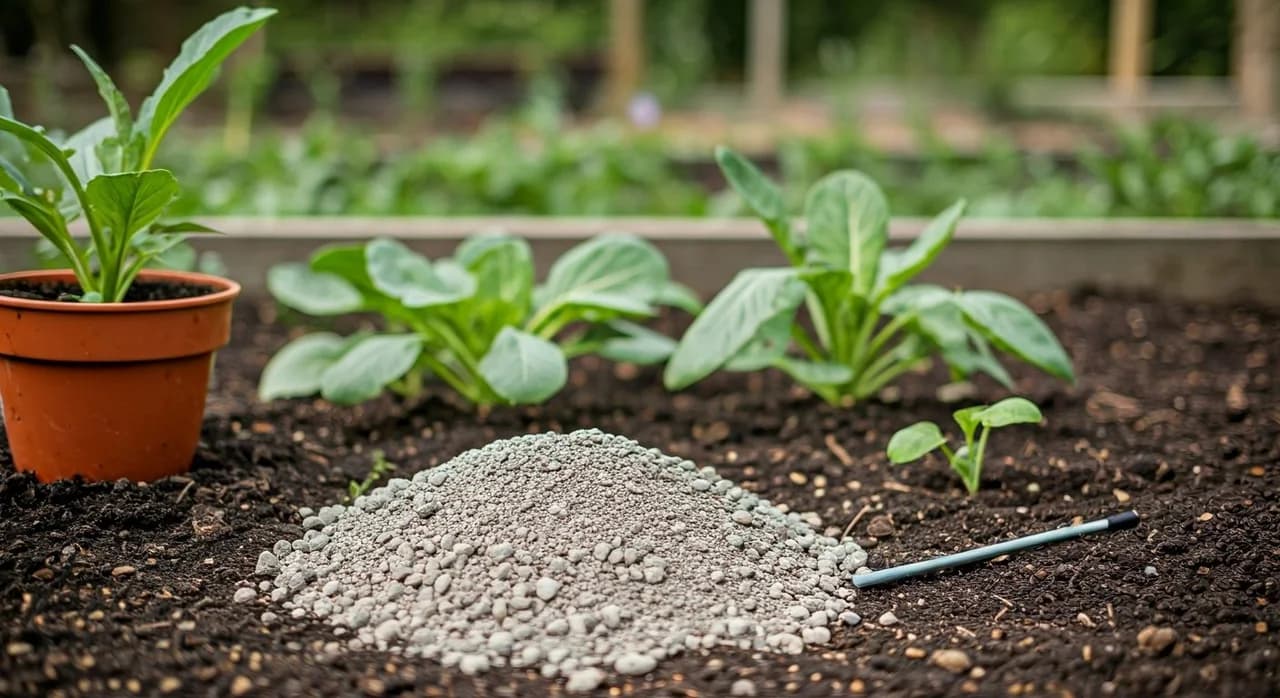
Rock dusts are exactly what they sound like: finely ground natural rocks. These can be sourced from various geological formations, including basalt, granite, and glacial till. The specific mineral composition of rock dust depends entirely on its parent rock. For example, a basalt dust from the Pacific Northwest might be rich in iron and magnesium, while a granite dust from New England can offer higher levels of potassium and silica. Particle size governs dissolution, with effective mineral release often requiring particles less than 10 microns in diameter, as observed in studies on coal and rock dusts [1]. Larger particles, like those over 100 microns, break down much more slowly, potentially taking decades to release their full mineral content.
Azomite’s unique composition and origin
Azomite, a brand name for ‘A to Z of Minerals Including Trace Elements,’ is a specific type of naturally occurring mineral deposit mined in Utah. It’s primarily composed of a hydrated sodium calcium aluminosilicate, often referred to as a rhyolitic tuff. The deposit formed when volcanic ash settled into a prehistoric seabed, producing a bed with reportedly over 70 trace minerals. The proportions vary, and the manufacturer publishes a guaranteed analysis on the bag: read that instead of relying on a generic figure. The fine grinding process ensures a high surface area, which theoretically aids in mineral availability to soil microbes and plant roots. However, the solubility of these finely divided dusts in water can still be quite low, as early research from 1924 indicated for various rock dusts [4].
- Basalt dust: Often contains iron, magnesium, and calcium, suitable for a range of soils.
- Granite dust: Provides potassium, silica, and other trace elements, beneficial for flowering plants.
- Glacial rock dust: A broad mineral blend pulverized from diverse rocks by moving glaciers.
- Azomite: A specific mineral deposit from Utah, known for its broad spectrum of trace elements.
- Particle size: Finer particles (under 10 microns) release minerals more readily than coarser ones.
The promise of remineralization and soil health
The core argument for using rock dusts and azomite is that they can restore the full spectrum of minerals to depleted soils, thereby improving plant health, nutrient density in crops, and overall soil biology. Proponents argue that many US soils in long-cultivated regions like the Corn Belt have lost trace elements such as boron, zinc, and selenium, though the evidence for a general, century-scale decline is contested. Proponents suggest that by reintroducing these elements, plants become hardier, better able to resist pests and diseases, and produce more nutritious food.
How minerals support plant and soil life
Minerals are fundamental to countless biological processes. Magnesium is central to chlorophyll production, iron is necessary for enzyme function, and trace elements like zinc and copper are essential cofactors for plant enzymes. When these are lacking, plant growth can be stunted, and yields reduced. Beyond the plants themselves, a diverse mineral profile supports a healthier soil microbiome. Beneficial bacteria and fungi also require these elements for their metabolic activities, which in turn helps cycle nutrients and build soil structure. Research from 2023 showed that silicate rock dusts, when applied to acid soils, slowly release calcium and magnesium to provide a measurable liming effect, raising pH by 0.5 to one point over a 24-month period [3]. This can be particularly helpful for gardens in the acidic soils of the US Southeast, where pH levels might naturally fall below 5.5. Regular use of a a calibrated soil pH or moisture test can help track these changes.
- Improved plant vigor: Stronger plants with better resistance to stressors.
- Increased nutrient density: Produce with higher levels of essential vitamins and minerals.
- Improved soil structure: Minerals contribute to the formation of stable soil aggregates.
- Support for soil microbes: Essential elements for a thriving community of beneficial bacteria and fungi.
- Slow-release liming: Silicate dusts can gradually raise pH in acidic soils over two to three years [3].
Evidence from the field and laboratory
While the theoretical benefits of rock dusts are compelling, real-world results can be more nuanced. Many studies focus on agricultural applications rather than home gardens, and the impact often depends on the specific soil type, the existing mineral deficiencies, and the fineness of the rock dust applied. For instance, research published in 2023 demonstrated that certain silicate rock dusts, when applied to acid soils, could effectively raise soil pH and provide a slow-release source of calcium and magnesium [3]. This effect was observed over a 24-month period, with pH increases of 0.5 to one point, which is significant for plants like Garden Peas (Pisum sativum) that prefer a pH range of 6.0 to 7.5. However, the study also noted that the rate of mineral release was gradual, suggesting that immediate, dramatic changes are unlikely.
Particle size and mineral availability
The fineness of the grind is the primary factor determining the effectiveness of rock dusts. A 1961 survey of coal and rock dusts found a significant fraction of particles below 10 microns [1]. That study measured particle size distribution for mine-safety purposes, so the link between fineness and soil mineral release is an inference from surface-area geometry, not a direct field trial. For mineral elements to become available to plants, they must first dissolve in the soil solution. Coarser particles, like those found in some commercially available products that might be 100 microns or larger, have a much smaller surface area relative to their mass. This means they dissolve very slowly, potentially over many years, making their immediate contribution to plant nutrition minimal. Just as sand erodes faster than solid stone, finer dust presents more exposed surface area for chemical weathering. This slow dissolution rate is why some gardeners report little immediate change after application, especially if using a coarser product. The USDA Natural Resources Conservation Service (NRCS) notes that soil organic matter supports nutrient cycling, which also aids the breakdown of rock dusts over time [6].
- Slow-release: Mineral availability from rock dusts is typically gradual, taking months to years.
- Particle fineness: Dusts with particles under 10 microns are more effective than coarser grinds [1].
- Soil pH: Silicate dusts can raise pH in acid soils by 0.5 to one point over two years [3].
- Organic matter: Incorporating rock dusts with compost can accelerate mineral release.
- Specific deficiencies: Best results occur when addressing known mineral shortages identified by soil tests.
Practical application for the home gardener
Before spreading any rock dust, start with a comprehensive soil test. Guessing at deficiencies is inefficient and can lead to imbalances. A standard soil test, typically costing between $20 and $50 from a university extension service in states like California or New York, will provide detailed information on your soil’s pH, organic matter content, and levels of major nutrients (nitrogen, phosphorus, potassium) as well as micronutrients like boron, zinc, and manganese. This data will tell you if you even have a deficiency that rock dusts can address. If your soil is already rich in a particular mineral, adding more could be detrimental to plant health, causing nutrient lockout for other elements.
Application rates and methods
Once you know what your soil needs, you can determine appropriate application rates. For general remineralization, common recommendations for rock dusts range from 50 to 100 pounds per 1,000 square feet, applied every two to three years. Azomite, being more concentrated, often has lower recommended rates, typically one to two pounds per 100 square feet annually. For best results, incorporate the dust into the top 4 to 6 inches of soil using a Wooden-Handle Garden Fork or a Lightweight Garden Hand Trowel. This ensures better contact with soil moisture and microbes. Applying it in conjunction with organic matter, like compost or well-rotted manure, improves its effectiveness. The organic acids produced during decomposition can help solubilize the minerals in the rock dusts, making them more available to plants over a 12-month period. For long-term soil health, consider integrating cover crops into your rotation, which can further improve soil structure and nutrient cycling, as discussed in our article on cover crops for the home garden.
- Soil testing: Essential first step, costs $20-50, identifies specific deficiencies.
- Application rates: 50-100 pounds per 1,000 square feet for rock dusts, one to two pounds per 100 square feet for azomite.
- Incorporation: Mix into the top 4-6 inches of soil for better contact.
- Combine with organic matter: Compost or manure aids mineral solubilization over 12 months.
- Frequency: Apply every two to three years for rock dusts, annually for azomite.
Cautions and considerations for gardeners
While rock dusts and azomite generally pose low risks, there are a few important considerations for home gardeners. First, always source products from reputable suppliers to ensure quality and purity. Some industrial dusts, such as lime kiln dusts or cement kiln dusts, can contain high levels of heavy metals or other undesirable compounds, making them unsuitable for garden use [5]. These industrial byproducts are very different from natural rock dusts. Always check product labels for detailed mineral analysis and any warnings. For instance, some granite dusts may have higher levels of naturally occurring radioactive elements, though no source cited here addresses radioactivity in garden dusts; check the supplier's full mineral analysis.
Safety and long-term effects
When handling any fine dust, wear a fitted N95 respirator: crushed rock dusts, granite especially, carry respirable crystalline silica, which is hazardous regardless of prior health conditions. Studies on coal dusts, for example, document respiratory hazards from fine particulate matter [2]. Once incorporated into the soil, the risk is minimal. For long-term effects, remember that mineral release is slow. You won’t see immediate changes overnight, or even within a single growing season. Consistent application over several years, combined with sound soil management practices like composting and cover cropping, builds healthy, remineralized soil over time. The benefits often accumulate over five to ten years, leading to sustained improvements in soil structure, microbial diversity, and plant resilience. Always monitor your soil’s health with annual soil tests to track changes and adjust your amendment strategy.
- Source reputable products: Avoid industrial dusts like lime kiln dusts unless specifically approved for agriculture [5].
- Check labels: Look for mineral analysis and heavy metal content.
- Wear an N95 respirator: a cloth or surgical mask will not stop the respirable silica in crushed rock dust [2].
- Manage expectations: Benefits are slow and cumulative, often taking years to fully manifest.
- Annual soil testing: Track changes in mineral levels and pH over time, costing $20-50 per test.
Comparison of common rock dusts for garden use
Feature | Basalt Dust | Granite Dust | Azomite |
|---|---|---|---|
Primary Minerals | Calcium, Magnesium, Iron | Potassium, Silica, Trace Elements | Broad Spectrum (70+ trace elements) |
Typical Application Rate | 50-100 lbs per 1,000 sq ft | 20-40 lbs per 1,000 sq ft | 1-2 lbs per 100 sq ft |
Frequency | Every 2-3 years | Every 2-3 years | Annually |
pH Effect | Mildly alkaline, can raise pH by 0.5 point [3] | Neutral to slightly acidic | Neutral |
Release Rate | Slow, over 2-5 years | Slow, over 3-6 years | Slow-to-moderate, over 1-3 years |
Cost per 50 lb bag (approx) | $20-$40 | $25-$50 | N/A (sold in smaller bags, e.g., 44 lb for $40-$60) |
Particle Size Matters: Finer rock dust weathers faster than a coarse grind because smaller particles expose far more surface area; a 1961 survey found a significant fraction of rock dust particles below 10 microns [1].
Slow Liming Effect: Silicate rock dusts can increase soil pH by 0.5 to one full point in acidic soils over a 24-month period, creating a gradual liming effect [3].
Soil Test First: A comprehensive soil test, typically costing $20-50, identifies specific mineral deficiencies before applying rock dusts.
References
- The Size Distribution of Coal and Rock Dusts in the Electron and Optical Microscope Ranges (1961).
- Mining hazards b) Coal dusts (1975).
- A comparison of silicate rock dusts and accelerated weathering tests to assess the slow-release liming effects in acid soils. (2023).
- Solubility of finely divided rock dusts in water, kerosene, and alcohol (1924).
- Guide for Commercial Use of Lime Kiln Dusts and Portland Cement Kiln Dusts (2023).
- USDA Natural Resources Conservation Service (2024).