Key takeaways
- June marks the start of winter in the Southern Hemisphere, requiring distinct planting strategies across Australian climate zones.
- Temperate and cool regions focus on hardy brassica transplants, broad beans, garlic cloves, and planting dormant bare-rooted fruit trees.
- Subtropical and tropical zones enter their peak growing window for tomatoes, capsicums, beans, and salad greens as monsoon humidity drops.
- Bare-rooted deciduous fruit trees, roses, and berry canes arrive in nurseries during June and should be planted immediately into prepared soil.
- Protect young winter seedlings from heavy frost using cloches, horticultural fleece, or simple timber-framed covers.
Quick answer: Knowing what to plant in June Australia depends on your regional climate zone. In temperate and cool areas, June is the prime window for planting garlic, broad beans, onions, English spinach, and bare-rooted fruit trees. In subtropical and tropical regions, cooler, drier winter weather creates the ideal season to grow warm-climate staples including tomatoes, capsicums, zucchini, and bush beans.
June marks the official arrival of winter across Australia, bringing cooler soil temperatures, shorter daylight hours, and frosty mornings to southern regions, while northern areas welcome milder temperatures and lower humidity. Knowing what to plant in june australia allows gardeners to take advantage of these distinct regional patterns rather than letting the veggie patch sit idle during the winter months.
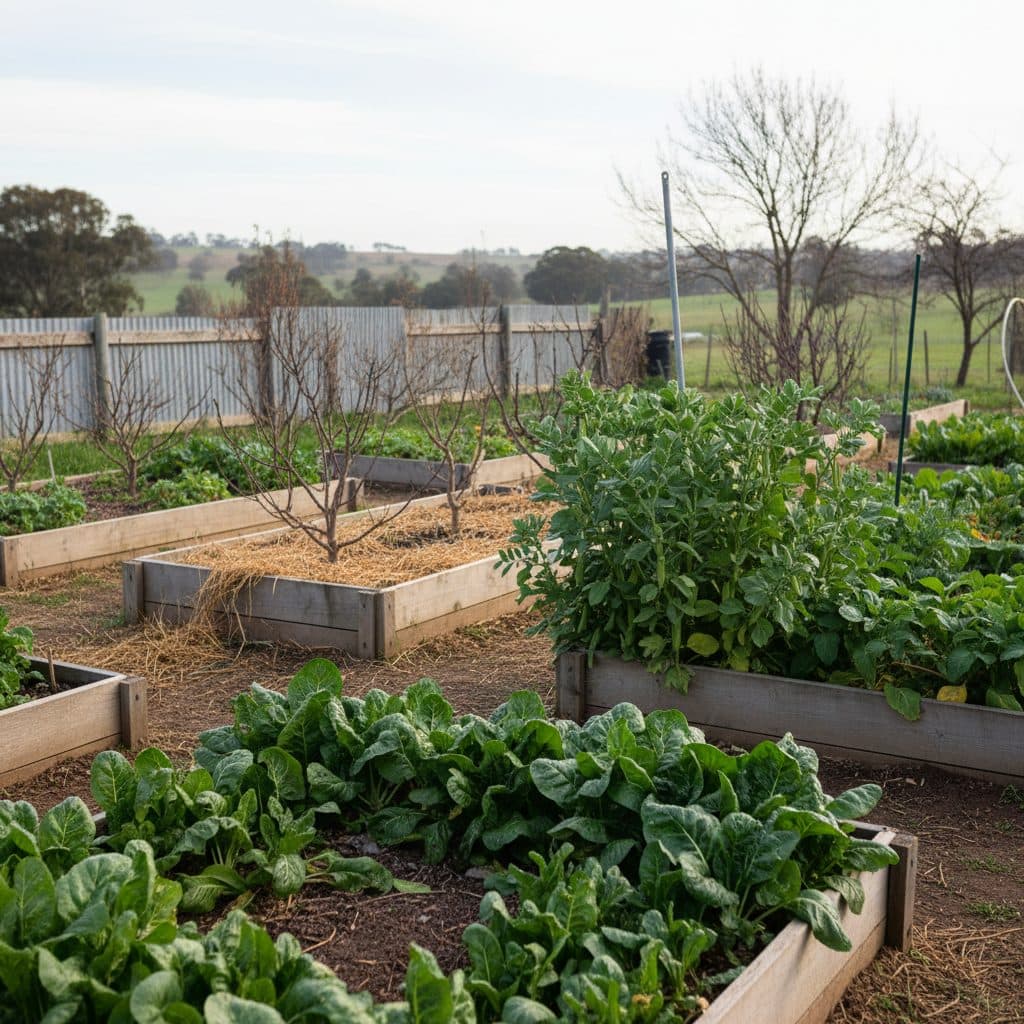
In the southern half of the continent, plant growth slows down, but the soil remains workable for hardy cool-season crops and dormant perennial plantings. June is renowned among Australian gardeners as the start of the bare-rooted planting season, when nurseries receive dormant deciduous fruit trees, grapevines, and berry canes ready for winter establishment.
Meanwhile, growers in northern Australia experience their most productive vegetable season. With the intense tropical heat and monsoonal rains gone, gardeners in northern Western Australia, the Northern Territory, and Queensland can cultivate crops that struggle during the extreme summer months. Understanding your specific climate zone ensures every seed and seedling is positioned for winter success.
Australian climate zones for June planting
Australia spans diverse climatic regions that dictate winter sowing schedules. Rather than relying on a single national planting calendar, divide your garden planning across four main climate categories:
+-------------------------------------------------------------------+
|               AUSTRALIAN WINTER CLIMATE ZONES                     |
|                                                                   |
|  TROPICAL (Far North QLD, NT, Kimberley)                          |
|  - Mild dry winter, 22°C to 30°C daily temps                      |
|  - Peak season for tomatoes, capsicum, cucumbers, beans           |
|                                                                   |
|  SUBTROPICAL (SE QLD, Northern NSW coastal)                       |
|  - Mild days (18°C to 24°C), cool nights, low frost risk          |
|  - Brassicas, root crops, leafy greens, peas, strawberries        |
|                                                                   |
|  TEMPERATE (Sydney, Melbourne coastal, Perth, Adelaide)           |
|  - Cool days (12°C to 17°C), cold nights, light occasional frost  |
|  - Broad beans, garlic, onions, silverbeet, bare-root trees       |
|                                                                   |
|  COOL / COLD (Tasmania, ACT, southern tablelands)                 |
|  - Cold days (5°C to 12°C), frequent heavy frosts, snow on peaks  |
|  - Garlic, broad beans, bare-root trees, green manures            |
+-------------------------------------------------------------------+- Tropical (Darwin, Cairns, Broome): June brings dry, pleasant weather with daily temperatures averaging 22°C to 30°C. This is the prime time to plant sweetcorn, tomatoes, rockmelons, cucumbers, and pumpkins.
- Subtropical (Brisbane, Gold Coast, Byron Bay, Coffs Harbour): Winter is mild with minimal frost risk. Gardeners can plant broccoli, cabbage, carrots, silverbeet, snow peas ('Mammoth Melting', 'Oregon Giant'), climbing peas ('Telephone'), beetroot, and late strawberry runners.
- Temperate (Sydney, Melbourne coastal, Adelaide, Perth): Cool conditions with occasional light frosts. Focus on broad beans, garlic, spring onions, leeks, English spinach, and root vegetables.
- Cool and Cold (Canberra, Hobart, Ballarat, Southern Tablelands): Sub-zero winter nights and frequent frosts. Direct seed sowing stalls in cold, wet soil (temperatures below 8°C); focus on bare-root fruit trees, transplanting hardy brassica seedlings, garlic, broad beans, and protecting beds under cloches or thick mulch.
Winter vegetables to plant in June across Australia
Cool-season vegetables thrive when established in well-draining soil enriched with compost.
Broad beans (fava beans)
Broad bean cultivars such as 'Aquadulce' and 'Coles Early Dwarf' are among the most reliable crops to plant across temperate and cool Australia in June. They germinate readily in cool soils between 8°C and 15°C and provide substantial nitrogen fixation through root nodules. Sow seeds directly into garden beds 5 cm deep and 20 cm apart. As plants grow up to 1.5 m tall, install sturdy timber stakes and twine to prevent heavy winter winds from lodging the stems.
Garlic and alliums
If you missed planting garlic in April or May, June is still a workable window across southern Australia, and cool-district growers often plant right up to the shortest day (winter solstice). In warmer subtropical areas, autumn planting (March to May) is required for cloves to experience adequate cold to divide properly. Break certified virus-free bulbs into individual cloves and plant them pointed end up, 3 cm below the soil surface with 15 cm spacing. June is also ideal for sowing brown, red, and white onion seeds in seed trays, as well as transplanting leek and spring onion seedlings. Reviewing our garlic planting guide provides detailed clove preparation steps.
Brassicas: broccoli, cabbage, and kale
In subtropical and warm temperate regions, June is an active planting window for brassica seedlings. Transplant sturdy seedlings of broccoli, cauliflower, cabbage, and Tuscan kale into soil that has been amended with well-rotted manure and blood and bone. Space large brassicas 45 cm apart to ensure adequate airflow, which minimises fungal issues during damp winter spells.
Root crops: carrots, beetroot, and parsnips
Direct sow carrots and beetroot in subtropical zones where warm soil speeds germination. In temperate zones, hold parsnip seed until soil warms in late winter to spring (roughly August onwards in temperate zones)—it germinates poorly in cold June soil. Understanding vegetable growth stages helps you monitor root swelling and harvest at peak tenderness.
Bare-root fruit trees and perennial canes
June marks the arrival of dormant bare-rooted stock in Australian garden centres and online nurseries. Planting deciduous trees while dormant reduces transplant shock and allows root systems to establish before spring bud break.
- Inspect root systems: Unpack your bare-rooted trees immediately upon arrival. Healthy roots should be firm and pliable with no sour or rotting odour.
- Hydrate before planting: Submerge the root system in a bucket of water with a dash of seaweed tonic for two to four hours prior to planting to rehydrate root tissues.
- Prepare the planting hole: Dig a hole twice as wide as the root spread but no deeper than the original root collar. Create a slight mound of soil in the centre of the hole.
- Position and spread roots: Set the tree on the mound, spreading roots evenly outward. Ensure the graft union sits at least 5 to 10 cm above the finished soil level.
- Backfill and firm: Backfill with native soil, firming gently with your hands to remove air pockets. Water deeply with 15 to 20 litres of water to settle the soil.
- Prune to balance growth: Prune back the leader and side branches by roughly one-third to establish strong structural framework. Learn proper techniques through winter pruning fruit trees.
Deciduous stone fruits (peaches, plums, nectarines, apricots), pome fruits (apples, pears), figs, and grapevines all benefit from June bare-root planting. Raspberry canes can be planted in June along a wire trellis. Blackberry is a Weed of National Significance and is declared in every Australian state—check your state's rules before planting any Rubus fruticosus cultivar.
Herbs and leafy greens for winter sowing
Leafy greens and hardy herbs provide fresh harvests throughout winter, particularly when protected from heavy downpours and frost.
- Silverbeet and English spinach: Silverbeet is exceptionally hardy and produces continuous harvests across temperate and subtropical regions. Plant seedlings 30 cm apart in rich, moist soil. English spinach thrives in cool conditions where it resists premature bolting.
- Rocket and Asian greens: Rocket, tatsoi, bok choy, and mizuna germinate rapidly even in cool weather. Direct sow seeds 1 cm deep in rows, harvesting baby leaves after four to five weeks.
- Winter coriander: Coriander tends to bolt to seed quickly during hot summer weather, making June the premier planting month across southern and subtropical Australia. Sow seeds directly into pots or garden beds in full sun.
- Parsley and thyme: Plant flat-leaf Italian parsley and robust thyme seedlings near the kitchen door for convenient winter harvesting.
Winter veggie patch soil care and frost protection
Cold, waterlogged soil is the primary enemy of winter crops in southern Australia. Taking proactive steps in June maintains biological activity and protects tender foliage from sub-zero morning frosts.
Mulching and drainage management
Apply a 3 to 5 cm layer of organic mulch, such as pea straw, lucerne, or sugarcane mulch, over your garden beds. Mulch insulates soil against rapid freezing, conserves moisture, and prevents soil compaction from heavy winter rains. Ensure raised beds have clear drainage outlets so roots do not sit in stagnant, freezing water. Applying natural compost accelerators to your compost bin ensures you generate rich organic matter for early spring top-dressing.
Frost protection strategies
In frost-prone inland and tableland districts, frost ruptures tender plant cells. Protect susceptible winter crops with simple measures:
- Cover beds with horticultural frost cloth or breathable hessian suspended on flexible PVC polypipe hoops.
- Avoid letting frost covers touch plant foliage directly, as cold transfers through damp cloth.
- Water garden beds lightly in the late afternoon before an expected frost; moist soil retains and radiates heat better than bone-dry soil.
- Remove covers mid-morning once the sun has melted any frost to allow sunlight and airflow into the bed.
Aligning your planting schedule with regional winter conditions keeps an Australian veggie patch productive through the colder months. At agripure, straightforward growing guidance helps you harvest fresh produce in every season.