Key takeaways
- Enforce P0 setbacks: site basins >=10 ft downslope from house foundations, >=25–50 ft from septic tanks and leach fields, >=2 ft above seasonal high water tables, and call 811 before digging.
- Verify a >=0.5 in/hr perc rate via a 24-hour test so 4–8 inches of standing water drains within <=24–48 hours—stopping Aedes and Culex mosquito breeding.
- Size the basin at 20% to 30% of contributing roof area at 6-inch depth (200–300 sq ft per 1,000 sq ft roof) and use an 18–24 inch bioretention mix (50–60% coarse sand, 20–30% sandy loam, 10–20% low-P compost) in slow clay.
- Layer natives across three zones: Zone 1 Deep Basin (sedges, irises, swamp milkweed), Zone 2 Bank Slope (switchgrass, asters, sweetspire), and Zone 3 Dry Berm (little bluestem, butterfly milkweed, coneflower).
- Keep oily garage runoff and NaCl/CaCl2 road-salt wash off edible shrubs (elderberry, chokeberry, serviceberry), and ban Lythrum salicaria, Iris pseudacorus, and Phragmites australis.
Quick answer: A functional US rain garden captures roof runoff at 20% to 30% of the contributing roof area (at a 6-inch ponding depth) and drains within 24 to 48 hours so Aedes and Culex mosquitoes cannot breed. Call 811 before digging, site basins >=10 feet downslope from foundations, >=25–50 feet from septic fields, and >=2 feet above the seasonal high water table, then verify >=0.5 in/hr drainage via a 24-hour perc test. Plant USDA Zones 3–10 natives across Zone 1 (4–8" basin), Zone 2 (slope), and Zone 3 (dry berm) while banning invasive wetland wreckers like purple loosestrife and yellow flag iris.
Why Rain Gardens Fail: Standing Water, Foundation Leaks & Wrong Zones
Most failed residential rain gardens break down for engineering reasons rather than plant hardiness. Digging a 12-inch pit into compacted backyard clay next to a downspout creates a stagnant mud bowl that floods basements, drowns upland perennials, and breeds summer mosquitoes.
According to U.S. EPA Soak Up the Rain, Rutgers Cooperative Extension, and Minnesota Blue Thumb stormwater standards, a rain garden is a temporary bioretention cell—not a permanent backyard pond. Engineered to infiltrate a 1-inch to 1.25-inch storm completely within 24 to 48 hours, a properly sited basin absorbs far more runoff than turf lawn while cutting downstream sediment and nutrient pollution. Review broader yard drainage patterns in our guides to stopping yard flooding and swales, berms, and French drains before staking out a site.
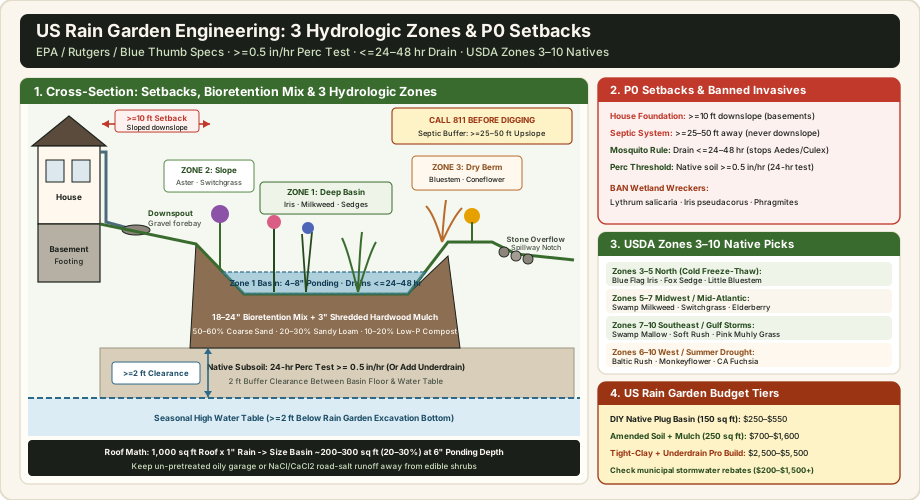
P0 Structural, Septic, Water Table & Utility Setbacks
Stormwater infiltration concentrates thousands of gallons of roof water into one spot each year. Putting that saturation zone in the wrong place cracks footings, backs up septic drain fields, or slices live buried gas and electric lines.
Mandatory P0 Setbacks, Percolation Thresholds & Engineered Bioretention Soil Specs
Site Parameter | Mandatory Engineering Threshold | Failure Consequence If Violated |
|---|---|---|
Underground Utilities (811) | Call 811 at least 3–5 business days before digging | Electrocution, severed fiber, ruptured gas or water service lines |
House Foundation (Basement) | >=10 ft downslope from foundation wall; grade yard away | Hydrostatic water pressure against basement walls, sump pump overload, seepage |
Slab-on-Grade Building | >=2–10 ft downslope (Rutgers minimum 2 ft only if grade slopes away) | Sub-slab frost heave in cold zones and edge undermining |
Septic Tank & Leach Field | >=25–50 ft horizontal setback; never place upslope-inline or over field | Hydraulic overload of septic absorption trench and untreated sewage surfacing |
Seasonal High Water Table | >=2 ft vertical soil clearance below bottom of excavated soil mix | Chronic groundwater upwelling turns basin into permanent stagnant mosquito marsh |
24-Hr Perc Test Infiltration | >=0.5 in/hr native drain rate (drains 4–8" ponding within <=24–48 hrs) | Aedes and Culex mosquitoes complete egg-to-adult cycle in stagnant water; root rot |
Bioretention Soil Mix (Clay) | 18–24" deep: 50–60% coarse sand, 20–30% sandy loam, 10–20% low-P compost | Using native clay or bagged bark topsoil seals pores into an anaerobic tub |
Mature Tree Dripline | Outside primary structural root zone of mature oaks, maples, or walnuts | Excavation cuts feeder roots and chronic ponding suffocates established trees |
Pollutant & edible shrub safety warning: Do not route un-pretreated oily garage/driveway runoff or winter sidewalk/road runoff loaded with sodium chloride (NaCl) or calcium chloride (CaCl2) de-icers onto edible fruiting shrubs such as black elderberry, black chokeberry, or serviceberry. Reserve fruiting native shrubs for clean roof-downspout basins, and keep road-salt or driveway basins planted strictly with salt-tolerant non-edible sedges and roadside salt-tolerant species behind a gravel sediment forebay.
If you live in an HOA neighborhood or municipal watershed district, confirm local utility easements and check our municipal rain garden stormwater rebate guide and swale foundation safety checklist. Many cities reimburse $200 to $1,500+ of plant and soil costs when setback distances are documented on a simple sketch.
24-Hour Percolation Test, Mosquito Prevention & Bioretention Soil Mix
Never guess drainage speed by looking at dry turf. Run a simple soil drainage percolation test in the exact footprint where the basin will sit before ordering plants or renting a trencher.
- Dig and pre-soak: Dig an 8×8-inch hole inside the proposed Zone 1 floor, fill it completely, and let it drain so pores reach field saturation.
- Measure hourly drop: Refill to a 6-inch mark and track drop over 4 hours (and check at 24 hours). A rate of >=0.5 inches per hour drains a 6-inch basin in 12 hours.
- Fix marginal rates (0.25–0.49 in/hr): Swap 18–24 inches of soil for bioretention mix, widen the basin, and cap ponding at 4–5 inches.
- Handle tight clay (<0.25 in/hr or ponding >48 hrs): Standing water past 48 hours lets Aedes and Culex larvae pupate in 5–7 warm days. Move the basin, add a 4-inch perforated underdrain, or build a waterlogged clay soil bed.
Engineered bioretention soil mix vs. backyard clay pitfalls
Dumping bagged garden soil or pure compost into a clay pit seals pore spaces within two seasons. Rutgers and Washington State manuals specify an open-pored bioretention mix: 50–60% coarse washed concrete sand (never fine play sand), 20–30% sandy loam topsoil, and 10–20% aged low-phosphorus leaf compost. See our heavy clay amendment guide and clay soil plant guide.
Top beds with 2–3 inches of shredded hardwood bark mulch—never buoyant wood chips or pine straw that float into overflow notches. Keep mulch 2 inches off shrub crowns and apply mosquito-safe swale practices.
Roof-Area Sizing Math & US Dollar Cost Tiers
Sizing a rain garden starts with measuring the impervious area feeding it, not guessing a pretty kidney shape. For most residential roofs in the US, sizing the flat basin floor at 20% to 30% of the contributing roof square footage at a 6-inch ponding depth handles a standard 1-inch to 1.25-inch storm without overflowing onto neighbor property.
Worked 1,000 sq ft roof sizing formula: Measure one roof plane feeding your chosen downspout—for example, a `25 ft × 40 ft = 1,000 sq ft` garage or half-house roof. Multiply area by a 1-inch (`0.0833 ft`) design storm (`1,000 × 0.0833 = 83.3 cu ft`, or `~623 gallons` per storm). Divide runoff volume by a `0.5 ft` (`6 in`) ponding depth (`83.3 ÷ 0.5 = 167 sq ft` in fast sandy soil), or apply Wisconsin/Rutgers soil sizing factors (`0.18–0.20` for sand, `0.25` for loam, `0.30` for amended clay) to size a `200–300 sq ft` rain garden (`e.g., 12 ft × 20 ft` oval). If you also harvest roof water upstream, calculate barrel draw-down using our rain barrel roof-area formula and rain garden siting and sizing manual.
US Rain Garden Roof-Area Sizing Ratios & Realistic Installation Budgets
Project Tier & Subsoil | 1,000 sq ft Roof Footprint | Excavation & Materials Scope | Typical US Cost ($) |
|---|---|---|---|
Sandy / Loam DIY Plug Basin (>=1.0 in/hr perc) | 180–220 sq ft (20% ratio, 6" depth) | Hand-dug 8" basin, downspout pipe + gravel splash pad, 3" hardwood mulch, 75–100 native plugs | $250–$550 |
Silty Loam / Light Clay DIY Amended Basin (0.5 in/hr) | 240–300 sq ft (25–30% ratio, 5–6" depth) | 18" soil swap with 50/30/20 bioretention blend, stone overflow notch, mulch, plugs + 2 shrubs | $700–$1,600 |
Heavy Clay / High-Runoff Build with Underdrain (<0.5 in/hr) | 300–350 sq ft (30%+ ratio, 4–5" depth) | Mini-excavator dig, 24" engineered mix, 4" perforated underdrain + gravel sleeve, mature pots | $2,500–$5,500 |
When excavating on sloped lawns, push spoil earth onto the downslope rim to form a gently rounded Zone 3 Dry Berm compacted lightly in 3-inch lifts so the basin floor sits dead level (checked with a line level or laser). Cut one 2-to-3-foot-wide overflow spillway notch 2 inches lower than the top of the berm and armor it with flat fieldstone or 2-to-4-inch river cobble so 3-inch cloudbursts exit gently without blowing out the berm.
The 3 Hydrologic Zones Inside Every Rain Garden
Plant survival depends on elevation inside the bowl. Even a 4-inch vertical drop completely flips root oxygen levels from wet-meadow saturation to upland drought between storms.
- Zone 1 — Deep Basin (4–8 inches inundation): The flat level floor where storm runoff pools deepest and drains over 12 to 48 hours, yet dries out cleanly for 2 to 3 weeks during August heat. Only true wetland-marginals with deep fibrous or rhizomatous roots—sedges (Carex), rushes (Juncus), swamp milkweed (Asclepias incarnata), blue flag iris (Iris versicolor), and swamp mallow—thrive across both extremes.
- Zone 2 — Bank Slope (transition zone, 15–20% grade): The gently angled inner walls rising from basin floor up to grade. Roots stay moist briefly as water draws down, then drain fast into dry subsoil. Anchor this slope with dense, deep-rooted clump grasses (switchgrass, prairie dropseed) and tough perennials (New England aster, cardinal flower, sweetspire) so sheet flow never cuts rills.
- Zone 3 — Dry Berm & Buffer Edge (outer rim): Rarely floods except during 10-year cloudbursts exiting the stone spillway. Treat Zone 3 as a standard drought-tolerant border—plant little bluestem, butterfly milkweed (Asclepias tuberosa), purple coneflower, serviceberry, or California fuchsia to frame the garden cleanly against turf. Explore slope reinforcement pairings in our basin depth and ponding guide and riparian three-zone buffer guide.
USDA Zones 3–10 Native 3-Zone Rain Garden Plant Matrix
Match species to both your local climate region (filter exact frost hardiness in our plant finder tool) and the exact hydrologic zone inside the basin. Planting a Zone 3 drought lover like butterfly milkweed (Asclepias tuberosa) in the bottom of Zone 1 rots its taproot in one rainy spring, whereas placing turtlehead (Chelone glabra) on a high dry berm crisps its foliage by July.
USDA Zones 3–10 Native Rain Garden Plant Matrix Across Zone 1 (Basin), Zone 2 (Slope) & Zone 3 (Dry Berm)
US Region & USDA Zones | Zone 1: Deep Basin (4–8" Ponding) | Zone 2: Bank Slope (Moist-to-Dry) | Zone 3: Dry Berm & Rim (Drought Edge) |
|---|---|---|---|
Northern & Upper Midwest (Zones 3–5) | Blue Flag Iris (Iris versicolor), Tussock Sedge (Carex stricta), Fox Sedge (C. vulpinoidea), Joe Pye Weed (Eutrochium maculatum) | Swamp Milkweed (Asclepias incarnata), White Turtlehead (Chelone glabra), Ostrich Fern (shade), Red-Osier Dogwood (Cornus sericea) | Little Bluestem (Schizachyrium scoparium), Creeping Phlox, Buffalo Grass, Saskatoon Serviceberry |
Mid-Atlantic & Central Plains (Zones 5–7) | Southern Blue Flag (Iris virginica), Soft Rush (Juncus effusus), Palm Sedge (Carex muskingumensis), Black Elderberry (clean roof runoff) | Cardinal Flower (Lobelia cardinalis), Switchgrass (Panicum virgatum), New England Aster (Symphyotrichum novae-angliae), Black Chokeberry | Butterfly Milkweed (Asclepias tuberosa), Purple Coneflower (Echinacea purpurea), Wild Bergamot (Monarda fistulosa), Showy Goldenrod (Solidago speciosa) |
Southeast & Gulf Coast (Zones 7–10) | Scarlet Rose Mallow (Hibiscus coccineus), Swamp Sunflower (Helianthus angustifolius), Native Yellow Canna (Canna flaccida), Louisiana Iris (Iris fulva) | Virginia Sweetspire (Itea virginica), Buttonbush (Cephalanthus occidentalis), Blue Mistflower (Conoclinium coelestinum), Cinnamon Fern | Pink Muhly Grass (Muhlenbergia capillaris), American Beautyberry (Callicarpa americana), Black-Eyed Susan (Rudbeckia hirta), Stokes' Aster |
Western, PNW & Arid Southwest (Zones 6–10) | Baltic Rush (Juncus balticus), Slough Sedge (Carex obnupta), Seep Monkeyflower (Erythranthe guttata), Desert Willow (Chilopsis linearis, SW washes) | Western Sword Fern (Polystichum munitum, PNW shade), Douglas Aster (Symphyotrichum subspicatum), Red-Flowering Currant, Apache Plume (SW) | California Fuchsia (Epilobium canum), Common Yarrow (Achillea millefolium), Blackfoot Daisy (Melampodium leucanthum), Oregon Grape |
When choosing cultivars for wildlife and pollinator density, keep at least 70% straight-species natives from local eco-types rather than double-petaled hybrids that block nectar access. For deeper regional plant pairings across wet yards, explore our guides on native rain garden plants by region, swale and creek-bank natives, trees and shrubs for wet soil, and growing native berries safely.
Establishment watering, seed stratification & multi-year care
Even drought-tough prairie natives spend Year 1 building deep vertical roots (`4–12 ft` for switchgrass and milkweeds) before showing strong top growth. Irrigate plugs at 1 inch per week across the first 60 days whenever rain skips a week, weed hand-pulled annuals monthly during Season 1, and wait until late winter or early spring (once overwintering stem-nesting bees emerge at 50°F+) before cutting dead stalks back to 6–10 inches. If starting native seed mixes yourself instead of buying plugs, follow cold-moist stratification steps over winter so milkweed and coneflower seed coats break dormancy evenly.
Banned Invasive Wetland Wreckers (Never Plant These)
Because rain gardens connect directly to storm drains, ditches, and neighborhood creeks during extreme downpours, planting aggressive exotic wetland ornamentals turns your yard into a seed-dispersal engine that wipes out downstream marshes. Federal, state, and Extension agencies explicitly warn against planting these invasive wetland wreckers:
Invasive Wetland Plants to Ban From Rain Gardens & Verified Native Swaps
Banned Invasive Species | Ecological & Basin Failure Mode | Safe US Native Replacement |
|---|---|---|
Purple Loosestrife (Lythrum salicaria) | Single plant drops millions of seeds down storm drains, choking wetlands into dense dead-zone monocultures | Prairie Blazing Star (Liatris pycnostachya) or Swamp Milkweed (Asclepias incarnata) |
Yellow Flag Iris (Iris pseudacorus) | Aggressive toxic rhizomes outcompete native sedges, trap sediment, and clog basin overflow outlets | Blue Flag Iris (Iris versicolor) or Copper Iris (Iris fulva) |
Common Reed (Phragmites australis, non-native) | Spreads via deep creeping stolons up to 15 ft tall, displacing all native wildlife and drying basins | Switchgrass (Panicum virgatum) or Soft Rush (Juncus effusus) |
Reed Canary Grass (Phalaris arundinacea) | Forms impenetrable turf mats that slow infiltration and overrun adjacent ditches and streams | Fox Sedge (Carex vulpinoidea) or Pink Muhly Grass (Muhlenbergia capillaris) |
Lantana (Lantana camara, Zones 8–11) | Category I invasive in Florida and Gulf South; toxic berries spread by birds into natural hammocks | Butterfly Milkweed (Asclepias tuberosa) or American Beautyberry (Callicarpa americana) |
Always check your state Department of Agriculture noxious-weed list and source nursery plugs tagged with true Latin binomials—many nurseries still mislabel invasive Iris pseudacorus simply as "water iris" or confuse non-native giant reed grasses with native erosion-control bunchgrasses. For complementary pollinator layering around dry basin margins, browse our pollinator plant calendar and echinacea growing guide.