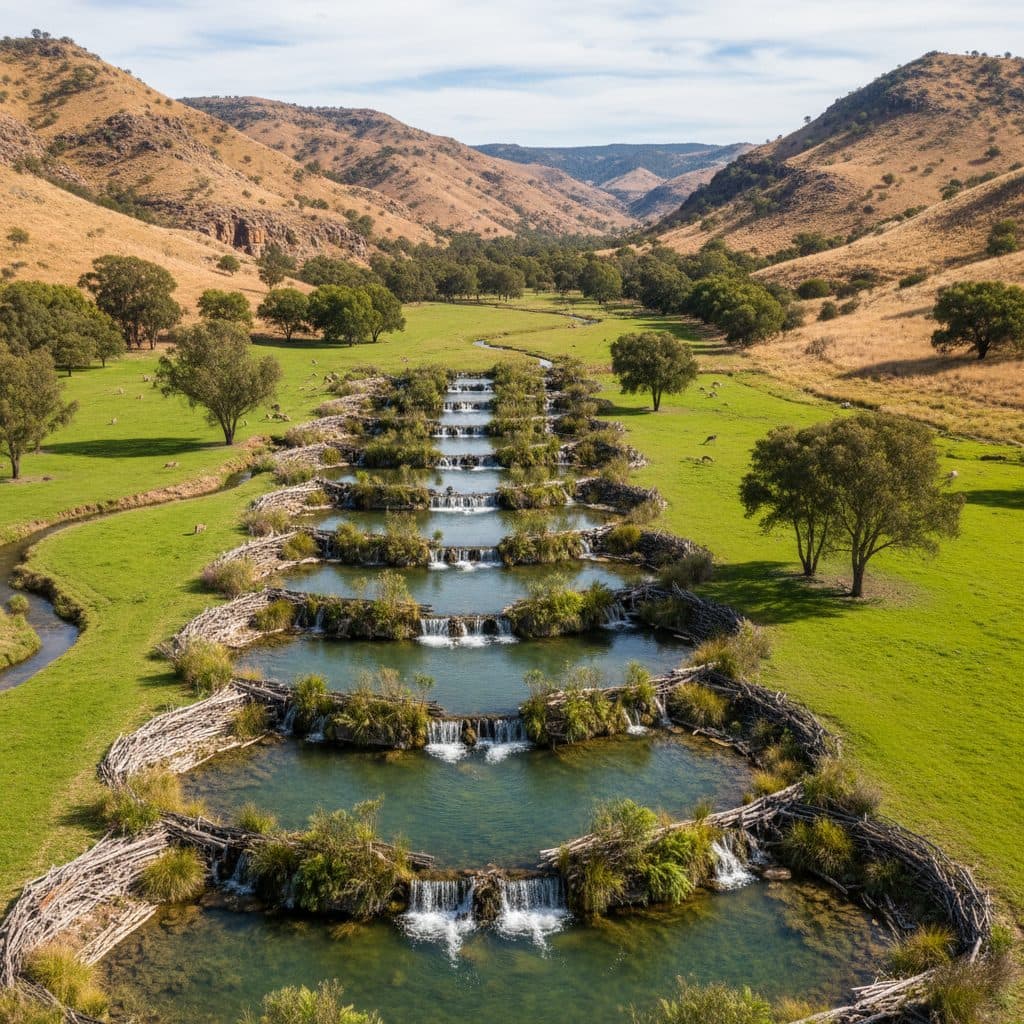
Key takeaways
- Understand how slowing water in upper catchments restores natural stepped-diffusion valley hydrology.
- Reconnect incised, eroded stream channels with their broader floodplains to rehydrate soil profiles.
- Construct porous, biological leaky weirs from fallen timber, rock, and vegetation rather than concrete dams.
- Use pioneer vegetation and deep-rooted plants to stabilise eroding gullies and cycle mineral nutrients.
- Transfer fertility biologically from low valley floors back to upper ridge slopes through grazing and mulch.
Quick answer: Natural sequence farming is an Australian regenerative land management system developed by Peter Andrews OAM that restores degraded agricultural landscapes by reinstating natural water cycles and vegetation patterns. By constructing porous leaky weirs to slow streamflow, elevating valley water tables, and using pioneer plants to build organic matter, it rehydrates parched landscapes naturally.
Australia's ancient landscapes evolved over millions of years under low-energy hydrological regimes. Prior to European settlement, Australian valley floors were not deep, rapid-flowing drainage gutters; they were chain-of-ponds systems, wide reed beds, and stepped floodplains where water moved slowly, soaking deeply into valley sediments and maintaining lush, hydrated pastures through severe continental droughts.
Over two centuries of land clearing, draining of wetlands, and hard-hoofed grazing degraded these delicate systems. Rivers incised into deep erosion gullies, draining the surrounding groundwater tables like a pulled bathtub plug and leaving millions of hectares susceptible to desertification, bushfires, and salinity.
Natural sequence farming (NSF) emerged as one response to this degradation. Conceived and demonstrated by Australian horse breeder and farmer Peter Andrews OAM at Tarwyn Park in the Bylong Valley of New South Wales, this method re-establishes the natural sequence of water movement, biological succession, and nutrient cycling across Australian farms.
The core principles of landscape rehydration
Natural sequence farming is founded on several core observations of how water and biology naturally interact in undisturbed Australian valleys:
- Water must be slowed, not drained: Conventional drainage engineering seeks to remove floodwaters as quickly as possible. NSF does the opposite: it slows water down, spreading it across the landscape so that gravity drives moisture downward into subsoil aquifers rather than racing out to sea.
- Stepping the water down the catchment: In nature, water flows down a valley through a series of stepped pools, wetlands, and riffles. By re-creating these steps, kinetic energy is dissipated, stopping erosion and allowing suspended sediments and organic matter to drop out and rebuild fertile soil.
- Reconnecting streams to floodplains: When a stream cuts down into an incised channel, it disconnects from its floodplain. NSF raises the stream bed height using biological structures, forcing small, routine flows to spill over the banks and soak into the surrounding floodplain soils.
- Restoring the groundwater sponge: When valley soils are fully hydrated, they act like a massive underground reservoir. This subterranean water moves slowly down the valley beneath the surface, maintaining green pasture growth and spring flows even through years of extreme drought.
To see how earthworks and hydrology integrate in permaculture design, review our guide to swales and water management.
Leaky weirs: restoring natural stream hydrology
The signature physical intervention in natural sequence farming is the leaky weir (or bed-control structure).
Unlike conventional concrete or earthen dams that completely block streamflow, create stagnant deep pools, and suffer catastrophic blowouts during major floods, a leaky weir is a permeable, biological filter:
- Materials: Constructed from natural, locally sourced materials—fallen logs, tree branches, rocks, gravel, and living vegetation such as reeds, sedges, and native wetland plants.
- Function: When streamflow is low, water filters slowly through the porous base of the structure. When heavy rains arrive, the weir backs water up, forcing the flood crest to spread gently across the adjoining floodplain, depositing nutrient-rich silt.
- Sediment trapping: Over time, silt, organic debris, and plant roots accumulate behind the weir, naturally raising the base level of the creek bed and reversing decades of gully erosion.
Because leaky weirs are permeable and built from flexible biological materials, they absorb the energy of floodwaters without failing, self-repairing as vegetation grows through the structure. In most Australian states, works in or beside a watercourse require approval from the state water or environment authority before you start — check before placing any structure in a creek line.
The vital role of pioneer plants and weeds
One of the most contested tenets of natural sequence farming is its tolerance of pioneer vegetation—including plants commonly classified as agricultural weeds.
Peter Andrews recognised that nature deploys specific plants to heal damaged, eroded landscapes:
- Nutrient cycling and soil building: Deep-rooted pioneer plants colonise bare, degraded soils — in Australian catchments that means native sedges (Carex appressa), common reed (Phragmites australis, which is native here), rushes (Juncus spp.) and river she-oak (Casuarina cunninghamiana). Willows (Salix spp.) and blackberry (Rubus fruticosus agg.) are Weeds of National Significance: do not plant them, and check your state's control requirements for any existing stands. Deep-rooted pioneers can return some subsoil minerals to the surface in leaf litter, though the 'dynamic accumulator' lists that circulate in permaculture writing are largely unmeasured.
- Bank stabilisation: Dense root networks of native sedges (Carex appressa), common reed (Phragmites australis) and rushes (Juncus spp.) lock loose stream banks in place, preventing catastrophic erosion during high-flow events.
- Organic matter generation: Pioneer vegetation produces massive volumes of biomass in degraded conditions where delicate pasture grasses fail. This biomass fuels soil biology, creates carbon-rich humus, and restores the soil sponge.
Rather than poisoning weeds with synthetic herbicides, which leaves bare soil open to renewed erosion, NSF manages weeds through strategic grazing, slashing, and biological succession. Once weeds rebuild soil organic matter and fertility, higher-order grasses and native species naturally outcompete them. Declared, prohibited and Weed of National Significance species must still be controlled to the standard your state requires; the retain-and-succeed approach applies only to undeclared pioneer species. Compare this regenerative philosophy with syntropic farming principles.
Biotic cycling: moving fertility uphill
In any natural catchment, gravity is constantly pulling water, dissolved minerals, and eroded topsoil downhill toward the valley floor. If left unmanaged, upper hillsides become impoverished while valleys accumulate fertility.
Natural sequence farming uses biological mechanisms to move fertility back uphill:
- Deep-rooted trees on ridges: Planting deep-rooted trees along upper ridges and contour lines draws moisture and nutrients deep from the bedrock, cycling them into foliage.
- Livestock as nutrient movers: Livestock graze on the lush, highly productive pastures of the hydrated valley floor during the day, then naturally walk up to high, dry ridge tops to camp overnight. Through their manure and urine, animals deposit fertility on the depleted upper slopes.
- Chop-and-drop mulching: Biomass harvested from vigorous valley plants is transported and applied as mulch around uphill agroforestry systems, building topsoil across the entire landscape profile.
To see how passive gravity water systems work in dryland conditions, review our guide to rainwater harvesting in low water gardens.
Implementing NSF on small acreages and homesteads
While natural sequence farming was pioneered on broadscale grazing properties, its principles scale effectively to smallholdings, homesteads, and permaculture properties:
- Create small rock and brush weirs: In seasonal drainage swales or minor gullies, place small lines of rocks, logs, and branch packings to slow storm runoff and capture silt.
- Maximise ground cover: Never leave bare soil exposed. Encourage deep-rooted plants, herbs, and mulches to keep soil cool and biologically active.
- Observe water flow pathways: Study your land during heavy downpours. Identify where water accelerates and causes erosion, and install biological obstacles to spread the flow into wide, slow-moving sheets.
- Plant windbreaks and tree belts on contours: Combine water slowing with high-value tree crops, integrating drought tolerant fruit trees along contour terraces to create resilient, productive food systems.