pioneer
Tagasaste tree lucerne
Chamaecytisus proliferus
International hardiness
- USDA 8-11
- RHS H4
- AU: Warm temperate, Cool temperate, Arid / semi-arid, Subtropical
Where it grows — regional guide
| Zones / rating | Regional notes |
|---|---|
USDA 8-11 | Hardy in Mediterranean microclimates across coastal California and the Pacific Northwest (Zones 8b to 11); monitor for invasive spread in chaparral and coastal scrub. |
| Zones / rating | Regional notes |
|---|---|
H4 (-10 to -5C) | Hardy in sheltered, well-drained coastal sites in southern England (RHS H4); sensitive to severe, waterlogged winter cold. |
| Zones / rating | Regional notes |
|---|---|
Warm temperate, Cool temperate, Arid / semi-arid, Subtropical | Extensively grown on sandy soils in Western Australia, South Australia, and Victoria for sheep browse, but regarded as a serious environmental weed in native bushland. |
| Zones / rating | Regional notes |
|---|---|
USDA 8-11 (USDA scale) Canada uses its own zone system; Canadian zones run roughly one lower than USDA. | No region-specific data yet |
| Zones / rating | Regional notes |
|---|---|
No region-specific data yet | No region-specific data yet |
Tagasaste tree lucerne (Chamaecytisus proliferus), also known by its synonyms Chamaecytisus palmensis and Cytisus proliferus, is a vigorous, evergreen leguminous shrub or small weeping tree belonging to the broom tribe (Genisteae) of the legume family (Fabaceae). Endemic to the volcanic mountain slopes of the Canary Islands, the plant has achieved worldwide fame across Mediterranean-climate regions of Australia, New Zealand, southern Africa, and the Americas as "tree lucerne." Celebrated as an indispensable living protein bank, tagasaste provides pastoralists and permaculture farmers with a deep-rooted, drought-resilient fodder shrub that thrives during severe summer dry seasons when annual pastures wither.
The agricultural architecture of Chamaecytisus proliferus is uniquely suited to winter-rainfall environments. Sinking a taproot down through sandy subsoils to depths exceeding 10 m (33 ft), tagasaste extracts water and minerals inaccessible to shallow-rooted grasses. Through symbiotic root nodules formed with Bradyrhizobium bacteria, it fixes atmospheric nitrogen, enriching depleted soils alongside dryland trees like phulai and orchards of almond. In Western Australia, over 100,000 hectares of deep sands have been transformed into productive silvopastoral grazing systems by planting tagasaste in wide fodder alleys alternating with cereal crops of oats. However, because its prolific seeds remain viable in soil for decades and germinate aggressively following fire, tagasaste presents an environmental weed risk that demands diligent management.
Growing Tagasaste tree lucerne
Chamaecytisus proliferus is adapted to Mediterranean and warm-temperate climates with cool, wet winters and hot, dry summers. It is winter-hardy in USDA Zones 8b to 11 and rated RHS H4. Mature shrubs withstand winter frost down to -7 to -9 °C (19 to 16 °F), although tender tip growth is burned by frosts below -2 °C (28 °F). It is heat and drought tolerant, thriving under annual rainfall between 350 and 1,000 mm (14 to 40 in) and surviving summer droughts lasting five to seven months without irrigation.
Soil drainage is the single most critical factor in cultivating tagasaste. The species demands deep, well-drained soils such as sands, gravels, or volcanic soils. Its root system cannot tolerate heavy, compacted, or waterlogged clay soils. If the root zone remains saturated for even three to five days during warm weather, the shrub rapidly succumbs to fatal root rot caused by Phytophthora pathogens. Soil pH tolerance is wide, ranging from acidic sands (pH 5.0) to alkaline limestone soils (pH 8.5).
Site the shrub in full sun: tagasaste requires direct solar radiation to maintain dense foliage, set abundant flowers, and recover rapidly from browsing. In shaded positions, it becomes leggy, brittle, and unproductive.
Propagation is achieved primarily from seed. Seeds possess a hard coat that enforces long dormancy. To achieve rapid germination, scarify seeds by immersing them in near-boiling water (80 to 90 °C / 176 to 194 °F) for one to two minutes, followed by an immediate soak in cool water for twenty-four hours. Sown into moist soil, scarified seeds germinate within seven to twelve days. Raise seedlings in deep nursery tubes to accommodate the descending taproot, outplanting them when they reach 15 to 25 cm (6 to 10 in) in height. Direct seeding into weed-free pasture rows is also widely practised during early winter rains.
In silvopastoral systems, tagasaste is typically planted in double hedgerows spaced 1 m (3.3 ft) apart, with 5 to 10 m (16 to 33 ft) wide inter-row pasture bays between alleys to allow livestock grazing and hay harvesting.
Harvest and uses
Tagasaste is cultivated primarily as a high-protein, drought-resilient perennial forage crop:
- High-protein livestock fodder: Leaves and young green twigs contain 18 to 25% crude protein on a dry-matter basis, with exceptional in vivo digestibility (70 to 80%) equal to prime alfalfa. Unlike many other browse shrubs, tagasaste foliage contains very low levels of condensed tannins and is free of toxic alkaloids, making it palatable to cattle, sheep, goats, horses, and poultry. In Western Australia, farmers utilise tagasaste as an autumn feed bank: sheep and cattle are turned into alleys during late summer when annual pastures are dry. Browsing tagasaste sustains high livestock growth rates, maintains flock fertility, and eliminates costly grain hand-feeding.
- Permaculture windbreaks and shelter: Planted along orchard boundaries, tagasaste forms dense, wind-firm hedges 3 to 6 m (10 to 20 ft) tall with a weeping habit. It provides windbreak protection against summer gales, while its deep roots intercept and cycle deep nutrients to surface mulch. Poultry runs enclosed by tagasaste hedgerows benefit from overhead shade, wind shelter, and a continuous drop of nutritious green leaves and seeds.
- Nitrogen fixation and soil building: Nodulates freely with Bradyrhizobium, fixing up to 100 kg of nitrogen per hectare annually. Prunings decompose rapidly, enriching topsoil with nitrogen and organic matter.
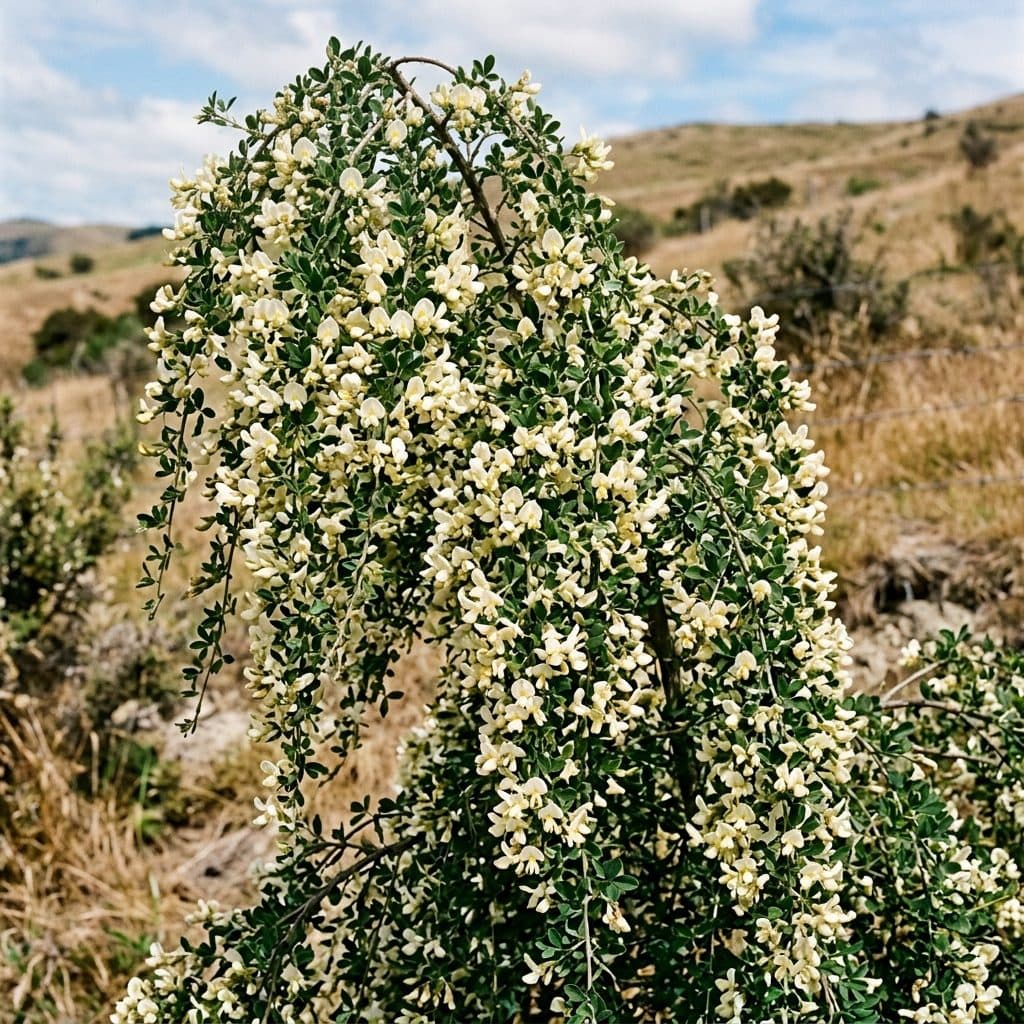
- Apiculture: In late winter and early spring, tagasaste erupts into masses of fragrant, creamy-white pea-like blossoms. Flowering during a critical window when few other flora are active, it provides an invaluable pollen and nectar flow that stimulates honeybee colony build-up.
- Firewood: Woody stems harvested from coppiced hedgerows provide dense, clean-burning domestic firewood.
Identifying Tagasaste tree lucerne
Chamaecytisus proliferus is identified by the following botanical characteristics:
- Habit: A large, spreading, multi-stemmed evergreen shrub or small tree reaching 3 to 6 m (10 to 20 ft) in height and width, with long, drooping, weeping velvety branches and smooth, pale grey-brown bark.
- Leaves: Alternate, trifoliate leaves supported by short petioles 1 to 2 cm (0.4 to 0.8 in) long. Leaflets are elliptic to lanceolate, measuring 2 to 5 cm (0.8 to 2 in) long and 0.5 to 1.5 cm (0.2 to 0.6 in) broad. Leaflets are dull grey-green on the upper surface and distinctly paler beneath, covered on both sides in fine, soft, appressed silky hairs.
- Flowers: Borne in dense axillary clusters of 3 to 8 blossoms along drooping branchlets. The flowers are pea-like, measuring 1.5 to 2 cm (0.6 to 0.8 in) long, with creamy-white to pale ivory-yellow petals and a sweet fragrance.
- Fruit: Flattened, oblong-lanceolate pods measuring 4 to 6 cm (1.5 to 2.4 in) long and 1 to 1.5 cm (0.4 to 0.6 in) wide. Pods are covered in dense, soft, velvety brownish hairs, turning dark brown to black at maturity.
- Seeds: Each pod contains 8 to 12 small, oval, flattened, shiny dark brown to black hard seeds measuring roughly 4 to 5 mm long.
It is distinguished from Scotch broom (Cytisus scoparius), which has five-angled green stems, smaller leaves, bright golden-yellow flowers, and contains toxic quinolizidine alkaloids, and from Chamaecytisus supinus, which is a low-growing prostrate shrub with yellow flowers.
Cautions
Pastoralists cultivating Chamaecytisus proliferus must account for environmental weed risks and management considerations:
- Serious environmental weed in Australia and New Zealand: Outside pastures, Chamaecytisus proliferus is recognised as a major environmental weed across south-eastern and south-western Australia and New Zealand. It readily escapes farmland into native bushland, roadsides, and national parks, forming dense monocultures that outcompete native understory shrubs.
- Long-lived persistent soil seed bank: A single mature bush produces thousands of hard-coated seeds each season that persist in soil seed banks for decades. Following bushfires or mechanical soil disturbance, these seeds germinate en masse, creating impenetrable thickets that choke out regenerating native flora.
- Bushfire fuel hazard: Tagasaste foliage contains volatile oils and produces dense, woody branching. In hot, dry Mediterranean summers, unpruned hedgerows near homes or forest boundaries present a severe bushfire fuel ladder. Hedgerows must be kept regularly browsed, mechanically pruned, and separated from buildings by adequate firebreaks.
- Fatal root rot in wet soils: Intolerant of poor drainage; saturated clay soils cause rapid, irreversible root rot caused by Phytophthora species.
- Containment protocol: Do not plant tagasaste within 200 m (650 ft) of native bushland, waterways, or national park boundaries. Graze or prune hedges heavily before pods mature to prevent seed set and environmental escape.
- Regulatory note: Regulated in multiple Australian states and New Zealand regional councils as an environmental weed; check local biosecurity registers before establishing new plantings.
Sources
- Royal Botanic Gardens, Kew. Chamaecytisus proliferus (L.f.) Link Plants of the World Online.
- Plants For A Future. Chamaecytisus proliferus - (L.f.) Link
- USDA PLANTS Database. Chamaecytisus proliferus (L.f.) Link
- California Invasive Plant Council (Cal-IPC). Tagasaste, tree-lucerne (Cytisus proliferus)
- Weeds of Australia, Biosecurity Queensland Edition. Tagasaste (Chamaecytisus palmensis)