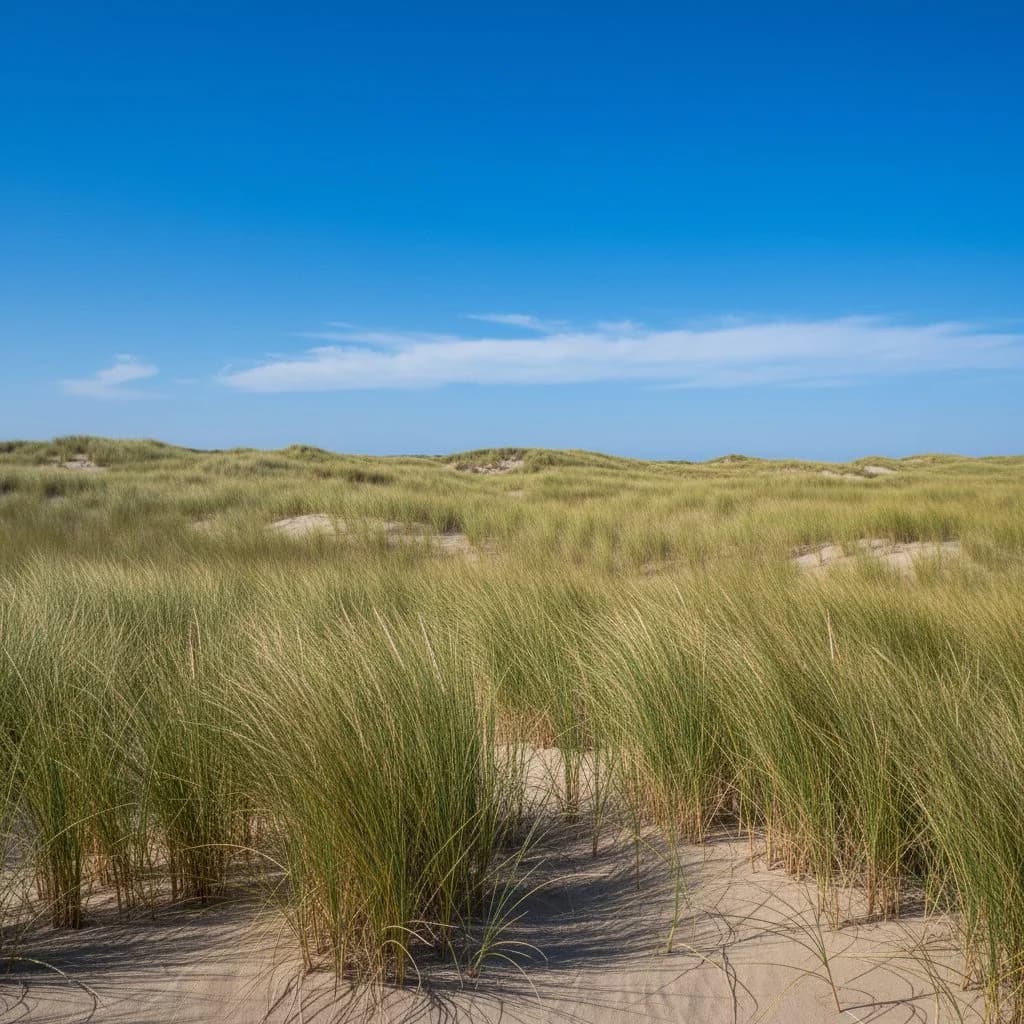
Key takeaways
- Picking, digging, or even possessing wild sea oats (Uniola paniculata) violates Florida Statute § 161.242 and carries up to 1 year in jail and a $1,000 fine under F.S. § 161.121; purchase nursery-propagated plugs only.
- Check coastal setbacks and permits before grading sand, installing sand fencing, or building walkovers—including FDEP CCCL and May 1–October 31 sea turtle windows in Florida, NC CAMA rules under 15A NCAC 07H, and Texas GLO county permits.
- Match foredune grasses to the correct coastline: Ammophila breviligulata thrives in North/Mid-Atlantic and Great Lakes dunes but dies out on warm Gulf shores, while Pacific Coast dunes must reject invasive Ammophila and restore native Leymus mollis.
- Zone your planting profile inland: stout rhizomatous Uniola or Ammophila on burying foredunes, Spartina patens in 15–30+ dS/m brackish swales, and Muhlenbergia capillaris on protected backdunes and coastal bluffs.
- Plant dormant Ammophila culms 6–9 inches deep during winter (October–April) without irrigation, dose nursery sea oats holes with 0.5–1 teaspoon controlled-release Osmocote, keep natural beach wrack, and fence out foot traffic.
Quick answer: Successful US coastal dune and slope stabilization matches native perennial grasses to their exact cross-shore stress zone while obeying strict coastal laws. Never cut, dig, or collect wild sea oats (Uniola paniculata)—picking or possessing wild sea oats or sea grapes violates Florida Statute § 161.242 (a first-degree misdemeanor under F.S. § 161.121) and similar southeastern statutes, so always buy certified nursery plugs. Plant dormant Ammophila breviligulata culms 6–9 inches deep on North Atlantic and Great Lakes foredunes, Uniola paniculata plus Panicum amarum on Southeast and Gulf dunes, Spartina patens in brackish interdune swales, and Muhlenbergia capillaris only on sheltered leeward dunes and coastal slopes, while checking FDEP CCCL, NC CAMA, or local dune permits first.
Legal Realities First: Sea Oats Harvest Bans, Coastal Setbacks & Dune Permits
Coastal dune stabilization differs fundamentally from backyard landscaping because primary dunes are regulated storm-surge infrastructure. A well-vegetated foredune absorbs wave energy and buffers coastal homes during nor'easters and hurricanes, which is why state legislatures treat wild dune grass harvesting and unpermitted dune grading as criminal or civil offenses.
Before ordering bare-root stems or carrying a spade onto beachfront property, verify both plant-protection statutes and coastal setback lines. Many homeowners unknowingly break state law by digging thinning sprigs from public dunes or importing rich topsoil onto fragile marine banks—rules outlined alongside broader property strategies in our coastal salt-tolerant gardens guide.
US Coastal Dune Protection Statutes, Setback Permits, and Seasonal Work Windows
Jurisdiction & Law | What Is Prohibited or Regulated | Permit & Setback Triggers | Required Compliance Action |
|---|---|---|---|
Florida Statute § 161.242 & § 161.121 | Cutting, harvesting, uprooting, or eradicating wild sea oats (Uniola paniculata) or sea grapes (Coccolobis uvifera)—including seed heads | Possession by non-landowners is prima facie violation; first-degree misdemeanor up to 1 yr jail and $1,000 fine | Source 100% of sea oats from certified commercial nurseries; keep purchase receipts on site |
Florida DEP CCCL & F.A.C. 62B-34.050 | Excavation, sand placement, permanent irrigation, non-native turf, or lighting seaward of the Coastal Construction Control Line | Sea turtle nesting season May 1–Oct 31 (starts Mar 1 in six SE FL counties) restricts heavy work and bright lights | Hand-plant native vegetation cleanly; apply for FDEP CCCL permit for fencing, irrigation, or grading |
North Carolina CAMA (15A NCAC 07H) | Grading, flattening, or stripping vegetation on frontal or primary dunes designated as Areas of Environmental Concern (AECs) | Oceanfront setbacks scale 30× to 90× annual erosion rate landward from the stable vegetation line | Consult county Local Permit Officer (LPO); narrow paths <= 6 ft and manual grass planting avoid major permits |
Texas Dune Protection Act (GLO & Counties) | Altering critical dunes or placing artificial rubble (concrete, asphalt, tires, plastics) to build dunes | County/municipal Dune Protection Permit required near Gulf shoreline and public beach easements | Use indigenous Gulf species (Uniola, Panicum amarum, Spartina patens) and biodegradable sand fencing |
SC SCDES-OCRM & MA Wetlands Protection Act | Clearing dune vegetation seaward of baselines (SC) or dumping topsoil, compost, or yard waste on coastal banks (MA) | Critical Area Permits (SC) and local Conservation Commission Orders of Conditions (MA/NJ) | Plant into bare native sand without soil amendments and route beach access onto raised walkovers |
P0 Florida Statute § 161.242 warning on wild sea oats: Never collect golden seed panicles or pull wild shoots from public beaches, roadside dunes, or neighboring vacant lots—even 'just a few seeds' to start plugs at home. Under Florida Statute § 161.242, harvesting or possessing wild Uniola paniculata without landowner consent is unlawful, and under F.S. § 161.121 Part I Chapter 161 violations constitute a first-degree misdemeanor carrying up to one year in county jail and a $1,000 fine. Georgia, South Carolina, and coastal counties nationwide enforce parallel vegetation bans; always buy nursery-propagated containers or bare-root culms.
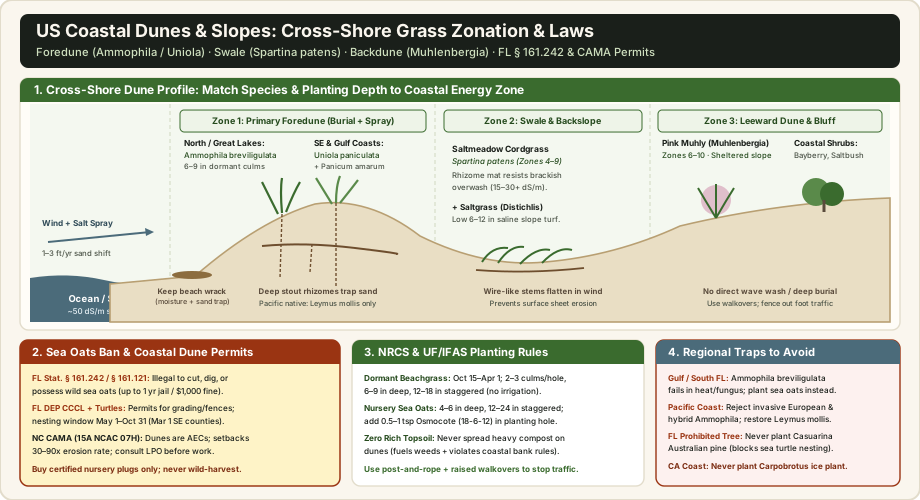
Cross-Shore Dune Zonation: Matching Grasses to Wind, Burial, and Salt Spray
Along exposed US shorelines, surface seawater carries roughly 50 dS/m electrical conductivity, while salt aerosols drift 1,000 feet or more inland depending on storm gusts. Yet salinity alone rarely kills misplanted coastal grasses—sand burial rate, root-zone drainage, and summer heat stress divide every dune into three distinct ecological bands.
Forcing a leeward slope grass onto an active frontal crest guarantees root exposure during the first winter gale, whereas planting a hyper-aggressive burial grass behind a sheltered bluff leaves thin, diseased stands once sand stops moving. Match your site first using our salt-tolerant plants overview and regional USDA plant finder.
US Coastal Grass & Groundcover Zonation Matrix (Foredune to Leeward Slope)
Species & Range | Dune Zone & Salinity Niche | Root Architecture & Sand Capture | Where It Fails or Turns Invasive |
|---|---|---|---|
American Beachgrass (Ammophila breviligulata, e.g. 'Cape') — Zones 3–8a | Zone 1 Primary Foredune (North/Mid-Atlantic & Great Lakes); high spray and >= 15–25 dS/m bursts | Cool-season vigorous lateral rhizomes; shoots elongate rapidly through 2–3 ft/yr sand burial, building wide dunes | Fails long-term on Gulf Coast and South FL from heat/fungal dieback; invasive on Pacific Coast (do not plant in OR/WA/CA) |
Sea Oats (Uniola paniculata) — Zones 7b–11 | Zone 1 Primary & Secondary Dune (VA Capes to FL and Gulf Coast); extreme heat, spray, and drought | Warm-season stout, deep underground rhizomes (not static clumps) anchoring deep sand into steep storm ridges | Slow first-year lateral spread; winter freeze kills shoots north of Virginia; illegal to wild-harvest |
Bitter Panicum (Panicum amarum) — Zones 6–10 | Zone 1–2 Foredune & Crest (Atlantic & Gulf coasts); high wind and salt spray | Deep rhizomatous stabilizer with blue-green blades; bridges NC/Mid-Atlantic transition where Ammophila thins | Does not tolerate standing brackish marsh water; combine with Uniola for disease diversity |
Saltmeadow Cordgrass (Spartina patens) — Zones 4–9 | Zone 2 Interdune Swale, Backdune & High Marsh; tolerates 15–30+ dS/m and tidal overwash | Creeping rhizomes weave fine wire-like stems into dense cow-licked surface erosion mats | Less effective at capturing 2–3 ft vertical windblown sand drifts than Ammophila or Uniola |
American Dunegrass (Leymus mollis) — Zones 4–9 | Zone 1–2 Pacific Coast Dunes (CA, OR, WA) & Alaska; cool maritime wind and burial | Native open-clumping rhizomatous grass leaving mosaic sand gaps essential for western snowy plover nesting | Never substitute European beachgrass (Ammophila arenaria), which creates invasive walls on West Coast dunes |
Pink Muhly Grass (Muhlenbergia capillaris) — Zones 6–10 | Zone 3 Protected Backdune, Coastal Flat & Upland Bluff; moderate salt spray, dry sand | Fibrous bunchgrass (2–3 ft tall/wide) with autumn pink-purple plumes; holds stable sandy slopes | Dies under heavy frontal burial or wave overwash; keep behind primary dune crest |
Saltgrass (Distichlis spicata) — Zones 4–10 | Zone 2–3 Saline Swale Margins & Alkaline Coastal Slopes; survives 20–30+ dS/m | Low 6–12 in stoloniferous and rhizomatous turf mat locking saline silt and sand | Thins in deep shade; thrives in exposed sunny brackish transitions |
Why North Atlantic, Gulf, and Pacific coasts cannot share one grass list
During coastal stabilization, manuals often mistakenly prescribe Ammophila breviligulata across every US beach. In North Carolina and Virginia—where cool-season northern dunes meet warm-season southern dunes—Ammophila establishes fastest in year one, then fades behind the crest after three to five hot summers as pathogens build. NC Sea Grant and NRCS engineers bridge that gap by interplanting Ammophila with sea oats (Uniola paniculata) and bitter panicum (Panicum amarum), so warm-season rhizomes hold the ridge long-term.
On the Pacific Coast (California, Oregon, and Washington), planting either European beachgrass (Ammophila arenaria) or Atlantic Ammophila breviligulata is an ecological disaster. Both species—plus their aggressive cross-coast hybrid (A. breviligulata × A. arenaria) documented across Oregon and Washington—build steep, impenetrable dune walls that starve inland sand sheets and wipe out nesting sightlines for endangered western snowy plovers. West Coast restorations remove Ammophila mechanically and replant native American dunegrass (Leymus mollis), beach strawberry (Fragaria chiloensis), and sand verbena (Abronia).
NRCS & UF/IFAS Establishment Engineering: Depth, Dormancy, and Nutrition
Most coastal dune failures stem from shallow planting, mid-summer heat installs, or treating dune sand like a suburban flower bed. Beach sand holds less than 10% moisture near the surface, yet sub-surface sand 6 to 8 inches deep stays cool and damp through winter and spring. Installing dormant bare-root stems shallowly lets 25 mph gusts desiccate nodes or blow whole rows away before spring rain arrives.
NRCS & Extension Establishment Specifications by Dune Grass Type
Establishment Factor | Dormant Beachgrass Culms (Ammophila breviligulata) | Nursery Sea Oats Plugs (Uniola paniculata) | Backdune Spartina patens & Muhlenbergia |
|---|---|---|---|
Planting Window | Dormant winter: Oct 15 – Apr 1 (peak Jan–Mar in unfrozen moist sand) | Late winter through June (avoid peak Aug heat; coordinate May–Oct turtle windows) | Spring (Mar–May) or mild fall (Sep–Oct) before winter freezes |
Planting Depth & Unit | 2–3 dormant culms/hole with >= 1 basal node buried 6–9 in deep (~3/4 underground) | Certified nursery plugs buried 4–6 in deep (collar flush/slightly below sand grade) | Plugs or divisions set even with root crown; firm moist sand tightly around root ball |
Spacing Pattern | 12–18 in staggered rows (12 in on steep eroding faces; 18 in standard) | 12–24 in staggered grid (12 in on frontal blowouts; 18–24 in broad fills) | Spartina: 12–18 in grid; Muhlenbergia: 24–36 in mass drifts |
Irrigation Protocol | None required on open dunes when planted deep in cool winter moisture | Water-in at planting to settle sand; temporary dry-spell soak only if permitted | Water at install plus deep supplemental soak during dry spells in first 6–8 weeks |
Fertilization Spec | Optional Year-1 spring side-dress (after Apr 1) at 30–60 lb actual N/acre; keep out of marshes | Place 0.5–1 tsp controlled-release Osmocote (18-6-12 or 15-9-12) inside planting hole | Zero heavy synthetic N; rely on native lean sand and natural beach wrack |
Why beach wrack beats compost—and why irrigation backfires on open dunes
Avoid hauling bagged potting mix, rich manure, or three inches of municipal compost onto coastal dunes. Aside from violating state coastal bank regulations, rich topsoil feeds opportunistic invasive weeds and holds moisture unevenly against stems adapted to lean sand. Instead, UF/IFAS dune trials show that leaving natural beach wrack (washed-up kelp, sargassum, and seagrass drift) near new plantings lowers surface sand temperatures, holds sub-surface moisture, traps blowing sand grains, and supplies gentle organic nitrogen and phosphorus—matching soil-building principles in our sandy soil nutrient retention guide.
Skip unbuffered quick-release 5-10-5 farm blends as well. Coarse sand has almost zero cation-exchange capacity, so soluble salts wash straight into coastal estuaries or burn fine roots. When establishing nursery Uniola plugs in Florida or Gulf projects, dropping 0.5 to 1 teaspoon (5–15 g) of 90-day controlled-release Osmocote directly into the planting hole feeds steady root expansion without leaching. Reserve drip irrigation for sandy soil and sandy-bed mulching strictly for landward coastal garden beds above permit lines—never run open sprinklers across public dune faces.
Coastal Slopes, Backdune Shrubs, and Invasive Plants to Exclude
Behind the primary ridge—where direct wave action ends but salt spray, blistering sun, and unstable gravelly or sandy slopes persist—grasses alone leave gaps during dormant winter months. Layering backdune bunchgrasses, woody maritime shrubs, and low salt-hardy groundcovers creates multi-depth root reinforcement that reduces slope erosion while sheltering inland homes from 30–50% of coastal wind shear.
On sheltered Zone 3 coastal bluffs and slopes, pair pink muhly grass (Muhlenbergia capillaris), switchgrass (Panicum virgatum), and little bluestem (Schizachyrium scoparium) with tough low-growing woody groundcovers and herbs. On cool or dry coastal slopes, creeping thyme, creeping phlox, and hardy upland rosemary anchor sunny lean soils, while arid Western coastal bluffs benefit from native fourwing saltbush (*Atriplex canescens*) and upland slope species in our erosion control and slope stabilization guide. On steep inland terraces well back from tidal salt marshes, sterile non-seeding vetiver grass and picks from ground cover for slopes hold clay-sand banks without spreading.
For vertical salt wind protection landward of your dune grass band, select native maritime shrubs highlighted in our salt-tolerant coastal windbreaks and salt-tolerant trees and shrubs guide: northern bayberry (Morella pensylvanica, nitrogen-fixing, Zones 3–7), groundsel bush (Baccharis halimifolia, brackish edge, Zones 5–9), beach plum (Prunus maritima, Zones 3–8), and yaupon holly (Ilex vomitoria, Zones 7–10). Pair plantings with clean structural beds explored in salt-tolerant coastal raised beds and Florida sandy soil gardening.
Three invasive coastal plants to remove and never plant on US dunes: First, Australian pine (*Casuarina equisetifolia*) is a Category I prohibited invasive in Florida; its dense shallow roots block endangered sea turtles from digging nests, shade out native Uniola, and blow over easily in hurricanes. Second, highway ice plant (Carpobrotus edulis) forms water-heavy carpets across California coastal bluffs that slip off slopes during winter rains—use native Abronia or Fragaria chiloensis on West Coast bluffs instead, reserving controlled *Delosperma* strictly for dry interior rockeries. Third, Russian olive (Elaeagnus angustifolia) and invasive Ammophila arenaria degrade Pacific and northern habitats; review regional slope options in our arid and PNW erosion plants guide and native erosion grasses guide.
Foot-Traffic Protection, Sand Fencing, and Long-Term Blowout Repair
Even mature sea oats and beachgrass die within one summer under repeated pedestrian traffic. Sneakers and beach carts snap brittle underground rhizomes and crush emerging tillers, carving narrow bare troughs that coastal gales widen into catastrophic dune blowouts during the next storm.
- Install post-and-rope barriers before planting: Stake treated wood posts and braided marine rope along the landward and seaward toe of fresh plantings, placing clear signage directing visitors to public access points. Keep fencing flexible and wildlife-safe so sea turtles or shorebirds never snag in wire mesh.
- Route foot traffic onto raised walkovers: Build raised timber dune walkovers (meeting local CCCL or CAMA width limits, often <= 4–6 ft wide) above the grass canopy rather than cutting ground paths through the ridge. Where footpaths are permitted, angle them diagonally across the crest so storm waves cannot funnel straight inland.
- Align porous wooden slat sand fencing properly: Set biodegradable chestnut or pine snow fencing (approx. 50% open porosity) landward of normal high-tide wave reach to trap windblown sand ahead of winter planting—never bury plastic netting or concrete rubble, which violates state dune rules and entangles turtles.
- Patch bare blowouts during the next cool window: Inspect dunes each fall after hurricane season and spring after nor'easters. Replant scoured pockets exceeding 3 × 3 ft in staggered 12-inch grids during cool months, pairing guidance from hillside erosion plants, embankment planting, windbreak trees, roadside salt plants, and drought-tolerant ground cover.