Key takeaways
- De-icers vary sharply: rock salt (NaCl) causes chloride burn and sodium clay dispersion; CaCl2 and MgCl2 melt down to -10 to -20°F yet still burn roots; urea dumps nitrogen; beet-juice brines cut chloride loads 25–50%; and CMA is salt-free.
- Two distinct pathways kill roadside beds: airborne plow mist scorches road-facing buds and evergreen needles, while meltwater spikes soil EC (>4 dS/m) and SAR (>13).
- Skip blanket gypsum: calcium sulfate fixes sodic clay dispersion (SAR > 13) only when paired with 6–12 inch spring leaching—on sandy or non-sodic high-EC soil, gypsum raises salinity and worsens root burn.
- Shield beds with 6–12 inch raised curb berms and November–April burlap spray screens staked 12–18 inches upwind.
- Screen borders for pets and invasives: daylilies kill cats, yew/juniper/yarrow/lavender carry pet toxicity, Norway maple is invasive, and Rosa rugosa invades coastal dunes.
Quick answer: Protect US roadside and driveway beds by separating airborne plow-mist desiccation (block with November–April burlap screens staked 12–18 inches roadside) from root-zone meltwater salt (EC > 4 dS/m and SAR > 13). Build 6–12 inch raised curb berms and flush thawed beds with 6–12 inches of fresh water each spring where drainage allows, never adding gypsum unless a lab test confirms sodic clay dispersion (SAR > 13)—on sandy or pure high-EC soil, gypsum spikes salinity and burns roots. Choose pet-safe, non-invasive species like creeping phlox, creeping thyme, sedum, switchgrass, little bluestem, and black chokeberry instead of cat-fatal daylilies or invasive Norway maple.
Why Most Roadside and Driveway Beds Decline Every Spring
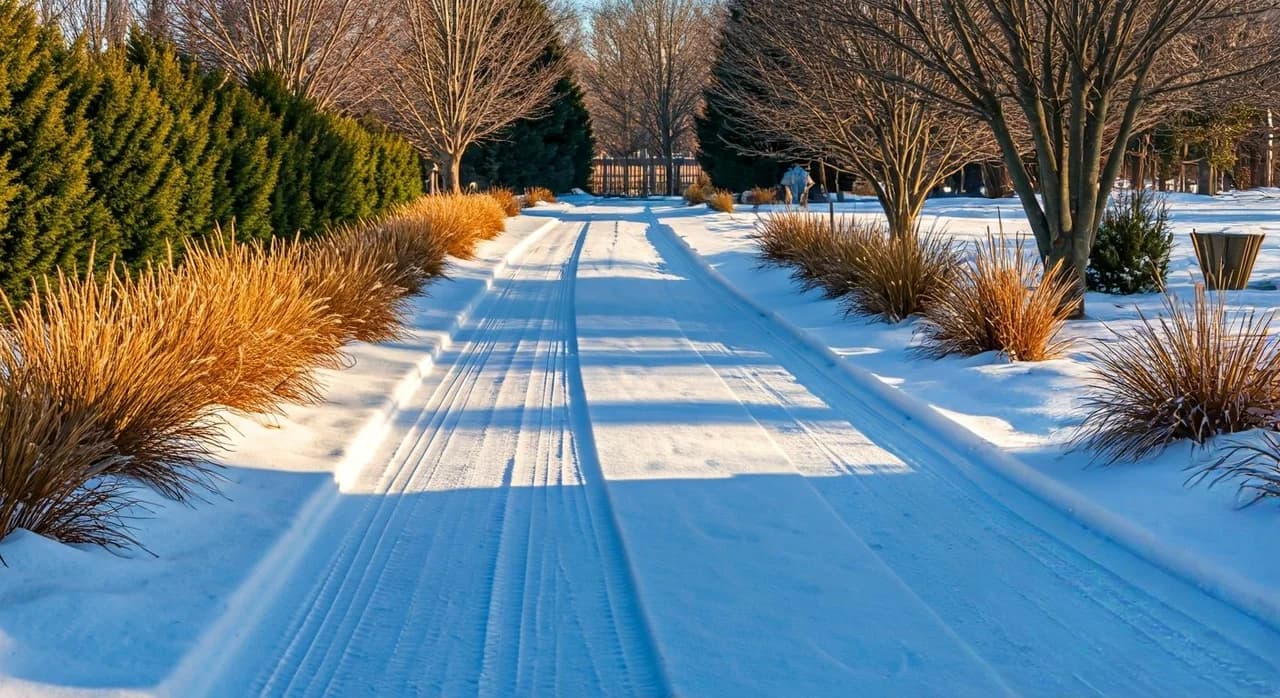
Walk along a plowed suburban driveway or township road in April and damage follows clean geometry. Arborvitae and white pines brown strictly on the traffic-facing side, turf scorches in a 3-foot band beside the curb, and perennial crowns rot inside sealed, muddy pockets.
Homeowners often mistake this injury for freeze kill, scatter gypsum over frozen ground, and replant sensitive shrubs or cat-hazardous daylilies into compacted road fill. Durable salt-tolerant plants survive only when species selection matches your exact de-icing chemistry, exposure pathway, and soil drainage.
De-Icing Salt Chemistry: Rock Salt vs. Chlorides, Urea, CMA & Beet Juice
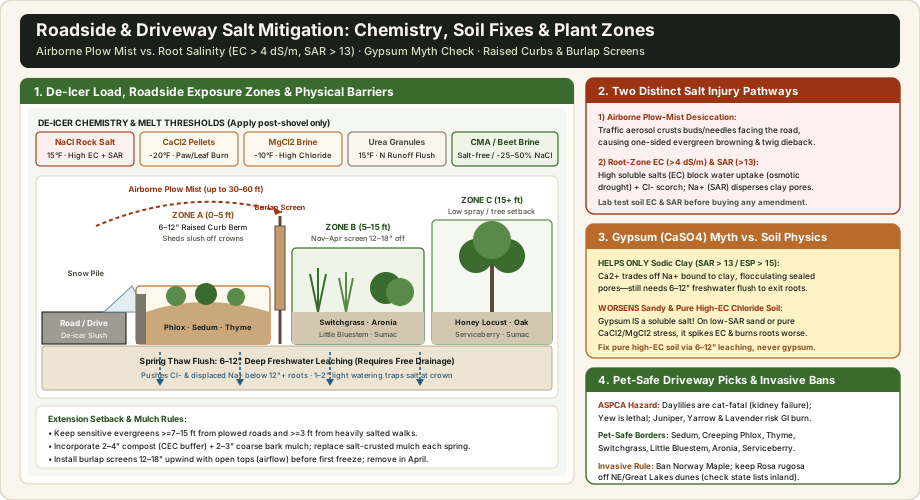
Municipal plows rely on cheap sodium chloride (rock salt), whereas homeowners and pet-friendly drives often switch to calcium chloride pellets, magnesium chloride brines, urea, calcium magnesium acetate (CMA), or agricultural beet-juice mixes.
De-Icing Chemical Comparison: Effective Melt Temperature, Plant/Soil Toxicity & Mitigation
De-Icing Agent | Effective Temp | Plant & Soil Chemistry Impact | Pet Paw & Concrete Risk | Driveway Mitigation Rule |
|---|---|---|---|---|
Sodium chloride (NaCl rock salt) | Down to ~15°F | Double threat: raises soluble EC, accumulates Cl- in leaf margins, and Na+ disperses clay (SAR > 13). | Stings paws; high concrete spalling and metal corrosion. | Shovel first; cap at ~12 oz per 20 ft drive; keep 3–15 ft off sensitive beds. |
Calcium chloride (CaCl2 pellets) | Down to ~-20°F | No Na+ clay dispersion, yet Cl- ions spike EC and scorch buds, needles, and feeder roots. | High paw irritation/burn risk; scales cured concrete. | Use only below 15°F; sweep residual pellets before thaw. |
Magnesium chloride (MgCl2 brine/flake) | Down to ~-10°F | High chloride load triggers osmotic drought and traffic-mist foliar desiccation. | Slightly milder on paws than NaCl; still corrodes masonry. | Apply lightly; never aim snowblower chutes toward border shrubs. |
Calcium magnesium acetate (CMA) | Down to ~20°F | Salt-free biodegradable acetate; blocks ice bonding without chloride burn or sodic dispersion. | Low paw irritation and safe on cured concrete. | Highest cost per lb; best near specimen shrubs and front walkways. |
Urea (CO(NH2)2 fertilizer granules) | Down to ~15°F | No Cl- or Na+, yet concentrated runoff dumps heavy nitrogen causing soft late shoots and nitrate leaching. | Moderate paw-lick GI upset; low concrete wear. | Keep away from storm drains; use sparingly on icy steps. |
Beet-juice & ag-byproduct brines | Lowers NaCl to ~0°F | Fermented beet liquid sticks brine to pavement, reducing bounce-scatter and total chloride by 25–50%. | Stains porous stone temporarily; cuts overall bed salt load. | Top municipal pre-treatment option for lower total roadside salt. |
Mechanical clearing remains your strongest defense. Shoveling before tires pack snow into ice slashes chemical demand, and blending minimal salt with coarse builder's sand adds grip without overloading adjacent soil-building beds—skip clay kitty litter, which turns to slick mud.
Two Distinct Injury Pathways: Airborne Plow Mist vs. Root-Zone EC and SAR
Extension research across Purdue, Wisconsin, Minnesota, and Utah State separates winter salt injury into two distinct physical mechanisms.
Pathway 1: Airborne plow-mist desiccation on buds and evergreens
Traffic and plow blades aerosolize salty slush into mist that drifts 30–60+ feet downwind. Saline droplets dry on conifer needles and dormant buds, pulling moisture from cells and causing one-sided road-facing browning plus stunted witches'-broom twigs. Soil amendments never stop aerial spray injury.
Pathway 2: Root-zone salinity (EC > 4 dS/m) and sodicity (SAR > 13)
When salted snowbanks melt into soil, soluble ions drive electrical conductivity (EC) past 4 dS/m, causing osmotic drought (roots cannot pull water from wet soil) and chloride leaf-margin scorch. Separately, sodium from NaCl pushes the Sodium Adsorption Ratio (SAR) above 13 (or ESP > 15), stripping calcium off clay platelets so clay swells, seals surface pores, and suffocates roots—see our clay soil drainage guide.
Salt Injury Diagnostics & Soil Remediation Protocol (Gypsum Decision Matrix)
Stress Profile | Field Symptoms & Lab Threshold | Does Gypsum (CaSO4) Help? | Exact Engineering & Soil Fix |
|---|---|---|---|
Airborne plow-mist spray | One-sided evergreen needle burn and bud death facing street; soil EC < 2 dS/m. | No. Gypsum acts in root-zone soil, not on aerial buds or needles. | Stake Nov–Apr burlap screen 12–18 in roadside; plant salt-spray shrubs. |
Pure high-EC salinity (sandy/loamy soil) | EC > 4 dS/m, SAR < 13 (CaCl2, MgCl2, or sandy shoulders); summer wilt. | No—hurts plants. Gypsum adds soluble salt that spikes EC and burns roots. | Leach 6–12 in fresh water after spring thaw; mix in 2–4 in compost. |
Sodic clay dispersion | SAR > 13 or ESP > 15 on clay/silt; sealed muddy surface and ponding. | Yes. Ca2+ swaps off bound Na+ on clay, restoring soil aggregation. | Lab test SAR, mix rated gypsum into top 4–6 in, then leach 6–12 in water. |
Saline-sodic combined stress | Both EC > 4 dS/m AND SAR > 13 (chronic NaCl snowbank clay curb). | Yes—required before heavy flushing so freshwater does not seal clay. | Mix compost + rated gypsum; confirm drainage outlet, then leach 6–12 in. |
Poorly drained basin / high water table | Standing meltwater lingers > 48 hrs; roots rot before salts drain. | No amendment fixes salt without physical drainage. | Build a 6–12 in raised curb berm or cut a subsurface drain outlet. |
Debunking the Blanket Gypsum Myth & Spring Leaching Math
Garden centers routinely push powdered gypsum (`CaSO4·2H2O`) as a cure-all for winter salt burn. Washington State University Extension's soil physics reviews explain why blanket applications fail and often injure roadside plants further.
Never add gypsum without a lab EC and SAR soil test: Gypsum is calcium sulfate, a soluble mineral salt. Its only role in salt recovery is trading divalent calcium (`Ca2+`) for sodium (`Na+`) stuck to dispersed clay (`SAR > 13`). On sandy shoulders, non-sodic loam, or beds hit by calcium or magnesium chloride (`SAR < 13`), adding gypsum spikes EC and accelerates osmotic root burn.
Submit a 6-inch core for an EC and SAR saturated-paste test via your Cooperative Extension soil lab. Review mineral dosing limits in our guides to gypsum for compacted and sodic clay soils and reading a soil test report.
Why 6–12 inches of spring freshwater leaching beats shallow sprinklers
Gypsum frees sodium from clay, but only leaching flushes displaced sodium and chloride below roots. Shallow 1-to-2-inch sprinklings wick salts back toward crowns as soil dries. Once thaw finishes, verify drainage with a percolation test and apply 6 to 12 inches of slow soaking water across two or three deep cycles—6 inches halves soluble salts in free-draining loam, while 12 inches flushes up to 80%.
Structural Defenses: Raised Curb Berms & Winter Burlap Screens
Bed geometry protects marginal plants better than fertilizers. University of Minnesota Extension setbacks place sensitive ornamentals >=3 feet from salted driveways and >=7–15 feet from plowed roads whenever space permits.
- Build 6–12 inch raised berm curbs: Rather than tall 24-inch boxes that block sightlines, mound sandy loam plus 2–4 inches of compost 6–12 inches high behind a low stone or granite curb lip so slush drains back onto pavement (see raised bed drainage principles).
- Refresh mulch cleanly: Spread 2–3 inches of coarse bark mulch in spring to slow moisture loss. Rake off visibly salt-crusted surface mulch in April rather than tilling brine into roots.
- Stake Nov–Apr burlap screens: Drive posts 12–18 inches roadside of vulnerable evergreens before freeze, staple breathable burlap or snow fencing with open tops for airflow, and remove screens in April.
Skip nitrogen feeding after mid-August so soft shoots harden before frost. Control driveway weeds via pulling or hardscape thermal weeding—never pour salt-and-vinegar weed killers onto edges where runoff poisons beds.
Hardiness-Zoned US Roadside Plants, Pet Safety & Invasive Checks
Keep sightline borders (`0–5 ft` from pavement) under 24 inches tall for backing vehicles, stepping up to native grasses and shrubs in the `5–15 ft` spray strip.
Hardiness-Zoned US Roadside & Driveway Plant Palette (With ASPCA Pet Safety & Invasive Checks)
Plant (Common & Botanical) | Form & Height | USDA Zones | Salt Exposure Fit | Pet Safety & Regional Invasive Check |
|---|---|---|---|---|
Black chokeberry (Aronia melanocarpa) | Native shrub, 3–6 ft | 3–8 | High spray & wet ditch runoff | Pet-safe berries/foliage; US native, zero invasive risk. |
Creeping phlox (Phlox subulata) | Evergreen mat, 4–6 in | 3–9 | Zone A curb edges (0–5 ft), moderate salt | ASPCA non-toxic to dogs, cats, and horses; low driveway sightline. |
Switchgrass (Panicum virgatum) | Native grass, 3–6 ft | 4–9 | Zone B heavy spray & wet salt ditches | Pet-safe native grass; deep fibrous roots stabilize road shoulders. |
Little bluestem (Schizachyrium scoparium) | Native grass, 2–4 ft | 3–9 | Zone A/B dry sandy road shoulders | Pet-safe US prairie native; thrives in compacted gravel. |
Creeping thyme (Thymus serpyllum) | Aromatic mat, 2–4 in | 4–9 | Dry well-drained driveway paver edges | ASPCA non-toxic to dogs/cats; avoid soggy clay slush pockets. |
Stonecrop (Sedum 'Autumn Joy' / groundcover spp.) | Succulent perennial, 4–24 in | 3–9 | Zone A dry sunny curb edges & heat | ASPCA non-toxic; fleshy foliage resists salt dehydration. |
Saskatoon serviceberry (Amelanchier alnifolia) | Native shrub/tree, 6–15 ft | 2–7 | Zone B (5–15 ft) moderate salt | Not listed as pet-toxic; US native screen replacement. |
Honey locust (Gleditsia triacanthos var. inermis) | Deciduous tree, 40–60 ft | 3–9 | Zone B/C urban street salt & compaction | Select thornless, seedless cultivars; wild pods/thorns pose risk. |
Fourwing saltbush (Atriplex canescens) | Western native shrub, 3–6 ft | 4–9 | Arid/Western high-EC & alkaline roadsides | Non-toxic US Western native; extreme soil salinity tolerance. |
Rugosa rose (Rosa rugosa) | Dense prickly shrub, 4–6 ft | 2–7 | Extreme spray & sandy roadbanks | ASPCA non-toxic (thorny); INVASIVE on NE & Great Lakes coastal dunes—verify state bans. |
Critical pet-toxicity and invasive bans for driveway borders: Avoid planting *daylilies (Hemerocallis spp.), yews (Taxus), creeping juniper, yarrow (Achillea), and *English lavender beside pet-accessible driveways: ASPCA Poison Control flags daylilies as acutely fatal to cats (kidney failure), yews as lethal to dogs/livestock, and yarrow, juniper, and lavender for pet GI toxicity. Never plant invasive Norway maple (Acer platanoides), autumn olive, or Russian olive, and keep Rosa rugosa** off New England and Great Lakes coastal dunes in favor of native northern bayberry or black chokeberry.
Pair low walkable mats from our ground cover between pavers guide and creeping thyme lawn guide with hardy ice plant or native buffalo grass. Add slope armor from native grasses for erosion control, compare honey locust vs. black locust, check hardiness via the USDA plant finder, and explore drought-tolerant shrubs, saline Southwest plants, and deer-resistant plants.
Annual Maintenance Calendar for Salt-Impacted Beds
Follow a tight four-season loop to protect borderline shrubs without endless replanting:
- November: Deep-water evergreens pre-freeze, stake burlap screens 12–18 inches upwind, and flag curbs for plow visibility.
- December–March: Shovel before salting, prefer CMA or beet-juice/sand blends near beds, and keep heavy salted snowbanks off shrub crowns.
- April: Pull screens down, rake out salted surface mulch, run an EC/SAR test if puddles linger, flush freely draining soil with 6–12 inches of fresh water, and prune only dead tips after budbreak.
- May–July: Top-dress 1–2 inches compost plus fresh bark mulch, and check establishment moisture through summer droughts (see coastal raised beds and salt-tolerant grasses for dunes).