Key takeaways
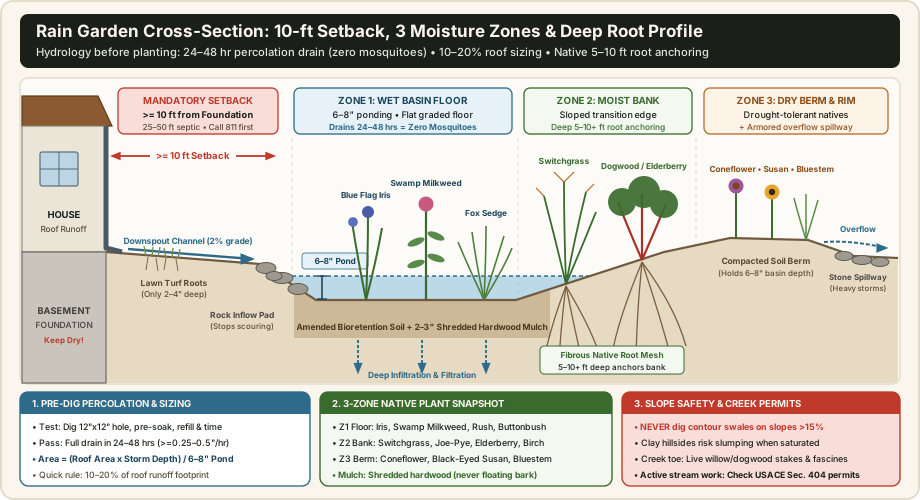
- Run a 12"×12" double-fill percolation test before digging; rain gardens must empty within 24–48 hours so Aedes and Culex mosquito larvae (needing 5–7+ days of standing water) cannot mature.
- Maintain hard safety setbacks: >=10 ft downhill from foundations, 25–50 ft from septic drain fields and wells, call 811 for buried lines, and never dig contour swales on slopes steeper than 15%.
- Size the flat basin with Area = (Impervious Runoff Area × Storm Depth) / Ponding Depth (6–8")—typically 10% of roof area on sandy loam up to 20% on amended clay.
- Place US natives across three moisture elevations—Zone 1 Wet Floor, Zone 2 Moist Bank, and Zone 3 Dry Berm—using 50–70% deep-rooted native sedges and grasses (5–10+ ft roots vs. 2–4" turf).
- Stabilize active creek toes with dormant live willow (Salix) and red-osier dogwood (Cornus sericea) stakes and fascines instead of rigid concrete walls or bare riprap that accelerate downstream scouring.
- Check county conservation districts, state environmental agencies, and USACE Section 404 Clean Water Act permit rules before grading or placing stone below a creek's Ordinary High Water Mark.
Quick answer: Successful rain gardens, swales, and creek-bank plantings begin with hydrology, not nursery shopping. Run a 12-by-12-inch double-fill percolation test first to verify the basin drains completely within 24–48 hours (breaking the 5–7 day mosquito breeding cycle). Site rain gardens at least 10 feet downhill from house foundations, 25–50 feet from septic fields, call 811 for utilities, and never cut contour swales on slopes above 15% or landslide-prone clay. Size the flat basin floor to 10–20% of contributing roof or driveway area using Area = (Runoff Area × Rainfall Depth) / Ponding Depth (6–8 inches). Match US native plants across three moisture zones—wet floor, moist bank, and dry berm—and anchor active creek toes with dormant live willow or dogwood stakes and fascines only after checking state and USACE Section 404 stream permits.
Hydrological Engineering Before Buying a Single Plant
Most residential stormwater plantings fail before a shovel touches dirt. Homeowners pull pretty wetland flowers off a generic list, dig a shallow bowl three feet from a downspout in tight clay, and end up with wet basements, drowned coneflowers, and a stagnant puddle. US EPA Soak Up the Rain, Rutgers Cooperative Extension, Wisconsin DNR, and University of Minnesota rain garden manuals reverse the sequence: verify percolation, setbacks, slope limits, and runoff volume first, then slot native plants into exact elevation bands.
Match your yard problem to the correct water structure:
- Rain garden (bioretention basin): A flat-bottomed, shallow depression (6–8" ponding depth) downhill from a roof downspout or driveway that captures, filters, and infiltrates storm runoff within 24–48 hours. See how rain gardens stop yard flooding.
- Contour swale (vegetated bioswale): A broad, level diversion channel with a low downhill berm that slows sheet runoff across gentle yards and spreads water into surrounding soil.
- Active creek bank (streambank): A flowing channel carrying high-velocity flood shear. Herbaceous perennials alone cannot hold an undercutting stream wall; active bank toes require woody bioengineering (live willow/dogwood stakes and fascines) and regulatory permit clearance.
Pre-Dig Percolation Test, Setbacks & Slope Limits
Never judge infiltration from healthy surface grass—suburban lawns often hide builder-compacted clay fill six inches below turf. Confirm real drawdown speed first.
The 12×12-Inch Double-Fill Percolation Test
- Dig the test pit: Excavate a straight-sided 12"×12" hole at planned basin-floor depth and rough up trowel-glazed sides with a fork so clay pores stay open.
- Pre-soak once: Fill the hole completely and let it drain to saturate surrounding soil; dry dirt absorbs water unrealistically fast.
- Refill and measure hourly drop: Immediately refill to 12 inches, lay a stick across the rim, and record drawdown at 1, 4, and 12 hours (full steps in our soil drainage percolation test guide).
- Pass the 24–48 hour drain check: Basin soil must drain at 0.25–0.5+ inches/hour so 6–8 inches of ponded rain empties completely within 24–48 hours. Aedes and Culex mosquito larvae require 5–7+ continuous days of standing water to become flying adults—fast drainage eliminates mosquito breeding. See swale design for mosquito prevention.
If water still lingers at 48 hours (`<0.15"/hr`), move to a sandier spot or excavate 18–24 inches of tight clay and backfill with a bioretention blend (50–60% coarse washed sand, 20–30% screened topsoil, 20% finished compost), or widen the basin to a shallower 4-inch ponding depth. Review amending heavy clay soil and plants for clay soil before digging.
Mandatory Setbacks, Utilities & Slope Safety
- Foundations (`>=10 ft` downhill): Keep rain gardens and swales at least 10 feet downhill from basement or crawlspace foundations (20 feet on sandy soils or wet basements) to avoid hydrostatic wall leaks—see swale foundation safety.
- Septic & wells (`>=25–50 ft`): Stay 25 feet from septic tanks and 25–50 feet from drain fields and private wells; flooding a leach field causes immediate backup.
- Call 811 first: Request free utility marking at least 3 business days before digging to avoid buried gas, power, fiber, and water lines.
- Skip high groundwater & mature tree canopies: Avoid low spots that stay muddy days after ordinary rain, and keep excavation outside mature tree drip lines.
Never Cut Contour Swales on Slopes Above 15%: Keep residential rain gardens on gentle slopes under 10–12%. Never excavate unengineered contour swales or ponding trenches on slopes steeper than 15%—or on clay hillsides with any history of slumping. Concentrating water into steep clay strata raises pore pressure and triggers landslides. On steep embankments, rely on deep-rooted native cover and engineered diversions rather than standing basins.
Rain Garden Sizing Formula and Worked Roof Example
Undersized basins blow out their downhill berms during routine storms; oversized pits dry out and starve wetland sedges. EPA, Rutgers, and University of Maryland stormwater manuals rely on one clean sizing relationship:
Rain Garden Sizing Formula: Rain Garden Area (sq ft) = (Impervious Runoff Area × Design Rainfall Depth) / Ponding Depth (6–8 inches). Keeping rainfall and ponding depth in inches cancels units directly.
Design around a 1-inch to 1.2-inch storm—capturing roughly 80–90% of annual rainfall events across eastern, midwestern, and coastal US climates. For a 1,000 sq ft roof section draining into one downspout, a 1-inch rain delivers ~623 gallons (`83.3 cu ft`). Dividing `(1,000 × 1) / 6` inches ponding yields a 167 sq ft flat basin (roughly 10×17 feet—16.7% of the contributing roof). On slower amended clay, flatten the ponding depth to 4–5 inches (`200–250 sq ft`) so water drains faster.
Rain Garden Footprint Sizing by Soil Texture (1-Inch Design Storm)
Soil Texture & Drain Rate | Target Roof Ratio | 500 sq ft Roof | 1,000 sq ft Roof | 1,500 sq ft Roof |
|---|---|---|---|---|
Sandy / Fast Loam (`>1.0"/hr`) | ~10% of roof area | 50–65 sq ft | 100–125 sq ft | 150–190 sq ft |
Silt Loam (`0.5–1.0"/hr`) | ~15% of roof area | 75–90 sq ft | 150–175 sq ft | 225–265 sq ft |
Amended Clay (`0.25–0.5"/hr`) | ~20% of roof area | 100–120 sq ft | 200–240 sq ft | 300–350 sq ft |
Many cities and watershed authorities offset native plant and soil costs—check our municipal rain garden stormwater credits and rain garden siting and sizing guides before digging.
3-Zone Moisture-Gradient Native Plant Matrix (USDA Zones 3–9)
Standard lawn turf sends roots barely 2 to 4 inches deep, peeling loose under concentrated runoff. US native prairie grasses, sedges, and riparian shrubs build fibrous root mats 5 to 10+ feet deep, stitching soil particles together while punching vertical channels that accelerate storm infiltration every season.
Following EPA, Rutgers, UW–Madison, and UMN Extension manuals, organize plantings across three elevation moisture zones and dedicate 50–70% of floor and slope cover to structural native grasses and sedges (per Xerces Society pollinator-stormwater design) interlaced with wildflowers so weeds cannot gain a foothold.
3-Zone US Native Plant Matrix for Rain Gardens, Swales & Riparian Edges
Moisture Zone & Hydrology | Recommended US Native Species | USDA Zones & Sun | Root Depth & Ecological Role |
|---|---|---|---|
Zone 1: Wet Basin Floor (6–8" storm ponding; 24–48 hr wet feet, dries between rains) | Blue Flag Iris (Iris versicolor), Swamp Milkweed (Asclepias incarnata), Soft Rush (Juncus effusus), Cardinal Flower (Lobelia cardinalis), Fox Sedge (Carex vulpinoidea), Red-Osier Dogwood (Cornus sericea), Buttonbush (Cephalanthus occidentalis) | Zones 3–9 (Dogwood 2–7; Rush 4–9); Full sun to part shade | Dense rhizomes and 2–5 ft fibrous roots survive oxygen-poor ponding, strip nitrogen/phosphorus, and feed monarchs (Asclepias) and hummingbirds (Lobelia). |
Zone 2: Moist Sloped Bank (Occasional inundation; high soil-shear edge) | Switchgrass (Panicum virgatum), Joe-Pye Weed (Eutrochium purpureum), American Elderberry (Sambucus canadensis), Black Chokeberry (Aronia melanocarpa), Winterberry Holly (Ilex verticillata), River Birch (Betula nigra), New England Aster (Symphyotrichum novae-angliae), Pawpaw (Asimina triloba, shaded terraces) | Zones 3–9 (Birch/Joe-Pye 4–9; Pawpaw 5–9); Full sun to part shade | 5–10+ ft anchoring root networks lock sloped banks against washouts while autumn asters and native berries sustain migrating birds and bees. |
Zone 3: Dry Berm & Upper Rim (Raised downhill rim; sheds excess rain, drought-prone) | Black-Eyed Susan (Rudbeckia fulgida), Purple Coneflower (Echinacea purpurea), Little Bluestem (Schizachyrium scoparium), Wild Bergamot (Monarda fistulosa), Ninebark (Physocarpus opulifolius), Saskatoon Serviceberry (Amelanchier alnifolia) | Zones 3–9 (Ninebark 2–7; Serviceberry 3–8); Full sun | Deep taproots and 4–8 ft prairie grass roots armor the dry earthen berm against overflow scouring with zero summer irrigation once rooted. |
Fine-tune species for arid western or Pacific Northwest watersheds with our rain garden plants by USDA zone, native grasses for erosion control, and trees and shrubs for wet soil. In high-deer suburbs, lean heavily on aromatic or stiff-bladed picks from our deer-resistant plants guide like Switchgrass, Wild Bergamot, Soft Rush, Fox Sedge, Buttonbush, and Ninebark.
Skip Invasive Wetland Look-Alikes: Stormwater basins wash seeds straight into creeks. Never plant invasive Yellow Flag Iris (Iris pseudacorus—plant native Blue Flag Iris versicolor instead), Purple Loosestrife (Lythrum salicaria), Reed Canary Grass (Phalaris arundinacea), or Japanese Knotweed (Reynoutria japonica). Also distinguish cold-hardy North American woodland Wild Ginger (Asarum canadense, inedible) from tropical culinary ginger (Zingiber officinale), which dies below 50°F.
Creek-Bank Bioengineering vs. Concrete Riprap (and Stream Permits)
Active creek banks face flood velocities that tear fresh perennial plugs out of vertical mud walls in one storm. Dumping broken concrete slabs, erecting vertical block walls, or lining the edge with bare rock riprap seems sturdy—yet USDA NRCS Engineering Field Handbook Chapter 16 and Penn State Extension stream manuals show smooth hard walls deflect flood currents straight downstream, accelerating severe flanking erosion on the next unprotected bend.
Creek-Bank Stabilization: Living Soil Bioengineering vs. Concrete / Bare Riprap
Factor | Live Willow & Dogwood Bioengineering | Concrete Wall or Bare Riprap |
|---|---|---|
Flood Hydraulics | Flexible woody stems bend and slow water velocity along the bank face | Rigid walls bounce fast currents straight downstream, carving neighbor banks |
Strength Over Time | Grows stronger every season as roots knit deeper and self-heal scars | Weakens steadily as floods scour under footings and dislodge stone |
Cost & Ecology | Low material cost (winter dormant cuttings); shades cool aquatic habitat | High rock/equipment cost; strips streamside shade and insect cover |
Best Fit | Moderate slopes (2:1 to 3:1 grade) planted late fall through early spring | Extreme scour near culverts—best joint-planted with live willow stakes |
Dormant Live Staking and Live Fascines
- Dormant live stakes: During winter dormancy (late fall–early spring while leafless), cut straight 0.5–1.5 inch thick, 2–3 ft long stems of native Black Willow (Salix nigra), Pussy Willow (Salix discolor), Sandbar Willow (Salix interior), Red-Osier Dogwood (Cornus sericea), or Silky Dogwood (Cornus amomum). Cut the base at a 45° point and the top flat so buds always face upward, soak butts 24 hours in cool water, punch pilot holes in gravel with rebar, and drive stakes perpendicular to the slope until 2/3 to 3/4 of the stem sits underground on 2–3 ft triangular spacing.
- Live fascines (wattles): Bind dormant willow and dogwood branches into tight 6–8 inch diameter bundles tied every foot with sisal twine, seat them horizontally in shallow toe trenches along the lower bank, anchor with dead wooden stakes plus live stakes on the downhill side, and partially backfill so bundles trap silt immediately before sprouting into a living hedge. Expand upland protection with a 30–100 ft three-zone riparian buffer.
Clean Water Act & Local Stream Permitting Warning: Before moving soil, shaping slopes, or placing rock below the Ordinary High Water Mark (OHWM) of any active creek, contact your county soil and water conservation district, state environmental department (DEP/DNR), and the U.S. Army Corps of Engineers (USACE). Altering stream banks triggers Clean Water Act Section 404 permitting (typically Nationwide Permit 13 for Bank Stabilization or NWP 27 for Aquatic Habitat Restoration). Hand-driving dormant live stakes without grading often qualifies for simpler review, whereas unpermitted excavation brings steep fines.
Basin Excavation, Shredded Mulch & First-Year Care
Finish earthwork accurately so storms spread evenly across the whole basin instead of cutting muddy gullies:
- Level the Zone 1 floor dead flat: Check across the basin with a string line level or 2×4 board and carpenter's level. A flat floor holds an even 6–8 inches of rain across every wet-zone root crown rather than drowning a single low pit.
- Compact the downhill berm and stone overflow notch: Build the Zone 3 berm from excavated subsoil tamped in 3-inch layers. Carve a broad overflow spillway 1–2 inches below berm height lined with landscape fabric and 3–6 inch river cobbles, aimed safely toward lawn or woods.
- Armor the downspout inflow: Set a 2×3-foot river-stone splash pad where runoff enters so fast gutter water loses energy before hitting mulch.
- Apply shredded hardwood mulch—never bark nuggets: Spread 2–3 inches of double-shredded hardwood bark mulch, whose fibers knit tightly underwater. Pine bark nuggets, cypress chips, and straw float straight into the overflow notch during the first heavy rain.
- Water through Year 1 and skip synthetic nitrogen: Plant plugs on 12–18 inch centers, supply 1 inch of water weekly during Year-1 dry spells while deep roots establish, pull competing turf and weeds monthly, and withhold high-nitrogen synthetic fertilizers that leach into waterways and make tall stems flop. Leave winter stems standing until late spring to shelter overwintering native bees.