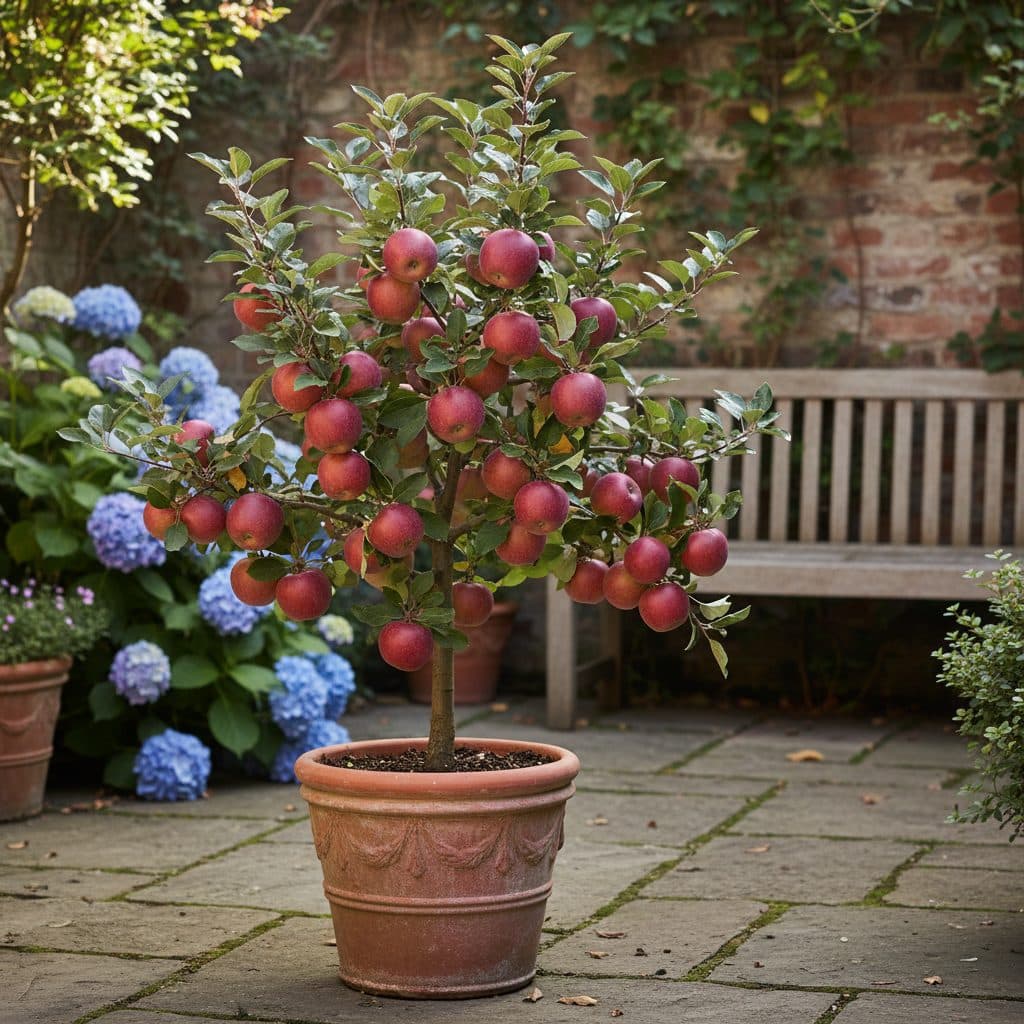
Key takeaways
- Choose dwarf rootstocks M27 (extremely dwarfing for small patios) or M9 (dwarfing for standard containers) to restrict tree size while maintaining full-sized fruit.
- Select self-fertile apple cultivars such as Scrumptious, Red Falstaff, or Fiesta if growing a single patio tree.
- Use a loam-based potting compost like John Innes No. 3 mixed with 20 percent horticultural grit to provide stability and moisture retention.
- Plant in a heavy pot at least 45 to 50 cm in diameter with generous drainage holes elevated on pot feet.
- Water consistently during flowering and fruit swelling, feeding fortnightly with a high-potash liquid organic tomato fertilizer through summer.
- Prune in August to restrict vegetative growth and encourage productive fruiting spurs for the following season.
Quick answer: To grow an apple tree in a pot in the UK, plant a dwarf tree grafted onto M27 or M9 rootstock into a 45 to 50 cm container using loam-based John Innes No. 3 compost. Position the pot in full sun, water regularly during dry spells, feed with high-potassium fertiliser in summer, and perform light summer pruning in August.
Growing an apple tree in a container allows gardeners with small courtyards, paved patios, or modest allotment plots to harvest crisp, homegrown fruit without dedicating large tracts of ground space. Containerised fruit trees remain manageable in size, blossom attractively in spring, and begin cropping within one to two years of planting.
However, cultivating a healthy apple tree in pot conditions requires a different approach than in-ground orchard management. Because the tree's root system is confined to a limited volume of soil, the grower must provide correct rootstock selection, stable potting compost, attentive summer watering, and specialized seasonal pruning.
+-------------------------------------------------------------+
|               APPLE TREE CONTAINER SYSTEM PROFILE           |
|                                                             |
|   Tree Canopy: Maintained at 1.5 to 2.0 metres height       |
|   Rootstock: M27 (Extremely Dwarf) or M9 (Dwarf)            |
|                                                             |
|   [ Heavy Glazed / Terracotta Pot (45-50 cm Diameter) ]     |
|   |~~~~~~~~~~~~~~~| |
|   |  Potting Medium: John Innes No. 3 + 20% Grit          | |
|   |  Nutrients: Slow-release organic feed + summer potash | |
|   |  Base: Mesh over drainage holes (no gravel or crocks) | |
|   +-------------------------------------------------------+ |
|             [ Pot Feet ]              [ Pot Feet ]          |
+-------------------------------------------------------------+
Choosing the best dwarfing rootstocks and cultivars
The final size of any apple tree is determined by its rootstock rather than the scion variety grafted onto it. When buying an apple tree for container growing in the UK, avoid the more vigorous rootstocks — M25 (vigorous) and, for anything smaller than a half-barrel, MM106 (semi-vigorous) — which will outgrow a patio pot.
+-------------------------------------------------------------+
|             UK DWARFING APPLE ROOTSTOCKS COMPARED           |
|                                                             |
|   1. M27 (Extremely Dwarfing):                              |
|   - Mature height: 1.2 to 1.5 metres                        |
|   - Best for: Small balconies, 35-40 cm pots (potted on)    |
|   - Needs: Permanent staking and meticulous watering        |
|                                                             |
|   2. M9 (Dwarfing):                                         |
|   - Mature height: 1.8-2.0m in pot (2.5-3.0m in open ground)|
|   - Best for: Standard patio pots (45-50 cm diameter)       |
|   - Balance: Heavy cropping with manageable vigour          |
|                                                             |
|   3. M26 (Semi-Dwarfing):                                   |
|   - Mature height: 2.5 to 3.0 metres                        |
|   - Best for: Very large half-whisky barrels (60 cm+)       |
+-------------------------------------------------------------+
Selecting self-fertile varieties
Most apple trees require cross-pollination from another compatible apple tree flowering in the same pollination group at the same time. If you only have space for a single container on your patio, choose a self-fertile or partially self-fertile cultivar:
- Scrumptious: Exceptionally sweet, crisp dessert apple; self-fertile; crops reliably in September.
- Red Falstaff: Very heavy cropper, juicy and crisp; self-fertile and acts as an excellent pollinator for other trees.
- James Grieve: Classic dual-purpose apple (pollination group 3). Only partially self-fertile — it will set some fruit alone but crops far better with a pollination partner nearby, so treat it as a second tree rather than a solo patio choice.
- Family Apple Trees: Single rootstocks grafted with two or three complementary cultivars on separate branches, providing cross-pollination on a single patio tree.
You can explore wider varietal genetics and heritage profiles such as Apple Fuji to understand how different apple types perform.
Pot selection and the right compost mix
Container selection directly impacts the stability and hydration of your patio tree.
Container Material | Advantages | Considerations |
|---|---|---|
Terracotta / Clay | Heavy, breathable; prevents blow-over in gales | Dries out faster in summer; must be frost-proof |
Glazed Ceramic | Excellent moisture retention, decorative | Heavy to move; requires adequate base drainage |
Heavy Plastic / Resin | Lightweight, retains water well | Can blow over in high winds unless weighted at base |
Timber Half-Barrel | Large soil volume, rustic aesthetic | Degrades over several years; line with plastic sheet |
Potting compost: why loam-based is essential
Never use standard multi-purpose peat-free potting compost alone for fruit trees. Multi-purpose compost decomposes and shrinks over two seasons, losing structural aeration and becoming difficult to re-wet once dry.
Instead, use a loam-based formula: John Innes No. 3 potting compost blended with approximately 20 percent horticultural grit or perlite. Loam contains natural clay and silt particles that retain nutrients, hold moisture evenly, and provide the physical weight needed to anchor the tree against strong UK gusts.
To integrate container fruit into wider container systems, see our practical advice for balcony container vegetable gardening.
Potting and step-by-step planting guide
Planting is best carried out during the dormant season between late autumn (November) and early spring (March), using either bare-root trees or container-grown stock.
+-------------------------------------------------------------+
|                 POTTING STEP-BY-STEP WORKFLOW               |
|                                                             |
|   Step 1: Cover drainage holes with fine mesh               |
|   Step 2: Fill compost mix directly to base (no gravel)     |
|   Step 3: Position tree ensuring graft union sits 10 cm     |
|           above finished soil line                          |
|   Step 4: Firm compost around root ball to remove air gaps  |
|   Step 5: Water deeply and elevate pot on terracotta feet   |
+-------------------------------------------------------------+- Prepare drainage: Cover each drainage hole with a small square of fine mesh or landscape fabric to stop compost washing out, and stand the pot on feet so the holes stay clear.
- Fill and position the tree: Fill with the compost mix straight to the base — do not add a gravel or crock drainage layer; a coarse layer under finer compost raises the water table in the pot rather than lowering it. Place the tree in the centre of the pot. Ensure the swollen graft union sits roughly 10 cm above the final compost level. If the graft union is buried beneath the soil line, the scion variety will throw out its own vigorous roots, bypassing the dwarfing rootstock.
- Backfill and firm: Fill around the roots with your John Innes No. 3 and grit mix, firming down gently with your knuckles to eliminate air pockets. Leave a 5 cm gap between the compost surface and the pot rim to allow for watering.
- Insert a support stake: Drive a short, sturdy wooden stake into the pot beside the trunk and secure it with an adjustable tree tie to prevent wind-rock while roots establish.
- Water in and elevate: Soak thoroughly until water drains freely from the base. Set the container on three or four pot feet to ensure surplus rain drains away quickly during damp UK winters.
To ensure your young tree develops a balanced, strong branch framework, follow our principles in formative pruning for young fruit trees.
Ongoing feeding, watering, and seasonal care
Potted fruit trees rely entirely on you for their water and nutrition.
Watering routine
During hot summer periods, a potted apple tree in full leaf can consume three to five litres of water daily. Check the compost daily from May to August by inserting your finger 5 cm into the pot. Water deeply whenever the compost feels dry beneath the surface, ensuring the entire root ball is saturated.
Nutritional program
- Early Spring (March): Scrape away the top 5 cm of old compost and replace it with fresh John Innes No. 3 mixed with a handful of blood, fish, and bone or slow-release organic fertilizer granules.
- Summer (June to August): Once fruit has set, feed every two weeks with a high-potash liquid organic tomato fertilizer to nourish swelling apples and promote next year's flower buds.
To improve natural fruit set on patio trees, plant nectar-rich companion blooms nearby using guidance from our guide on pollinator companion flowers for fruit set.
Summer pruning and winter maintenance
Pruning container apple trees differs from standard orchard pruning. In a pot, your primary objective is to restrict vegetative vigor and channel nutrients into fruiting spurs.
+-------------------------------------------------------------+
|                SUMMER PRUNING SYSTEM (AUGUST)               |
|                                                             |
|   Target: New leafy green shoots of the current season      |
|   Method: Cut back shoots longer than 20 cm                 |
|   Cut Point: 3 leaves above the basal cluster of leaves     |
|   Result: Encourages short, stubby fruiting spurs           |
+-------------------------------------------------------------+
August summer pruning
Perform summer pruning in mid-to-late August when current-year shoots have stopped growing and formed terminal buds:
- Identify new leafy green shoots (laterals) growing from the main branches.
- Cut back laterals that are longer than 20 cm to three leaves above the basal cluster of leaves at the shoot base.
- This removes foliage that would otherwise shade developing fruit and stimulates the basal buds to transform into flowering fruit spurs for the following spring.
Fruit thinning (June Drop)
In June, apple trees naturally shed excess fruitlets. In July, inspect remaining clusters: thin each cluster to leave only the one or two largest, unblemished fruitlets. Leaving too many apples on a dwarf potted tree causes branch breakage and triggers biennial bearing, where the tree exhausts itself and fails to crop the following year.
Managing pests and winter protection
For non-chemical pest prevention, including codling moth traps and grease bands, review our techniques in organic apple pest control.
During winter, keep containers elevated on pot feet so drainage remains clear. In severe freezing spells, wrap the exterior of terracotta pots in bubble wrap or hessian sacking to prevent the wet root ball from freezing solid and cracking the pot.