secondary
Wild leeks
Allium tricoccum
International hardiness
- USDA 3-7
- RHS H7
Where it grows — regional guide
| Zones / rating | Regional notes |
|---|---|
USDA 3-7 | Ranges from New England and the Great Lakes south through the Appalachian Mountains; practice sustainable leaf-only harvest to safeguard depleted wild colonies. |
| Zones / rating | Regional notes |
|---|---|
H7 (below -20C) | Cultivated as a specialist woodland vegetable in damp deciduous shade; requires moist, humic, alkaline-to-neutral forest soils to flourish. |
| Zones / rating | Regional notes |
|---|---|
No region-specific data yet | No region-specific data yet |
| Zones / rating | Regional notes |
|---|---|
USDA 3-7 (USDA scale) Canada uses its own zone system; Canadian zones run roughly one lower than USDA. | Native to rich hardwood forests of Ontario and Quebec; strictly protected in Quebec where commercial foraging is illegal and personal harvest is capped at 50 bulbs. |
| Zones / rating | Regional notes |
|---|---|
No region-specific data yet | No region-specific data yet |
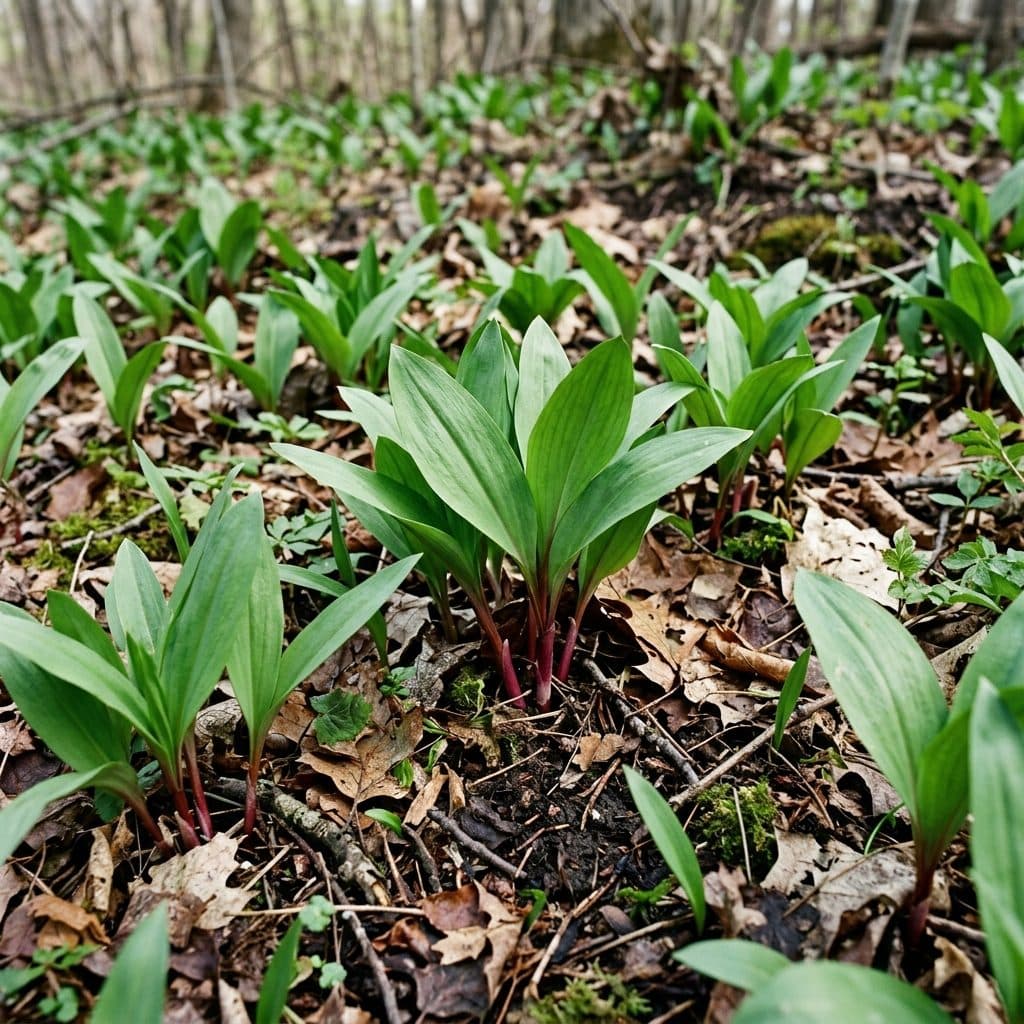
Wild leeks (Allium tricoccum), known across eastern North America as ramps, are perennial woodland spring ephemerals in the amaryllis family (Amaryllidaceae). Indigenous to the rich, moist deciduous hardwood forests of eastern Canada and the eastern United States—ranging from Quebec and Ontario south through the Appalachian Mountains—wild leeks occupy a specialised ecological niche. They emerge through the woodland leaf litter in early spring, completing their annual vegetative growth and photosynthesising during the brief, sunlit window before the forest canopy of sugar maple, American beech, and oak closes overhead.
Celebrated for centuries in Appalachian folk culture and Indigenous food traditions as an essential spring tonic after long winters, wild leeks have achieved international acclaim in fine culinary circles. The plant delivers an intense, complex flavour that merges the pungent sweetness of spring onion with the rich, earthy sharpness of garlic. Both the broad, tender leaf blades and the small white underground bulbs are edible, providing exceptional flavour when prepared fresh or preserved.
In forest farming, agroforestry assemblies, and shaded permaculture systems, wild leeks are an exemplary native groundcover crop. They thrive in damp, dappled woodland understories where common garden vegetables fail to grow. Because wild populations have suffered severe depletion from commercial overforaging, establishing cultivated ramp colonies from seed or nursery-grown bulbs in managed woodlots is both an ecological conservation imperative and a productive homestead endeavour.
Growing wild leeks
Wild leeks demand specific woodland environmental conditions to flourish. They require partial to full seasonal deciduous shade: abundant direct sunlight during early spring while the tree canopy is bare, followed by dense, cooling shade throughout late spring, summer, and autumn. In open garden beds exposed to summer sun, foliage scorches prematurely and soil temperatures rise to lethal levels for dormant bulbs. They are fully cold-hardy across USDA Zones 3 to 7, tolerating northern winters with deep soil freezing beneath a blanket of snow and leaf litter.
The soil must closely replicate the floor of a mature deciduous forest. Wild leeks thrive in deep, crumbly, moist loams rich in decomposed leaf mould, organic matter, and calcium, with a soil pH between 6.0 and 7.2. They cannot tolerate dry, compacted ground or heavy, stagnant clay that causes bulb rot. If cultivating wild leeks in a domestic shade garden or forest plot, amend the planting area with generous quantities of composted hardwood leaves, and maintain an annual mulch layer of shredded maple or oak leaf litter 5 to 7 cm (2 to 3 in) deep.
Consistent soil moisture during early spring is critical for leaf expansion and carbohydrate storage. The forest floor should remain cool and damp, though never waterlogged. Once the foliage dies back in early summer, the dormant underground bulbs tolerate drier conditions beneath the canopy, provided the soil does not bake dry.
Propagating wild leeks from seed requires patience and an understanding of seed physiology. Ramp seeds possess complex morphophysiological dormancy, requiring a sequence of warm-moist followed by cold-moist stratification to break dormancy. Sown outdoors in autumn, seeds typically germinate only after eighteen months (two winters), and seedling plants require five to seven years to reach reproductive maturity and bulb-harvesting size.
For faster establishment, plant dormant bulbs or mature offsets in late summer or early autumn. Set bulbs 5 to 8 cm (2 to 3 in) deep, spaced 10 to 15 cm (4 to 6 in) apart in small clusters of three to five bulbs. Water thoroughly after planting and cover with leaf mulch. Established bulbs slowly divide to form dense, perennial colonies.
Harvest and uses
Wild leek foliage emerges in early to mid-spring, typically throughout April and May depending on regional elevation and snowmelt. The harvest window is brief, lasting only three to four weeks before the canopy closes and leaves yellow and senesce.
Because wild leek colonies reproduce and expand very slowly, sustainable harvesting practices are mandatory. Traditional foraging that uproots the entire bulb and root system destroys decades-old patches. Homesteaders and responsible foragers should adopt a leaf-only harvest protocol: using a sharp knife, harvest only one leaf per mature plant, slicing the blade cleanly above the ground while leaving the second leaf, bulb, and roots undisturbed in the soil. This allows the plant to continue photosynthesising and maintain energy reserves for flowering. Never harvest more than ten to fifteen percent of leaves from any colony in a single year, and never dig bulbs from small or establishing patches.
In the kitchen, wild leeks are exceptionally versatile. Tender spring leaves are chopped fresh into salads, folded into soft scrambled eggs, blended with pine nuts and olive oil into vibrant green ramp pesto, or sautéed gently in butter. Bulbs harvested from cultivated beds can be grilled whole, pickled in seasoned vinegar brine for winter pantries, or simmered in potato and leek soups. Stems and bulbs also infuse oils, compound butters, and salt rubs.
Identifying wild leeks
Allium tricoccum is identified by clear diagnostic features across its seasonal growth cycle:
- Habit: Low-growing herbaceous perennial spring ephemeral forming loose to dense colonies, with leaves reaching 15 to 30 cm (6 to 12 in) in height.
- Foliage: Two to three smooth, broad, flat, lanceolate to oblong-elliptic leaves measuring 15 to 30 cm (6 to 12 in) long and 4 to 8 cm (1.6 to 3.1 in) wide, tapering to a distinct narrow petiole. Leaf bases are often flushed deep reddish-purple (A. tricoccum var. tricoccum) or pale greenish-white (A. tricoccum var. burdickii).
- Aroma: Crushed leaves and bulbs release an unmistakable, powerful, pungent garlic and onion fragrance.
- Bulbs: Small, slender, ovoid white bulbs measuring 2 to 5 cm (0.8 to 2 in) long, surrounded by fibrous brownish outer tunics and rooted by fleshy white roots.
- Flowers: In midsummer (July to August), long after the foliage has withered, a solitary naked scape 15 to 25 cm (6 to 10 in) tall emerges carrying a spherical terminal umbel of twelve to thirty creamy-white, star-shaped six-petalled flowers, maturing into three-lobed capsules holding shiny black seeds.
Wild leeks are distinguished from domestic chives and field garlic by their broad, flat leaves (chives produce slender, hollow tubular leaves).
Cautions
Foragers and growers must observe critical botanical identification rules and conservation laws when handling wild leeks:
- Lethal look-alike false hellebore (Veratrum viride): Highly toxic false hellebore, also called Indian poke, grows in the same moist woodland seepage areas and forest wetlands at the exact same time wild leek leaves emerge. False hellebore contains deadly steroidal alkaloids that cause rapid cardiovascular collapse, severe bradycardia, convulsions, and fatal cardiac arrest. While its young leaves may superficially resemble ramps, false hellebore leaves are strongly ribbed and pleated like an accordion, clasp the central stalk in a tight spiral without petioles, and completely lack any onion or garlic odour. Rule: Never consume any plant that does not release a strong, pungent onion or garlic fragrance when crushed.
- Toxic look-alike lily of the valley (Convallaria majalis): Toxic lily of the valley also emerges in spring woods, containing potent cardiac glycosides that disrupt heart rhythm. Its leaves emerge rolled in pairs, feel stiffer and thicker, and lack any onion aroma.
- Legal protections and foraging bans: Wild leek populations have been decimated by unsustainable commercial exploitation. In Quebec, commercial harvesting of wild leeks has been banned by law since 1995 under the Act Respecting Threatened or Vulnerable Species, and personal collection is strictly limited to 50 bulbs or plants per person annually from non-protected lands. In Ontario, digging wild leeks is illegal within all provincial and national parks. Verify regional regulations before harvesting, and cultivate nursery-propagated stock to safeguard wild forest ecology.
Sources
- Royal Botanic Gardens, Kew. Allium tricoccum Aiton Plants of the World Online.
- USDA PLANTS Database. Allium tricoccum Aiton
- Plants For A Future. Allium tricoccum - Aiton
- NC State Extension Plant Toolbox. Allium tricoccum