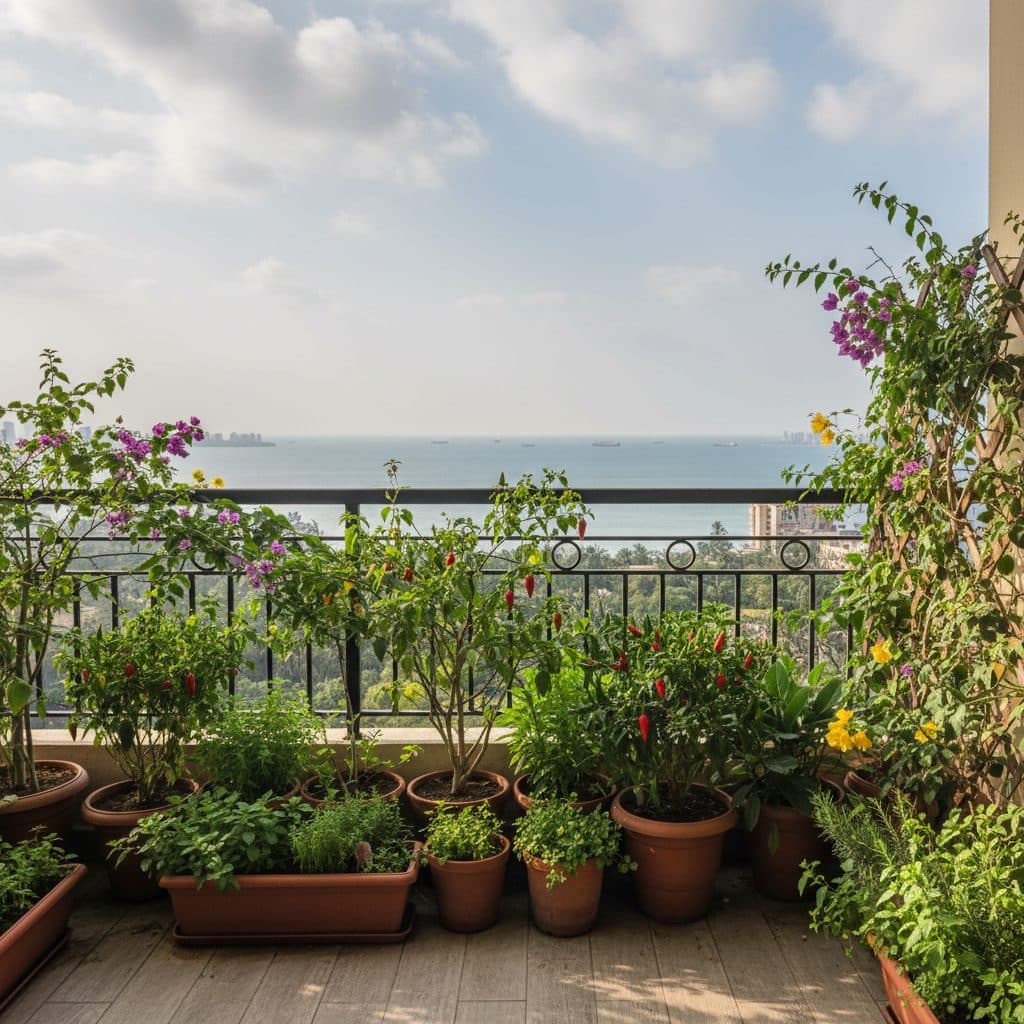
Key takeaways
- Choose lightweight, porous growing media blending cocopeat, vermicompost, and perlite to minimize dead load on apartment balcony slabs.
- Mount railing planters on the inside face of the railing only - never overhanging the drop - and use two independent fixings per planter.
- Elevate all grow bags and pots on drainage stands to prevent water stagnation and root rot during torrential July and August monsoon rains.
- Protect tender foliage from salt spray and intense pre-monsoon heat using 50 percent green agro-shade netting along windward railings.
- Select resilient Indian vegetable and herb varieties like kadi patta, green chillies, lemongrass, and methi that adapt to humid coastal microclimates.
Quick answer: Creating a thriving balcony garden in Mumbai requires balancing extreme seasonal swings: intense coastal heat and humidity from March to May, torrential southwest monsoon rains from June to September, and mild winter growing weather from November to February. High-rise apartment gardeners succeed by utilizing lightweight cocopeat-based potting mixes, securing containers against high-velocity coastal winds, ensuring rapid container drainage, and selecting heat-tolerant Indian crops.
Gardening on a high-rise balcony in Mumbai presents a distinct set of environmental conditions found in few other urban settings. With dense residential towers overlooking the Arabian Sea, balcony growers contend with salt-laden coastal air, intense reflected heat from concrete facades, high wind speeds on upper floors, and torrential monsoon downpours that deliver over 2,000 mm of rain in just four months.
Despite spatial constraints, a compact 2-metre by 1-metre balcony can produce fresh herbs, leafy greens, and vegetable harvests year-round. Transforming a tiled apartment balcony into a lush kitchen garden requires adjusting traditional soil management to container physics.
By understanding how to select appropriate containers, build lightweight growing media, manage windbreaks, and transition crops between the kharif (monsoon) and rabi (winter) seasons, Mumbai residents can establish a resilient, productive balcony garden.
Navigating Mumbai high-rise microclimates
High-rise apartment balconies experience localized microclimates that vary drastically depending on building orientation, floor height, and coastal proximity.
+------------------------+-----------------------------------+-----------------------------------+
| Balcony Aspect         | Light & Thermal Conditions        | Ideal Plant Selections            |
+------------------------+-----------------------------------+-----------------------------------+
| East-Facing            | Gentle morning sun, cool afternoons| Coriander, mint, palak, methi     |
| West-Facing            | Blistering afternoon sun and heat | Tulsi, bougainvillea, chillies    |
| South-Facing           | Continuous intense sunlight       | Brinjal, bhindi, curry leaf       |
| North-Facing           | Shaded most of the year, but takes direct overhead sun around midsummer (roughly mid-May to late July) plus early and late sun in the summer months | Ferns, money plant, syngonium - with netting or a shift to a shadier corner for those weeks |
+------------------------+-----------------------------------+-----------------------------------+
On floors above the tenth level, wind speeds increase substantially. Strong drafts accelerate transpiration, drying out container soil in a matter of hours during the hot pre-monsoon months of April and May. Installing permeable bamboo blinds or 50 percent green shade net along exposed railings buffers wind velocity while allowing adequate air circulation.
Mount railing planters on the inside face of the railing only - never overhanging the drop - use two independent fixings per planter, and inspect every fixing before and after the monsoon. Check your society's rules first; many prohibit pots on the outer face entirely.
Lightweight potting mixes for balconies
Standard garden soil (heavy red or black clay) becomes excessively dense and waterlogged in containers, placing unnecessary weight on balcony slabs. Balcony slabs, especially cantilevered ones, are not uniformly loadable and no single figure fits every building. Keep heavy water-filled containers close to the wall, over the supporting structure, rather than out at the open edge; keep total weight modest; and before installing anything heavy - drums, a wicking bed, or a dense run of filled grow bags - have the load checked by a structural engineer and confirm what your housing society permits.
+-------------------------------------------------------------------+
|            BALCONY LIGHTWEIGHT POTTING MIX FORMULATION            |
+-------------------------------------------------------------------+
| [40%] Washed & Buffered Cocopeat (Moisture retention & aeration)  |
| [30%] Well-Aged Vermicompost (Biological microbial fertility)     |
| [15%] Rice Husk / Perlite (Improves drainage & reduces weight)    |
| [10%] Sterilized Topsoil / Red Earth (Mineral trace elements)     |
| [5%]  Neem Cake Powder (Natural pest & root nematode deterrent)   |
+-------------------------------------------------------------------+
Cocopeat provides high water-holding capacity without compacting, while vermicompost delivers soluble plant nutrients. Using quality organic matter as discussed in vermicompost vs regular compost worms win ensures steady nutrient release in restricted container volumes.
Selecting containers and grow bags
Choosing the right containers balances root space, durability, and drainage efficiency.
+------------------------+------------------------------------+-------------------+-------------------------------+
| Container Type         | Durability & Trade-offs            | Weight Profile    | Best Suited For               |
+------------------------+------------------------------------+-------------------+-------------------------------+
| Terracotta / Clay Pots | Heavy, breakable, dries fast; lasts| Heavy, porous     | Herbs, succulents, tulsi      |
| HDPE Grow Bags         | Light, cheap; UV-degrades in seasons| Extremely light   | Bhindi, brinjal, tomatoes     |
| Recycled Plastic Pots  | Moderate durability; UV-resistant  | Moderate weight   | Railing planters, creepers    |
| Geotextile Fabric Bags | Light, well-aerated; shortest life | Very light        | Root crops, radish, ginger    |
+------------------------+------------------------------------+-------------------+-------------------------------+
For high-rise balconies, HDPE grow bags and UV-stabilized plastic pots are superior to heavy terracotta. Ensure every container features multiple drainage holes along the bottom and lower sidewalls. Sourcing the right bag dimensions is detailed in our guide on grow bags for terrace garden.
Surviving the Mumbai monsoon (June to September)
The southwest monsoon brings intense, prolonged downpours that can drown container root systems within 48 hours if water cannot escape freely.
+-------------------------------------------------------------------+
|                  MONSOON DRAINAGE CHECKLIST                       |
+-------------------------------------------------------------------+
| 1. Elevate Containers   --> Place pots on 5 cm metal / PVC stands |
| 2. Clear Drain Trays    --> Remove saucers to prevent water pools |
| 3. Angle Sloping Pots   --> Tilt deep pots slightly for runoff    |
| 4. Prune Dense Canopies --> Thin foliage to improve air movement  |
|5. Space and Prune      --> Thin canopies and increase airflow; remove infected leaves |
+-------------------------------------------------------------------+
Preventing waterlogging and root rot
Never allow pots to sit directly on flat balcony tiles during July and August. Rainwater pooling beneath drainage holes blocks oxygen exchange, causing anaerobic root rot. Elevate containers on slatted plastic stands or simple brick risers to allow unimpeded outflow toward balcony floor drains.
Fungal disease and nutrient leaching
Continuous rain washes soluble nutrients out of container potting mix within weeks. Once monsoon rains ease, top-dress each pot with a fresh handful of vermicompost and neem cake. Reserve cold-pressed neem oil sprays (5 ml per litre of water with 2 drops of mild liquid soap) for actual pest pressure, applying in the evening during a dry spell - oil sprays can scorch foliage in Zaid heat.
Year-round seasonal cropping calendar
Mumbai does not experience severe winter frost, so gardeners can crop continuously across three distinct seasons:
+-------------------+-----------------------+-------------------------------------------+
| Season            | Months                | Recommended Balcony Crops                 |
+-------------------+-----------------------+-------------------------------------------+
| Kharif (Monsoon)  | June to September     | Bhindi, brinjal, turmeric, ginger, gourds |
| Rabi (Winter)     | October to February   | Tomatoes, methi, palak, coriander, radish |
| Zaid (Summer)     | March to May          | Kadi patta, mint, amaranth, lemongrass    |
+-------------------+-----------------------+-------------------------------------------+
Kharif (monsoon sowing)
Sow seeds in late May or early June before the first rains arrive. Vegetables with sturdy stems—such as bhindi (okra) and brinjal (eggplant)—tolerate monsoon humidity well. Climbing cucurbits like ridge gourd (turai) and bitter gourd (karela) can be trained up vertical balcony grills.
Rabi (winter sowing)
October through February provides the ideal growing window in Mumbai. Mild temperatures between 20°C and 30°C suit fast-growing leafy greens such as methi (fenugreek), palak (spinach), and coriander. Sow leafy greens in shallow, wide rectangular troughs every three weeks for continuous harvests.
Zaid (summer management)
From March to May, ambient temperatures on concrete balconies frequently exceed 36°C. Move delicate herbs into shaded corners and install 50 percent shade netting overhead as described in shade cloth vegetables percentage install. For automated moisture control during hot workdays, explore drip irrigation for terrace garden systems scaled for balcony taps.
Applying container principles outlined in rooftop patio container gardening allows any Mumbai apartment dweller to grow a productive, high-yielding green space.