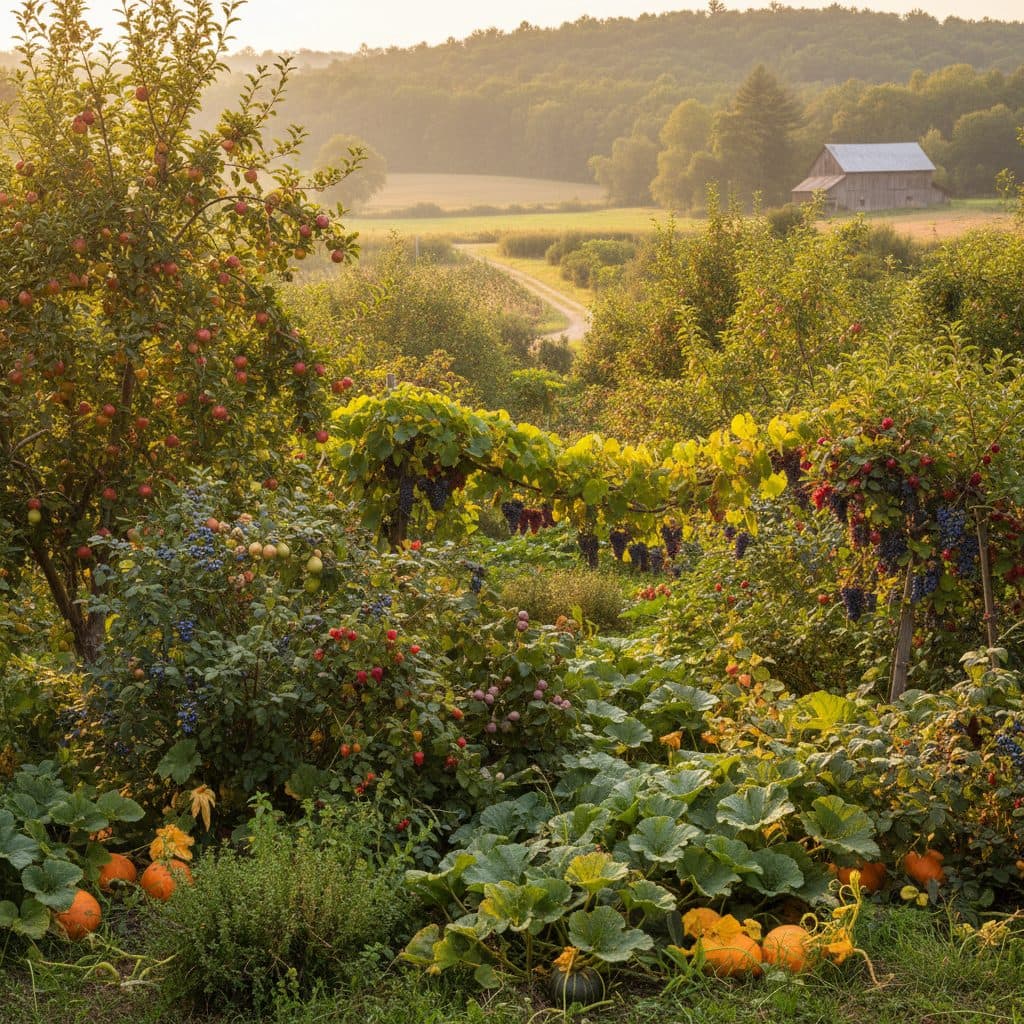
Key takeaways
- Thorough site assessment and soil building in ‘year zero’ matter for long-term success.
- Year one focuses on planting the canopy and understory, often with 30-50 diverse species.
- Years two and three involve consistent mulching, pruning, and observing plant health for early harvests.
- By years four and five, the system diversifies, yields increase, and maintenance shifts towards management.
- Swales, guilds, and zone planning are fundamental permaculture design elements that reduce labor over time.
- Expect a significant time investment in the first three years, with reduced effort as the system matures.
Quick answer: Establishing a food forest in USDA Zone 6 requires thorough site assessment and soil building in ‘year zero,’ followed by planting canopy and understory species in year one. Years two through five involve consistent mulching, pruning, and observation, with maintenance shifting to management as the system matures and yields increase.
Establishing a food forest is a long-term commitment, transforming a piece of land into a productive, perennial ecosystem. In regions like USDA zone 6, with its distinct four seasons, a well-planned food forest can provide diverse yields for decades. This isn’t a weekend project; it’s a multi-year endeavor that requires patience, observation, and consistent effort, especially during the initial five years.
year zero: planning and site preparation
Before any planting begins, a significant amount of planning and site preparation is necessary, often referred to as ‘year zero.’ This phase can span six months to a full year, depending on site conditions and available resources. A comprehensive site assessment is the first step, evaluating sunlight patterns, water flow, existing vegetation, and soil composition. For instance, in a typical Midwestern property, you might find clay soil with a pH of 7.5, requiring amendments to support a wider range of fruit and nut trees. Understanding your site’s specific characteristics is fundamental to successful permaculture design, as detailed in our guide on how to read a site.
building soil and water management systems
Once the assessment is complete, focus shifts to improving soil health and managing water. Incorporating several inches of organic matter, such as compost or aged wood chips, can dramatically improve soil structure and fertility. For example, adding four to six inches of wood chips over a 1,000 square foot area feeds soil microbes and steadily builds organic matter as it breaks down. Water management structures, like swales, are often installed during this phase. A 50-foot long swale, dug on contour with a one percent slope, can capture thousands of gallons of rainwater annually, directing it to plant roots rather than allowing runoff. The USDA Natural Resources Conservation Service publishes guidance on conservation practices including water-harvesting earthworks. Investing in soil and water infrastructure up front generally lowers the maintenance burden later, though how much depends entirely on your site.
- conduct a detailed site assessment, noting sun, wind, and water patterns
- test soil pH and nutrient levels, aiming for a range between 6.0 and 7.0
- amend soil with several inches of compost or other organic matter
- install water harvesting features like swales or rain gardens
- map out zones and access paths for efficient future management
year one: establishing the canopy and understory
Year one is primarily about planting. With your site prepared, the focus shifts to installing the backbone of your food forest: the canopy trees and understory shrubs. In USDA zone 6, spring is often the best time for planting bare-root stock, as it allows plants to establish roots before the summer heat. You might plant a mix of species, such as five apple trees, three pear trees, and two cherry trees as your main canopy, spaced 15 to 20 feet apart. Underneath, you could integrate nitrogen-fixing shrubs, planting 10-15 of these throughout the system. Check your state's noxious-weed list before you choose: autumn olive (Elaeagnus umbellata) is bird-dispersed and is listed as invasive or outright prohibited across much of the eastern and midwestern US, and goumi (Elaeagnus multiflora) is restricted in some states for the same reason. Where Elaeagnus is banned or discouraged, a native actinorhizal shrub such as New Jersey tea (Ceanothus americanus) plus a clover understory does the same job without the escape risk. Understanding what a food forest is emphasizes these layered plantings.
planting guilds and initial care
The concept of plant guilds is central to permaculture. Each canopy tree should be surrounded by a guild of beneficial plants, including nitrogen fixers, dynamic accumulators, pest deterrents, and groundcovers. For an apple tree, a guild might include sterile Bocking 14 comfrey (Symphytum x uplandicum 'Bocking 14', which does not set seed), chives (pest deterrent), and clover (nitrogen fixer), planted within a five-foot radius. Use comfrey as chop-and-drop mulch only: its pyrrolizidine alkaloids are hepatotoxic, so it is neither food for people nor fodder for livestock. Each new tree or shrub will require consistent watering, especially during its first growing season; typically, 5-10 gallons of water per plant per week during dry spells. Applying a thick layer of mulch, three to six inches deep, immediately after planting holds soil moisture and suppresses most competing weeds, cutting hand-weeding substantially. This initial care is critical for the long-term health and productivity of your young forest.
- plant bare-root canopy trees (e.g., apple, pear) in early spring — leave oak out of the canopy if you plan to graze livestock under it later, since acorns and oak foliage are toxic to cattle, horses, sheep and goats
- install understory shrubs (e.g., elderberry, hazelnut, serviceberry)
- create plant guilds around each primary tree, including nitrogen fixers and dynamic accumulators
- apply a three to six inch layer of wood chip mulch around all new plantings
- water deeply and regularly, providing 5-10 gallons per plant weekly during dry periods
years two and three: supporting growth and early harvests
By years two and three, your food forest begins to take shape. The plants are establishing their root systems, and you’ll observe significant growth. This period calls for continued maintenance and observation. Regular mulching remains a top priority; replenish mulch layers to maintain a consistent depth of four to six inches, which is what keeps weed pressure manageable. Pruning also becomes important, especially for fruit trees. Dormant pruning in late winter removes dead, damaged, or diseased wood, and helps shape the tree for future production. For instance, you might remove 10-20 percent of a young apple tree’s branches to encourage an open structure. Many low maintenance perennials will start to thrive.
observing and adapting
You may start to see your first small harvests during this period. Berry bushes like elderberry or currants might produce a few pounds of fruit per plant, and some early-bearing fruit trees could offer a handful of apples or pears. This is also the time to observe your system closely. Are certain plants struggling? Are pests becoming an issue? For example, if you notice aphid infestations on your young peach trees, introducing beneficial insects or applying neem oil can help manage the problem. Adjust your planting strategy or add new species to fill gaps or address observed challenges. The goal is to create a resilient system that requires less intervention over time, with the workload easing noticeably between year one and year three.
- replenish mulch layers to maintain a four to six inch depth
- perform dormant pruning on fruit trees to shape and encourage production
- monitor for pests and diseases, addressing issues proactively
- harvest first small yields from berries and early-bearing fruit trees
- plant additional groundcovers or herbs to fill in open spaces
years four and five: increasing yields and system resilience
By years four and five, your food forest should be showing significant signs of maturity and increased productivity. Canopy trees will have larger root systems and more extensive branch structures, and many will begin producing substantial harvests. For example, a well-established apple tree in USDA zone 6 might yield 20-30 pounds of fruit annually, while a hazelnut shrub could offer 5-10 pounds of nuts. This is also an excellent time to consider integrating animals, such as chickens, into your system. A food forest for chickens can provide forage, pest control, and fertility, with a flock of 10-15 birds effectively managing a half-acre area.
diversification and advanced management
As the system matures, the focus shifts from establishment to diversification and fine-tuning. You might introduce new understory plants, perennial vegetables, or medicinal herbs to increase the variety of yields. For instance, planting 20-30 additional perennial kale or sorrel plants can fill in sunny gaps. Advanced water management, like optimizing swale function, becomes more important; regular inspection keeps a swale's berm intact and its basin from silting up, which is what lets it keep catching runoff. The overall health of the ecosystem should be strong, with a noticeable reduction in pest issues due to a balanced predator-prey relationship. Maintenance tasks, while still present, are generally less intensive than in the early years.
- expect significant harvests from established fruit and nut trees
- consider integrating small livestock like chickens for pest control and fertility
- introduce new perennial vegetables, herbs, and fungi to increase biodiversity
- monitor and maintain water harvesting systems, such as swales, for optimal function
- observe natural pest control mechanisms and reduce human intervention
Soil health: adding four to six inches of organic matter improves water retention and cuts how much fertilizer a young planting needs from outside the system.
Water: a 50-foot swale on contour can capture and infiltrate a large share of the rainwater that would otherwise run off your site, reducing irrigation for nearby plants.
Frequently asked questions
How long does it take for a food forest to produce significant yields?
While some berry bushes might yield small harvests in years two or three, most canopy trees will begin producing significant yields in years four to five. A mature apple tree, for example, can yield 20-30 pounds of fruit annually by year five.
What is the most critical step in year one of a food forest?
The most critical step in year one is consistent watering and mulching for newly planted trees and shrubs. Each plant typically needs 5-10 gallons of water per week during dry periods, and a four to six inch mulch layer is essential for moisture retention.
Can I integrate animals into my food forest early on?
Wait until year four or five, when trees have bark that can take a scratching and the groundcover layer is thick enough to regrow. Chickens do damage young plantings: they scratch mulch away from trunks, dust-bathe at the base of shrubs, and strip a herb and groundcover layer down to bare soil. If you run them earlier, run them in a movable tractor rather than free-range, and keep them off any bed planted that season.
How much maintenance is required in the first five years?
Maintenance is highest in year one, focusing on planting and initial care. Years two and three involve consistent mulching and pruning, with the workload easing as plants establish. By years four and five, maintenance shifts to management and takes noticeably less time than year one.
What role do swales play in a food forest?
Swales are critical for water management, capturing and slowly releasing rainwater into the soil rather than letting it run off the site. How much a given swale captures depends on the catchment feeding it and your local rainfall, so size it from your own numbers.
References
- Self-employment rates: total (2023). Self-employment rates: total.
- Self-employment rates: men (2023). Self-employment rates: men.
- Light Year (2013). Light Year.
- YEAR ZERO (2024). YEAR ZERO.