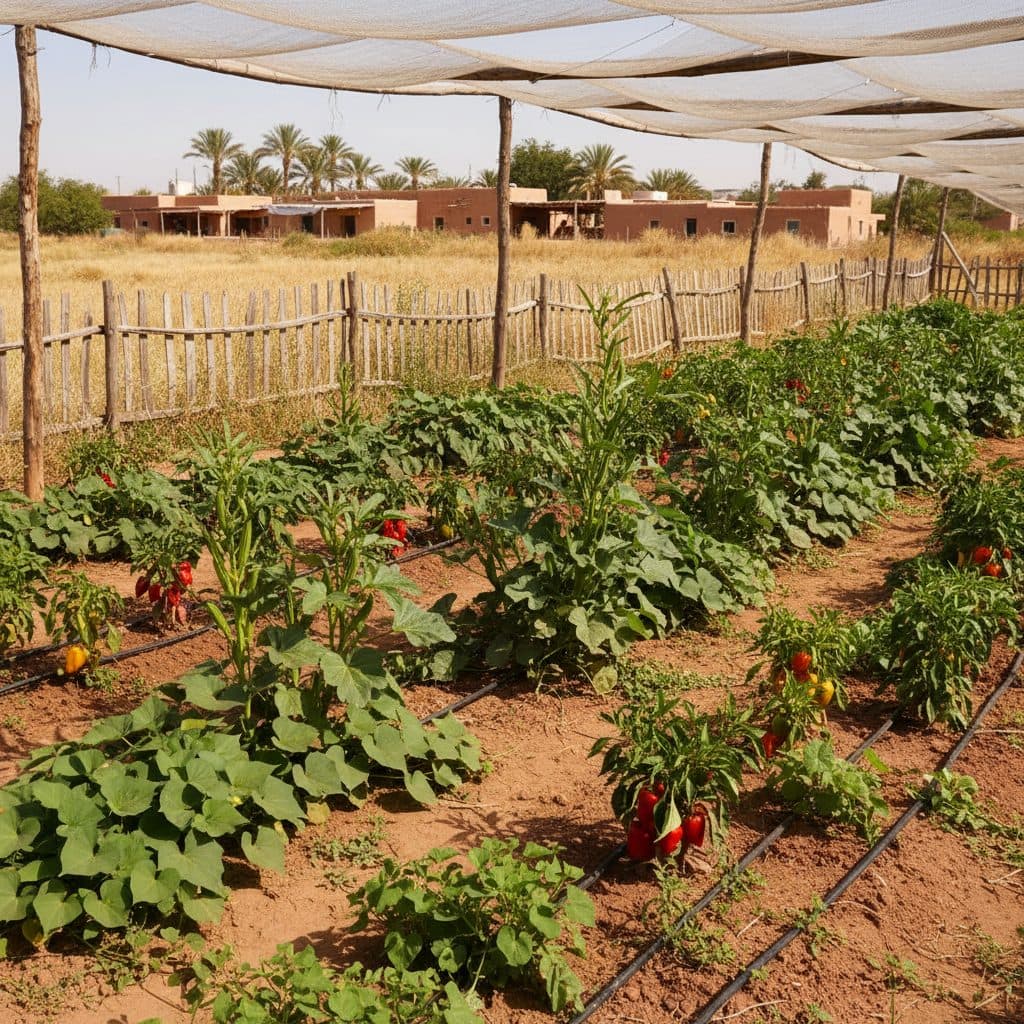
Key takeaways
- USDA Zones 8-10 allow for year-round gardening with proper planning and specific crop choices.
- Implementing a 3-4 year crop rotation cycle significantly reduces pest and disease pressure while maintaining soil fertility.
- Succession planting every 2-4 weeks ensures a continuous harvest of warm-season vegetables, preventing gluts and gaps.
- Prioritize heat-tolerant varieties like okra, sweet potatoes, and southern peas that thrive in temperatures above 85°F.
- Consistent irrigation of 1-2 inches of water per week and a 3-4 inch layer of organic mulch are crucial for summer plant health.
- Strategic shade provision during the hottest parts of the day can protect sensitive crops and extend their production into late summer.
Quick answer: To achieve continuous harvests in USDA Zones 8-10, implement a hot-season planting calendar focusing on crop rotation, succession planting, and heat-tolerant varieties. Consistent irrigation, mulching, and strategic shading are crucial for plant health and maximizing yields.
Gardening in USDA zones 8-10, encompassing vast stretches of states like Florida, California, Texas, and Arizona, presents unique opportunities and challenges. With average annual extreme minimum winter temperatures ranging from 10°F to 40°F, these regions often allow for year-round cultivation, but summer heat can be intense, with daily highs frequently exceeding 90°F for weeks on end. Understanding how to manage this heat is key to a productive garden.
To truly thrive in these warmer climates, growers must adopt intelligent strategies like crop rotation and succession planting. These methods aren’t just for short-season growers; they are vital tools for maximizing yields and maintaining soil health in areas where pests and diseases can overwinter easily. A well-planned hot-season calendar can turn your garden into a continuous source of fresh food, even when temperatures climb above 100°F.
Navigating the climate of zones 8-10
USDA zones 8, 9, and 10 are defined by their average annual extreme minimum winter temperatures, ranging from 10°F to 40°F. While this means a longer growing season, often with a last frost in March and a first frost in November for zone 8b, the real challenge comes from the summer heat. Many parts of zone 9, for instance, experience average summer temperatures consistently above 85°F, with heat waves pushing past 100°F for several days. This intense heat, often coupled with high humidity in coastal areas or arid conditions inland, demands specific planting and care strategies to prevent crop failure and maximize yields.
Understanding heat stress and plant responses
Plants respond to high temperatures in various ways; some, like lettuce, will bolt and become bitter when temperatures exceed 75°F, while others, such as okra, thrive in conditions above 80°F. Intense sunlight can also scorch leaves and fruit, reducing overall photosynthesis. Providing afternoon shade, especially for less heat-tolerant varieties, can extend their productive life by several weeks. Understanding your specific microclimate, including factors like sun exposure and air circulation, is crucial for success in these warmer zones, where soil temperatures can reach 120°F in direct sun.
- High daytime temperatures: Frequently above 90°F, leading to plant stress.
- Warm night temperatures: Often staying above 70°F, which can hinder fruit set for some crops.
- High humidity (coastal): Increases fungal disease pressure.
- Arid conditions (inland): Requires careful water management, with plants needing 1-2 inches of water weekly.
- Extended growing season: Allows for multiple planting cycles, often 2-3 per year.
The power of crop rotation
Crop rotation is a fundamental practice for maintaining soil health and preventing the buildup of pests and diseases, especially in zones 8-10 where warm temperatures allow pathogens to persist year-round. By rotating plant families through different beds over a 3-4 year cycle, you break disease cycles and manage nutrient demands more effectively. For example, planting nitrogen-fixing legumes like cowpeas in a bed that previously grew heavy feeders such as corn can replenish soil nitrogen by 50-100 pounds per acre, reducing the need for synthetic fertilizers. The USDA Natural Resources Conservation Service emphasizes the role of diverse planting in maintaining soil vitality.
Designing an effective rotation plan
A simple rotation involves dividing your garden into three or four sections and moving plant families annually. For instance, follow heavy feeders (corn, squash) with legumes (beans, peas), then root crops (carrots, potatoes), and finally leafy greens (kale, chard). This systematic movement helps to prevent specific soil-borne diseases, like Fusarium wilt, which can devastate tomato crops if planted in the same spot year after year. Consider incorporating cover crops during off-seasons to further improve soil structure and slowly build organic matter. For more on beneficial legumes, see our guide on The Best Nitrogen-Fixing Trees for Every USDA Zone.
- Legumes: Beans, peas, cowpeas – fix nitrogen, reducing the nitrogen demand of the crop that follows.
- Brassicas: Cabbage, broccoli, kale – moderate feeders, can deter some pests.
- Solanaceae: Tomatoes, peppers, eggplant – heavy feeders, prone to specific diseases.
- Cucurbits: Squash, cucumbers, melons – heavy feeders, benefit from rich soil.
- Root crops: Carrots, radishes, beets – lighter feeders, improve soil structure.
Mastering succession planting for continuous yield
Succession planting is the art of staggering plantings to ensure a continuous harvest rather than a single large flush. In zones 8-10, where the growing season is long, this technique is particularly valuable for extending the yield of warm-season crops and even getting multiple harvests of some cool-season plants before the intense summer heat. By planting small batches of a crop every two to four weeks, you can enjoy fresh produce over several months. For example, instead of planting all your bush beans at once, plant a 10-foot row every three weeks from April through early June, then start the succession again in late summer once nights begin to cool.
Timing and crop selection for success
The key to successful succession planting lies in understanding the ‘days to maturity’ for each crop and planning accordingly. For fast-growing crops like radishes (25-30 days) or bush beans (50-60 days), you can plant new batches frequently. For longer-season crops like tomatoes, consider planting an early variety in spring and a heat-tolerant variety in mid-summer for a fall harvest. Utilizing living mulches can also enhance soil health and moisture retention, which is critical for continuous production; learn more at Best Living-Mulch and Cover-Crop Legumes by USDA Zone for No-Dig Beds.
- Bush Beans: Plant every 3 weeks from April through early June, then resume in late summer for a fall crop.
- Radishes: Plant every 2 weeks from March to May, and again in September/October, maturing in 25-30 days.
- Summer Squash: Plant new seeds every 4 weeks to replace older, less productive plants, ensuring 8-10 weeks of harvest.
- Cucumbers: Stagger plantings every 3-4 weeks to avoid a single large harvest and extend the season by 6-8 weeks.
- Okra: A single planting in May or June can produce for 10-14 weeks, but a second planting in July can extend harvests into fall.
Hot-season crop selection and care
This builds directly on mastering succession planting.
Choosing the right crops is paramount for success in the intense summer heat of zones 8-10. While many vegetables struggle when temperatures consistently exceed 85°F, several varieties are specifically adapted to thrive in these conditions. Consider heat-loving plants like okra, which can produce prolifically even when temperatures hit 100°F, or sweet potatoes, which are drought-tolerant once established and yield tubers in hot soil. Southern peas (black-eyed peas, crowder peas) are another excellent choice, providing both food and soil improvement as nitrogen fixers, potentially adding 60 pounds of nitrogen per acre.
Essential care for summer abundance
Beyond crop selection, proper care is critical. Consistent watering, typically 1-2 inches per week, is vital, especially during fruit set, to prevent blossom drop and ensure plump harvests. Applying a 3-4 inch layer of organic mulch, such as straw or wood chips, helps to conserve soil moisture by up to 50%, suppress weeds, and keep soil temperatures cooler, benefiting root health. For more on drought-tolerant options, explore Drought-Tolerant Trees and Shrubs by USDA Zone. Strategic afternoon shade, using shade cloth or taller companion plants, can protect sensitive crops from the harshest sun between 1 PM and 4 PM.
- Okra: Thrives in heat, producing pods for 10-14 weeks.
- Sweet Potatoes: Heat-loving tubers, drought-tolerant once established, typically yielding a few pounds of roots per plant.
- Southern Peas: (Black-eyed, Crowder) Heat-tolerant, nitrogen-fixing, matures in 60-90 days.
- Eggplant: Many varieties tolerate heat well, especially if given consistent moisture, yielding 5-10 fruits per plant.
- Malabar Spinach: A heat-tolerant leafy green that provides a continuous harvest when traditional spinach bolts.
Hot-Season Planting Guide for Zones 8-10
Crop | Early Summer Planting (April-May) | Mid-Summer Planting (June-July) |
|---|---|---|
Bush Beans | Harvest in June-July, yields 1-2 lbs per plant. | Harvest in August-September, yields 1-2 lbs per plant. |
Okra | Harvest from July-September, continuous pods for 10-12 weeks. | Harvest from September-October, extending season by 4-6 weeks. |
Sweet Potatoes | Plant slips by May, harvest in October-November, 5-10 lbs per plant. | Plant slips by July, harvest in November-December, 3-7 lbs per plant. |
Southern Peas | Harvest in July-August, quick 60-day maturity. | Harvest in September-October, good for fall canning. |
Malabar Spinach | Harvest from June-October, grows vigorously in heat. | Harvest from August-November, provides greens into cooler weather. |
Water Efficiency: Drip irrigation systems can reduce water usage by up to 50% compared to overhead sprinklers in hot climates, delivering 0.5-1 gallon per hour directly to root zones.
Soil Temperature: A 3-inch layer of organic mulch can reduce soil surface temperatures by 10-15°F during peak summer heat, protecting beneficial soil microbes and plant roots.
Frequently asked questions
What are the best vegetables to grow in USDA zones 8-10 during summer?
For summer in zones 8-10, focus on heat-loving crops such as okra, sweet potatoes, southern peas, eggplant, and Malabar spinach. These plants generally thrive in temperatures above 85°F and can continue producing even when daily highs exceed 95°F. Consider planting varieties specifically bred for heat tolerance.
How often should I water my garden in hot climates?
In hot climates, consistent watering is crucial. Most garden vegetables require 1-2 inches of water per week, delivered through deep, infrequent irrigation to encourage deep root growth. During extreme heat waves, or for plants in containers, you might need to water every one to two days. Using drip irrigation can save up to 50% of water compared to overhead watering.
Can I grow cool-season crops in zones 8-10?
Yes, cool-season crops like lettuce, spinach, and broccoli can be grown in zones 8-10, primarily during the cooler months of fall, winter, and early spring. Plant these crops after the intense summer heat subsides, typically from September through March, to avoid bolting. Some varieties can even be grown under shade cloth to extend their season by 2-4 weeks into early summer.
What is the benefit of using mulch in a hot-season garden?
Mulch offers significant benefits in hot-season gardens. A 3-4 inch layer of organic mulch, such as straw or wood chips, helps to conserve soil moisture by reducing evaporation by up to 50%. It also suppresses weeds, reducing competition for water and nutrients, and moderates soil temperature, keeping roots cooler by 10-15°F during peak heat and warmer during cool nights.
When is the last frost date for zones 8-10?
The average last frost date varies within zones 8-10. For zone 8, it’s typically in mid-March, while zone 9 often sees its last frost in late February to early March. Much of zone 10 is effectively frost-free, with frost a rare event confined to the coldest nights of January or February. Always check local extension office data for the most accurate dates, which can vary by 1-2 weeks annually.
References
- Planting Considerations for Short-Season Environments (2021). Planting Considerations for Short-Season Environments.
- Forest Tree Planting in Arid Zones (1969). Forest Tree Planting in Arid Zones.
- Implementation of Moving Average and Soft Computing algorithm to support planting season calendar forecasting system on mobile device (2016). Implementation of Moving Average and Soft Computing algorithm to support planting season calendar forecasting system on mobile device.
- USDA Natural Resources Conservation Service (2024). USDA Natural Resources Conservation Service.