Key takeaways
- Interplanting fast and slow crops maximizes bed space, potentially doubling yield within a single growing season.
- Successful interplanting requires understanding crop maturity rates, light needs, and nutrient demands.
- Tailor your planting calendar to your specific USDA zone, considering frost dates and season length.
- Strategic crop pairings, like lettuce under tomatoes, optimize resource use and minimize competition.
- Maintain soil fertility with regular compost additions and precise watering for intensive cropping systems.
- Harvest fast crops promptly to create space for slower crops to thrive and enable continuous succession.
Quick answer: Interplanting fast and slow crops maximizes garden output by growing two or more crop types together, utilizing different growth rates and habits to optimize space, light, water, and nutrients. This strategy allows for continuous harvesting and significantly higher yields per square foot.
In the fertile Willamette Valley of Oregon, a 4 ft by 8 ft raised bed can stay in production from March through October when managed with thoughtful interplanting strategies. This method involves growing two or more crop types together in the same space, utilizing different growth rates and habits to maximize production. The core idea is to pair fast-maturing crops with slower-growing ones, allowing you to harvest the quick-turnaround vegetables before the long-season plants need the full space.
This approach isn’t just about fitting more plants into a small area; it’s about optimizing light, water, and nutrient use. By carefully selecting compatible species and understanding their growth cycles, growers in regions like USDA zone 6 or 7 can achieve significantly higher yields per square foot compared to traditional monoculture. The goal is to keep your garden beds actively producing throughout the entire growing season, from early spring to late fall.
differentiating fast and slow crop cycles
Understanding the time each crop needs to reach maturity is the first step in successful interplanting. Fast crops, often called short-season crops, mature quickly, typically within 25 to 60 days. Examples include radishes, which can be ready in 25 to 30 days, leaf lettuce varieties in 30 to 45 days, and spinach in 30 to 40 days. These plants are harvested early, clearing space for their slower companions. In contrast, slow crops require a longer growing period, often 70 to 120 days or more, such as tomatoes, peppers, cabbage, and winter squash. A study in 1969 explored interplanting secondary crops into existing strawberry fields, demonstrating potential for increased land use efficiency by integrating different maturity rates [1].
calculating days to maturity for planning
When planning your interplanting strategy, always check the ‘days to maturity’ listed on seed packets or plant tags. For instance, a ‘Celebrity’ tomato might take 70 days from transplant to harvest, while ‘Cherry Belle’ radishes are ready in 28 days. This difference allows for a window of about 40 days where the radishes can grow and be harvested before the tomato plant reaches its full size and canopy. Consider the specific needs of each plant, including their light requirements and eventual size. For example, planting shade-tolerant crops like lettuce beneath taller, sun-loving plants like corn can optimize light distribution in a 4 ft wide bed.
- radishes: 25-30 days
- leaf lettuce: 30-45 days
- spinach: 30-40 days
- bush beans: 50-60 days
- beets: 50-65 days
tailoring interplanting to your usda zone
Your frost-free season length dictates how many interplanting cycles you can achieve. Your USDA hardiness zone does not — it maps average annual extreme winter lows, not season length, and two gardens in the same zone can differ by weeks. In USDA zone 5, with a shorter season of 120 to 150 frost-free days, you might aim for one fast crop before a slow crop. However, in USDA zone 8, with 210 to 240 frost-free days, you could easily fit in two or even three quick successions around longer-season plants. For example, a gardener in USDA zone 7 can typically plant early radishes and spinach in March, harvest them in April, and then plant tomatoes or peppers in the same spot by early May, allowing for a full season of growth for the slow crops.
developing a zone-specific planting calendar
Start by identifying your average last spring frost date and first fall frost date. For instance, in parts of USDA zone 6, the last frost might be around April 15th, and the first fall frost around October 15th, providing a 180-day growing window. Plan your slow crops to occupy the majority of this window. Then, identify gaps where fast crops can thrive. Consider living mulches and cover crops which can also be interplanted to improve soil health, especially legumes that fix nitrogen. You can find excellent resources on appropriate species for your region at Best Living-Mulch and Cover-Crop Legumes by USDA Zone for No-Dig Beds. The USDA Natural Resources Conservation Service provides extensive data on soil types and climate conditions across all 50 states, important for regional planting decisions [3].
- identify last spring frost date
- determine first fall frost date
- calculate total frost-free days
- select slow crops for the main season
- fit fast crops into early and late season gaps
effective crop pairings for increased yield
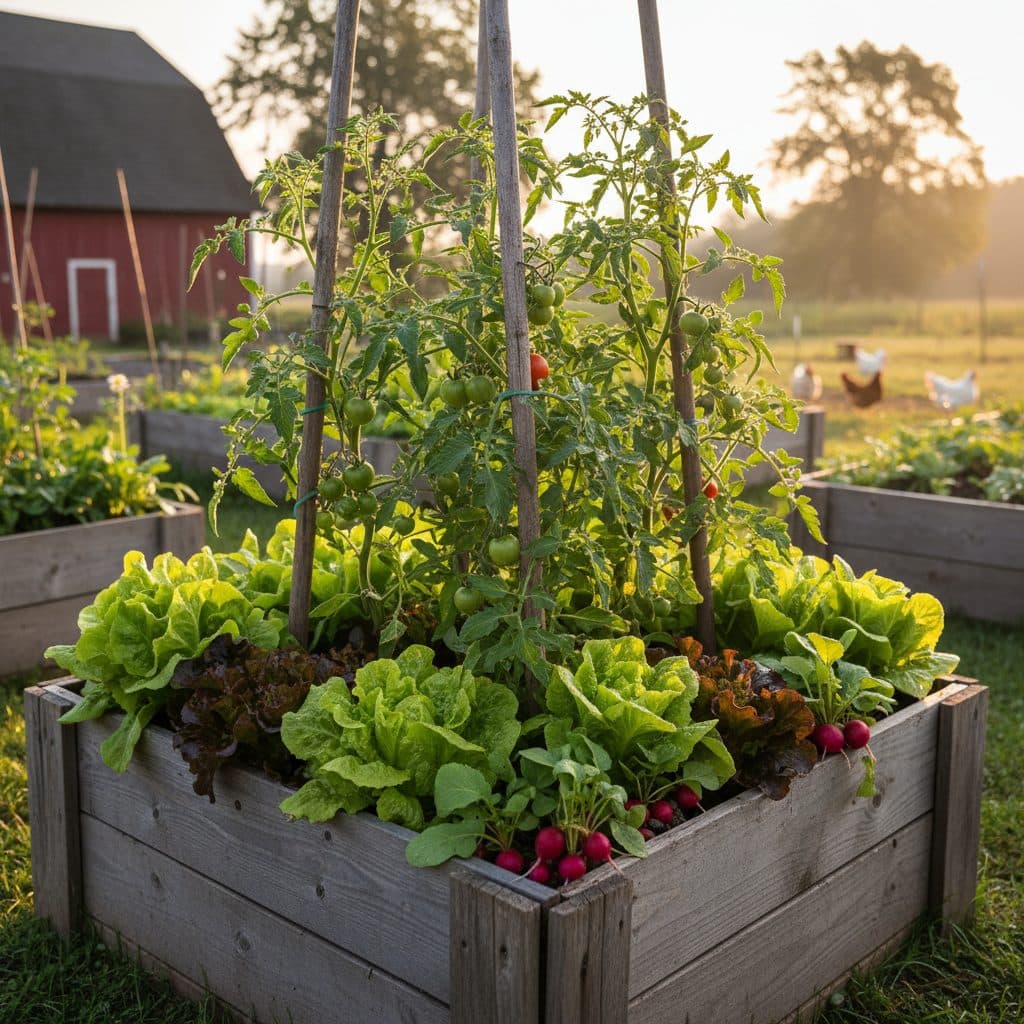
The art of interplanting lies in selecting compatible crop pairings that benefit each other or, at the very least, do not compete excessively. A classic example is planting leaf lettuce or spinach beneath taller, sun-loving plants like tomatoes or pole beans. The fast-growing greens benefit from the partial shade provided by the taller plants as summer temperatures rise, which can prevent bolting. Meanwhile, the taller plants appreciate the ground cover that helps suppress weeds and retain soil moisture. This strategy makes fuller use of a 10 ft by 10 ft garden bed than growing each crop separately.
maximizing space with complementary growth habits
Another effective pairing involves crops with different root depths. Carrots, with their deep taproots, can be interplanted with shallow-rooted crops like radishes or onions. The radishes will be harvested long before the carrots need the full soil volume, and their quick growth helps loosen the soil, potentially benefiting the developing carrots. Relay interplanting cover crops in sweet corn has also shown benefits, with studies demonstrating how additional biomass can be integrated into production systems [2]. For more on what plants grow well together, consult resources like Companion planting: what to plant together (and what to keep apart). When planning, ensure each plant has enough room to grow to its mature size without undue crowding; for example, give a tomato plant 24 to 36 inches of space, while lettuce only needs 6 inches.
- lettuce under tomatoes
- radishes with carrots
- spinach around corn
- bush beans between squash
- onions with peppers
maintaining soil health for double cropping
Intensive interplanting places higher demands on soil nutrients and water. To sustain this level of production, consistent soil amendment is critical. Incorporating 2 to 3 inches of high-quality compost into your beds annually, or even twice a year in very intensive systems, can replenish organic matter and essential nutrients. This organic material improves soil structure, increases water retention, and supports a healthy microbial ecosystem. For example, a 4 ft by 8 ft bed will require approximately 8 cubic feet of compost per year to maintain optimal fertility.
nutrient and water management strategies
Beyond compost, consider organic fertilizers to provide targeted nutrients. For leafy greens, a balanced organic fertilizer with an N-P-K ratio like 5-5-5 or 4-6-4 can be beneficial. For fruiting plants like tomatoes, a fertilizer higher in phosphorus and potassium (e.g., 2-8-4) is often preferred. Consistent watering also matters, since multiple crops draw more moisture from the soil. Drip irrigation or soaker hoses are highly efficient, delivering water directly to the root zone and reducing water waste by up to 50% compared to overhead sprinklers. You can explore options for nitrogen-fixing plants to further enrich your soil at The Best Nitrogen-Fixing Trees for Every USDA Zone (2 to 12). Proper soil management, including the addition of 2-3 inches of compost annually, can support intensive cropping systems [3].
- add 2-3 inches of compost annually
- use organic fertilizers for specific crop needs
- implement drip irrigation for efficient watering
- test soil pH every 2-3 years
- incorporate nitrogen-fixing cover crops
harvesting, succession, and continuous production
The final stage of interplanting involves timely harvesting and immediate succession planting. As your fast crops reach maturity, harvest them promptly to free up space and reduce competition for the slower-growing plants. For example, once your early spring radishes are pulled, the remaining space can be immediately prepped for a second planting of bush beans or a transplant of a summer squash. This continuous cycle ensures that your garden bed is always working, maximizing its output over the entire growing season, which can span 180 days in USDA zone 7.
planning for seamless transitions
Consider planting your slow crops as seedlings rather than direct sowing seeds, especially if you are following a quick crop. This gives them a head start and reduces the time they spend in the ground, allowing for faster turnover. For instance, start tomato seedlings indoors 6 to 8 weeks before your last frost date. When the radishes are harvested in late April, the robust tomato transplants can go directly into the prepared soil. This strategy allows for a seamless transition, keeping the bed productive and potentially yielding 15-20 pounds of tomatoes from a single plant. Many fast-maturing crops, such as radishes, can be harvested in as little as 25 days, freeing up bed space quickly [3].
- harvest fast crops as soon as they mature
- prepare the vacated space immediately
- plant new fast crops or slow crop transplants
- consider staggered planting for continuous harvest
- document your planting and harvest dates
Interplanting vs. Monoculture in a 4 ft x 8 ft Bed (USDA Zone 7)
Characteristic | Monoculture (e.g., only tomatoes) | Interplanting (tomatoes with lettuce/radishes) |
|---|---|---|
Total Yield (lbs/season) | 30-40 lbs (from 4-5 plants) | 50-70 lbs (30-40 lbs from the same 4-5 tomato plants + 20-30 lbs greens) |
Bed Utilization (months) | 4-5 months (May-Sept) | 7-8 months (March-Oct) |
Soil Coverage (%) | 60-70% (during peak growth) | 90-100% (throughout season) |
Weed Suppression | Moderate, requires weeding | High, dense canopy shades out most weed seedlings |
Water Efficiency | Standard | Improved, ground cover slows evaporation from the soil surface |
Yield Boost: Interplanting can raise the total yield of a garden bed compared to single-crop planting, though the gain depends entirely on crop selection, spacing and management.
Space Efficiency: A 4 ft by 8 ft raised bed, when interplanted effectively, can stay in production from early spring to late fall in USDA zone 7.
Frequently asked questions
What are the best fast crops to interplant with slow crops?
Excellent fast crops for interplanting include radishes, leaf lettuce, spinach, and bush beans. Radishes can mature in as little as 25 days, making them ideal for quick turnover before slower crops like tomatoes or peppers require full space.
How do I ensure enough nutrients for multiple crops in one bed?
To sustain multiple crops, enrich your soil with 2 to 3 inches of high-quality compost annually. Supplement with organic fertilizers tailored to specific crop needs, such as a 5-5-5 N-P-K blend for leafy greens, and ensure consistent watering, potentially using drip irrigation to save 50% water.
Can interplanting help with pest control?
Yes, interplanting can contribute to natural pest control by increasing biodiversity. A solid stand of French marigolds grown as a full-season cover crop before planting can suppress root-knot nematodes in that ground, though a few plants tucked between tomatoes will not. Diverse plantings can also make it harder for pests to locate a host and can attract beneficial insects.
Is interplanting suitable for all USDA zones?
Interplanting is suitable for all USDA zones, though the specific crop pairings and timing will vary significantly. In shorter season zones like USDA zone 4, focus on one fast crop before a slow crop, while longer season zones like USDA zone 9 can accommodate multiple successions and more complex interplanting schemes throughout a 240-day growing season.
How much space should I leave between interplanted crops?
Spacing depends on the mature size of both fast and slow crops. For example, when interplanting lettuce with tomatoes, allow 6 inches for lettuce and 24 to 36 inches for the tomato plant. The goal is to provide enough initial space for the fast crop, knowing it will be harvested before the slow crop reaches its full mature size.
References
- Interplanting Secondary Crops into Existing Strawberry Fields. (1969). Interplanting Secondary Crops into Existing Strawberry Fields..
- 627 PB 457 RELAY-INTERPLANTING COVER CROPS IN SWEET CORN (1994). 627 PB 457 RELAY-INTERPLANTING COVER CROPS IN SWEET CORN.
- USDA Natural Resources Conservation Service (2024). USDA Natural Resources Conservation Service.