Key takeaways
- Northeast and Midwest growers in zones 3-5 often start seeds indoors 8-12 weeks before their last frost date, which can be as late as early June.
- Cold basement environments, typically 50-60°F, suit cool-season crops like kale and keep warm-season seedlings compact, but they are no substitute for hardening off, which has to happen outdoors.
- Southeast and Southwest growers in zones 8-10 start seeds much earlier, sometimes in January or February, due to last frost dates in March.
- Warm region growers must manage high temperatures, often above 80°F, and consider heat-tolerant varieties or providing shade for young plants.
- Consistent light (14-16 hours daily) and proper soil moisture are critical for successful germination and seedling development in all regions.
- Understanding your specific USDA zone and average last frost date is the most important factor for accurate seed starting timing.
Quick answer: Seed starting timing varies significantly by region, primarily dictated by USDA zone and average last frost date. Growers in cold climates like Maine start seeds 8-12 weeks before a late frost, often in cool basements, while those in warm climates like Florida start earlier, managing high temperatures.
In USDA zone 5, a grower in central Michigan might not see their last frost until mid-May, while a counterpart in USDA zone 9 in central Florida could be planting tender annuals outdoors by early March. This significant difference of over two months in planting windows dictates entirely different approaches to seed starting. What works for a cold basement in Aroostook County, Maine, where average minimum temperatures can drop to -20°F, simply won’t apply to a sun-drenched patio in Phoenix, Arizona, where winter lows rarely dip below freezing.
Successful propagation hinges on precise timing, and that timing is profoundly regional. From the chilly, damp confines of a 55°F basement in the Northeast to the bright, warm conditions of a 75°F sunroom in the Southwest, the environmental controls and schedules we adopt must align with our local climate and the specific needs of the plants we aim to grow. This article explores these regional nuances, offering practical advice for growers across the United States.
cold basement seed starting in the northeast and midwest (zones 3-5)
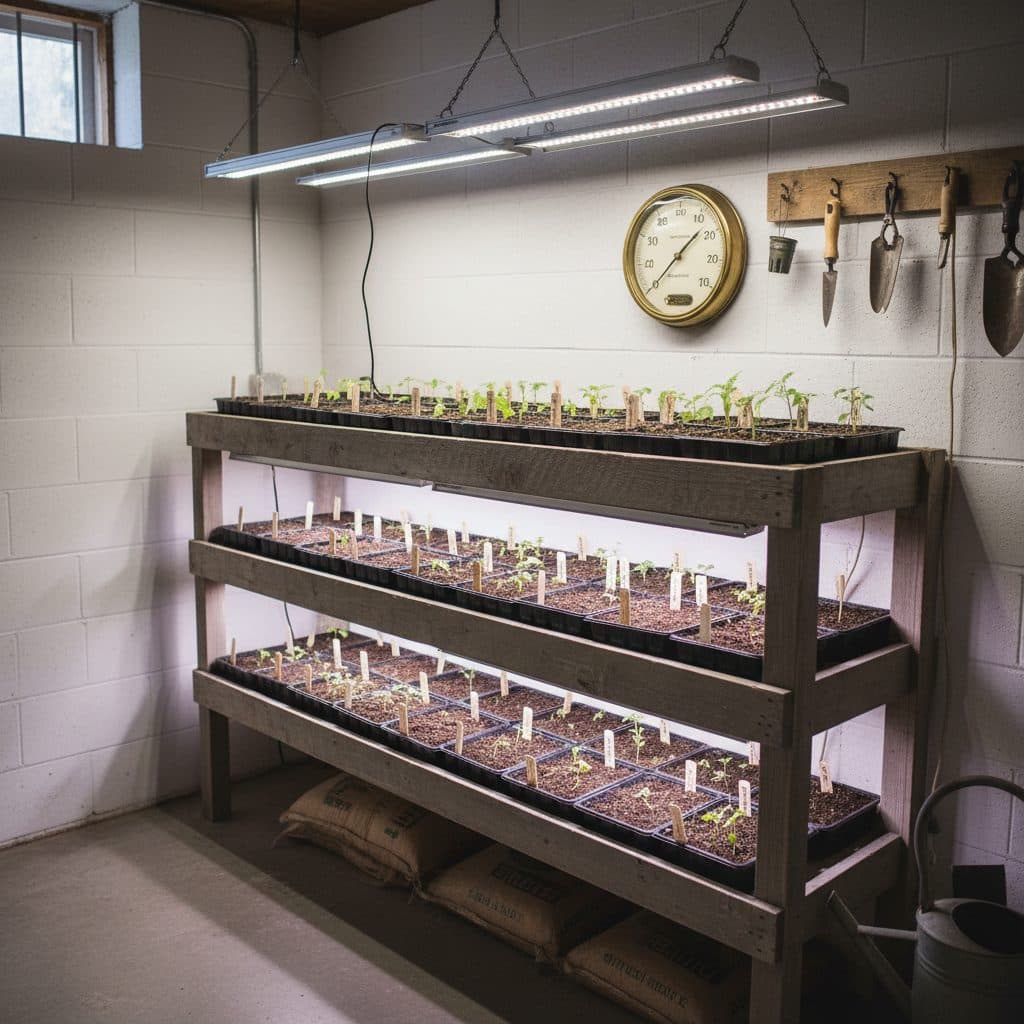
For growers in USDA zones 3-5 across the Northeast and Midwest, the cold basement has historically been useful for early seed starting. A typical cold basement maintains a stable temperature, often ranging from 50°F to 60°F, which is cooler than many living spaces but warmer than outdoor winter air. This consistent, moderate temperature is excellent for germinating cool-season crops and for providing a gradual transition for warm-season seedlings before they face the fluctuating outdoor spring temperatures. The average last frost date in these zones can be as late as mid-May to early June, meaning indoor starts need a longer lead time, often 8 to 12 weeks before transplanting.
optimizing your cold basement environment
To maximize success in a cold basement, several environmental factors need careful management. Adequate lighting is paramount; seedlings require 14 to 16 hours of light daily from grow lights, positioned 2 to 4 inches above the plant tops. Humidity levels between 60% and 70% are ideal to prevent young seedlings from drying out, which can be achieved with a humidifier or by covering trays with clear domes. A well-draining seed starting mix (commonly around two or three parts peat moss or coir to one part perlite) provides the necessary structure and moisture retention for healthy root development. Ensure your planting containers, such as 24-cell seedling propagation trays, are clean to prevent disease spread. For more detailed guidance on basic seed starting, visit seed starting for beginners.
- Use full-spectrum LED grow lights for 14-16 hours daily.
- Maintain basement temperatures between 50°F and 60°F.
- Ensure humidity is consistently 60-70% for optimal growth.
- Select a sterile, well-draining seed starting mix.
- Consider bottom heat for germination using a heat mat if basement temperatures are consistently below 60°F.
seed starting for specific crops in cold regions
When starting seeds in colder zones, selecting the right crops and understanding their specific needs matters. For warm-season crops like tomatoes (6 to 8 weeks) and peppers (10 to 12 weeks), starting them too early can lead to leggy, weak plants if light and space are insufficient. For instance, bell peppers, often requiring 10 to 12 weeks indoors, should be sown in late February or early March in USDA zone 4, targeting a late-May to early-June transplant date once the local last-frost date has passed. Our guide on how to grow peppers provides more specific timing. Cool-season crops, such as kale and broccoli, can be started 6 to 8 weeks before the last frost, making them ideal candidates for a 55°F basement environment. These plants thrive in cooler conditions and can tolerate light frosts after hardening off, often allowing for transplanting in April in zone 5.
timing for cool and warm season varieties
For a successful harvest, consider the specific requirements of each crop. Tomatoes, needing 8 weeks indoors, might be sown around March 15th in a zone 5 garden, aiming for a post-May 15th transplant. Beets, which benefit from a cool start, can be sown indoors 4 to 6 weeks before the last frost for an earlier harvest, or direct-sown later. Our article on how to grow beets details their cool-season timing. Leafy greens like kale, a cold-hardy crop, can be started indoors in mid-March in zone 4, then transplanted in early May once they have been hardened off. Kale leaves become sweeter after a few light frosts, making it an excellent choice for northern climates. For more information on cold-hardy plants, explore how to grow kale.
- Tomatoes: Start 8 weeks before the last frost (e.g., mid-March for zone 5).
- Peppers: Start 10-12 weeks before the last frost (e.g., late February for zone 4).
- Kale: Start 6-8 weeks before the last frost (e.g., mid-March for zone 4).
- Broccoli: Start 6-8 weeks before the last frost (e.g., mid-March for zone 5).
- Beets: Start 4-6 weeks before the last frost (e.g., late March for zone 5).
warm region seed starting in the southeast and southwest (zones 8-10)
In contrast to the cooler regions, growers in USDA zones 8-10 across the Southeast and Southwest face a different set of challenges and opportunities. With average last frost dates often in late February or early March, the indoor seed starting window is significantly shorter, or sometimes even unnecessary for direct-sown crops. For example, in USDA zone 9, the last frost could be as early as February 20th, allowing for outdoor planting much sooner than in northern states. The primary concern here is often managing heat, as indoor temperatures can easily exceed 75°F, and outdoor temperatures can quickly climb above 85°F, stressing young seedlings. Many warm-season vegetables, such as southern peas, can be direct-sown outdoors as early as March or April once soil temperatures consistently reach 65°F; okra wants warmer ground still, closer to 70°F, and rots in cold, wet soil.
managing heat and light in warm climates
When indoor starting is required, such as for long-season peppers or specific tomato varieties, managing ambient heat is critical. Seedlings can become leggy and weak if temperatures are too high and light is insufficient. Providing adequate air circulation with a small fan for 1-2 hours daily helps prevent fungal issues and strengthens stems. If starting seeds indoors, ensure they receive 14 to 16 hours of bright light, either from a south-facing window or supplemental grow lights. For crops that prefer cooler conditions, like some lettuce varieties, consider starting them in a shadier, cooler spot or delaying their planting until late fall for a winter harvest. The USDA Natural Resources Conservation Service provides detailed regional climate data that can inform planting decisions.
- Monitor indoor temperatures, aiming for 70-75°F for most warm-season starts.
- Provide 14-16 hours of bright light from a window or supplemental grow lights.
- Ensure good air circulation to prevent damping-off in humid conditions.
- Consider heat-tolerant varieties for outdoor planting.
- Plan for succession planting to extend harvests in a longer growing season.
environmental controls and tools for all regions
Regardless of your USDA zone, certain tools and environmental controls are universally beneficial for seed starting. A reliable heat mat, for instance, can significantly improve germination rates for many seeds, especially warm-season crops like peppers and tomatoes, by maintaining soil temperatures between 75°F and 85°F. Once seeds sprout, the heat mat can often be removed, as cooler temperatures (60-70°F) are generally preferred for seedling growth to prevent legginess. Good quality grow lights are another non-negotiable tool, providing the 12 to 16 hours of intense light young plants need. Full-spectrum LED lights are energy-efficient and effective, typically costing less than $50 for a basic setup. Proper air circulation, achieved with a small oscillating fan running for 1 to 2 hours daily, helps strengthen seedling stems and reduces the risk of fungal diseases like damping-off.
essential equipment for successful starts
Beyond temperature and light, humidity management is vital. Clear plastic domes over seedling trays can create a miniature greenhouse effect, maintaining high humidity (around 70%) for germination. Once seedlings emerge, domes should be removed to improve air circulation and prevent fungal issues. Investing in quality seedling propagation trays, like the 24-Cell Seedling Propagation Tray with Dome, also contributes to better outcomes by providing consistent cell size and drainage.
- Heat mats: Essential for germinating warm-season seeds at 75-85°F.
- Grow lights: Provide 12-16 hours of full-spectrum light daily.
- Air circulation: Use a small fan to strengthen stems and prevent disease.
- Humidity domes: Maintain high humidity (70%) for germination.
- Quality seed starting mix: A sterile, well-draining blend supports root health.
transplanting and hardening off: regional considerations
The transition from indoor seedling to outdoor plant is a delicate phase, and regional climate plays a significant role in its success. Hardening off, the process of gradually acclimating seedlings to outdoor conditions, is critical in all zones, but its duration and intensity vary. In colder regions (zones 3-5), where the last frost can be in late May or early June, hardening off might span 10 to 14 days, slowly exposing plants to increasing sunlight, wind, and cooler nighttime temperatures (down to 45°F). This slow introduction prevents shock and ensures a stronger plant once permanently transplanted. For example, kale seedlings started indoors in March in zone 4 would be hardened off for two weeks in early May before transplanting around May 15th.
adapting hardening off to your climate
In warmer regions (zones 8-10), the hardening off period might be shorter, perhaps 7 to 10 days, as the transition to outdoor temperatures (often above 60°F at night) is less drastic. However, the intensity of the sun and potential for high daytime temperatures (over 80°F) demand careful attention to shade and watering during this phase. Seedlings in these zones might need protection from direct midday sun for the first few days outdoors. Regardless of region, always check your local 10-day forecast before transplanting to avoid unexpected cold snaps or heat waves. For instance, a sudden dip to 35°F overnight can severely damage tender tomato plants, even after a week of hardening off. Hardened-off seedlings establish far more reliably than plants moved straight from indoors to the garden.
- Gradually expose seedlings to outdoor conditions over 7-14 days.
- Start with 1-2 hours of shade on day one, increasing exposure daily.
- Bring seedlings indoors if temperatures drop below 45°F or exceed 85°F.
- Reduce watering slightly during hardening off to encourage root growth.
- Transplant on a cloudy day or in the late afternoon to minimize shock.
seed starting timing: cold vs. warm regions
factor | northeast/midwest (zones 3-5) | southeast/southwest (zones 8-10) |
|---|---|---|
average last frost | mid-may to early june | late february to early march |
indoor start window | 8-12 weeks before last frost | 4-8 weeks before last frost (or direct sow) |
typical indoor temp | 50-60°F (basement) | 70-75°F (living space) |
hardening off duration | 10-14 days | 7-10 days |
primary challenge | cold springs, short season | early heat, intense sun |
cold region starts: Growers in USDA zone 4 often start peppers indoors 10-12 weeks before their last frost date, which commonly falls in late May or early June.
warm region starts: In USDA zone 9, many heat-loving crops can be direct-sown outdoors by early March, once soil temperatures reach 65°F.
Frequently asked questions
what is the ideal temperature for seed germination?
Most warm-season vegetable seeds germinate best when soil temperatures are consistently between 70°F and 85°F. Using a heat mat can help achieve these temperatures, especially in cooler environments like a 55°F basement. Cool-season crops are different: lettuce and spinach germinate best around 60-70°F and go dormant in warm soil, so keep them off the mat.
how many hours of light do seedlings need daily?
Seedlings require 12 to 16 hours of intense light daily to grow strong and stocky. Insufficient light, especially less than 10 hours, can lead to leggy, weak plants, regardless of your USDA zone.
when should i start seeds indoors in usda zone 5?
In USDA zone 5, with an average last frost date around mid-May, you should typically start warm-season crops like tomatoes 6-8 weeks before this date (mid-March to early April) and peppers 10-12 weeks prior (late February to early March) to ensure they are ready for transplanting.
can i direct sow seeds in usda zone 9?
Yes, many crops can be direct-sown in USDA zone 9 due to its earlier last frost date, often in early March. Heat-loving plants like beans and corn can be planted directly outdoors once soil temperatures consistently reach 65°F, typically by late March or early April; okra prefers warmer soil, closer to 70°F.
what is hardening off and why is it important?
Hardening off is the gradual process of acclimating indoor-grown seedlings to outdoor conditions like wind, direct sun, and fluctuating temperatures. This 7-14 day process strengthens plants, reducing transplant shock.