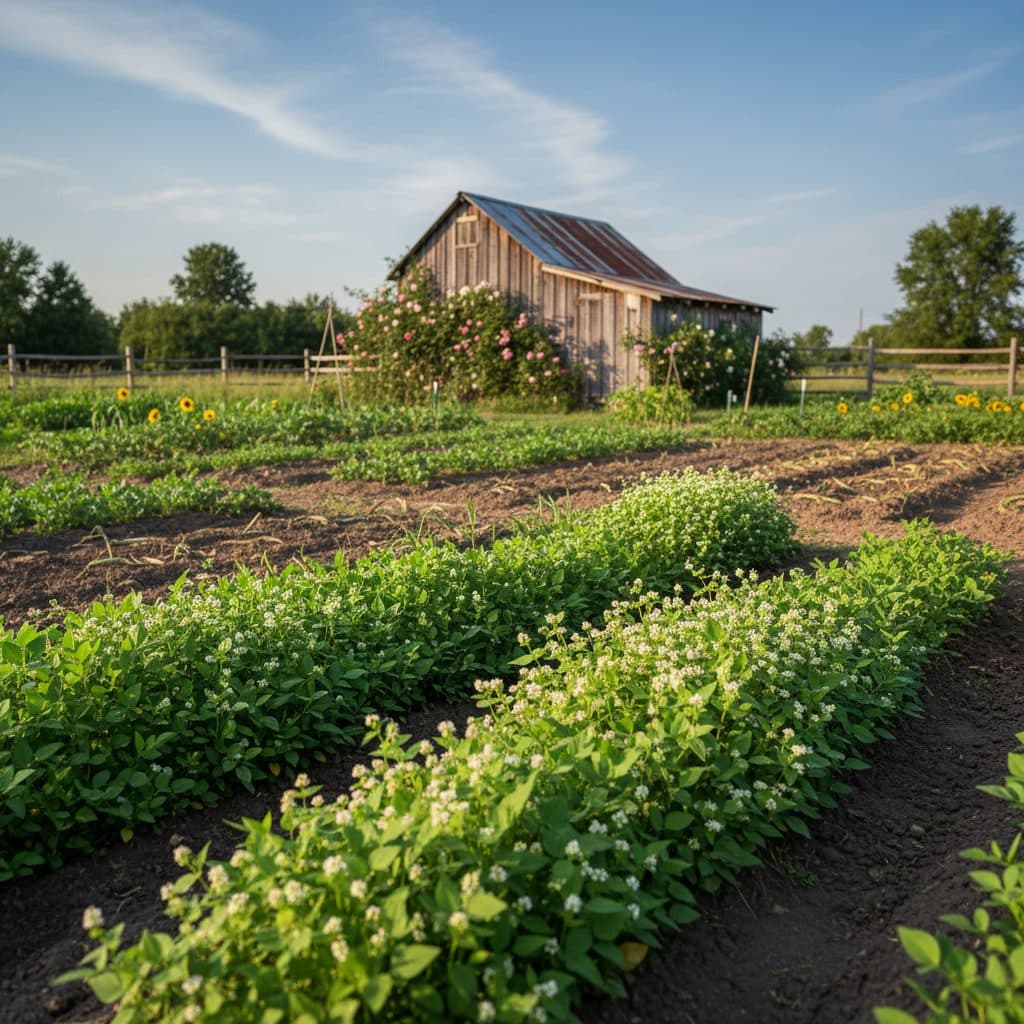
Key takeaways
- Summer cover crops like buckwheat and cowpeas prevent soil erosion and build organic matter during fallow periods.
- Buckwheat is fast: it flowers in about three to six weeks and is normally terminated at 30-45 days as a cover crop, suppressing weeds and cycling phosphorus in the process.
- Cowpeas are excellent nitrogen fixers, contributing 75-100 pounds of nitrogen per acre, and tolerate drought well.
- Proper planning for succession planting in USDA zones 5-9 allows for optimal cover crop benefits between cash crops.
- Timely termination, often 7-10 days after flowering for buckwheat and before full pod maturity for cowpeas, is important to prevent reseeding.
- Integrating these cover crops can reduce nutrient leaching by 30-50% and increase soil infiltration by 20-30%.
Quick answer: Summer cover crops like buckwheat and cowpeas improve soil health by preventing erosion, suppressing weeds, increasing organic matter, fixing nitrogen, and enhancing water infiltration, especially in USDA zones 5-9.
In many parts of the US, from the humid Southeast to the drier Midwest, summer can leave garden beds bare between harvests. For growers in USDA zones 5 through 9, this period of exposed soil can lead to nutrient loss, increased weed pressure, and a decline in soil structure. Leaving soil exposed to the elements for even a few weeks lets heavy rain carry off topsoil and the nutrients held in it.
Instead of bare ground, consider planting summer cover crops like buckwheat and cowpeas. These plants work hard to protect and improve your soil, providing tangible benefits that can increase yields in subsequent cash crops. By implementing these strategies, growers can see a measurable increase in soil organic matter by 0.1-0.2% annually, leading to healthier, more productive gardens.
the role of summer cover crops in succession planting
Succession planting is a cornerstone of productive gardening, allowing continuous harvests from the same plot. However, the gaps between crops present an opportunity to improve soil health rather than letting it lie fallow. Summer cover crops fill these gaps, actively contributing to the soil food web and nutrient cycling. For instance, in a garden in central Iowa, planting a summer cover crop after an early potato harvest can prevent significant soil degradation during July and August heat, reducing erosion by over 90% [1].
benefits for soil and subsequent crops
These temporary plantings offer multiple advantages. They reduce soil erosion by binding soil particles with their root systems, a critical function during summer thunderstorms that can drop 1-2 inches of rain in an hour [2]. Cover crops also suppress weeds by outcompeting them for light and nutrients, potentially reducing weed biomass by 50-90% [3]. Furthermore, they contribute organic matter, which improves soil structure, increases water infiltration by 20-30%, and improves nutrient retention, particularly nitrogen and phosphorus. A growing cover crop takes up nutrients that would otherwise leach below the root zone.
- Erosion control: Reduces soil loss by over 90% during heavy rainfall events.
- Weed suppression: Decreases weed growth by 50-90%, reducing competition for cash crops.
- Organic matter addition: Increases soil organic matter by 0.1-0.2% annually.
- Nutrient cycling: Scavenges leftover nutrients and can fix atmospheric nitrogen.
- Improved water infiltration: Boosts the soil’s ability to absorb water by 20-30%.
buckwheat — the rapid soil builder
Buckwheat (Fagopyrum esculentum) is an excellent choice for growers needing a quick-growing cover crop. It flowers in about three to six weeks and is normally cut down at 30-45 days as a cover crop, making it ideal for short windows between cash crops, such as after an early spring vegetable harvest in USDA zone 7. This plant is not a true grain but a broadleaf annual that produces a dense canopy, effectively shading out weeds within 3-4 weeks of planting [3].
planting and managing buckwheat
Plant buckwheat seeds 0.5-1 inch deep at a rate of 50-60 pounds per acre, or about 2-3 ounces per 100 square feet, when soil temperatures are consistently above 55°F. It thrives in well-drained soils and can even grow in poorer soils, scavenging phosphorus and other nutrients that might otherwise be unavailable to subsequent crops [3]. To prevent reseeding, terminate buckwheat approximately 7-10 days after flowering begins, which is usually 4 to 6 weeks after planting, by mowing, tilling, or crimping. This timing is critical to avoid unwanted volunteers in the next crop cycle.
- Quick growth: Reaches maturity in 70-90 days, providing rapid soil coverage.
- Weed suppression: Forms a dense canopy that outcompetes weeds within 3-4 weeks.
- Nutrient scavenger: Makes phosphorus and other nutrients available for future crops.
- Soil conditioning: Improves soil structure with its fibrous root system.
- Pollinator friendly: Flowers attract beneficial insects for 4-6 weeks.
cowpeas — the nitrogen powerhouse
Cowpeas (Vigna unguiculata) are a warm-season legume, making them an excellent choice for summer cover cropping, especially in hotter climates like the American Southeast (USDA zones 8-10). Known for their ability to fix atmospheric nitrogen, cowpeas can contribute a substantial 75-100 pounds of nitrogen per acre to the soil [4]. This natural fertilization reduces the need for synthetic nitrogen inputs for subsequent crops.
cultivation and nitrogen fixation
Plant cowpea seeds 1-2 inches deep at a rate of 60-90 pounds per acre. They thrive in full sun and are notably drought-tolerant once established, performing well in regions receiving less than 20 inches of annual rainfall [4]. Their deep taproots also help break up compacted soil, improving water penetration and aeration down to 18 inches. To maximize nitrogen contribution, terminate cowpeas before their pods fully mature, typically 60-90 days after planting. This ensures that the nitrogen fixed in the plant biomass is returned to the soil rather than being used for seed production. Consider incorporating cowpeas into your system if you’re looking for living mulch and cover crop legumes by USDA zone.
- Nitrogen fixation: Adds 75-100 pounds of nitrogen per acre to the soil.
- Drought tolerance: Performs well in hot, dry conditions once established.
- Soil compaction relief: Deep taproots break up compacted layers up to 18 inches.
- Biomass production: Produces significant organic matter for soil health.
- Weed suppression: Creates a dense canopy that smothers competing weeds.
planning your summer cover crop strategy
Effective integration of summer cover crops requires thoughtful planning, especially concerning your specific USDA zone and crop rotation. In USDA zone 6, for example, you might plant buckwheat in late May after harvesting early peas, allowing it to grow for 60 days before terminating it in late July to prepare for fall brassicas. This strategy ensures continuous soil coverage and nutrient cycling, reducing the nutrient loss that occurs on bare soil.
timing and rotation considerations
Consider the growth habits of your cash crops and the cover crops. For instance, if you plan to follow a cover crop with a heavy nitrogen feeder like corn, cowpeas are an excellent choice due to their high nitrogen fixation rate of 75-100 pounds per acre [4]. For beds that need a quick turnaround or have phosphorus deficiencies, buckwheat is superior. Always ensure you have enough time for the cover crop to establish and provide its benefits, typically 6-8 weeks, before termination. For more detailed guidance, consult resources like Cover crops for the home garden: best species, timing, and termination.
- Zone-specific timing: Adjust planting and termination dates based on your USDA zone’s frost dates and growing season length.
- Crop rotation: Select cover crops that complement your cash crop rotation, such as legumes before nitrogen-demanding crops.
- Growth window: Ensure a minimum of 6-8 weeks for cover crop establishment and benefit realization.
- Seed availability: Plan ahead for seed purchases, as specific varieties may be seasonal.
- Termination method: Decide on mowing, crimping, or tilling based on your equipment and next crop’s needs.
termination and integration into your garden
The success of a summer cover crop program hinges on timely and effective termination. For buckwheat, the ideal window is 7-10 days after flowering begins — usually about 30 to 45 days after planting, since buckwheat starts flowering roughly three to six weeks from sowing. Watch the plants, not the calendar: viable seed can form within about ten days of first bloom, so waiting much past that is how a cover crop becomes a weed [3]. If allowed to set seed, buckwheat can produce up to 1,000 pounds of seed per acre, creating a significant volunteer problem for future seasons. For cowpeas, termination should occur before the pods fully mature, usually 60-90 days after planting, to ensure the fixed nitrogen is returned to the soil rather than being stored in the seeds [4].
methods for effective termination
Common termination methods include mowing, crimping, or light tillage. Mowing with a flail mower or brush hog is effective for both buckwheat and cowpeas, cutting the plants down to 2-4 inches from the ground. For no-till systems, a roller-crimper can effectively terminate cover crops, leaving a protective mulch layer on the soil surface that can reduce weed germination by 70% [3]. After termination, allow the biomass to decompose for 2-3 weeks before planting your next cash crop. This decomposition period matters for nutrient cycling and for avoiding allelopathic effects that some cover crops can have on young seedlings. This approach feeds the soil food web, raising microbial activity as the residue breaks down.
- Buckwheat timing: Terminate 7-10 days after flowering starts to prevent seed set.
- Cowpea timing: Terminate before pods fully mature, typically 60-90 days post-planting.
- Mowing: Cut plants to 2-4 inches high for effective termination.
- Crimping: Use a roller-crimper for no-till systems, creating a weed-suppressing mulch.
- Decomposition period: Allow 2-3 weeks for biomass breakdown before planting cash crops.
long-term soil health and yield benefits
Implementing summer cover crops like buckwheat and cowpeas is not just a short-term fix; it’s a long-term investment in the health and productivity of your garden. Over several seasons, consistent use of cover crops can significantly increase soil organic matter content, which directly correlates with increased water retention, improved nutrient availability, and greater microbial diversity. Consistent cover cropping raises soil organic matter gradually over years, and the resulting gains in structure, water-holding capacity and nutrient supply tend to show up as better cash-crop performance.
building a resilient garden system
Beyond immediate benefits, these cover crops contribute to a more resilient growing system. Their ability to reduce the need for synthetic fertilizers by fixing nitrogen (75-100 pounds per acre for cowpeas) and scavenging phosphorus (buckwheat) translates into cost savings and a reduced environmental footprint [4]. Furthermore, by improving soil structure and water infiltration, cover crops help mitigate the impacts of both drought and heavy rainfall events, making your garden more resilient in the face of unpredictable weather patterns. This holistic approach builds a healthier soil ecosystem, which is the foundation for sustainable and abundant harvests for years to come. Consider integrating syntropic chop-and-drop species by zone for even greater biomass cycling.
- Yield increase: Long-term use can lead to a 5-10% increase in cash crop yields over five years.
- Fertilizer reduction: Nitrogen fixation by legumes reduces the need for synthetic nitrogen by 75-100 pounds per acre.
- Water management: Improved infiltration and retention help buffer against extreme weather.
- Biodiversity boost: Supports a more diverse and active soil microbial community.
- Pest and disease management: Can interrupt pest cycles and improve plant vigor.
Buckwheat vs. Cowpeas: Summer Cover Crop Comparison
Feature | Buckwheat | Cowpeas |
|---|---|---|
Growth Rate | Fast (70-90 days to maturity) | Moderate (60-90 days to maturity) |
Nitrogen Fixation | None (scavenges P) | High (75-100 lbs/acre) [4] |
Drought Tolerance | Moderate | High (once established) [4] |
Weed Suppression | Excellent (dense canopy) | Good (dense canopy) |
Soil Improvement | Phosphorus availability, light tillage | Nitrogen addition, deep taproot compaction relief |
Planting Depth | 0.5-1 inch [3] | 1-2 inches [4] |
Seeding Rate | 50-60 lbs/acre [3] | 60-90 lbs/acre [4] |
Erosion Prevention: A living cover intercepts raindrop impact and holds soil with its roots, sharply reducing the soil loss that occurs on bare ground during heavy rain.
Nutrient Cycling: A well-nodulated cowpea stand fixes a substantial amount of nitrogen, part of which becomes available to the following crop as the residue breaks down.
Weed Control: Buckwheat’s rapid growth and dense canopy can suppress weed biomass by 50-90% within 3-4 weeks of planting, minimizing competition for cash crops [3].
Frequently asked questions
What are the main benefits of using summer cover crops?
Summer cover crops provide numerous benefits, including reducing soil erosion by 90% or more, suppressing weeds by 50-90%, increasing soil organic matter by 0.1-0.2% annually, and improving water infiltration by 20-30%. They protect bare soil and enhance its fertility for future plantings.
When should I plant buckwheat as a cover crop?
Buckwheat should be planted when soil temperatures are consistently above 55°F, typically from late spring to late summer in USDA zones 5-9. It matures quickly in 70-90 days, making it suitable for short windows between cash crops, such as after an early vegetable harvest in June.
How much nitrogen do cowpeas add to the soil?
Cowpeas are excellent nitrogen fixers, capable of adding a significant 75-100 pounds of nitrogen per acre to the soil. This natural fertilization can reduce the need for synthetic nitrogen fertilizers by 10-20% for subsequent crops, improving soil fertility over 60-90 days of growth.
How do I terminate summer cover crops without tilling?
For no-till systems, cover crops can be terminated by mowing or roller-crimping. Mowing cuts plants to 2-4 inches from the ground, while roller-crimping lays them down to create a protective mulch layer. This mulch can reduce weed germination by up to 70% and conserve soil moisture for 2-3 weeks.
Can summer cover crops help with weed control?
Yes, both buckwheat and cowpeas are effective at suppressing weeds. Buckwheat’s rapid growth and dense canopy can outcompete weeds within 3-4 weeks, reducing weed biomass by 50-90%. Cowpeas also form a thick cover, shading out unwanted plants and reducing weed pressure throughout their 60-90 day growth cycle.
What is the ideal timing for cover crop termination?
The ideal termination timing depends on the species. For buckwheat, terminate 7-10 days after flowering begins (usually about 30 to 45 days after planting) to prevent seed set. For cowpeas, terminate before their pods fully mature, usually 60-90 days after planting, to maximize nitrogen transfer to the soil.
References
- USDA Natural Resources Conservation Service (2024). USDA Natural Resources Conservation Service.
- EPA — Soak Up the Rain (2024). EPA — Soak Up the Rain.
- SARE — Sustainable Agriculture Research & Education (2023). SARE — Sustainable Agriculture Research & Education.
- ATTRA / NCAT Sustainable Agriculture (2023). ATTRA / NCAT Sustainable Agriculture.
- USDA National Agroforestry Center (2023). USDA National Agroforestry Center.