Key takeaways
- Sow low-PA Sunn Hemp ('Tropic Sun' or 'AU Golden') with cowpea EL inoculant (0.7–1.2 lb/1,000 sq ft) for 60–120 lb N/ac and Meloidogyne suppression; cut at early bloom (55–65 days) pre-pod and never graze pods to livestock or poultry.
- Sorghum-Sudangrass builds 3–5 tons/ac dry biomass, shatters pans, and exudes sorgoleone, but poses lethal HCN prussic acid risk under 18–24 inches or drought/frost and requires a 2–3 week post-kill wait before fall seeds.
- 'Iron & Clay' Cowpea pairs 80–150 lb N/ac fixation (with Cowpea-group EL inoculant) and Rk-gene root-knot nematode resistance, though aggressive Meloidogyne enterolobii still demands crop rotation.
- Buckwheat closes canopy in 2–3 weeks and solubilizes soil phosphorus, but sets shattering seed unevenly—mow within 7–10 days of first bloom (<=25–50% flower) inside a 30–40 day cycle.
- Target the 24:1–25:1 C:N microbial sweet spot by mixing legumes (16:1–21:1) with grasses (25:1–45:1+), or convert full-summer fallows with Lablab, Velvetbean, or HCN-free Pearl Millet.
Quick answer: Across Southern US Zones 7–10, sow warm-season green manures once soil reaches 65–70°F (late April through July) to suppress weeds, curb nematodes, and shield humus from intense heat. Top options include Sunn Hemp ('Tropic Sun' or 'AU Golden', 0.7–1.2 lb/1,000 sq ft with cowpea EL inoculant, cut at 55–65 days pre-pod to prevent woody stems and pyrrolizidine alkaloid pod toxicity), Sorghum-Sudangrass (0.7–1.0 lb/1,000 sq ft, mowed at 3–4 ft, grazed only >24 inches without frost or drought stress to avoid HCN poisoning, with a 2–3 week wait for sorgoleone allelopathy), 'Iron & Clay' Cowpea (1.2–2.0 lb/1,000 sq ft with EL inoculant, Rk-gene nematode resistance), Buckwheat (1.2–1.6 lb/1,000 sq ft, cut <=25–50% bloom in 30–40 days), plus Lablab, Velvetbean, and Pearl Millet.
Why Southern Summers Demand Living Green Manures Between Spring and Fall
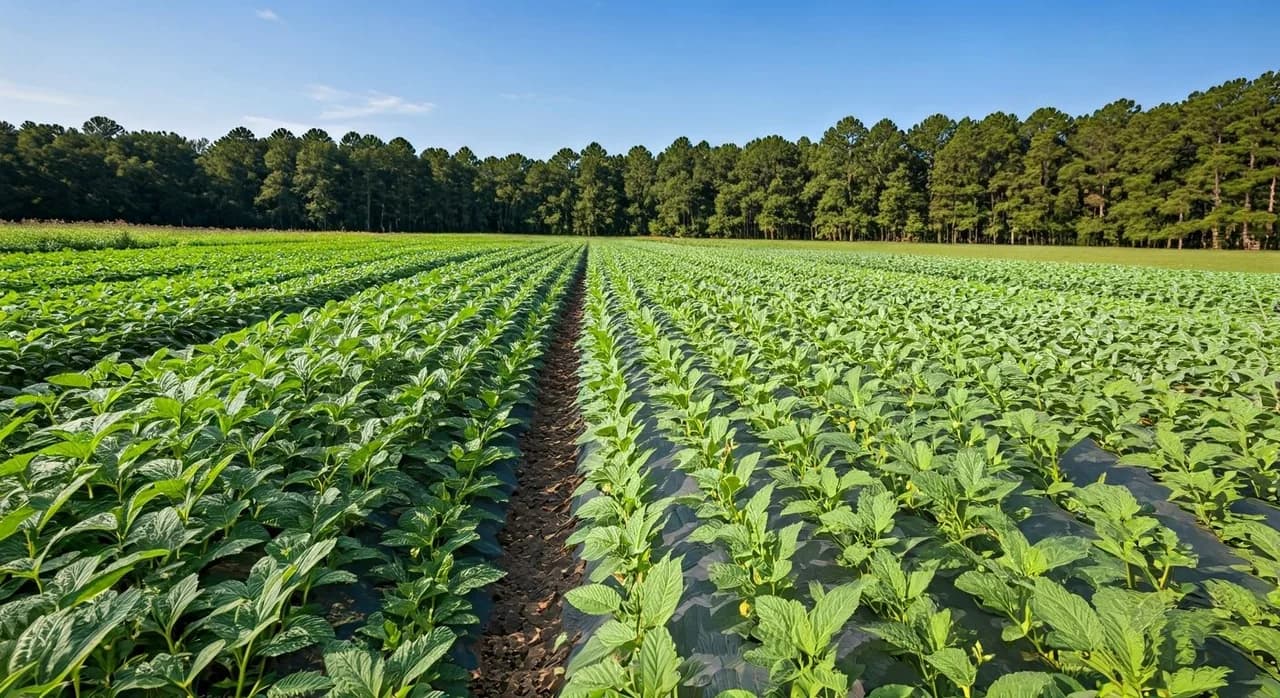
Across USDA Zones 7 through 10—from the Piedmont red clays of Georgia and the Carolinas to Gulf Coast sandy loams and Texas blacklands—bare summer beds lose organic matter faster between June and August than during the entire rest of the year. Soil temperatures under blazing Southern sun climb past 105°F in the top two inches, burning off microbial humus while torrential summer thunderstorms seal bare clay and leach mobile nitrates below root reach.
Leaving beds empty between spring tomatoes and Deep South fall gardening also invites pigweed, nutsedge, crabgrass, and root-knot nematodes to multiply unchecked. Guided by USDA SARE and Southern Cooperative Extension trials across UGA, UF/IFAS, Clemson, Auburn, and Texas A&M, warm-season green manures turn that 45-to-90-day summer heat window into free fertility, weed control, and deep root structure—whether grown in backyard raised beds, Southeast food-forest alleyways, or swale berms.
Top 5 Southern Warm-Season Green Manures (Plus Fallow Field Options)
Wait until soil temperatures settle reliably at 65°F to 70°F—typically late April in the Gulf Coast through May and July across the Mid-South—before sowing. Never skip fresh *Cowpea-group EL Bradyrhizobium inoculant* on Southern legumes: native soil bacteria rarely nodulate tropical species like sunn hemp or lablab densely on first planting, cutting nitrogen fixation in half.
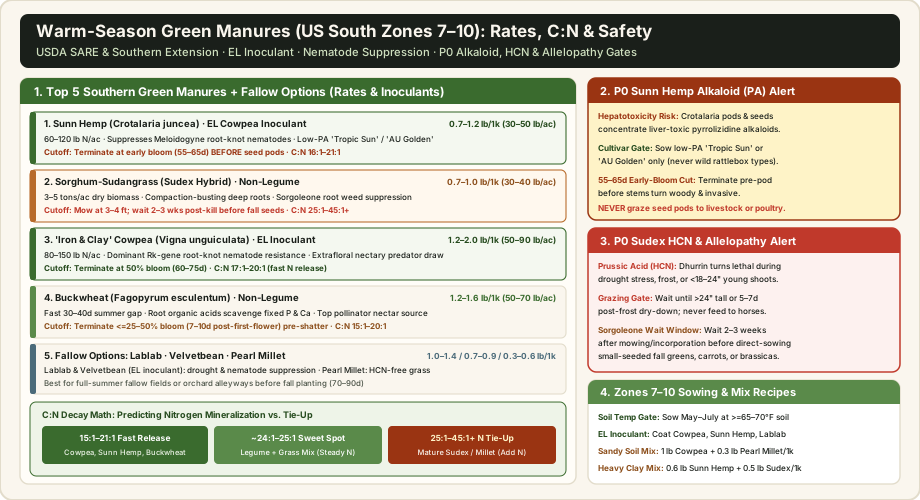
Master Agronomy Matrix: Top 5 Southern Warm-Season Green Manures & Fallow Options
Species & Key Cultivars | Broadcast Rate (lb/1,000 sq ft | lb/ac) | Inoculant Group | Days to Terminate & Cutoff | Biomass, N Credit & Core Function |
|---|---|---|---|---|
1. Sunn Hemp (*Crotalaria juncea*) — 'Tropic Sun', 'AU Golden' | 0.7–1.2 lb/1k sq ft (30–50 lb/ac broadcast; 25–30 lb/ac drilled) | Cowpea-group EL (Bradyrhizobium) | 55–65 days at early bloom, BEFORE seed pods form | 2–5 tons/ac dry biomass; fixes 60–120 lb N/ac; suppresses Meloidogyne root-knot nematodes; 24"+ taproot |
2. Sorghum-Sudangrass (*Sorghum bicolor* × sudanense) | 0.7–1.0 lb/1k sq ft (30–40 lb/ac broadcast; 20–30 lb/ac drilled) | None (non-legume grass) | Mow at 3–4 ft (45–60d) to tiller; wait 2–3 wks post-kill to sow | 3–5 tons/ac dry biomass; aggressive subsoil pan buster; releases sorgoleone to suppress small-seeded weeds |
3. 'Iron & Clay' Cowpea (*Vigna unguiculata*) | 1.2–2.0 lb/1k sq ft (50–90 lb/ac broadcast; 30–50 lb/ac drilled) | Cowpea-group EL (Bradyrhizobium) | 60–75 days at ~50% flower (before dry pods harden) | 1.5–2.5 tons/ac; fixes 80–150 lb N/ac; dominant Rk-gene root-knot nematode resistance; extrafloral nectaries draw wasps |
4. Buckwheat (*Fagopyrum esculentum*) | 1.2–1.6 lb/1k sq ft (50–70 lb/ac broadcast) | None (non-legume forb) | 30–40 days at <=25–50% bloom (7–10d post-first flower) | 1.0–1.5 tons/ac; fastest summer weed canopy; root acids mobilize fixed P and Ca; premier pollinator nectar crop |
5a. Lablab (*Lablab purpureus*) — 'Rongai', 'Rio Verde' | 1.0–1.4 lb/1k sq ft (45–60 lb/ac broadcast; 25–45 lb/ac drilled) | Cowpea-group EL (Bradyrhizobium) | 70–90 days pre-pod; mow/crimp before stems vine over beds | 2.0–3.5 tons/ac; deep drought-hardy vining canopy for long summer fallows; P conservation & livestock forage |
5b. Velvetbean (*Mucuna pruriens*) & Pearl Millet (*Pennisetum glaucum*) | Velvetbean: 0.7–0.9 lb/1k (30–40 lb/ac) | Millet: 0.3–0.6 lb/1k (12–25 lb/ac) | EL (Velvetbean) / None (Millet) | 70–90 days pre-seed (60d mow for millet prior to heading) | Velvetbean smothers tough weeds & nematodes on big fallows; Pearl Millet gives HCN-free fibrous biomass |
1. Sunn Hemp ('Tropic Sun' and 'AU Golden'): High-N Nematode Fighter With a Hard Cutoff
Sunn hemp shoots past 5 to 7 feet in two months across humid Southern clay and sandy soil, fixing 60 to 120 lb N/ac and starving sedentary Meloidogyne root-knot nematodes while breaking subsurface hardpans. Stick strictly to verified agricultural cultivars—University of Hawaii/USDA 'Tropic Sun' or Auburn University's 'AU Golden' (or 'AU Durbin')—and avoid unverified wild Crotalaria relatives, which carry substantially higher toxin loads and invasive seed potential.
P0 Pyrrolizidine Alkaloid (PA) Hepatotoxicity & Woody-Stem Cutoff: Plants in the Crotalaria genus produce hepatotoxic pyrrolizidine alkaloids (including trichodesmine and junceine) that concentrate heavily inside maturing flowers, pods, and seeds. Even with low-PA cultivars like 'Tropic Sun' and 'AU Golden', NEVER allow livestock, horses, pigs, or backyard poultry to graze ripening sunn hemp seed pods. Terminate cleanly at early bloom (55–65 days after sowing)—before pods set—so fibrous stalks stay soft enough for a string trimmer or mower to chop cleanly instead of turning into woody poles or self-seeding weeds.
2. Sorghum-Sudangrass: Biomass Engine With Two Non-Negotiable Safety Gates
Nothing builds soil carbon faster during a blazing Southern summer than sorghum-sudangrass hybrids, cranking out 3 to 5 tons/acre of dry root and shoot biomass in 60 days while driving dense roots through tight clay pans. To keep stalks manageable for garden equipment and force thick subterranean root proliferation, mow or string-trim the stand to a 6–8 inch stubble whenever shoots hit 3 to 4 feet tall—each cut triggers aggressive tillering underground.
P0 Prussic Acid (HCN) Livestock Poisoning & Sorgoleone Allelopathy Alert: Sorghum-sudangrass contains dhurrin, a cyanogenic glucoside that breaks down into lethal hydrogen cyanide (HCN / prussic acid) when cells rupture. NEVER graze goats, sheep, or cattle on stunted stands under 18–24 inches tall, during severe drought stress, or immediately after a frost (wait 5–7 days after a killing frost until tissue dries completely, and never feed any sorghum-family grass to horses due to spinal/urinary cystitis risk). Second, sorghum roots exude sorgoleone, a potent natural herbicide: wait 2 to 3 weeks (plus a soaking rain or irrigation flush) after mowing or tilling residue before direct-sowing small-seeded fall lettuce, carrots, spinach, or brassicas.
3. 'Iron & Clay' Cowpea: Rk-Gene Root-Knot Nematode Resistance
Do not swap grocery-store black-eyed peas for true cover-crop 'Iron & Clay' cowpea on nematode-infested Southern beds. Bred from historic resistant lines, 'Iron & Clay' carries the dominant nuclear **Rk gene* that suppresses population buildup of major root-knot nematodes (Meloidogyne incognita, M. javanica, and M. hapla), fixes 80 to 150 lb N/ac when coated with fresh EL inoculant, and exudes sweet nectar from stem extrafloral nectaries that pull in predatory wasps and lady beetles ahead of fall crops. Keep one UF/IFAS caveat in mind: aggressive local M. incognita races or invasive guava root-knot nematode (M. enterolobii) can overcome single-gene Rk* resistance, so rotate cowpeas with sunn hemp or sorghum-sudangrass rather than relying on one legume every summer.
4. Buckwheat: The 30–40 Day Phosphorus Scavenger & Pollinator Magnet
When you only have five to six weeks between early sweet corn or snap beans and fall brassicas, buckwheat reaches flower in 30 to 40 days, shades weeds within 14 days, and secretes mild organic acids from fine fibrous roots that solubilize tightly bound rock phosphate and calcium—adding bioavailable phosphorus as reviewed in our natural soil phosphorus guide. Because lower flower clusters drop viable seed while top buds keep opening, Purdue and SARE guidelines warn growers to terminate at <=25% to 50% bloom (7–10 days after first flowers open) before seed shattering creates volunteer weeds.
5. Lablab, Velvetbean & Pearl Millet for Full-Summer Fallows
When taking an entire garden block, new orchard row, or rural acreage out of summer production for 75 to 90 days, consider three Southern fallow specialists. Lablab (Lablab purpureus, inoculated with cowpea EL Bradyrhizobium) shrugs off late-summer dry spells better than cowpeas while scavenging phosphorus. Velvetbean (Mucuna pruriens, large seed planted 1–1.5 inches deep with EL inoculant) forms a thick vining blanket that outcompetes crabgrass and suppresses nematodes on larger plots, though itchy pod hairs make termination strictly pre-pod. Where backyard goats or poultry share homestead margins, swap sorghum-sudangrass for Pearl Millet (Pennisetum glaucum): it delivers comparable heat-loving fibrous biomass with zero prussic acid (HCN) toxicity.
C:N Decay Math: Timing Fall Crops Without Nitrogen Immobilization
Many Southern gardeners terminate a towering stand of July sorghum-sudangrass in late August, transplant fall broccoli a week later, and wonder why leaves turn pale yellow despite inches of organic mulch. The culprit is predictable microbial carbon-to-nitrogen (C:N) math.
Soil microbes require a balanced diet near 24:1 to 25:1 carbon to nitrogen to digest plant tissue. When green manure residue falls below 20:1 (young buckwheat, cowpea, and vegetative sunn hemp), microbes feast on excess nitrogen and rapidly mineralize plant-available nitrate into the root zone within 10 to 14 days. Once mature grass stalks climb past 30:1 to 45:1+, bacteria strip soluble soil nitrate straight away from fall seedlings—a temporary tie-up called immobilization.
C:N Decay Math, Microbial Immobilization Risk & Follow-Crop Wait Windows
Green Manure Residue at Termination | Typical C:N Ratio | Microbial Impact on Soil Nitrogen | Wait Window Before Fall Sowing / Planting |
|---|---|---|---|
Buckwheat (cut at <=25–50% bloom) | 15:1 – 20:1 | Rapid mineralization; cycles P, Ca, and mild N in 1–2 weeks | 5–10 days (faster if chopped and surface-mulched) |
'Iron & Clay' Cowpea (cut at 50% bloom) | 17:1 – 20:1 | Fast mineralization; releases 50%+ of fixed N over first 4–6 weeks | 7–14 days for transplants; 10–14 days for direct seeds |
Sunn Hemp (cut early bloom 55–65d, pre-pod) | 16:1 – 21:1 | Fast leaf release; fine stems decay cleanly without tie-up if cut <=65d | 10–14 days (delay to 21d if stems grew woody past 75d) |
Legume + Grass Mix (Cowpea/Sunn Hemp + Millet/Sudex) | ~23:1 – 26:1 | Balanced ~24:1–25:1 microbial sweet spot; steady N release + persistent mulch | 14 days post-termination (21 days if Sudex component is high) |
Sorghum-Sudangrass (mowed young at 3–4 ft vs. headed) | 25:1 (vegetative) – 45:1+ (headed) | Mild to severe N immobilization if tilled in mature; leaves high-C mulch | 2–3 weeks mandatory wait for sorgoleone flush; side-dress fall brassicas with N |
To verify local N release curves, UGA CAES Extension Bulletin 1466 recommends mixing legumes and grasses whenever your schedule allows. Combining 0.6 lb sunn hemp + 0.4 lb sorghum-sudangrass (or 1.0 lb 'Iron & Clay' cowpea + 0.3 lb pearl millet) per 1,000 sq ft locks your bed right onto the 24:1–25:1 sweet spot—avoiding both rapid nitrate leaching from pure legumes under heavy summer rain and nitrogen starvation behind tall grasses.
Southern Mix Recipes, Permaculture Alleyways & No-Till Termination
In Southern permaculture plant guilds and young orchards—such as pecan groves, fig rows, or contour swale systems—warm-season green manures act as living summer solar panels that cool tree roots and suppress aggressive Bermuda or Johnson grass along alleyways. Pick the mix that matches your soil texture and summer window below.
Ready-to-Sow Southern Warm-Season Mixes (Scaled per 1,000 sq ft & Acre)
Site Goal & Soil Profile | Mix Formula (per 1,000 sq ft) | Acreage Equivalent | Key Management & Rotation Notes |
|---|---|---|---|
Sandy Coastal Plain Nematode & Heat Builder | 1.0 lb 'Iron & Clay' Cowpea (EL) + 0.3 lb Pearl Millet + 0.3 lb Buckwheat | 44 lb Cowpea + 13 lb Millet + 13 lb Buckwheat/ac | HCN-safe around backyard livestock; buckwheat shades weeds week 2 while cowpeas climb millet |
Heavy Piedmont Clay Compaction & Biomass Smasher | 0.6 lb Sunn Hemp (EL) + 0.5 lb Sorghum-Sudangrass | 26 lb Sunn Hemp + 22 lb Sudex/ac | Mow once at 3–4 ft (Sudex) or terminate together at 55–60d; wait 2–3 wks before fall greens |
Fast 35-Day Pollinator & Phosphorus Gap Crop | 1.3 lb Buckwheat + 0.5 lb 'Iron & Clay' Cowpea (EL) (or Buckwheat sole) | 55 lb Buckwheat + 22 lb Cowpea/ac | Cut buckwheat at <=25–50% bloom (35d) for summer insectary boost between spring corn and fall greens |
Weekend planting and chop-and-drop termination workflow
- Time planting cleanly: Sow 'Iron & Clay' cowpeas in early May once soil hits 65°F, slot buckwheat into a fast June succession gap, or drill sunn hemp + sorghum-sudangrass from late May through mid-July ahead of fall crops.
- Inoculate legumes right before sowing: Dampen cowpea, sunn hemp, lablab, or velvetbean seed lightly with non-chlorinated water (or a pinch of sugar sticker) in a bucket, stir in fresh EL inoculant until evenly coated black, and rake into moist soil out of direct midday UV light—sunlight kills Bradyrhizobium on exposed seed within hours.
- Terminate without churning soil: On small beds, mow or cut stems cleanly at the crown with a string trimmer, hedge shears, or scythe at the target cutoff stage (30–40d buckwheat, 55–65d sunn hemp, 3–4 ft sudex), then rake stalks flat or crimp with a step-board and pin under an opaque silage tarp for 10–14 days if regrowth threatens—following our no-till cover crop termination guide and occultation method.
- Wait out allelopathy and transition cleanly: Leave chopped residue on top as cooling summer mulch—pair with living mulch cooling tactics or summer moisture conservation—and respect the 2–3 week flush window after sorghum-sudangrass before direct-seeding carrots, lettuce, spinach, or fall brassicas. Explore sandy-soil cover crops, Southeast clay groundcovers, Southern soil health mixes, and compacted soil broadforking for year-round rotation.