Key takeaways
- Understand your specific USDA hardiness zone and average frost dates to plan planting schedules effectively.
- Implement succession planting by sowing small batches of crops every 2-3 weeks for continuous harvests.
- Practice a 3- to 4-year crop rotation to maintain soil fertility and reduce pest and disease pressure.
- Utilize season extension techniques like cold frames or row covers to protect plants from early and late frosts.
- Choose appropriate plant varieties that are cold-hardy or have short maturity periods for extended growing.
- Regularly amend your soil with compost and organic matter to support vigorous growth throughout the season.
Quick answer: To extend your garden’s harvest in USDA Zone 6, implement succession planting, practice 3-4 year crop rotation, utilize season extension techniques, and understand your specific frost dates and microclimates.
In the Mid-Atlantic region, a well-managed 100 square foot garden can keep a household in fresh vegetables for much of the year, far outproducing the same plot planted once in spring and left alone. Many home growers in areas like Pennsylvania or Ohio face a relatively short growing season, often just 150 to 180 days between the last spring frost and the first hard frost of autumn. This limited window means that without strategic planning, much of a garden’s potential goes unrealized, leaving gardeners without fresh produce for a significant portion of the year.
However, by applying principles of crop rotation, succession planting, and a detailed USDA-zone planting calendar, even a small plot can provide harvests from early spring into deep winter. These methods, refined over generations, allow growers to maximize every square foot of their garden space and provide a steady supply of vegetables for the kitchen. The goal is to grow food consistently and abundantly, making the most of every growing day available in your specific climate.
understanding your growing season and microclimates
Before you can plan for a continuous harvest, you must first understand the specific conditions of your garden plot. The USDA Plant Hardiness Zone Map provides a general guide, with zones like 6a or 7b indicating average minimum winter temperatures. For example, a gardener in USDA zone 6 typically experiences average minimum winter temperatures between -10°F and 0°F, which dictates perennial plant survival. However, relying solely on this map is insufficient for annual vegetable planning; you need to know your average last spring frost date and first fall frost date, which can vary by as much as 14 days even within the same zone. For instance, central Iowa (USDA zone 5b) might see its last frost around May 10, while a coastal area in Washington (USDA zone 8b) could be frost-free by April 1.
identifying your frost windows
Local extension offices often provide precise frost data, sometimes with records spanning 30 years or more. These dates matter most for deciding when to safely plant tender crops like tomatoes or peppers, and when to start preparing for frost-hardy crops in the fall. Furthermore, consider your garden’s microclimates. A south-facing wall can create a localized warm pocket, extending the growing season by several weeks, while a low-lying area might be prone to earlier frosts. Observing these subtle differences in your own yard can inform planting decisions, allowing you to plant heat-loving crops in warmer spots and cold-tolerant greens in more exposed areas. Understanding these nuances helps you select the best perennial edible greens for your specific microclimate, as some varieties thrive with a bit of extra protection. For example, a small sheltered area might allow you to grow spinach or lettuce an extra 15-20 days.
- average last spring frost date
- average first fall frost date
- sun exposure patterns throughout the day
- wind protection from structures or fences
- proximity to heat-absorbing surfaces like stone or concrete
the power of succession planting
Succession planting is a strategy to ensure a continuous harvest by staggering plantings of the same crop, or by following one crop with another in the same space. Instead of planting all your lettuce seeds at once in April, you might plant a small row every two to three weeks. This prevents a glut of produce followed by a long period with nothing. For example, in a 4 ft by 8 ft raised bed, you could plant 10 feet of radishes in early April, another 10 feet in late April, and a final 10 feet in mid-May. This ensures a steady supply rather than a single large harvest that quickly bolts in warmer weather. This method is particularly effective for crops with short maturity periods, often less than 60 days.
planning your staggered plantings
To implement succession planting effectively, track the days to maturity for each variety you plant. For example, many radish varieties mature in 25-30 days, while bush beans might take 50-60 days. When one crop is nearing its end, prepare the soil for the next planting. This means having seedlings ready to go, or direct-sowing seeds immediately after the previous crop is harvested. A well-planned succession can allow you to get two or even three harvests from the same plot of ground in a single growing season. For instance, a 20-foot row of spinach harvested in late spring could be followed by bush beans, and then by a fall planting of kale, yielding significantly more food from the same 80 square feet of garden space. Consider companion planting strategies to further optimize space and plant health, so that successive crops benefit from previous plantings.
- plant small batches of quick-maturing crops every 2-3 weeks
- follow early spring crops with warm-season vegetables
- use empty spaces for fall plantings of cool-season greens
- interplant fast-growing crops between slower-growing ones
- select varieties with varying days to maturity for continuous harvest
strategic crop rotation for soil health and pest control
Crop rotation is a fundamental practice for maintaining long-term soil fertility and minimizing pest and disease problems. Planting the same crop in the same spot year after year can deplete specific nutrients from the soil and encourage the buildup of crop-specific pests and pathogens. For instance, tomatoes (a solanaceae) planted repeatedly in the same bed can lead to an increase in early blight spores in the soil. A typical rotation plan involves dividing your garden into three or four sections and rotating plant families through them over a 3- to 4-year cycle.
designing your rotation plan
Consider grouping plants by family: legumes (beans, peas), brassicas (cabbage, broccoli), solanaceae (tomatoes, peppers), and root crops (carrots, beets). Legumes, for example, fix atmospheric nitrogen into the soil, enriching it for subsequent crops. A legume cut and turned in before it sets pods returns nitrogen to the bed; a bush bean crop you harvest exports most of what it fixed in the pods, so plan on little carryover. After a nitrogen-fixing crop, you might plant a heavy feeder like corn or cabbage. The USDA Natural Resources Conservation Service emphasizes the importance of diverse cropping systems for soil health and reduced erosion [5]. For small gardens, a simple three-bed rotation can be highly effective, moving crops like leafy greens, root vegetables, and legumes through the beds each year. Explore how common beans can contribute to soil health in your specific zone. Even a 4 ft by 10 ft bed can benefit significantly from a rotation that prevents nutrient depletion and pest cycles.
- rotate plant families (e.g., legumes, brassicas, solanaceae, root crops)
- avoid planting the same crop in the same spot for at least 3 years
- follow heavy feeders with nitrogen-fixers or light feeders
- incorporate cover crops like clover or vetch during off-seasons
- map out your rotation plan on paper for easy tracking
extending the harvest into the colder months
This builds directly on strategic crop rotation.
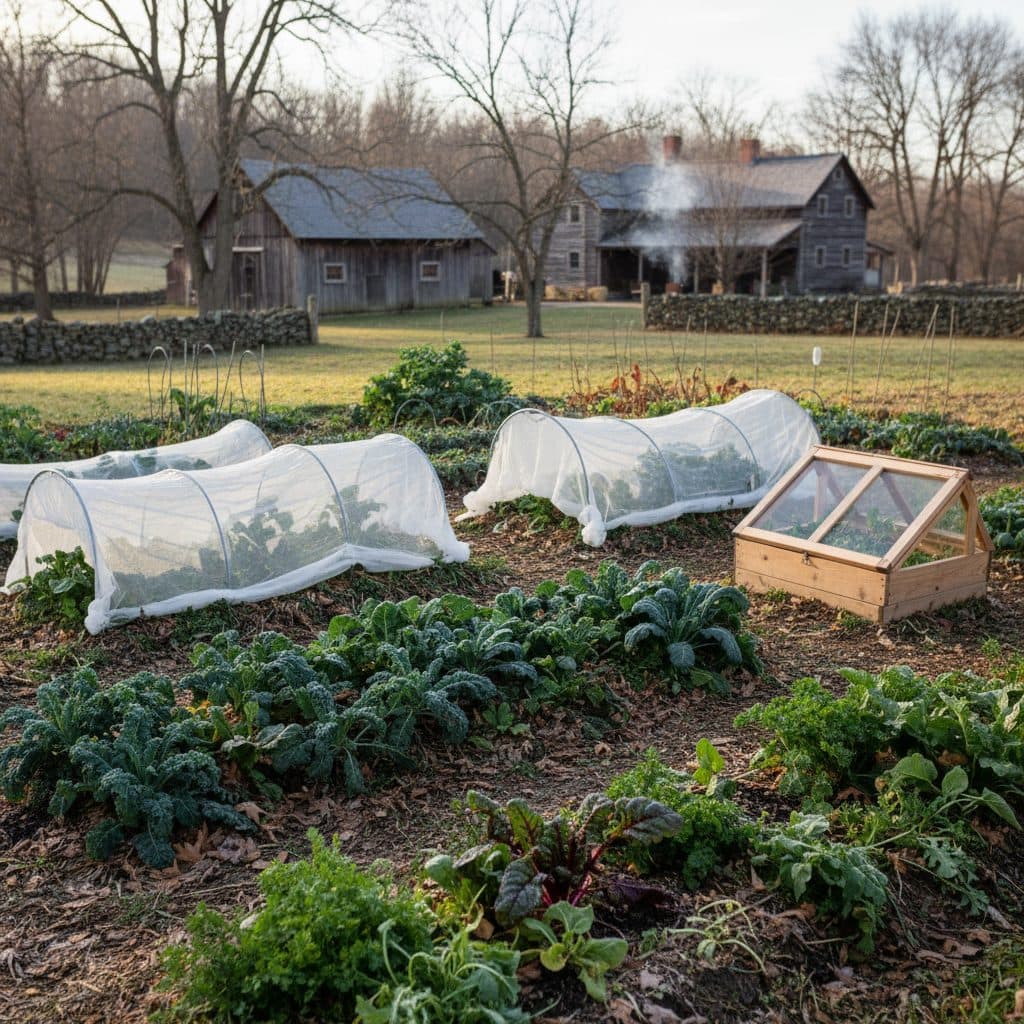
When the first fall frosts threaten, your gardening season doesn’t have to end. Various season extension techniques can add weeks, or even months, to your harvest period. Simple solutions like row covers can carry plants through a light frost — lightweight fabric buys roughly 2-4°F and heavyweight fabric roughly 6-8°F, so match the weight to the night you are protecting against. For example, a lightweight row cover placed over a bed of fall spinach in USDA zone 5 can extend its harvest by 3-4 weeks past the first light frost. More robust structures, such as cold frames or hoop houses, can offer even greater protection, allowing you to grow cool-season crops like lettuce, kale, and even some root vegetables through much of the winter in many temperate zones.
utilizing cold frames and row covers
Cold frames are essentially bottomless boxes with clear tops that capture solar energy, warming the soil and air inside. A 3 ft by 6 ft cold frame can easily house enough greens for a small family throughout the winter in zones 6-7. For areas with colder winters, like USDA zone 4, a double-layered hoop house might be necessary to keep temperatures above freezing. Planting times for these extended harvests are critical: sow fall crops like spinach, arugula, or mache in late summer (e.g., August 15 in zone 6) to allow them to establish before the days shorten and temperatures consistently drop below 50°F. These plants will then grow slowly through the colder months, ready for harvest even when there’s snow on the ground. Consider using biomass species for chop-and-drop in your cold frames to add organic matter and insulate the soil. Even a simple plastic sheet draped over hoops can provide 5°F of protection, making a significant difference for tender greens.
- install row covers or cloches for early and late season frost protection
- build or purchase a cold frame for overwintering greens
- select cold-hardy varieties of vegetables like kale, spinach, and collards
- plant fall crops in late summer to ensure establishment before cold weather
- use mulches like straw or leaves to insulate soil and roots
Season Extension Techniques Comparison
Technique | Cost (Approx.) | Frost Protection (°F) | Ease of Use | Typical Use |
|---|---|---|---|---|
Row Covers (lightweight) | $10-$30 per 100 sq ft | 5-10 | Easy | Extending spring/fall by 2-4 weeks |
Cold Frame | $50-$200 per unit | 10-20 | Moderate | Overwintering greens, starting seedlings early |
Low Tunnel (Hoop House) | $50-$150 per 20 ft section | 10-20 | Moderate | Growing cool-season crops through winter |
Cloche (Bell Jar) | $5-$20 per unit | 5-10 | Easy | Protecting individual plants from early/late frost |
High Yields: A small 100 square foot garden can produce over 30 pounds of vegetables annually with proper planning and management [4].
Nitrogen Fixation: A legume cover crop cut and turned in before it sets pods returns nitrogen to the bed. A bean or pea crop you actually harvest exports most of the nitrogen it fixed in the pods, so plan on little carryover to the next crop.
Explore season extension tools
Frequently asked questions
What is the best way to start succession planting in a small garden?
Start by selecting 2-3 fast-maturing crops like radishes, lettuce, or bush beans. Plant a small section (e.g., 5-10 feet) every 2-3 weeks. This ensures a continuous harvest rather than a single large one, maximizing the yield from a small 4 ft by 8 ft bed.
How many years should I rotate my crops?
A 3- to 4-year rotation cycle is generally recommended for most home gardens. This duration helps break pest and disease cycles and allows the soil to recover specific nutrients.
Can I really grow vegetables through winter in a cold climate like USDA zone 5?
Yes, with proper season extension. In USDA zone 5, a well-built cold frame or low tunnel can protect cold-hardy crops like spinach, kale, and mache, allowing harvests even when outside temperatures drop below 20°F. Planting these crops in late August is key for establishment.
What are some easy vegetables for fall and winter harvest?
Easy-to-grow, cold-hardy vegetables for fall and winter include spinach, kale, collard greens, arugula, and certain varieties of lettuce. Many of these can tolerate temperatures down to 25°F with minimal protection, providing fresh greens for 2-3 months longer than unprotected crops.
How does understanding my USDA zone help with year-round gardening?
Your USDA zone provides a baseline for average minimum winter temperatures, which influences which perennial crops can survive and helps determine the general timing for annual planting. For example, knowing you are in USDA zone 6 tells you which perennials will survive the winter, but it does not tell you your frost dates — those vary widely within a single zone, so use your local extension office's records rather than a zone-wide date.
What is the role of soil health in continuous garden production?
Healthy soil, rich in organic matter, matters most for continuous production. It retains moisture, provides essential nutrients, and supports beneficial microbial life. Regular additions of compost and practicing crop rotation are vital for sustained high yields.
References
- How to keep a window garden (1885). How to keep a window garden.
- Part One All About the Garden (2009). Part One All About the Garden.
- The Land where Spring Meets Autumn (1924). The Land where Spring Meets Autumn.
- High Productivity from Small Spaces: Some Special Techniques (2009). High Productivity from Small Spaces: Some Special Techniques.
- USDA Natural Resources Conservation Service (2024). USDA Natural Resources Conservation Service.