Key takeaways
- Distance and porosity dictate foliar survival: heavy ocean salt spray dominates 0–660 ft (1/8 mile) inland, while a 40–50% porous living barrier of height H cuts drift sharply for 5H and shelters beds up to 10H downwind.
- Read lab salinity in dS/m accurately: USDA saturated-paste ECe sets <2 dS/m (<1,280 ppm) as non-saline, 2–4 dS/m slightly saline, 4–8 dS/m moderately saline, and >8 dS/m strongly saline—whereas 1:2 lab extracts read 2.5–3× lower.
- Coarse beach sand holds 0.5–0.8 inches of available water per foot (not 0.1 in/ft): work 2–3 inches of finished compost into the top 6–8 inches and mulch 3–4 inches deep to curb capillary salt wicking.
- Freshwater leaching beats unnecessary additives: 6 inches of clean water flushes ~50% of soluble salts from the top foot of drained sand (12 inches flushes ~80%), whereas gypsum (20–40 lb/1,000 sq ft) works only on sodic clay (SAR > 13).
- Plant across USDA Zones 4–11 rather than relying on warm-coast picks alone: pair northern Beach Plum and Sea Buckthorn (Zones 3–7) or Pacific Shore Pine with southern Live Oak, Yaupon Holly, Sea Oats (protected), and Sea Grape.
Quick answer: To keep a US coastal garden thriving across USDA Zones 4–11, match plantings to both windborne salt-spray exposure and root-zone soil electrical conductivity (ECe). Reserve tough halophytes for the exposed 0–660 ft (1/8-mile) coastal belt and soils exceeding 4–8+ dS/m, install a 40–50% porous windbreak of height H to shelter beds 5H to 10H downwind, and flush storm-surge salts with 6–12 inches of fresh water across drained sand.
How Salt Spray and Soil Salinity Actually Stress Coastal Plants
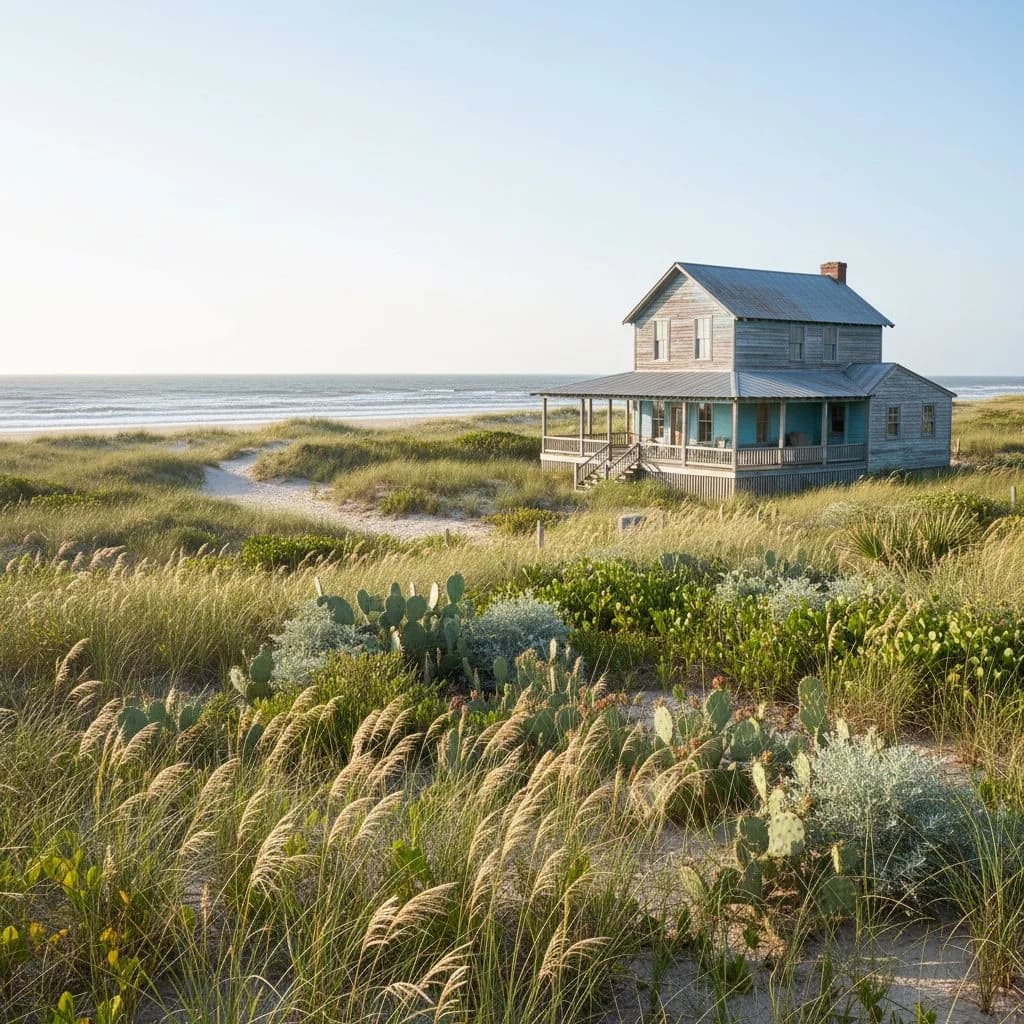
Coastal gardens from Maine and the Oregon headlands down to the Outer Banks, Gulf beaches, and Florida Keys face two distinct salt pathways—and species tolerant of one often perish from the other. Knowing whether a site endures aerial salt spray, saline soil, or both steers every decision across USDA Zones 4 through 11.
Breaking surf propels microscopic brine inland on onshore gusts. UF/IFAS Extension places acute salt-spray stress within one-eighth of a mile (660 ft) of saltwater, though nor'easters and hurricanes push aerosol burn one to two miles inland. Evaporating droplets coat leaves and buds in sodium (`Na+`) and chloride (`Cl-`), dehydrating cells and causing margin scorch and stunted "witches-broom" shoots. Virginia Cooperative Extension notes evergreens show burn fast after storms, while deciduous trees reveal damaged buds at spring leaf-out.
Underground, soil salinity spikes after storm surges, king tides, brackish well irrigation exceeding 0.75 dS/m (`Rutgers FS848`), or shallow saline water tables. Dissolved ions reverse root osmosis so plants wilt in wet ground. Coarse coastal sand holds roughly 0.5–0.8 inches of available water per foot (vs. 1.8–2.4 in/ft in silt loam), leaching nutrients fast while allowing salty groundwater to wick upward in bare sand. Snowy Atlantic and Great Lakes coasts also receive 24 million tons of roadway de-icing salts annually splashed `30–60 feet` off pavement, covered in our roadside salt-tolerant plants guide.
Engineering Wind and Salt-Spray Barrier Zones (The 10H Rule)
By shaping airflow with staggered living windbreaks, coastal gardens support flowering perennials, herbs, and kitchen crops behind tough oceanfront armor.
Porous screens beat solid walls every time
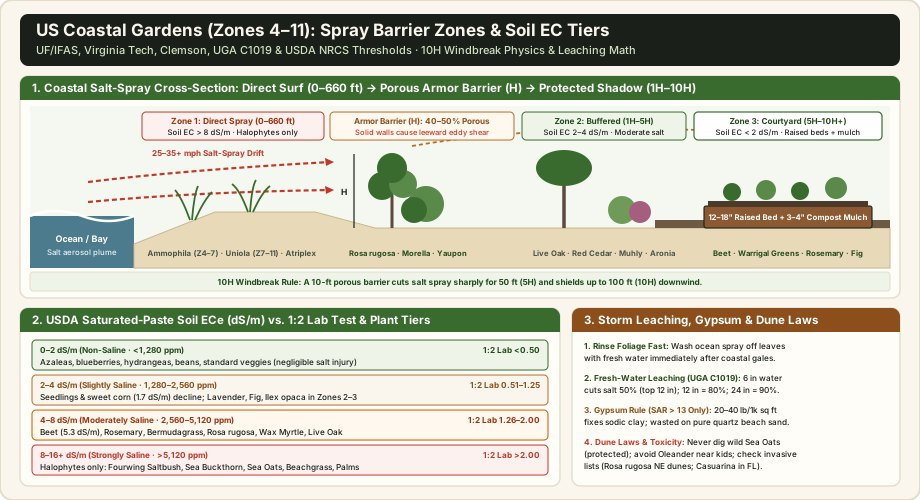
Solid masonry walls or tight board fences force onshore gales upward, generating destructive leeward eddies that slam salt spray onto beds just behind the wall. Instead, install 40–50% porous barriers—slatted fencing, temporary woven wind-cloth, or dense multi-row coastal hedges—that filter salt droplets out of the air while slowing wind velocity smoothly.
Barrier spacing follows the 10H rule: a porous hedge of height H drops wind speed and salt drift steeply across 1H to 5H downwind, with shelter extending to 10H. A 10-foot hedge of Bayberry, Yaupon Holly, or Wax Myrtle protects a 50-foot buffer bed strongly and calms a 100-foot courtyard. Coordinate layout with our coastal windbreak guide and shelterbelt spacing manual.
- Zone 1 — Fore-Dune / Direct Exposure (0–660 ft oceanfront, windward of barriers): Faces constant salt spray, 25–35+ mph gusts, and shifting sand. Plant only halophytes, dune grasses, and thick-cuticle natives.
- Zone 2 — Transition Buffer (1H–5H behind armor shrubs or dunes): Spray loads drop sharply, letting moderately tolerant shade trees, hollies, and grasses establish with year-one freshwater.
- Zone 3 — Sheltered Courtyard (5H–10H downwind or behind structures): Shielded from direct drift; with clean rainwater or municipal irrigation and raised beds, herbs, figs, and tolerant vegetables thrive.
Soil Salinity EC (dS/m) Thresholds and Post-Storm Recovery
Collect an 8-to-10-core composite soil sample (`0–6 inches` deep, `UGA Circular 1019`) and verify lab test units via our Cooperative Extension testing guide and soil report manual. Check whether labs use Saturated Paste Extract (`ECe`) or a 1:2 water extract, since `1:2` dilutions read lower for identical salt loads (`1 dS/m = 1 mmho/cm ≈ 640 ppm` TSS).
USDA Soil Salinity Classes (ECe dS/m) vs. 1:2 Lab Extracts, Crop Response & Coastal Benchmarks
Saturated Paste ECe (dS/m) | Approx. 1:2 Lab Extract (dS/m) | Soluble Salts (TSS ppm) | USDA Salinity Class | Plant Response & Coastal Benchmarks |
|---|---|---|---|---|
0–2.0 dS/m | < 0.50 dS/m | < 1,280 ppm | Non-Saline | Negligible salt stress; safe for azaleas, blueberries, beans, and standard crops |
2.0–4.0 dS/m | 0.51–1.25 dS/m | 1,280–2,560 ppm | Slightly Saline | Seedlings & sweet corn (1.7 dS/m) decline; Zone 2 shrubs, figs, and lavender thrive |
4.0–8.0 dS/m | 1.26–2.00 dS/m | 2,560–5,120 ppm | Moderately Saline | Sensitive plants scorch; beets (5.3 dS/m), rosemary, Bermudagrass, Rosa rugosa, and Wax Myrtle perform |
8.0–16.0 dS/m | > 2.00 dS/m | 5,120–10,240 ppm | Strongly Saline | Halophytes & armor species: Fourwing Saltbush, Sea Buckthorn, Beachgrass, Sea Oats, Date Palm |
> 16.0 dS/m | > 4.00 dS/m | > 10,240 ppm | Very Strongly Saline | Hyper-saline tidal flats and overwash basins; Spartina cordgrass, glasswort, mangroves |
Post-storm surge flushing math and the gypsum myth
After coastal flooding or winter salt splash, fast freshwater flushing saves roots (`Rutgers E349` & `Virginia Tech 430-031`):
- Rinse foliage fast: Wash sea-salt residue off leaves and buds with clean fresh water as soon as winds calm.
- Leach with 6–12 inches of clean water: UGA Circular 1019 shows 6 inches of low-salt water removes 50% of soluble salts from the top foot of drained sand, 12 inches removes 80%, and 24 inches clears 90%. Apply in split 2-inch cycles after confirming drainage with a percolation test; leaching stalls if brackish groundwater sits within 6–8 feet (`USU Extension`).
- Reserve gypsum (`CaSO4`) for sodic clay/loam: Applying 20–40 lb/1,000 sq ft helps only when lab tests show sodic dispersion (`SAR > 13` or `ESP > 15`) in clay or silty marsh soils (see our sodic soil gypsum guide). On coarse coastal quartz sand, freshwater leaching flushes `NaCl` alone.
Best Salt-Tolerant Plants Across USDA Zones 4–11 (Regional Picks)
Choose species suited to your regional temperature extremes rather than generic warm-coast lists. Check frost dates via our USDA frost-date tool and browse woody picks in our zone-sorted salinity guide.
Salt-Tolerant Coastal Trees & Windbreak Shrubs Across US Coasts (USDA Zones 4–11)
Species & Botanical Name | USDA Zones | US Coastal Region | Spray Zone & Soil EC Tier | Role, Size & Critical Cautions |
|---|---|---|---|---|
Sea Buckthorn (Hippophae rhamnoides) | 3–7 | Maine, New England, Great Lakes | Zone 1–2 · up to 8+ dS/m | Nitrogen-fixing 8–15 ft armor hedge; needs male + female plants for berries; suckers readily |
Beach Plum (Prunus maritima) | 3–8 | Maine to Mid-Atlantic dunes | Zone 1–2 · 4–8 dS/m | Native 4–10 ft deciduous dune shrub; spring blossoms & edible plums in lean dry sand |
Northern Bayberry (Morella pensylvanica) | 3–7 | Atlantic Coast (ME–NC) | Zone 1–2 · 4–8 dS/m | Semi-evergreen 5–10 ft fragrant windbreak; nitrogen-fixing roots stabilize barren gravel |
Rugosa Rose (Rosa rugosa) | 2–9 | New England, Pacific NW, Great Lakes | Zone 1 · 4–8 dS/m | 4–6 ft thorny salt armor with blooms & rose hips; check invasive status on NE dunes |
Black Chokeberry (Aronia melanocarpa) | 3–8 | Atlantic & Great Lakes | Zone 2 · 2–4+ dS/m | 4–8 ft native shrub handling damp brackish edges & road salt; edible dark fruit |
Shore Pine (Pinus contorta var. contorta) | 6–9 | Oregon, Washington, Northern CA | Zone 1–2 · 4–8 dS/m | 20–35 ft wind-firm Pacific bluff evergreen against winter gales |
Eastern / Southern Red Cedar (Juniperus virginiana) | 2–9 | Atlantic & Gulf Coasts | Zone 1–2 · 4–8 dS/m | 30–50 ft evergreen conifer; premier second-line coastal shelterbelt |
Yaupon Holly (Ilex vomitoria) & Wax Myrtle (Morella cerifera) | 7–10 / 7–11 | Mid-Atlantic, Southeast, Gulf | Zone 1–2 · 4–8 dS/m | 10–25 ft tough native evergreens; handle shearing, drought, and brackish flooding |
Southern Live Oak (Quercus virginiana) | 7b–10 | VA to Texas Gulf Coast | Zone 2 · 4–8 dS/m | 40–60 ft storm-firm shade canopy with waxy leaves; give wide root clearance |
Chaste Tree (Vitex agnus-castus) | 6–9 | Mid-Atlantic, Gulf, Coastal CA | Zone 2–3 · 4–8 dS/m | 10–15 ft summer-blooming drought/salt shrub for sandy courtyards |
Oleander (Nerium oleander) | 8–11 | South Atlantic, Gulf, SoCal | Zone 1–2 · 4–8+ dS/m | 6–12 ft salt-spray bloomer; CAUTION: every part is fatally toxic—avoid near kids/pets; never burn prunings |
Sea Grape (Coccoloba uvifera) & Cabbage Palm (Sabal palmetto) | 9b–11 / 8–11 | South Florida, Keys, Hawaii | Zone 1 · 8–16 dS/m | Oceanfront dune armor; Sea Grape grows 15–30 ft with round leathery leaves & edible fruit |
9–11 / 10b–11 | SoCal, South FL, Hawaii, PR/USVI | Zone 1–2 · 8–12+ dS/m | True saline performers tolerating brackish water tables and oceanfront gusts |
Coastal perennials, dune grasses, and salt-tolerant edibles
Underplant armor shrubs with coastal dune grasses and low groundcovers that lock sand down and buffer moisture. Check our salt-tolerant plants hub and sandy-soil vegetables for more picks.
Salt-Tolerant Coastal Perennials, Dune Grasses & Edibles (USDA Zones 4–11)
Plant & Botanical Name | USDA Zones | Exposure & Soil EC Tolerance | Coastal Function & Growing Notes |
|---|---|---|---|
American Beachgrass (Ammophila breviligulata) | 3–8 | Zone 1 · 8–16 dS/m | Atlantic/Great Lakes dune grass; thrives under sand burial; plant dormant culms |
Sea Oats (Uniola paniculata) | 7b–11 | Zone 1 · 8–16 dS/m | Southeast/Gulf dune stabilizer; legally protected across FL/NC/SC/GA/TX—buy nursery plugs only |
Pink Muhly Grass (Muhlenbergia capillaris) | 6–10 | Zone 1–2 · 4–8 dS/m | 3×3 ft bunchgrass with autumn pink plumes; shrugs off salt spray and dry sand |
Sea Thrift (Armeria maritima) & Coastal Strawberry (Fragaria chiloensis) | 4–8 / 6–9 | Zone 1–2 · 4–8 dS/m | Evergreen cliff & Pacific bluff groundcovers; require fast sandy drainage |
5–10 / 9–11 | Zone 1–2 · 4–8 dS/m | Succulent leaves dilute salt on sunny slopes (skip invasive Carpobrotus in CA) | |
Beach Sunflower (Helianthus debilis) & Blanket Flower (Gaillardia pulchella) | 8b–11 / 3–10 | Zone 1–2 · 2–6 dS/m | Coastal bloomers; H. debilis forms fast evergreen sand mats (distinct from annual H. annuus) |
5–9 / 4–9 / 8–10 | Zone 2–3 · 2–6 dS/m | Waxy/aromatic herbs thriving in sandy beds behind a Zone 1 windbreak | |
Fourwing Saltbush (Atriplex canescens) & Bermudagrass | 4–10 / 7–10 | Zone 1–2 · 8–16 dS/m | True halophyte shrub (arid/saline coasts) and rugged high-salinity turfgrass (`6–12 dS/m`) |
Annuals (4–11) | Zone 2–3 · 4–8 dS/m | Halophytic New Zealand spinach, beets (`5.3 dS/m` threshold), and succulent purslane |
Coastal Soil Building, Raised Beds, and Drip Leaching Setup
Even true halophytes stall in sterile beach fill without establishment moisture and organic structure. Apply three core habits:
- Build organic moisture sponges: Work 2–3 inches of finished compost into the top 6–8 inches (`3–5%` target organic matter), skipping high-salt raw manures. See our sandy soil retention guide and Florida sandy-soil methods.
- Mulch 3–4 inches deep: Coarse pine bark, pine straw, or aged wood chips stabilize sand and block capillary salt wicking when kept `3–4 inches` clear of trunks. Follow our sandy-bed mulching guide.
- Build raised edible beds with drip irrigation: Over brackish water tables or surge-prone yards, construct `12–18 inch` coastal raised beds. Hydrate deeply 2–3 times weekly in year one using drip lines tuned for sand and captured rainwater barrels (`~0 dS/m`) whenever wells run saline (`>0.75 dS/m`).
Skip overhead sprinklers on salty well water: Spraying brackish well water (`>0.75–1.0 dS/m`) through overhead sprinklers coats leaves with sodium and chloride just like ocean surf. Switch to ground-level drip emitters with periodic `15–30%` leaching runs to keep salts below roots.
Dune Protection Laws, Toxic Plants, and Invasive Traps
Before planting or clearing coastal ground, verify three critical legal and safety rules:
- Dune-plant and wetland laws: Wild Sea Oats (Uniola paniculata) anchor protective storm dunes; picking seed or digging plants is illegal across Florida, North Carolina, South Carolina, Georgia, and Texas. Coastal towns from Massachusetts to Oregon also require permits before altering coastal banks—always buy nursery-grown plugs.
- Fatal toxicity: Nerium oleander shrugs off Zone 8–11 salt spray, yet every tissue carries lethal cardiac glycosides. Never plant near children, pets, or edibles, and never burn or mulch prunings.
- Invasive escapes: Skip Australian Pine (Casuarina equisetifolia), Brazilian Pepper (Schinus terebinthifolia), California highway Ice Plant (Carpobrotus edulis), Russian Olive (Elaeagnus angustifolia), and Tamarisk (Tamarix spp.). Even Rosa rugosa is restricted near sensitive New England dunes—swap native Prunus maritima or Morella pensylvanica instead, or explore region-wide choices in our plant finder tool.